Yishun Primary Mathematics tuition should begin by identifying the learner’s mathematical state, not by assuming every student needs the same worksheet sequence.
This rebuilt legacy page owns a distinct RFE: Repair / Stabilise / Extend routing. The Yishun Mathematics estate already contains stronger later commercial owners, so this old URL now serves as a routing page: find the earliest mathematical weakness, decide whether the learner needs prerequisite repair, reliable retrieval or deeper extension, then test whether the improvement survives a new problem.
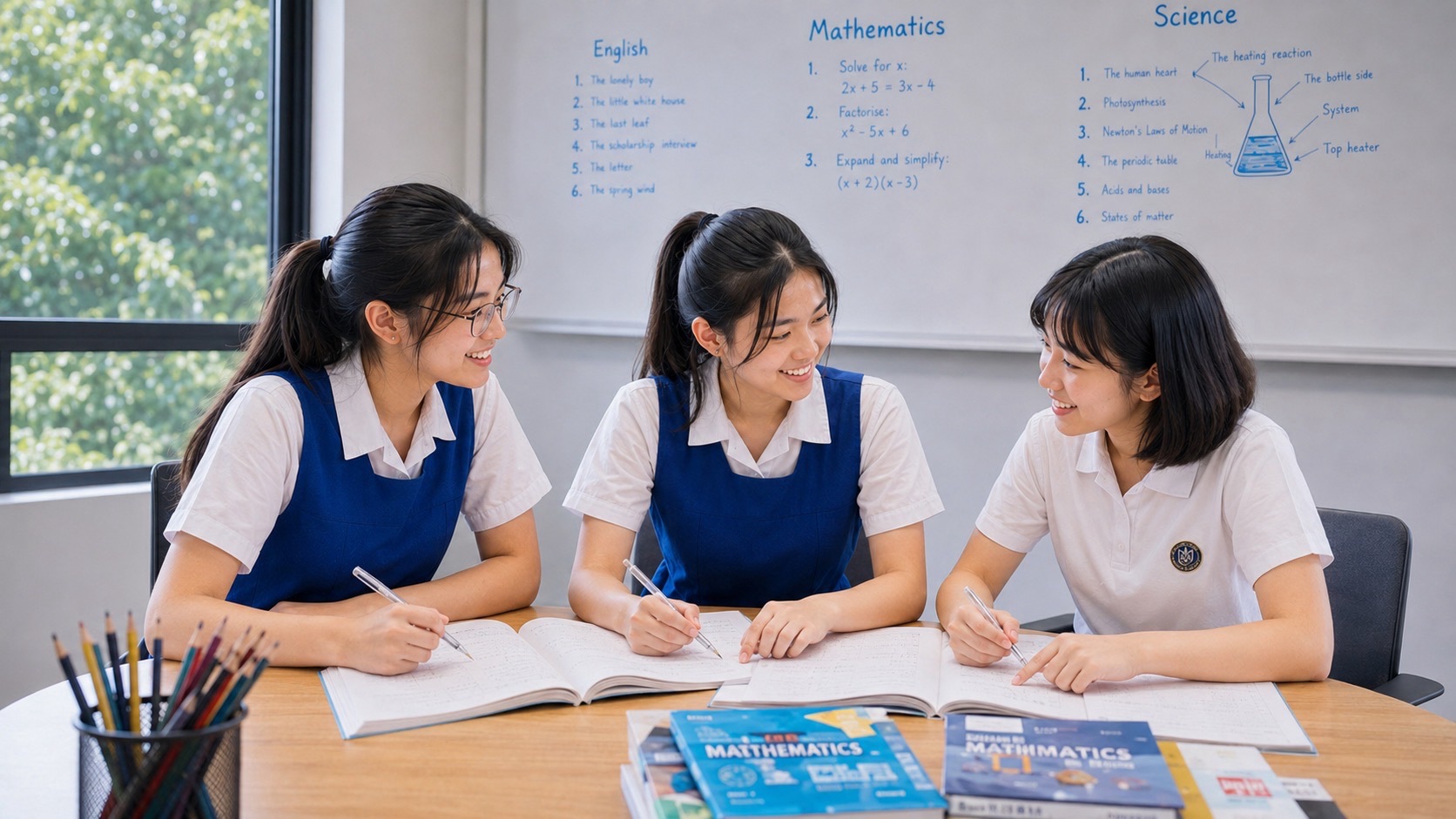
eduKate teaches in groups of up to three students, generally for 90 minutes. In a 3-pax Mathematics class, the tutor can compare representations, ask each learner to explain the method and assign different routes without losing individual visibility.
Location-integrity note: this legacy URL previously referred to an old Yishun address. The historical URL is preserved for continuity, but it should not be read as proof of a current branch at that address. Current class location and availability should be confirmed directly.
The 2026 Primary Mathematics Context
For the 2026 PSLE, Mathematics is subject code 0008. The examination assesses recall and computation, application of mathematical concepts in varied contexts, and mathematical reasoning, inference and strategy selection. From 2026, the 2021 Primary Mathematics syllabus applies through Primary 6.
Parents can verify the current assessment through the 2026 PSLE Mathematics syllabus and the current MOE Primary Mathematics syllabus.
The Three Routes
| Route | Use when | Main job |
|---|---|---|
| Repair | A prerequisite is missing | Rebuild the concept/representation |
| Stabilise | Understands but performance varies | Retrieval, mixed practice, transfer |
| Extend | Foundation is strong and independent | Deeper reasoning, alternatives, efficiency |
A learner may be in Repair for fractions, Stabilise for geometry and Extend for whole-number reasoning at the same time.
Route 1: Repair the Earliest Broken Link
Repair is justified when the learner cannot reliably explain or represent the underlying idea.
Examples:
- place value is weak, so regrouping is procedural;
- multiplication facts exist but equal-group meaning is fragile;
- fractions are treated as two unrelated whole numbers;
- ratio is memorised as a format rather than multiplicative comparison;
- bar models are copied without understanding what each segment represents.
The repair sequence should be:
meaning → representation → procedure → explanation → fresh problem.
Repair Is Not “Go Back and Do Easier Worksheets”
A good repair isolates the mechanism.
Example: a P5 student repeatedly makes fraction errors.
Possible causes:
- cannot see equivalent fractions;
- does not understand common denominator;
- whole-number thinking contaminates fraction magnitude;
- operation choice is wrong;
- arithmetic accuracy is the real issue.
The tutor should discriminate among these before reteaching an entire chapter.
Route 2: Stabilise What Already Exists
Stabilisation is needed when the learner can do the work after prompting but cannot retrieve or select the method reliably.
Use:
- spaced retrieval;
- mixed topics;
- method discrimination;
- delayed retests;
- unfamiliar wording;
- light timing after method is stable.
The goal is to make the concept available when the question does not announce the method.
Recognition vs Retrieval
Recognition:
“Yes, I remember this when I see the worked example.”
Retrieval:
“I can reconstruct the relationship and choose the method without the example.”
Mathematics becomes reliable when retrieval replaces visible-example dependence.
Method Selection
A common upper-Primary problem is not knowing which known method applies.
The learner may know:
- unitary method;
- ratio;
- fractions;
- percentage;
- bar modelling;
- working backwards;
but choose poorly when a problem is unfamiliar.
Stabilisation therefore includes:
read → represent → identify relationship → select method → solve → check.
Route 3: Extend Without Racing Ahead
Extension does not need to mean teaching Secondary Mathematics early.
Higher-value Primary extension can include:
- multiple solution methods;
- proof-like explanation;
- generalisation;
- counterexamples;
- efficient representation;
- non-routine problem solving;
- explaining why a tempting method fails.
The learner goes deeper inside the current mathematical structure.
Extension Through Alternatives
Ask:
- Can this be solved with a bar model?
- Could an equation be cleaner?
- Can we use a unitary method?
- Which method scales better?
- What information is unnecessary?
Strong learners learn method judgement, not just speed.
The Diagnostic Dashboard
| Dimension | Question |
|---|---|
| Concept | Can the learner explain why? |
| Representation | Can quantities/relationships be modelled? |
| Procedure | Can computations be carried out accurately? |
| Selection | Can the right strategy be chosen? |
| Transfer | Can it survive unfamiliar wording? |
| Retrieval | Can it return after delay? |
| Independence | Can the learner begin without prompting? |
Red, Amber and Green
Red
Underlying relationship is missing or repeatedly fails. Use Repair.
Amber
Knowledge exists but transfer/retrieval varies. Use Stabilise.
Green
Reliable enough for maintenance or Extension.
The dashboard should change over time as evidence changes.
What a 90-Minute 3-Pax Lesson Can Look Like
0–10 minutes: Retrieval
Previously learned facts, representations and relationships return without notes.
10–25 minutes: Diagnostic Problem
One question exposes concept, representation and strategy choice.
25–45 minutes: Route Work
Each learner receives Repair, Stabilise or Extend work at the right level.
45–65 minutes: Guided-to-Independent Transfer
The same relationship appears in a different surface.
65–80 minutes: Mixed Problems
Method labels disappear.
80–90 minutes: Explain and Update
Students explain the method and update the red/amber/green state.
Why Three Students Helps Mathematics Routing
- Different solution methods become visible.
- The tutor can see who is copying vs reasoning.
- Students explain to one another without disappearing in a large group.
- Different routes can coexist in one lesson.
- Every learner still solves independently.
What Parents Can Bring
- recent school papers;
- marked worksheets;
- teacher comments;
- examples of problems the learner can do only with help;
- assessment dates;
- timing information where relevant.
What Progress Looks Like
- red prerequisites close;
- method choice becomes more independent;
- retrieval survives delay;
- unfamiliar problems feel less unfamiliar;
- explanations become clearer;
- school work reflects the same improvement.
Frequently Asked Questions
Does this page claim a current Yishun Mathematics tuition centre at the historical address?
No. The old URL is retained, but current location and availability must be confirmed directly.
Can a strong student still need Repair?
Yes. A learner can be advanced overall but have one fragile prerequisite that creates repeated errors.
Should strong Primary students always learn Secondary topics?
No. Deeper reasoning, multiple methods and transfer can be more useful than racing ahead.
Ten Checks for the Right Mathematics Route
- Can the concept be explained?
- Can it be represented?
- Is computation accurate?
- Can the strategy be selected?
- Can the learner start independently?
- Can the method survive a new problem?
- Can it return after delay?
- Is the error recurring?
- Is more practice actually the right repair?
- Should the next move be Repair, Stabilise or Extend?
Choose the Route From the Learner State, Not the Worksheet Chapter
observe → diagnose → Repair / Stabilise / Extend → transfer → retest → update.
Almost-Code Summary
PAGE_RFE = Primary_Maths_route_selection
STATE = concept + representation + procedure + selection + transfer + retrieval + independence
ROUTE = Repair | Stabilise | Extend
CLASS = max_3
LESSON = 90_minutes
LOCATION = legacy_Yishun_url_not_branch_claim
GOAL = smallest_justified_mathematics_intervention