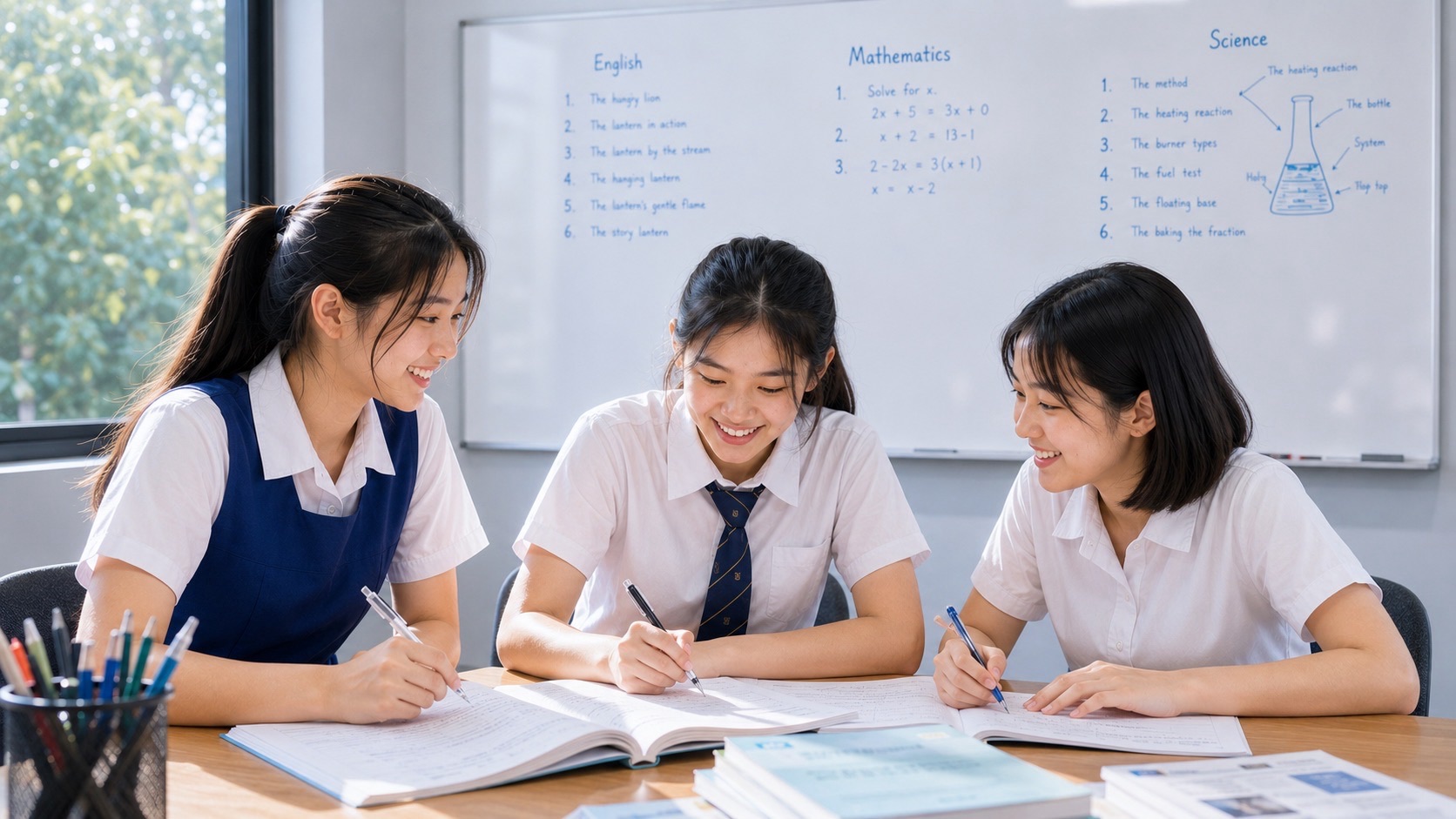
Primary 1 Mathematics tuition should build number sense before speed: see small quantities, understand part–whole relationships, compare magnitude, use number bonds and treat equality as “same value” rather than “the answer comes next”.
This rebuilt legacy Yishun page owns a distinct RFE: early number-sense diagnostic dashboard. Later Yishun Primary 1 Math pages already own the broad tuition term. This URL now helps parents and learners identify whether the mathematical floor is stable before arithmetic becomes more formal.
eduKate teaches in groups of up to three students, generally for 90 minutes. For P1, lessons change mode frequently across objects, pictures, oral explanation, number sentences and simple problems so attention remains productive and mathematical meaning stays visible.
Location-integrity note: this legacy URL previously referred to an old Yishun address. The URL is retained for continuity but does not establish a current branch there. Current class location and availability should be confirmed directly.
The P1 Number-Sense Dashboard
| Capability | Question |
|---|---|
| Subitising | Can a small quantity be recognised without counting one-by-one? |
| Magnitude | Which number is greater/less and why? |
| Part–whole | Can a whole be decomposed and recombined? |
| Number bonds | Can useful combinations be retrieved? |
| Equality | Can both sides of = be understood as same value? |
| Missing number | Can an unknown part be reconstructed? |
| Representation | Can objects, pictures and numerals be connected? |
Subitising
Subitising means recognising a small quantity rapidly without counting each item individually.
For example, five dots can be seen as:
- 5;
- 2 + 3;
- 4 + 1.
This flexibility supports later number bonds and mental arithmetic.
Counting Must Have Meaning
Students should understand:
- one-to-one correspondence;
- stable number sequence;
- the last number counted tells the quantity;
- counting can continue from a known amount rather than restart from 1.
“Counting on” becomes an early efficiency improvement.
Part–Whole Thinking
Example:
7 = 5 + 2 = 4 + 3 = 6 + 1.
Students learn that one number can be decomposed in multiple ways.
This becomes a foundation for:
- addition;
- subtraction;
- number bonds;
- missing-number problems;
- later bar models.
Number Bonds
Useful combinations should become retrievable, but not through blind memorisation alone.
Use:
objects → visual pattern → oral relationship → number sentence → retrieval.
The learner understands why 8 can be split into 5 and 3 before retrieving the bond quickly.
Equality Is “Same Value”
Weak interpretation:
3 + 4 = ? means “do something and write the answer”.
Stronger interpretation:
3 + 4 = 5 + 2
Both sides represent the same value.
This helps later algebraic reasoning and missing-number work.
Missing-Number Reasoning
Examples:
- 5 + __ = 9;
- __ + 2 = 7;
- 8 = 3 + __.
Students use part–whole thinking rather than guessing.
Comparison
Ask:
- Which is greater?
- How much greater?
- Can you show it with objects?
- Can you place both numbers on a number line?
Magnitude should be represented, not just named.
Addition and Subtraction as Relationships
Addition can combine parts into a whole.
Subtraction can:
- remove a part;
- find a missing part;
- find a difference.
P1 students benefit from seeing multiple meanings early.
Common P1 Failure Modes
1. Count-all dependence
Every calculation restarts from 1.
2. Numeral recognition without quantity meaning
The child can name “8” but cannot build or compare eight objects.
3. Weak part–whole
Number bonds are memorised but inflexible.
4. Equals-as-answer-arrow
Balanced equations feel wrong.
5. Operation keyword dependence
Simple stories trigger operations from words rather than meaning.
6. Adult prompting
The learner waits for the first move every time.
The P1 Diagnostic
Quantity
Can small sets be recognised/built?
Sequence
Can counting continue accurately?
Part–Whole
Can numbers be decomposed?
Number Bonds
Can useful combinations be retrieved?
Equality
Can same-value statements be understood?
Comparison
Can magnitude/difference be represented?
Independence
Can a simple task begin without adult rescue?
What a 90-Minute 3-Pax P1 Lesson Can Look Like
0–10 minutes: Quantity warm-up
Dot patterns and number bonds return.
10–25 minutes: Concrete number work
Objects show part–whole and comparison.
25–40 minutes: Pictorial representation
Pictures/number lines bridge to symbols.
40–55 minutes: Number sentences
Equality and missing parts are explored.
55–70 minutes: Simple word problems
Meaning determines addition/subtraction.
70–85 minutes: Fresh transfer
The same relationship appears in a new context.
85–90 minutes: Self-explanation
The learner explains one number relationship.
Why Three Students Helps P1 Mathematics
- Children see different decompositions.
- Peer explanations strengthen mathematical language.
- The tutor can observe who counts all vs recognises structure.
- Natural wait time supports independence.
- Every learner remains closely visible.
Parent Evidence Checklist
- Can your child recognise small quantities?
- Can a number be split in several ways?
- Can number bonds be explained?
- Does “=” mean same value?
- Can missing numbers be reconstructed?
- Can the child begin a simple problem independently?
What Progress Looks Like
- count-all dependence decreases;
- number bonds become more fluent;
- part–whole reasoning becomes flexible;
- balanced equality statements make sense;
- simple word problems rely less on keyword guessing;
- P2 place-value learning has a stronger foundation.
Frequently Asked Questions
Does this page claim a current Yishun branch?
No. The legacy URL is preserved; current location and availability must be confirmed directly.
Should P1 children memorise number bonds?
Fluent retrieval is useful, but it should grow from strong quantity and part–whole understanding.
Should P1 Mathematics be timed?
Some short fluency work can eventually be useful, but understanding and flexible representation should come before speed pressure.
Ten Checks for Early Number Sense
- Can small quantities be seen quickly?
- Can counting continue from a number?
- Can the whole be split?
- Can number bonds be retrieved?
- Can equality be explained?
- Can a missing part be found?
- Can magnitude be compared?
- Can addition/subtraction meaning be explained?
- Can objects/pictures/numerals connect?
- Is independence increasing?
Almost-Code Summary
PAGE_RFE = P1_number_sense_dashboard
BUILD = quantity -> part_whole -> number_bonds -> equality -> comparison -> operations
CLASS = max_3
LESSON = 90_minutes
LOCATION = legacy_Yishun_url_not_branch_claim
GOAL = strong_number_sense_before_procedural_speed