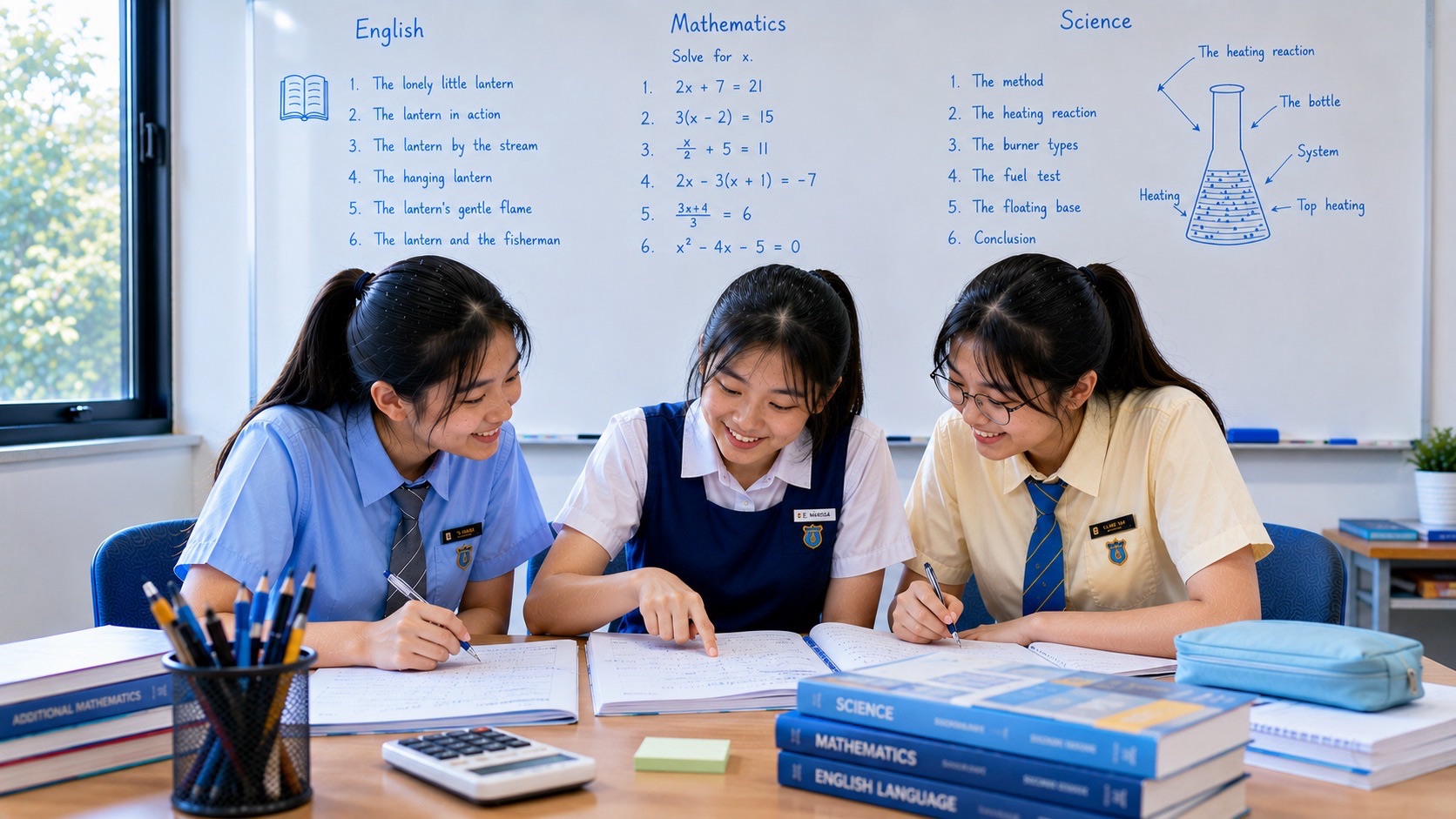
Primary 5, Primary 6 and Secondary 1 should not feel like the same English programme with bigger worksheets. The underlying language system continues, but the dominant job changes. Primary 5 builds the runway, Primary 6 adds examination-performance control, and Secondary 1 begins asking the learner to operate with denser texts, broader purposes and more independent judgement.
This page is for Bukit Timah families comparing English tuition across the P5 → P6 → Secondary 1 transition. Its distinct reader job is to explain when the English track should change and what should remain continuous.
The preserved 2019 URL mixed Bukit Timah and Yishun commercial wording. Those old centre, teacher and “latest syllabus” claims are not carried forward. This rebuilt page uses Bukit Timah as the reader context while avoiding collision with broader Bukit Timah English service pages. eduKate Singapore is an independent tuition provider and is not affiliated with MOE, SEAB or any school.
What Should Stay Continuous Across P5, P6 and Secondary 1
- reading for meaning;
- vocabulary depth;
- grammar as a meaning system;
- evidence selection;
- paragraph relationships;
- writing structure;
- self-checking;
- increasing independence.
Students should not discard good Primary habits when Secondary school begins. The task is to extend them into more complex environments.
Primary 5 Track: Build the Runway
Primary 5 is the ideal year to make earlier English knowledge more retrievable and transferable before PSLE pressure peaks.
- read longer passages without losing paragraph state;
- retrieve vocabulary without constant word banks;
- use grammar in mixed contexts;
- choose evidence precisely;
- plan writing causally;
- reduce tutor prompts;
- begin light fluency and timing work.
The P5 track should still be rich language learning. It should not become a year of endless PSLE papers.
Primary 6 Track: Convert Capability Into Reliable Performance
Primary 6 adds a stronger performance layer. The student needs to select the right process under mixed and timed conditions.
- question-demand recognition;
- retrieval after delay;
- transfer to unfamiliar surfaces;
- timed-versus-untimed comparison;
- stopping rules;
- targeted checking;
- full-paper integration;
- recovery after difficult items.
Primary 6 tuition should move between learning mode and performance mode depending on what the marked evidence shows.
Secondary 1 Track: Shift From PSLE Performance to Broader Language Judgement
After PSLE, the student should not remain permanently trapped in Primary examination routines. Secondary English begins widening the work.
- denser texts;
- more sustained inference;
- viewpoint and tone;
- purpose and audience;
- register;
- extended writing;
- more independent annotation and revision.
The track should therefore shift from “How do I secure this PSLE component?” toward “How do I control meaning and communication across more complex Secondary tasks?”
A Three-Stage Transition Matrix
| Area | P5 | P6 | Sec 1 |
|---|---|---|---|
| Reading | Longer passages and paragraph state | Efficient evidence under time | Viewpoint, tone and denser structure |
| Vocabulary | Depth and retrieval | Reliable use under performance load | Nuance, abstraction and register |
| Grammar | Mixed selection | Transfer and checking | Editing, cohesion and style |
| Writing | Causal planning | Timed task fulfilment | Purpose, audience and extended development |
| Independence | Reduce prompts | Perform without rescue | Self-manage strategies and revision |
When the Track Should Change Earlier
A strong student may be ready for deeper reading or writing earlier than the calendar suggests.
- Primary material is consistently too easy.
- Evidence control is stable.
- Vocabulary retrieval is strong.
- Writing structure survives unfamiliar prompts.
- Prompts are minimal.
- The learner can discuss viewpoint and tone naturally.
Extension should deepen the capability, not simply start the next year’s workbook.
When the Track Should Not Change Yet
- Reading foundations remain fragile.
- Grammar works only in labelled drills.
- Vocabulary is mostly recognition-based.
- Writing depends on model phrases.
- Comprehension evidence is inconsistent.
- Adult prompts remain heavy.
Moving early into harder-looking material can hide these foundations instead of fixing them.
After PSLE: Remove Examination Scaffolds Deliberately
PSLE-specific routines are useful during Primary 6. After the examination, some should be retained and some should fade.
| Retain | Fade or repurpose |
|---|---|
| Evidence discipline | Rigid PSLE answer templates |
| Planning before writing | Topic-specific memorised phrases |
| Targeted checking | Full-paper repetition without reason |
| Vocabulary retrieval | PSLE-only word banks |
| Recovery after difficulty | Overdependence on examination tricks |
The Secondary 1 Reading Upgrade
Secondary 1 texts increasingly reward the reader who can hold more than plot and facts.
- What does the writer want the reader to notice?
- How does the tone change?
- Whose viewpoint is limited or privileged?
- What assumption supports the argument?
- How does one paragraph modify another?
This is a qualitative shift in reading judgement, not only a quantitative increase in length.
The Secondary 1 Writing Upgrade
Writing should increasingly be evaluated through purpose, audience and development.
- Who is the reader?
- What effect should the writing create?
- What register fits?
- How should paragraphs build the message?
- Which examples or details deserve space?
Students who learned strong Primary narrative control can carry that structural discipline forward while expanding the range of writing they can produce.
How a 3-Pax Class Handles the Transition
In a maximum three-student group, learners at nearby stages can sometimes share an anchor text while receiving different tasks.
- P5: paragraph relationships and vocabulary.
- P6: evidence localisation and timed response.
- Sec 1: viewpoint, tone and response writing.
This works only when all students can access the text. If the productive ranges separate too far, separate tracks are cleaner.
Current MOE/SEAB Boundary
The MOE Primary English Language Syllabus 2020 remains the broad Primary English curriculum reference in 2026. For PSLE-year paper details, families should use the current SEAB 2026 PSLE information. Secondary learners should follow current subject and cohort requirements rather than relying on archived tuition claims.
Bukit Timah Collision Boundary
This page does not replace broader Bukit Timah English service pages. Its single job is the P5 → P6 → Secondary 1 track transition. The preserved URL remains for continuity, while historic Yishun/location claims have been removed.
What Parents Should Ask at Each Transition
- P5 → P6: Which foundations still fail under mixed conditions?
- During P6: Which bottleneck limits examination reliability?
- After PSLE: Which examination scaffolds should now fade?
- Entering Sec 1: Which new reading and writing judgements must be built?
Signs the Track Is Changing at the Right Time
- Foundations remain stable as complexity rises.
- New tasks require deeper judgement rather than merely more volume.
- Prompt dependence continues to fall.
- Primary strengths transfer into Secondary work.
- The student can explain how the new stage differs from the previous one.
P5 → P6 → Sec 1: Almost-Code Summary
P5:
    deepen_language()
    build_retrieval()
    build_transfer()
    reduce_prompts()

P6:
    add_performance_mode()
    timing
    recovery
    checking
    full_paper_integration

SEC1:
    expand_text_density()
    viewpoint
    tone
    register
    extended_writing
    independence

CHANGE_TRACK_WHEN:
    current_stage_capabilities_stable
    next_stage_demands_are_productive

OUTPUT:
    smoother_transition
    less_premature_acceleration
    stronger_secondary_readiness