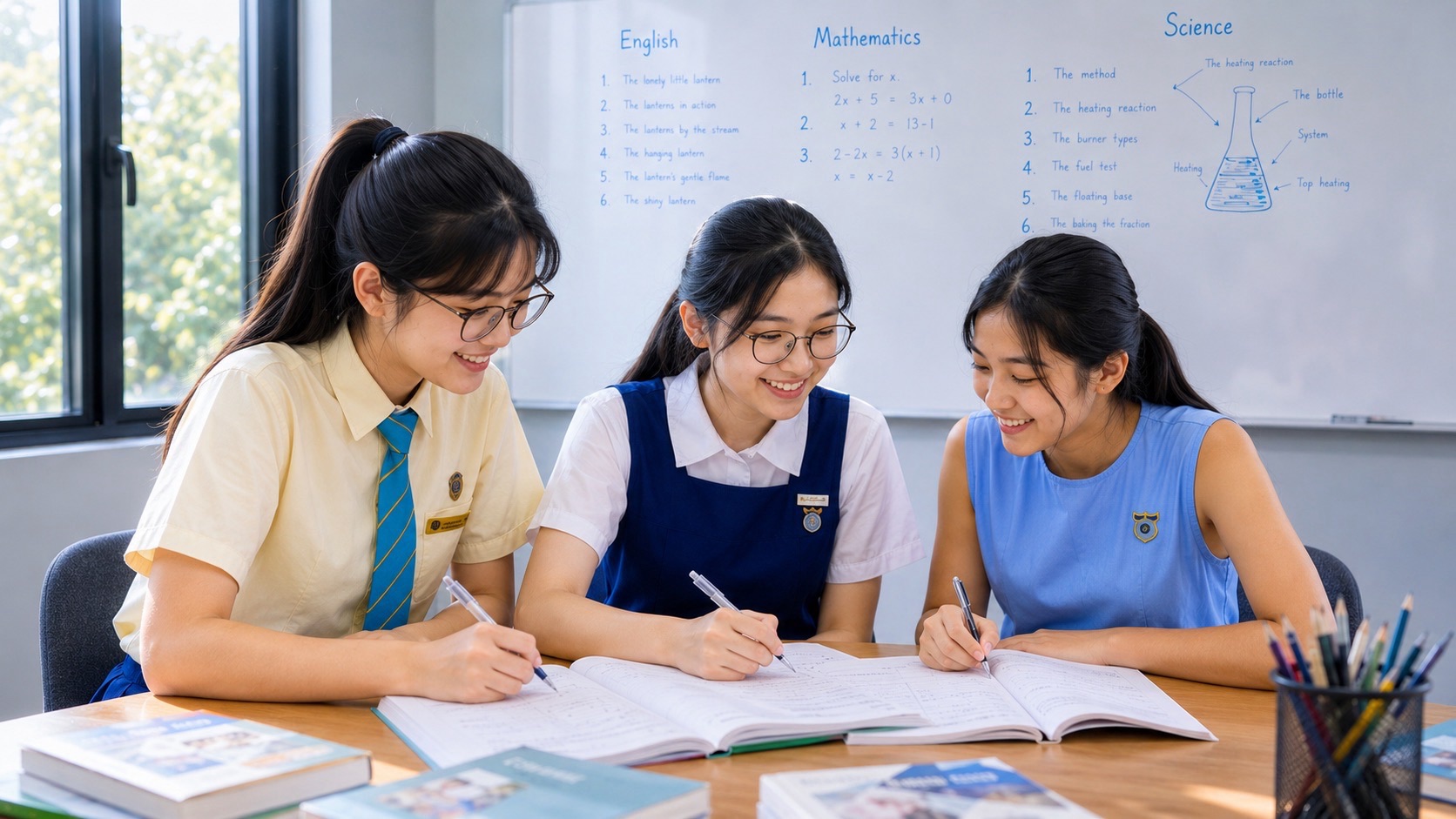
A Primary Maths tuition centre in Punggol should do more than put three students beside one another. A 3-pax class should function as a mathematical reasoning laboratory: one shared problem, several representations, explicit comparison of methods, then individual transfer.
This rebuilt legacy page owns a distinct RFE: 3-pax mathematical reasoning laboratory. The modern Punggol Mathematics estate already has strong broad commercial and level-specific owners. This legacy URL now explains what a genuinely useful small-group lesson should make possible.
eduKate teaches in groups of up to three students, generally for 90 minutes. The small number matters because every learner should remain visible while still benefiting from peer methods, explanation and contrast.
Location-integrity note: this is a legacy Punggol URL. Any historical address or old registration wording should not be treated as a current branch claim. Current class location and availability should be confirmed directly.
The 2026 Primary Mathematics Context
The 2021 Primary Mathematics syllabus applies through P6 from 2026. Current PSLE Mathematics assessment includes knowledge and computation, application in varied contexts, and mathematical reasoning and strategy selection.
Parents can refer to MOE’s Primary Mathematics syllabus and the 2026 PSLE Mathematics syllabus.
What Makes Three Students Different?
A good 3-pax class can support:
- individual diagnostic visibility;
- multiple solution methods;
- peer explanation;
- productive disagreement;
- independent work while the tutor observes another learner;
- fast correction without constant one-to-one prompting.
The goal is not simply smaller class size. It is a different learning architecture.
The 3-Pax Reasoning Cycle
one_problem
-> independent_attempt
-> expose_representations
-> compare_methods
-> explain_why
-> tutor_repair_if_needed
-> new_problem
-> independent_transfer
Stage 1: Independent Attempt
Students begin before the tutor supplies a method.
The tutor observes:
- how the problem is read;
- what is represented;
- which strategy is selected;
- where each learner stalls;
- whether arithmetic begins too early.
This preserves diagnostic information.
Stage 2: Expose the Representation
Each learner may use:
- bar model;
- table;
- diagram;
- equation;
- number line;
- part–whole structure.
The question is not merely “Who got it right?” It is:
What mathematical relationship did each representation make visible?
Stage 3: Compare Methods
For the same problem:
- Which method is easiest to explain?
- Which is shortest?
- Which is most robust if the numbers change?
- Which method reveals the structure?
- Did one method work only by luck?
Students learn mathematical judgement.
Stage 4: Explain Why
Every learner should be able to answer:
- What does this number represent?
- Why did you use this operation?
- Why is this bar length appropriate?
- Why must this quantity be the whole?
- How do you know the answer is reasonable?
Explanation reveals hidden misconceptions.
Stage 5: Repair the Earliest Wrong Link
If a student is wrong, the tutor identifies whether the problem is:
- concept;
- representation;
- operation;
- arithmetic;
- strategy selection;
- question reading;
- checking.
The repair targets the mechanism, not the final red mark.
Stage 6: Transfer Alone
A new problem changes:
- numbers;
- story context;
- order of information;
- representation;
- surface language.
Students solve independently. If the learning survives, the group discussion created transfer rather than imitation.
Why Peer Explanation Helps
A peer may describe a method differently from the tutor.
This can help because:
- language is age-near;
- different representations become normal;
- students practise evaluating reasoning;
- the learner sees that Mathematics is not one memorised script.
The tutor remains responsible for mathematical correctness.
Why Three Is Not Automatically Better Than One
A small group fails when:
- one student dominates;
- all students copy the fastest learner;
- the tutor lectures continuously;
- students are grouped with incompatible task needs;
- individual errors are not tracked.
Good grouping requires task compatibility and tutor visibility.
Different Routes in One Group
One learner may need Repair, another Stabilise, another Extend.
A shared anchor problem can branch:
- Repair — rebuild the representation;
- Stabilise — mixed transfer/delayed retrieval;
- Extend — alternative method/generalisation.
Then the group returns to a shared comparison.
A 90-Minute 3-Pax Mathematics Lesson
0–10 minutes: Retrieval
Older facts, concepts and representations return.
10–25 minutes: Shared diagnostic
All three attempt one problem independently.
25–40 minutes: Representation comparison
Methods are exposed and discussed.
40–60 minutes: Differentiated route
Repair/Stabilise/Extend work occurs.
60–75 minutes: New transfer problem
Students work independently.
75–85 minutes: Method comparison
Efficiency and robustness are evaluated.
85–90 minutes: Return target
Each learner records one active mathematical risk.
Progress Evidence
A useful small-group programme should show:
- better independent starts;
- clearer representations;
- more accurate strategy selection;
- fewer recurring errors;
- stronger explanation;
- transfer to unfamiliar problems;
- school-return evidence.
Parent Checklist for Group Quality
- Can the tutor describe my child’s current mathematical bottleneck?
- Does my child solve independently before receiving help?
- Are multiple methods discussed when useful?
- Does my child explain why?
- Are errors classified rather than labelled careless?
- Does support fade?
- Is there delayed retrieval?
- Are new problems used for transfer?
- Is my child individually visible?
- Does progress return to school work?
Frequently Asked Questions
Does this page claim a current Punggol branch at an old address?
No. Current class location and availability must be confirmed directly.
Why a maximum of three students?
The model aims to preserve individual observation and feedback while allowing comparison of reasoning and representations.
Should all three students be at exactly the same level?
Not necessarily, but their learning tasks should be compatible enough that shared problems and discussion remain useful.
The Small Group Should Make Mathematical Thinking More Visible
attempt → represent → compare → explain → repair → transfer → return.
Almost-Code Summary
PAGE_RFE = Punggol_3pax_math_reasoning_lab
GROUP = max_3
LESSON = 90_minutes
FLOW = independent_attempt -> compare_representation -> differentiated_route -> transfer
LOCATION = legacy_Punggol_url_not_branch_claim
GOAL = individual_visibility_plus_peer_reasoning