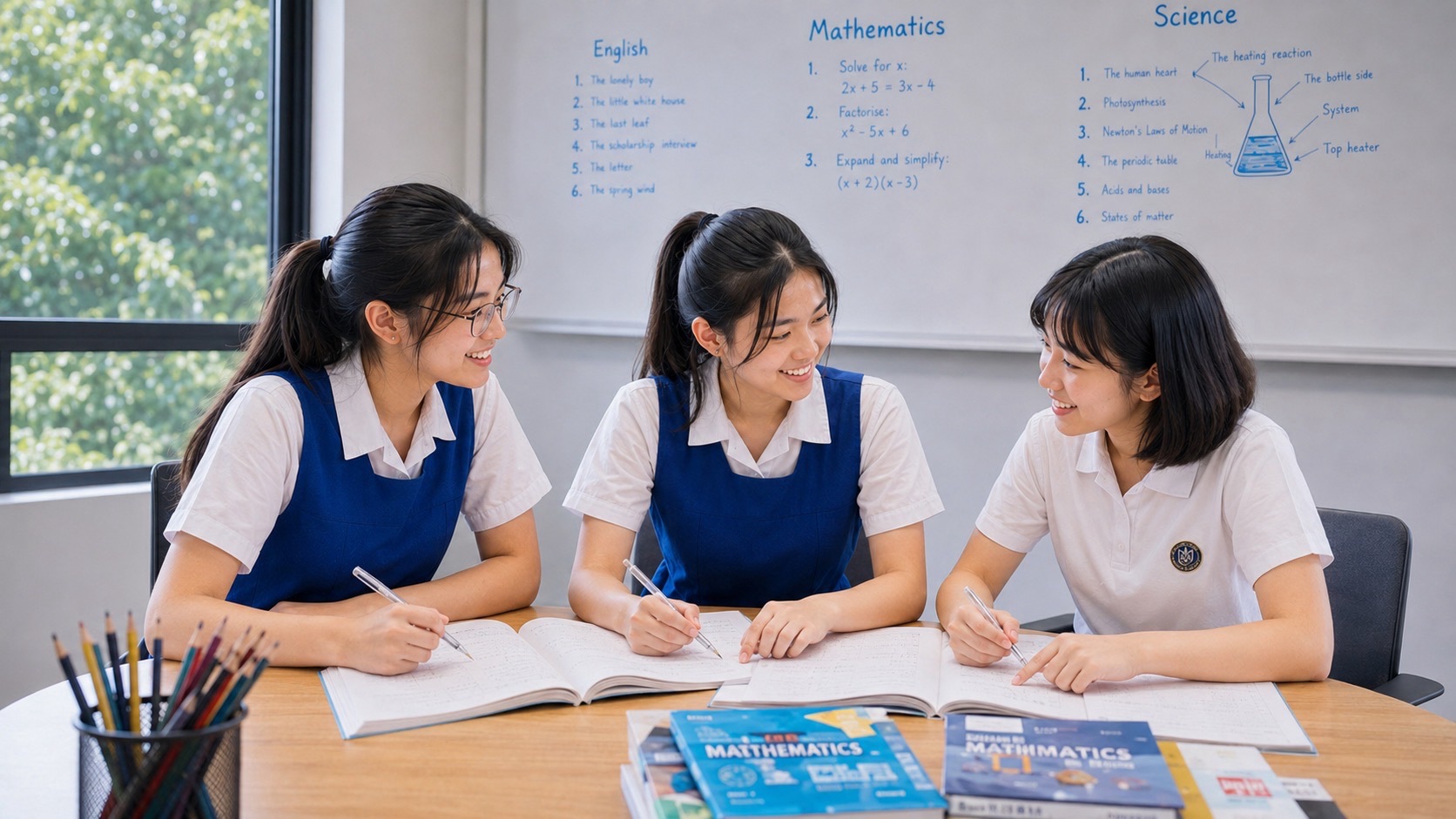
Primary Mathematics tuition in Punggol should connect directly to the learner’s real school evidence: marked papers, repeated errors, teacher comments and the mathematical relationships that are not yet transferring reliably.
This rebuilt legacy page owns a distinct RFE: school → tuition diagnosis → targeted mathematical repair → fresh retest → delayed retest → return to school. The modern Punggol Mathematics estate already owns the broad commercial terms, so this old URL becomes a feedback-loop page rather than another generic tuition listing.
eduKate teaches in groups of up to three students, generally for 90 minutes. A 3-pax class allows the tutor to inspect each learner’s school work closely while still using shared problems to compare mathematical representations and methods.
Location-integrity note: this legacy Punggol URL may contain historical location or registration language. It should not be treated as proof of a current branch or old address. Current class location and availability should be confirmed directly.
The 2026 Primary Mathematics Context
From 2026, the 2021 Primary Mathematics syllabus applies through P6. PSLE Mathematics subject 0008 assesses mathematical facts and computation, application across contexts, and mathematical reasoning and strategy selection.
Parents can refer to MOE’s Primary Mathematics syllabus and the 2026 PSLE Mathematics syllabus.
The Feedback Loop
SCHOOL_EVIDENCE
-> identify recurring error
-> classify mechanism
-> targeted repair
-> fresh problem
-> delayed retrieval
-> return to SCHOOL
-> check recurrence
-> update plan
The loop is complete only when the mathematical improvement survives outside tuition.
What Should Come From School to Tuition?
Useful evidence includes:
- recent marked papers;
- teacher comments;
- worked corrections;
- homework attempted independently;
- questions that required help;
- time-pressure problems;
- topics where marks vary sharply.
The tutor does not need every worksheet. Representative evidence is more useful.
Classify the Error Mechanism
| Error | Question |
|---|---|
| Concept | Is the mathematical relationship understood? |
| Representation | Was the problem modelled correctly? |
| Operation | Was the right operation selected? |
| Arithmetic | Was the method right but calculation wrong? |
| Strategy | Was an inefficient or mismatched method chosen? |
| Question reading | Was the unknown/condition misread? |
| Checking | Could the error have been detected? |
Different mechanisms require different repairs.
Example: Fraction Error
School result: wrong answer on a fraction word problem.
Possible causes:
- wrong whole/base;
- equivalent fractions not understood;
- bar model misrepresented;
- operation choice wrong;
- arithmetic slip.
Tuition should identify the first wrong mathematical decision before choosing the repair.
Example: Word Problem Error
School result: multi-step problem incomplete.
Check:
- Was the final unknown identified?
- Were quantities labelled?
- Was an intermediate value required?
- Did the learner start calculating before representing?
- Was the strategy too complex?
Repair the representation if representation is the bottleneck.
Example: “Careless” Calculation
Instead of accepting careless, ask:
- Was a place-value regrouping error repeated?
- Was multiplication fact retrieval slow?
- Were columns misaligned?
- Did time pressure cause rushing?
- Was there no checking routine?
The label becomes a testable mechanism.
Targeted Repair
A useful repair sequence:
meaning → representation → procedure → explanation → fresh question.
For a retrieval/selection problem:
recall → mixed discrimination → fresh problem → delay → mixed return.
Tuition should not simply redo the original paper.
Fresh Retest
Change:
- numbers;
- context;
- diagram;
- wording;
- position of the unknown.
The learner should reconstruct the relationship.
Delayed Retest
Days later, test again without the earlier correction visible.
Ask:
- Can the concept be retrieved?
- Can the representation be rebuilt?
- Can the method be selected?
- Can the learner self-check?
Immediate correction is weaker evidence than delayed independent retrieval.
Return to School
Look for:
- the same error occurring less often;
- better teacher feedback;
- less homework prompting;
- stronger unfamiliar problem solving;
- more stable test performance;
- improved mathematical explanation.
The school environment is the real transfer test.
The Feedback Ledger
DATE =
SCHOOL_SIGNAL =
ERROR_TYPE = concept | representation | operation | arithmetic | strategy | reading | checking
REPAIR =
FRESH_RETEST =
DELAYED_RETEST =
SCHOOL_RETURN =
STATUS = open | improving | stable
Keep a small active list of recurring mechanisms rather than an enormous list of surface errors.
Parent Role
Parents can:
- bring recent marked work;
- preserve the child’s original working;
- note where help was needed;
- avoid rewriting the solution before the tutor sees it;
- observe whether the repair appears at home and school.
The parent connects evidence; the learner should increasingly own the Mathematics.
What a 90-Minute 3-Pax Feedback Lesson Can Look Like
0–15 minutes: School evidence
One recurring mathematical mechanism is selected.
15–30 minutes: Cause test
A fresh question confirms whether the diagnosis is correct.
30–50 minutes: Repair
Concept/representation/strategy is rebuilt.
50–70 minutes: Fresh transfer
The learner solves a different problem.
70–85 minutes: Independent mixed retest
Support is removed and the method must be selected.
85–90 minutes: School return target
The learner states what should improve in the next school task.
Why Three Students Helps
- Different error mechanisms can be compared.
- Students see multiple representations.
- The tutor can preserve individual error ledgers.
- Peer explanations make reasoning visible.
- Every learner receives an individual return target.
What Progress Looks Like
- recurring errors decrease;
- representations become more accurate;
- strategy selection improves;
- support fades;
- delayed retrieval becomes stronger;
- school and tuition performance converge.
Frequently Asked Questions
Does this page claim a current Punggol branch at an old address?
No. Current location and availability must be confirmed directly.
Should tuition follow every school worksheet?
No. School work should inform the learning model, while tuition still follows a coherent mathematical progression and repairs underlying mechanisms.
What if the school method differs from the tuition method?
The learner should understand the underlying mathematical relationship and be able to meet school expectations. Tuition should not create unnecessary method conflict.
Ten Checks for the Mathematics Feedback Loop
- What does the school evidence show?
- What error repeats?
- What is the earliest wrong decision?
- Is it concept or representation?
- Is operation/strategy the issue?
- Is arithmetic the real bottleneck?
- Was the repair tested on a fresh problem?
- Did it survive delay?
- Did it return to school?
- Should the plan update?
Mathematics Tuition Should Close the Loop Back to the Child’s Real School Work
school → diagnose → repair → transfer → delay → school return → observe again.
Almost-Code Summary
PAGE_RFE = Punggol_school_tuition_school_math_loop
INPUT = marked_school_evidence
PROCESS = classify -> repair -> fresh_transfer -> delay
RETURN = school_performance
CLASS = max_3
LESSON = 90_minutes
LOCATION = legacy_Punggol_url_not_branch_claim
GOAL = closed_mathematics_feedback_loop