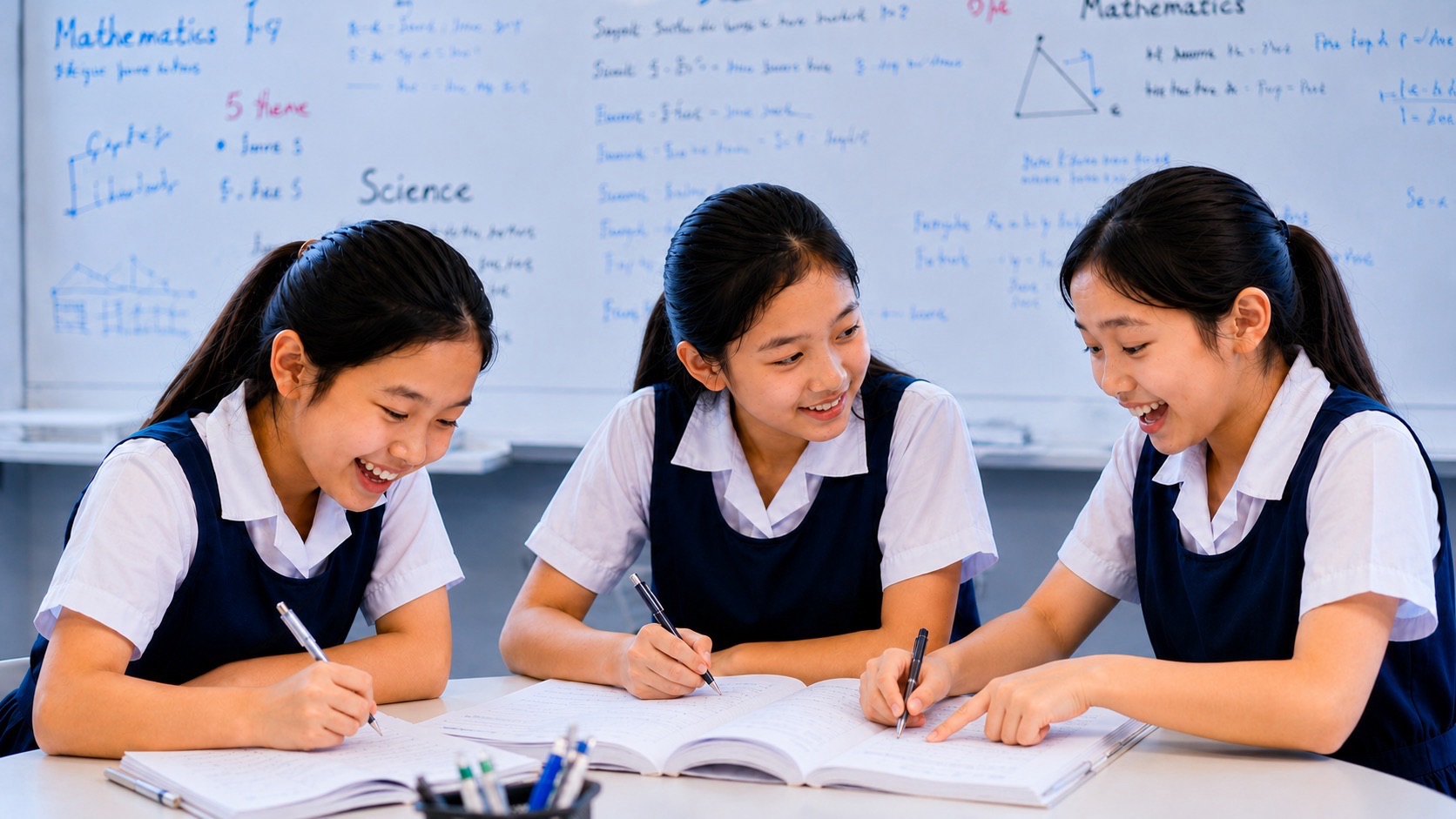
A Primary School child learns:
Plants need sunlight.
That is useful.
Then the child learns:
Plants use light energy during photosynthesis.
Later:
Light intensity can affect the rate of photosynthesis.
Then:
Increasing light intensity does not increase the rate indefinitely because another factor may become limiting.
The topic appears to be the same.
Plants. Light. Photosynthesis.
But the student’s scientific capability has changed.
The learner has moved from:
FACT
to:
MECHANISM
to:
RELATIONSHIP
to:
CONSTRAINT
to:
SYSTEM
That is Evolution.
And it is one of the most useful ways to understand what good Punggol Science Tuition in Small Groups should actually be designed to produce.
Evolution Is More Than Darwin
In Science, the word Evolution naturally points towards biology.
Variation.
Inheritance.
Selection.
Adaptation.
Changing populations.
Changing environments.
But there is a broader machine hidden underneath these ideas:
STATE₀+VARIATION+ENVIRONMENT+SELECTION+RETENTION+TIME→STATE₁
Something exists.
Conditions act upon it.
Some possibilities succeed better than others.
What survives changes what becomes possible next.
Then the cycle continues.
That pattern is useful far beyond evolutionary biology.
It can help us understand scientific learning itself.
A child enters Science with one model of the world.
The child observes.
Predicts.
Tests.
Receives evidence.
Finds contradictions.
Modifies the model.
Then encounters a harder problem.
So learning becomes:
MODEL₀↓OBSERVATION↓PREDICTION↓TEST↓EVIDENCE↓COMPARE↓KEEP / MODIFY / REJECT↓MODEL₁
That is scientific evolution inside the learner.
Science Is Not a Collection of Finished Answers
Young children often encounter Science as facts.
Water freezes at 0°C.
Plants need light.
Magnets attract certain materials.
Animals need food.
Objects fall.
These facts are important.
But Science becomes much more powerful when the learner starts asking:
Why?
Then:
How do we know?
Then:
What changes if one condition changes?
Then:
Would this still happen somewhere else?
Then:
What evidence would prove me wrong?
Now the learner is not merely remembering Science.
The learner is beginning to operate scientifically.
The First Scientific Evolution: From Object to Relationship
A young learner might see:
PLANT
and think of an object.
A stronger learner begins to see relationships.
PLANT↕LIGHT↕WATER↕AIR↕SOIL↕TEMPERATURE↕OTHER ORGANISMS
The plant is no longer an isolated noun.
It exists inside a system.
The same transformation happens throughout Primary Science.
A magnet becomes:
MAGNET + MATERIAL + DISTANCE + ORIENTATION
A shadow becomes:
LIGHT SOURCE + OBJECT + SCREEN + POSITION
A circuit becomes:
SOURCE + PATH + COMPONENTS + CONNECTIONS
Evaporation becomes:
WATER + ENERGY + EXPOSED SURFACE + AIR CONDITIONS + TIME
Science capability increases when the learner stops seeing isolated things and begins seeing relationships between variables.
Small Groups Matter Because Thinking Is Visible
A worksheet may show that an answer is wrong.
A small-group Science tutor can ask:
Why did you choose that answer?
That question is enormously important.
Two students can select the same wrong option for completely different reasons.
One may have forgotten a fact.
Another may understand the fact but reverse cause and effect.
Another may misread the diagram.
Another may assume that two things happening together means one caused the other.
Another may use a correct rule in the wrong environment.
The visible answer is identical.
The internal model is not.
So good Science tuition needs to distinguish:
SAME ERROR≠SAME CAUSE
That is one reason small-group teaching can be powerful.
The tutor can observe the reasoning machinery, not merely the final response.
Variation Is Necessary for Learning
Suppose a child learns:
A metal spoon is a good conductor of heat.
Then every practice question shows a metal spoon.
The student may perform perfectly.
But has the learner understood thermal conduction?
Or memorised:
metal spoon = conductor?
We do not know yet.
So we create variation.
What about:
- a metal rod,
- an aluminium pan,
- a plastic spoon,
- a wooden handle,
- two materials joined together,
- a diagram with no spoon at all?
Now the underlying concept has to survive changing appearances.
That is a transfer test.
Science learning needs variation because real understanding should survive changes in presentation.
Too Little Variation Produces Brittle Knowledge
A student may appear strong because the learning environment never changes.
Same diagrams.
Same wording.
Same examples.
Same sequence.
Then an examination question rotates the situation.
The concept looks unfamiliar.
Performance collapses.
The learner knew the surface.
Not the machine.
This is an important distinction.
SURFACE KNOWLEDGE="I recognise this question."
versus:
SCIENTIFIC CAPABILITY="I recognise the mechanism even though the question looks different."
Small-group tuition should gradually move the learner from the first state towards the second.
But Variation Without Selection Becomes Noise
There is an opposite failure.
Imagine giving a student twenty unusual experiments before the basic concept is stable.
The learner may become confused.
Evolution needs variation.
But not random variation.
There must also be selection.
In teaching, selection asks:
Which representation helps this child now?
Which example exposes the misconception?
Which variable should change?
Which variable should stay constant?
Is the learner ready for a transfer question?
Is this difficulty productive or merely distracting?
This is why expertise matters.
A Science tutor is not simply supplying more worksheets.
The tutor is controlling the learning environment.
Evolution Requires an Environment
In biological evolution, selection does not happen in empty space.
The environment matters.
The same characteristic can be useful in one environment and disadvantageous in another.
Scientific answers behave similarly.
Consider:
Water boils at 100°C.
At Primary level, this may be an appropriate working statement under ordinary classroom assumptions.
Later, the learner discovers that boiling point depends on pressure.
The original answer was not simply useless.
It belonged to a particular resolution and environment.
This is important in education.
A simpler model may be appropriate at one stage.
Then conditions change.
The model must be refined.
So learning often looks like:
USEFUL SIMPLE MODEL↓NEW EVIDENCE / NEW SCALE↓MODEL LIMIT EXPOSED↓REFINEMENT↓MORE POWERFUL MODEL
That is evolution without pretending the earlier learning was worthless.
Science Education Is Full of Model Evolution
Consider matter.
A young child begins with:
SOLID | LIQUID | GAS
Later:
Particles.
Movement.
Spacing.
Energy.
Then perhaps much later:
Atoms.
Molecules.
Electron structure.
Quantum behaviour.
The earlier model is not discarded immediately.
Its useful range becomes clearer.
This gives students an important scientific habit:
A model can be useful without being complete.
Science therefore does not demand that every child possess the final description of reality immediately.
It demands that the learner knows what the present model can explain—and where it starts to fail.
Observation Must Come Before Explanation
Evolution also depends on differences being detectable.
Science does too.
Suppose two plants grow differently.
The weak response is:
Plant A grew better.
The stronger scientific response asks:
Better in what measurable sense?
Height?
Leaf number?
Mass?
Colour?
Growth rate?
Survival?
The word better hides multiple possible variables.
Science begins by improving observation.
WORLD↓OBSERVE↓DISTINGUISH↓MEASURE↓COMPARE
Only then should explanation begin.
A child who cannot distinguish the state accurately will struggle to explain why it changed.
Observation Is Not the Same as Interpretation
Imagine a student sees droplets on the outside of a cold cup.
Observation:
Water droplets appeared on the outer surface of the cup.
Interpretation:
Water vapour in the surrounding air condensed.
These are related.
But they are not identical.
This distinction is foundational.
Science requires students to separate:
WHAT I SAW
from:
WHAT I THINK CAUSED IT
That is a remarkably important intellectual habit.
Because once observation and explanation are fused, incorrect assumptions become harder to detect.
Prediction Makes the Model Testable
Science becomes more powerful when the learner can say:
If my explanation is correct, then this should happen next.
For example:
If greater exposed surface area increases evaporation rate, then identical amounts of water placed in containers with different exposed surface areas should decrease at different rates under otherwise similar conditions.
Now the model produces a prediction.
The prediction can meet the world.
MODEL↓PREDICTION↓WORLD↓RESULT
Then comes the critical comparison:
PREDICTION = RESULT?
If yes, confidence may increase.
If no, something needs investigation.
That return signal is essential.
Failure Is Information
Students often interpret a wrong answer as:
I am bad at Science.
That interpretation wastes useful information.
A wrong answer can tell us where the model failed.
For example:
WRONG ANSWER↓WHY?├── FACT MISSING├── VARIABLE MISIDENTIFIED├── CAUSAL DIRECTION REVERSED├── DIAGRAM MISREAD├── CONDITION IGNORED├── EVIDENCE MISUSED├── TERMINOLOGY IMPRECISE└── CONCEPT NOT TRANSFERRED
These are very different repair jobs.
The small-group tutor should be interested in the branch underneath the error.
Because once the failure is identified correctly, the repair can become much more efficient.
Evolution Needs Selection Pressure
Suppose every answer receives:
Good try.
That may be kind.
But it is not enough to build scientific precision.
Suppose every vague explanation is accepted.
Then vagueness survives.
Suppose every unsupported causal claim passes.
Then weak reasoning survives.
Suppose every memorised phrase receives full credit regardless of whether it answers the question.
Then imitation survives.
A learning environment selects what gets retained.
So teaching inevitably creates selection pressure.
The question is whether it selects for the right things.
At eduKate Singapore, useful Science selection pressures include:
- accurate observation,
- correct variable identification,
- causal clarity,
- evidence use,
- precise vocabulary,
- mechanism,
- relevance,
- complete answering,
- transfer.
These are capabilities we want to survive repeated practice.
Primary Science: From Naming to Mechanism
Consider a simple sequence.
Stage 1 — Naming
This is evaporation.
Stage 2 — Description
Water changes from liquid to gas.
Stage 3 — Relationship
Higher temperature can increase the rate of evaporation.
Stage 4 — Variable Control
To test temperature fairly, other relevant variables should be controlled.
Stage 5 — Mechanism
Greater energy changes particle behaviour, increasing the likelihood of particles escaping from the liquid surface.
The student has not simply collected more sentences.
The explanation has changed resolution.
That is Science learning as evolution.
Vocabulary Evolves in Science Too
Scientific words can appear deceptively simple.
Consider:
force
In everyday English, force may mean coercion.
In Science, it becomes a technical representation.
Then:
- gravitational force,
- frictional force,
- magnetic force,
- applied force.
The learner has to build a more constrained scientific identity for the word.
The same happens with:
- work,
- energy,
- power,
- current,
- resistance,
- adaptation,
- solution,
- cell.
Scientific literacy therefore requires very careful vocabulary control.
A word carried from everyday English may need to be recalibrated when it enters Science.
The Receiver Must Change
This connects to a deeper principle.
As Science becomes more sophisticated, the material changes.
But the receiver must change too.
A Primary 3 child may see:
The shadow became longer.
A stronger learner later sees a geometric relationship between:
- light source,
- object,
- distance,
- angle,
- screen.
The world did not necessarily become more complicated at that moment.
The learner acquired a more powerful decoder.
This matters enormously.
Education is not merely putting more information in front of a child.
It is changing what the child can extract from the same world.
One Diagram, Different Minds
Show five children the same circuit diagram.
One sees:
battery and bulb.
Another sees:
complete circuit.
Another notices:
open switch.
Another predicts:
no current through the circuit.
Another asks:
what happens if a second bulb is added in series?
The visual signal is the same.
The reconstruction differs.
So expertise changes perception.
The expert often appears to “see more”.
What actually happened is that the expert has more organised representations available.
Small Groups Allow Controlled Evolution
Why small groups?
Because the tutor can change the environment in response to the learner.
If three students are present, the tutor may discover:
Student A understands the concept but writes incomplete explanations.
Student B memorises keywords but does not understand the causal mechanism.
Student C understands the mechanism but makes careless variable-control errors.
One topic.
Three developmental states.
The tutor can now route differently.
COMMON TOPIC↓DIAGNOSE├── STUDENT A → COMPLETENESS├── STUDENT B → MECHANISM└── STUDENT C → CONTROL / PRECISION
That is much closer to evolutionary teaching than simply moving everyone through identical pages at identical speed.
Science Learning Needs Inheritance Too
Evolution does not begin from zero every generation.
Science learning should not either.
A child inherits earlier capabilities.
Measurement supports experiments.
Vocabulary supports explanation.
Observation supports inference.
Graphs support relationships.
Mathematics supports quantitative reasoning.
Reading supports question interpretation.
Each new capability sits on older ones.
So:
CAPABILITY₀↓RETAIN+EXTEND+RECOMBINE↓CAPABILITY₁
Good teaching protects useful earlier structures while introducing new ones.
But Inheritance Is Not Enough
A child may inherit a Science notebook full of perfect notes.
That does not mean the child possesses Science capability.
A textbook can preserve:
- definitions,
- diagrams,
- experiments,
- model answers,
- formulas.
But the learner still has to reconstruct and use them.
This gives us an important distinction:
INHERITED REPRESENTATION≠LIVING CAPABILITY
Science is alive in the learner only when the learner can:
- recognise,
- explain,
- predict,
- test,
- compare,
- infer,
- transfer,
- correct.
The notes may survive.
The capability still has to be enacted.
The Environment Changes at Examination Time
A Science examination is interesting because it changes the learning environment.
During tuition, the child may have:
- teacher prompts,
- familiar worksheets,
- hints,
- discussion,
- correction.
In the examination:
Those supports disappear.
The student must operate independently.
So a tutor should progressively remove scaffolds.
SUPPORTED↓PARTIALLY SUPPORTED↓UNSUPPORTED↓TRANSFER
If the capability disappears when the tutor disappears, the system has not finished evolving.
The Evolution of an Answer
Consider this question:
Why did the ice melt faster on the metal plate than on the wooden board?
A weak answer:
Because metal is colder.
The tutor does not merely replace it with a model answer.
First diagnose.
What does the learner believe?
Perhaps:
metal feels colder → therefore metal contains more coldness.
Now we have found the underlying model.
The tutor can test it.
Why does the metal plate feel colder even when both have been in the same room?
What is temperature?
What does metal conduct more effectively?
Which direction is energy transferred?
The student’s internal model begins to change.
Eventually:
The metal plate conducts thermal energy to the ice more effectively than the wooden board, so energy is transferred to the ice more quickly and it melts faster.
The visible answer evolved because the internal model evolved.
That is the important event.
Darwin’s Machinery as a Learning Machine
We can now return to Darwin.
Darwin’s great contribution was not simply the word evolution.
It was a machinery involving:
variation inheritance environment selection time
For education, we can rotate the machine:
STUDENT STATE↓GENERATE / ENCOUNTER VARIATION↓TEST IN ENVIRONMENT↓FEEDBACK↓SELECT├── RETAIN├── MODIFY└── DISCARD↓RECOMBINE WITH EXISTING CAPABILITIES↓NEW STUDENT STATE
That gives us a useful Science teaching architecture.
Not because a child literally undergoes biological selection in tuition.
But because learning requires alternatives, environmental testing and retention.
Science Also Evolves
There is another lesson for students.
Science itself is not a frozen cabinet of eternal school answers.
Human beings build models.
Evidence accumulates.
Instruments improve.
Old explanations are challenged.
Some are retained.
Some narrowed.
Some replaced.
New questions become possible.
That does not make Science unreliable.
It is part of what makes Science powerful.
Science contains mechanisms for correcting itself.
At the learner level:
I THINK↓I TEST↓I FIND↓I UPDATE
At civilisation scale:
HYPOTHESIS↓EXPERIMENT / OBSERVATION↓EVIDENCE↓SCRUTINY↓REPLICATION / CHALLENGE↓MODEL UPDATE
The scales differ.
The correction principle survives.
Scientific Honesty
This leads to another important characteristic.
A scientific learner must be able to say:
I do not know.
Or:
The evidence does not prove that.
Or:
My prediction was wrong.
These are not failures of intelligence.
They are necessary parts of the scientific correction loop.
If the learner protects every first answer, learning stops.
If every model must be defended regardless of evidence, Science stops.
So the ability to update is itself a capability.
Completeness Without Overwriting
Science answers need enough information.
But more words are not automatically better.
A strong answer includes the required mechanism.
A weak answer may hide behind vocabulary.
For example:
The plant died because it could not photosynthesise properly due to the lack of sunlight which caused various processes to be affected and therefore the plant could not survive.
This sounds scientific.
But what exactly happened?
A more controlled answer might say:
Without sufficient light, the plant could not make enough food through photosynthesis to support its needs, so it eventually died.
Science rewards usable causal structure.
Not decorative complexity.
The Four Questions Behind Strong Primary Science
A useful small-group lesson can repeatedly return to four questions.
1. What changed?
Identify the state or variable.
2. What caused it?
Find the mechanism.
3. What evidence supports that?
Anchor the explanation.
4. Would the same explanation survive if the situation changed?
Test transfer.
These four questions can transform a large amount of Primary Science.
The Evolution Ladder
We can compress the developmental pathway.
NOTICE↓NAME↓DESCRIBE↓COMPARE↓RELATE↓EXPLAIN↓PREDICT↓TEST↓CONTROL↓TRANSFER↓REVISE
Each level contains the earlier ones.
The learner does not stop observing after learning explanation.
Observation becomes part of a larger machine.
Punggol Science Tutors Small Groups
The phrase small groups should not merely describe class size.
It should describe a teaching advantage.
Small-group Science tuition should allow the tutor to:
OBSERVE LEARNER STATE↓IDENTIFY MISCONCEPTION↓SELECT NEXT TASK↓CREATE USEFUL VARIATION↓APPLY APPROPRIATE PRESSURE↓RECEIVE STUDENT OUTPUT↓CORRECT↓RETEST
Then repeat.
The value is not that fewer children sit in the room.
The value is that the feedback loop can become tighter.
From Primary Science to a Scientific Mind
The ultimate purpose of Science tuition should not be:
remember every model answer.
It should gradually produce a learner who can enter an unfamiliar situation and ask:
What do I observe?
What variables are present?
What changed?
What stayed constant?
What might explain this?
What evidence do I have?
What prediction follows?
How could I test it?
What result would make me change my mind?
Those questions travel far beyond Primary School.
The Reason for Existence
Why teach Science?
Because children inhabit a world full of changing systems.
Bodies.
Weather.
Materials.
Machines.
Ecosystems.
Energy.
Technology.
Disease.
Food.
Water.
Environment.
Eventually, they will encounter claims about all of them.
Science gives the learner a way to move from:
something happened
towards:
what happened, why, how do we know, and what follows?
That is a profound capability.
Punggol Science Tutors Small Groups | Evolution
The full machine can now be written:
WORLD↓OBSERVE↓REPRESENT↓MODEL↓PREDICT↓TEST↓EVIDENCE↓COMPARE↓SELECT├── RETAIN├── MODIFY└── REJECT↓TRANSFER↓NEW ENVIRONMENT↓EVOLVE
And the learner:
STUDENT₀+EXPERIENCE+EXPLANATION+EXPERIMENT+FEEDBACK+TIME→STUDENT₁
Then:
STUDENT₁→STUDENT₂→STUDENT₃→...
The destination is not simply a student who knows more Science.
It is a student whose scientific machinery has become more capable.
Better observation.
Better models.
Better questions.
Better causal reasoning.
Better evidence.
Better correction.
Better transfer.
The world changes.
The question changes.
The representation changes.
The learner changes.
That is Evolution.
And that is what well-designed Punggol Science Tuition in Small Groups should ultimately make possible.
eduKate Singapore
Properly Taught Kids Shine a Bright Light Into the Future.