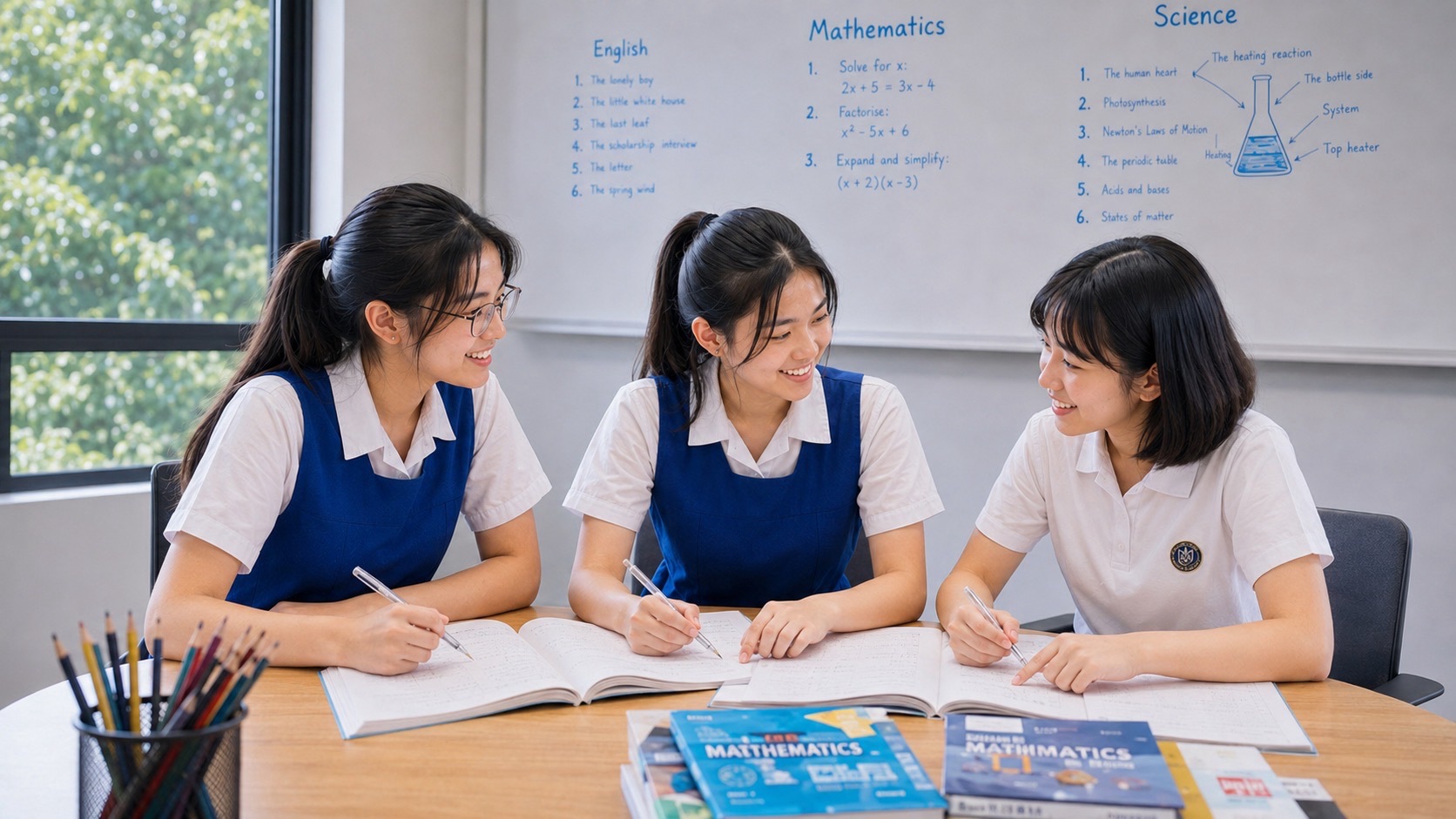
Primary 6 English changes when the student moves from learning a skill to performing that skill reliably under examination conditions. The underlying English does not disappear. Reading, vocabulary, grammar, writing, listening and speaking still matter. What changes is the operating environment: the student must retrieve the right knowledge without being told which topic is being tested, manage time, recover from uncertainty and produce an answer that satisfies the exact task.
This page is for Punggol families considering Primary 6 and PSLE English tuition. Its distinct purpose is to explain the transition from learning mode to performance mode—without reducing English to tricks, speed drills or endless full papers.
eduKate Singapore is an independent tuition provider and is not affiliated with MOE, SEAB or any school. Families looking for the broader local programme can continue to PSLE English Tuition in Small Groups at Punggol or Primary 6 English Tuition in Small Groups at Punggol.
Learning Mode and Performance Mode Are Different States
| Learning mode | Performance mode |
|---|---|
| Topic is usually known | Student must identify what is being tested |
| Prompts and explanations are available | Prompts are reduced or absent |
| Time is generous | Time is finite and must be allocated |
| Errors can be corrected immediately | Student must detect and recover independently |
| Examples may be similar to teaching | Surface form can be unfamiliar |
| One skill may be isolated | Multiple skills compete for attention |
A student can be strong in learning mode and unstable in performance mode. This is why “she can do it at home” and “the examination result is inconsistent” can both be true.
Performance Mode Starts With Task Recognition
When the examination does not label the skill, the student must identify the demand. A comprehension question may require a reason, evidence, inference or comparison. A grammar item may depend on tense, agreement, word form or reference. A writing prompt may require a particular purpose, audience and content set.
We therefore teach students to pause long enough to identify the task before executing it. This prevents fast, confident answers to the wrong problem.
Retrieval: Can the Skill Return Without Reteaching?
Learning mode often keeps the relevant knowledge active. Performance mode asks the student to retrieve it after delay and among competing possibilities.
- Can a tense rule be selected in mixed grammar?
- Can a vocabulary word be retrieved during composition without a word bank?
- Can the student identify evidence in an unfamiliar passage?
- Can a writing structure be rebuilt for a new topic?
- Can the student remember an oral-response framework after several weeks?
This is why spaced retrieval and mixed practice are important in Primary 6. Repeatedly seeing the same rule is not the same as being able to call it back when the paper demands it.
Transfer: Can the Skill Survive a Changed Surface?
Examination questions often preserve a familiar underlying relationship while changing the surface wording. A student who learned only the original pattern may fail even though the concept is known.
We test transfer by changing:
- sentence structure;
- passage genre;
- vocabulary;
- question wording;
- composition topic;
- position of evidence;
- timing conditions.
If performance collapses as soon as the surface changes, the learning is still tied too closely to the original example.
Paper 1: Learning to Write Is Not the Same as Writing Under Time
In learning mode, a student can spend time discussing an idea, improving one paragraph and revising vocabulary. Performance mode requires enough planning to prevent expensive rewrites while preserving time for both Situational Writing and Continuous Writing.
For the 2026 PSLE English examination, SEAB lists Paper 1 at 1 hour 10 minutes. Families should check the current official details on the SEAB PSLE 2026 page.
Performance training therefore includes:
- rapid but sufficient task analysis;
- compact planning;
- clear causal structure;
- sentence control under load;
- vocabulary precision without long search pauses;
- high-value revision;
- time allocation across tasks.
Paper 2: Mixed Language Requires Selection
Paper 2 places grammar, vocabulary and comprehension inside a mixed environment. The student must decide which relationship matters without a chapter heading.
That means Primary 6 preparation should move from isolated rule practice toward:
- mixed grammar;
- cloze constraint reading;
- editing with personalised error profiles;
- synthesis and transformation through sentence relationships;
- comprehension evidence selection;
- supported inference;
- timed passage navigation.
The purpose is not to make every lesson examination-like. It is to ensure that learned language can function when the examination removes the training wheels.
Listening: Prepare the Attention System
Listening performance depends on more than hearing English. The student has to know what information matters, hold names or details long enough, distinguish distractors and update an answer when later information changes the meaning.
In learning mode, the audio can be paused and discussed. In performance mode, the student needs an internal listening routine: anticipate the information type, track references, notice contrast or correction, and avoid replacing evidence with memory of a similar phrase.
Oral: Fluency Must Remain Relevant
Oral performance can look fluent while remaining thin or off-topic. Performance mode therefore asks the student to respond directly, develop the answer with relevant reasoning and maintain spoken sentence control.
A useful temporary structure is:
Position → reason → example → implication → return to question.
The structure should fade into natural speaking. It is a support for thinking, not a script to recite.
Timed Versus Untimed Performance Tells Us What to Repair
| Pattern | Likely interpretation | Priority |
|---|---|---|
| Weak untimed and timed | Skill itself is not secure | Return to learning mode |
| Strong untimed, weak timed | Retrieval, fluency or pacing issue | Compress the correct process |
| Strong early, weak late | Stamina or time allocation | Section pacing and recovery |
| Fast but inaccurate | Guessing under pressure | Restore verification |
| Slow but accurate | Process is too effortful | Automate high-frequency decisions |
This comparison prevents the mistake of treating every performance issue as a speed problem.
The Recovery Skill
Performance mode includes what happens when the student does not immediately know the answer. A strong learner has a recovery sequence instead of panic.
- Restate the question.
- Identify what is known.
- Localise the relevant text or relationship.
- Generate a small set of candidates.
- Eliminate with evidence.
- If still stuck, apply a stopping rule and return later where appropriate.
This protects the rest of the paper from one local failure.
Checking in Performance Mode
Checking should become selective. Students cannot re-solve the whole paper during the final minutes.
We build a personalised risk profile. One student checks tense and pronoun reference in writing. Another checks unanswered comprehension items and overlong answers. Another checks situational-writing content points.
The most efficient check is the one aimed at an error the student actually makes.
Why Full Papers Should Come After Targeted Repair
Full papers are important because they test integration, stamina and timing. But when a repeated root error is already known, another full paper may simply produce the same loss again.
A stronger cycle is:
- Use the marked paper to diagnose.
- Return to learning mode for the weak capability.
- Repair with controlled practice.
- Test transfer with changed examples.
- Add time pressure progressively.
- Return to a full paper.
- Compare the new error pattern.
How a 3-Pax Class Manages the Mode Switch
A maximum three-student class allows learners to move between modes without everyone receiving the same intervention. One student may still need grammar teaching while another is ready for timed mixed practice.
The tutor can observe whether failure appears because the student does not know, cannot retrieve, cannot transfer or cannot perform under time. Those are different states and should be treated differently.
Current Curriculum and Examination Boundary
The MOE Primary English Language Syllabus 2020 remains the broad curriculum reference for Primary English in 2026, emphasising effective use of language knowledge, skills and strategies. The PSLE is one assessment of that broader capability.
SEAB’s official 2026 materials provide the current paper structure and timing. Tuition should align performance training to those requirements while continuing to build durable language capability rather than teaching the child to recognise only one examination pattern.
What Progress Looks Like
- Topic labels are needed less often.
- Old grammar and vocabulary return after delay.
- Comprehension strategies transfer to new passages.
- Writing plans become compact and executable.
- Timed accuracy approaches untimed accuracy.
- Checking becomes targeted.
- The student recovers after difficult items.
- Full-paper mistakes become fewer and more specific.
- The learner can explain whether a problem is knowledge, retrieval, transfer or performance.
Questions Parents Often Ask
When should my child start doing timed papers?
Once the relevant processes are reasonably accurate and repeatable. Timing should test and compress a controlled process, not replace missing learning.
Does Primary 6 tuition become only exam preparation?
No. Performance training becomes more important, but examination reliability depends on underlying reading, writing, grammar, vocabulary, listening and oral capability. We switch between learning and performance modes as needed.
How do we know when to go back to learning mode?
If the student is inaccurate even without time pressure or cannot explain the underlying rule or reasoning, return to learning mode and repair the capability before adding more performance pressure.
What should we bring to tuition?
Recent marked papers, writing samples, timed practice and teacher comments are useful because they show how the student behaves under real school conditions.
Learning Mode → Performance Mode: Almost-Code Summary
LEARNING_MODE:
    understand()
    model()
    controlled_practice()
    feedback()

TEST_READINESS:
    accurate_without_heavy_prompts?
    retrieve_after_delay?
    transfer_to_changed_surface?

IF no:
    remain_in_learning_mode()

IF yes:
    PERFORMANCE_MODE:
        mixed_tasks
        reduced_prompts
        time_limits
        stopping_rules
        targeted_checking
        full_paper_integration

IF performance_breaks:
    classify:
        knowledge
        retrieval
        transfer
        timing
        recovery

RETURN_TO_CORRECT_LAYER()

OUTPUT:
    durable_English
    examination_reliability
    controlled_speed
    better_recovery
    increasing_independence