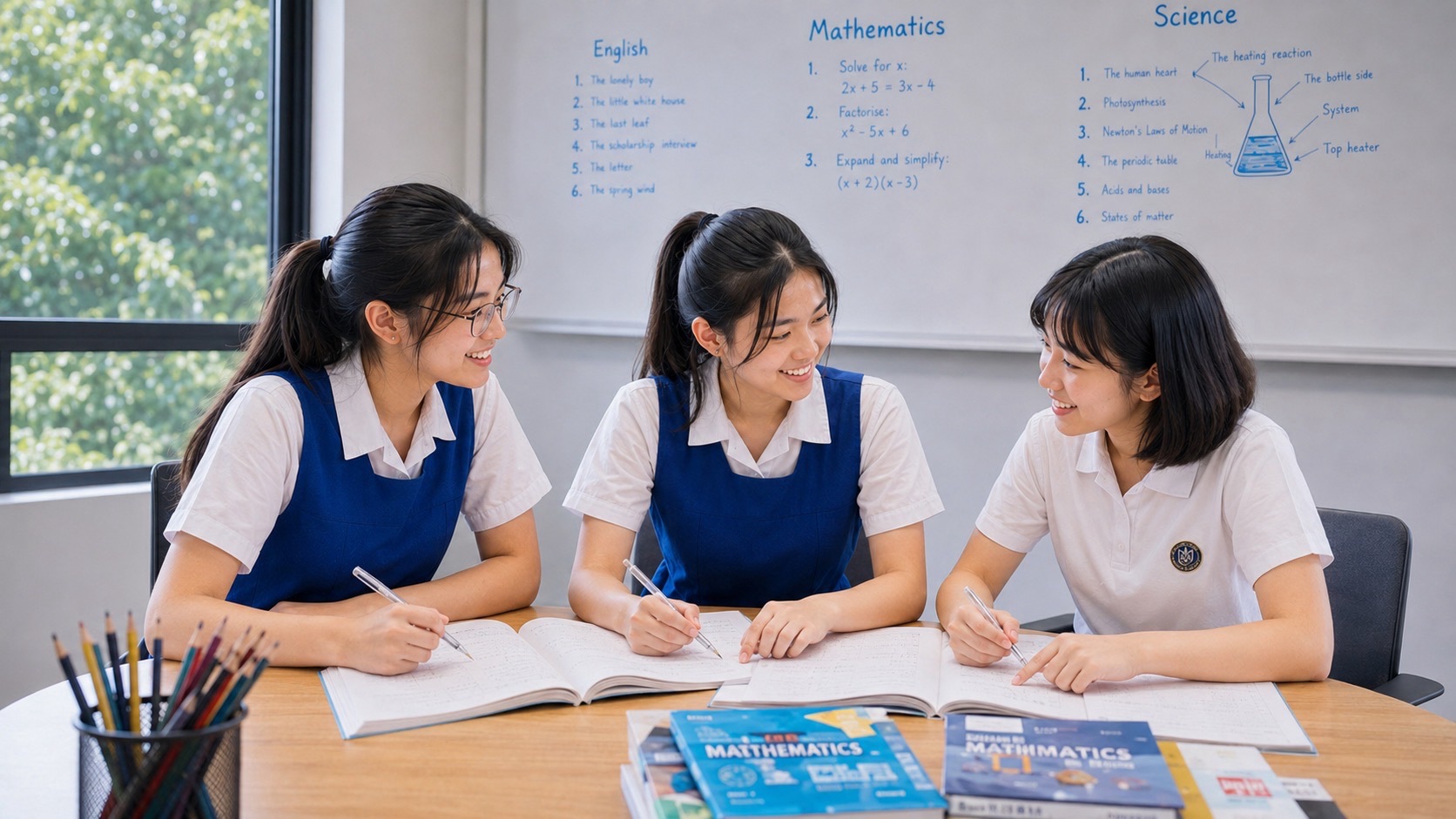
Primary English, Mathematics and Science tuition in Punggol should not become three unrelated piles of worksheets. When a child is finding school difficult across several subjects, the useful question is not simply which subject produced the lowest mark. It is where the learning chain first became unstable, which weaknesses are shared across subjects, and which problems really do need subject-specific teaching.
That distinction matters because the same visible result can come from very different causes. A student may lose marks in English because instructions are misunderstood, in Mathematics because the same instruction language is misread, and in Science because the child knows the concept but cannot express the relationship clearly. Three scores have fallen, yet one underlying language-and-representation problem may be contributing to all three.
Another student may read very well but have weak number sense. A third may be mathematically capable yet struggle to retain Science concepts over time. Coordinated support therefore does not mean teaching every subject in the same way. It means reading the whole learner first, separating shared causes from subject-specific causes, then giving each subject the treatment it actually requires.
At eduKate Singapore, our small-group tuition model in Punggol is built around that reading. Classes are kept small so the tutor can see how a student reads, explains, calculates, writes, checks, hesitates and responds to correction. The purpose is to make schoolwork clearer and increasingly manageable, not to make the child dependent on tuition.
When Does Coordinated Multi-Subject Support Make Sense?
Not every Primary student who needs tuition should attend tuition for three subjects. Sometimes one subject is the bottleneck and repairing it is enough. Coordinated support becomes more useful when difficulties are interacting across English, Mathematics and Science or when the family needs a coherent way to prioritise limited study time.
| What parents may notice | Possible underlying issue | What useful support should investigate |
|---|---|---|
| The child struggles with word problems and Science open-ended questions | Language decoding or relationship tracking | Can the student identify actor, quantity, condition, change and required output? |
| Homework takes a very long time in every subject | Weak task entry, attention control or retrieval | Can the child begin independently and retrieve what was learned? |
| Marks are acceptable but unstable | Knowledge is not surviving transfer or delay | Does the method still work when the question changes or returns weeks later? |
| English is weak and Science answers are vague | Expression may be limiting demonstrated Science understanding | Can the child state cause, process, effect and evidence precisely? |
| Many “careless” mistakes appear in Mathematics and Science | Checking and working control may be weak | Where does the first error enter, and is there a repeatable pattern? |
| The child is overwhelmed by tuition, schoolwork and revision | Study load is fragmented | Which repair has the highest leverage, and what can be removed? |
The table is deliberately diagnostic. It prevents a common mistake: treating the subject label as the diagnosis. “English problem”, “Math problem” and “Science problem” are useful starting categories, but they are not always the real cause.
The Shared Learning Layer Beneath Three Different Subjects
English, Mathematics and Science are different disciplines. They should remain different. English develops language, literacy, interpretation and communication. Mathematics develops quantitative and relational reasoning under valid rules. Science develops understanding of the natural world through concepts, evidence, models and inquiry.
Yet the student brings the same brain, habits and working processes into all three classrooms. Several capabilities therefore sit underneath the subjects:
- reading the instruction accurately;
- holding relevant information in working memory;
- distinguishing important from distracting information;
- retrieving earlier knowledge;
- choosing a representation;
- sequencing steps;
- checking whether an answer satisfies the task;
- learning from feedback instead of merely correcting the final answer;
- managing effort when a task feels unfamiliar.
If these shared processes are weak, three separate tuition programmes can accidentally repeat the same failure. The student receives more content but not a better operating system for using it. Coordinated tuition should notice this and decide which work is shared and which must remain subject-specific.
English: The Language Layer That Carries Learning
The Ministry of Education’s Primary English Language Syllabus 2020 describes language as a means of making meaning and communication, with reading, viewing, speaking, representing, writing and language use working together. This is a useful way to understand Primary English tuition: English is not one chapter. It is the system through which much of school is received and expressed.
A child may therefore need help at very different English layers. One student needs decoding and vocabulary. Another can read fluently but misses reference words such as “this”, “they” or “which”. Another understands the passage but cannot select evidence. A fourth has good ideas yet writes sentences that lose the relationship between actor, action, time and condition.
Useful English diagnostic questions
- Can the student explain what the question is asking in their own words?
- Can the student locate the sentence or paragraph that contains the relevant evidence?
- Can the student distinguish explicit information from an inference?
- Can the student tell who or what a pronoun refers to?
- Can the student build a complete sentence that preserves the intended meaning?
- Can the student organise ideas before writing?
- Can the student revise meaning and structure before surface proofreading?
Good English support makes these processes visible. Instead of telling the child to “read carefully”, the tutor can show what careful reading consists of: anchor the question, localise evidence, track relationships, interpret vocabulary in context, verify the answer against the passage, then express it at the required level of precision.
Mathematics: Where Representation and Method Must Stay Connected
Primary Mathematics often looks like calculation from the outside. Inside the task, however, the student is moving among language, quantities, diagrams, units, relationships and operations. A child who can calculate accurately may still fail a problem because the wrong relationship was constructed. Another may understand the relationship but execute a fraction or percentage step inaccurately.
This is why “more practice” is too vague a prescription. Practice helps when the correct object is being practised. It is less useful when the child repeatedly rehearses a wrong interpretation or copies a method without understanding why it applies.
A Mathematics repair sequence
- Identify the required output.
- Extract the quantities and conditions.
- Represent the relationship using a model, equation, table or diagram where useful.
- Choose the operation or method.
- Execute with clean working.
- Check units, magnitude and reasonableness.
- Ask whether the method survives a changed question.
The final step is important. One correct answer does not prove mastery. A method is more secure when the student can use it after a delay, with different numbers, inside a mixed-topic paper and without being told which chapter is being tested.
Science: From Keywords to Complete Explanations
Primary Science becomes difficult when students mistake keywords for explanations. Knowing “evaporation”, “photosynthesis”, “friction” or “electrical conductor” is useful, but a Science answer often requires a relationship: what changed, why it changed, through which mechanism, and what observation supports the claim.
For the 2026 PSLE, SEAB states that the Science paper assesses knowledge with understanding together with application of knowledge and scientific inquiry, including prediction, interpretation, evaluation and communication of explanations and reasoning. Families should always check the current examination-year documents on the SEAB website because assessment details can change.
A useful Science explanation chain
Cause → process → observable effect → evidence.
When a student jumps directly from cause to final effect, the missing middle is often where marks disappear. Tuition should therefore teach the student to reconstruct the mechanism, not merely insert a memorised phrase.
The tutor can also separate observation from inference. “The water level fell” is an observation. “Water evaporated because heat energy enabled particles to escape from the surface” is an explanation. Students need to know which kind of statement the question requires.
Why One Weak English Process Can Affect Mathematics and Science
Cross-subject difficulty often appears when the child can perform a skill in isolation but cannot decode the language that tells them when and how to use it.
Consider a Mathematics problem using “at least”, “remaining”, “difference”, “for every”, or “increased by”. Each phrase carries a relationship. If that relationship is misread, correct arithmetic may be applied to the wrong model. In Science, words such as “compare”, “explain”, “state”, “predict” and “give a reason” also signal different answer contracts.
This does not mean Mathematics and Science should become English lessons. It means the tutor should identify when language is the entry barrier and repair that barrier deliberately. Subject knowledge then has a clearer path to expression.
Why One Mathematics Weakness Can Also Affect Science
Science increasingly asks students to read tables, compare values, notice patterns and interpret graphs. A child with weak scale reading, ratio sense or numerical comparison may appear to have a Science problem when part of the difficulty is quantitative.
The correct repair is not to merge the subjects. It is to preserve the scientific purpose while strengthening the mathematical tool that Science needs. The student should know, for example, that a graph in Science is evidence about a changing variable, not simply another graph exercise.
Three Student Profiles That Need Different Coordination
Profile 1: The Child Who Is Falling Behind Everywhere
This student often needs triage rather than acceleration. The family may feel pressure to repair every chapter immediately, but the better route is to find the earliest high-cost weakness.
If task language is weak, strengthen task reading. If basic number relationships are unstable, repair them before adding harder Mathematics. If Science concepts were memorised without mechanisms, rebuild the explanation chain. The first objective is to reduce noise and restore a workable learning rhythm.
Profile 2: The Child Who Is Passing but Unstable
This student often understands recent work but loses it after two or three weeks. Results move sharply because performance depends on what was practised most recently. Coordinated support should add cumulative retrieval, mixed practice and delayed checks so knowledge survives beyond the immediate worksheet.
The parent should begin to see fewer “surprise” collapses. The child becomes better at recovering earlier knowledge and selecting it without chapter labels.
Profile 3: The Strong Student Carrying Too Much Tuition
A capable student can also be over-supported. If the child is secure, the role of tuition should change from constant rescue to carefully chosen stretch, transfer and independence. Adding hours simply because the child can tolerate them may reduce time for reading, rest, school commitments and independent learning.
Coordination therefore includes subtraction. A good plan asks what no longer needs intensive support.
The eduKate Small-Group Advantage: Visibility Before Volume
A maximum three-student class gives the tutor enough proximity to observe the process producing the answer. This matters across all three subjects.
- In English, the tutor can hear how the student interprets a line before the written answer hides the reasoning.
- In Mathematics, the tutor can see the exact line where a relationship or sign becomes wrong.
- In Science, the tutor can ask the student to distinguish observation, concept and inference before memorised wording takes over.
Small-group teaching also preserves useful peer learning. One student may explain a Mathematics method differently. Another may notice an ambiguity in a comprehension answer. A third may challenge a Science explanation. The tutor can use these differences without allowing any student to disappear into the class.
The goal is not permanent tutor proximity. The goal is to use visibility to build a learner who needs less intervention over time.
What a Coordinated Week Should Look Like
A coordinated week is not one giant combined lesson. Each subject keeps its own intellectual structure. Coordination happens in planning, diagnosis, retrieval and workload.
| Layer | English | Mathematics | Science |
|---|---|---|---|
| Entry | Decode task and text | Identify required quantity and relationship | Identify phenomenon, variables and question demand |
| Core work | Interpret, organise, express | Represent, transform, solve | Explain, apply, infer from evidence |
| Checking | Meaning, evidence, grammar, completeness | Method, working, units, reasonableness | Mechanism, terminology, evidence, claim strength |
| Transfer | New text or writing context | Mixed or unfamiliar problem | Novel scenario or data representation |
Parents do not need to reproduce the entire tuition system at home. A simple question can help: “What was the first thing that went wrong?” This moves discussion away from blame and towards diagnosis.
How to Decide Which Subject Needs Priority
When time is limited, priority should be based on leverage rather than anxiety. The loudest problem is not always the first one to repair.
- Check access. Can the child understand instructions and lesson language well enough to enter the task?
- Check prerequisites. Is current work failing because an older foundation is missing?
- Check frequency. Does the problem appear repeatedly across many tasks?
- Check cost. How much downstream work does this weakness damage?
- Check time. Is there an imminent school assessment or transition that changes priority?
- Check independence. Which repair would allow the child to do more alone?
This turns tuition planning into a sequence rather than a panic response. Some families may need English first, others Mathematics, and others a coordinated programme because the weaknesses genuinely interact.
What Improvement Should Look Like Before the Marks Move
Marks are important, but they are a delayed and compressed signal. Useful improvement often appears earlier in behaviour.
- The child begins homework with less prompting.
- Instructions are restated more accurately.
- Mathematics working becomes cleaner and easier to check.
- Science explanations contain a complete mechanism rather than isolated keywords.
- English answers use evidence with greater precision.
- The student notices a mistake before the tutor points it out.
- Old topics are retrieved with less relearning.
- A changed question produces less panic.
- The student can explain what was repaired and why it mattered.
These are useful leading indicators because they show that the process producing performance is becoming more reliable.
What Coordinated Support Should Not Become
Multi-subject tuition can become counterproductive when it simply fills every free hour. More tuition is not automatically more education.
- It should not duplicate school without diagnosis.
- It should not turn every mistake into another worksheet.
- It should not hide weak sleep, attention or schedule problems behind academic volume.
- It should not make the child afraid to attempt work without a tutor.
- It should not promise guaranteed grades.
- It should not treat every subject as if the same teaching method applies.
The proper question is whether tuition improves the child’s capability and control. If the learner understands more, remembers longer, transfers better and needs less rescue, the support is doing useful work.
Current Curriculum and Examination Boundary
This article is a tuition and parent-guidance page, not an official syllabus document. Curriculum and assessment details should be checked against current Ministry of Education and Singapore Examinations and Assessment Board sources. The MOE Primary English Language Syllabus 2020 remains the main Primary English curriculum reference in 2026, while SEAB publishes examination-year PSLE formats and syllabuses. Science assessment from 2026 reflects the 2023 Primary Science syllabus. Mathematics assessment information should likewise be checked for the child’s examination year.
eduKate Singapore does not represent or speak for any school, MOE or SEAB. Our role is educational support: to understand the student’s present learning state, teach within the relevant Singapore curriculum context and help the child become more capable and independent.
Where to Continue
Families who need a dedicated English route can continue to our Primary English Tuition in Punggol guide. Families comparing English support across Primary and Secondary can use our broader English Tuition in Punggol page.
For Mathematics and Science, the correct route depends on the student’s level and the exact weakness. A consultation should begin with recent schoolwork, assessment papers and the parent’s main concern rather than a generic request for “more practice”.
Questions Parents Often Ask
Does my child need tuition for all three subjects?
Not necessarily. If one high-leverage weakness is causing problems elsewhere, it may be better to repair that first. Three-subject support makes sense when the difficulties are genuinely distributed or interacting and the weekly load can remain healthy.
Can English tuition improve Mathematics and Science?
English support can improve access to instruction language and expression, but it does not replace Mathematics or Science teaching. A student still needs mathematical relationships and scientific concepts taught accurately. Coordination means identifying where language is limiting those subjects, not pretending the subjects are the same.
How do we know whether a weakness is truly repaired?
Retest it after a delay, change the question form, reduce prompting and look for transfer. A correct answer immediately after teaching is evidence of progress; independent performance later is stronger evidence of mastery.
What should we bring to a consultation?
Recent school papers, worksheets showing repeated errors, current level, upcoming assessments, any teacher feedback, and a short description of what homework looks like at home are useful. The aim is to read the student from evidence rather than guess from one mark.
What is the long-term goal?
The long-term goal is not permanent tuition dependence. It is a learner who can receive an instruction, understand the concept, retrieve what is needed, apply it accurately, check the result, learn from errors and continue with greater independence.
Punggol Primary Multi-Subject Tuition: Almost-Code Summary
STUDENT:
    level = Primary 1..6
    location = Punggol
    subjects = English | Mathematics | Science

READ:
    task_language
    foundation_stability
    retrieval
    representation
    method_selection
    explanation_quality
    working_control
    transfer
    independence

IF one_shared_bottleneck:
    repair_high_leverage_cause()
    retest_across_subjects()

IF subject_specific_gap:
    route_to_subject_teaching()
    preserve_subject_integrity()

IF workload_overloaded:
    prioritise()
    remove_low_value_repetition()

RUN:
    diagnose
    localise
    teach
    practise
    interleave
    transfer
    review

OUTPUT:
    clearer_learning
    stronger_subject_foundations
    better_cross_subject_control
    less_rescue
    growing_independence