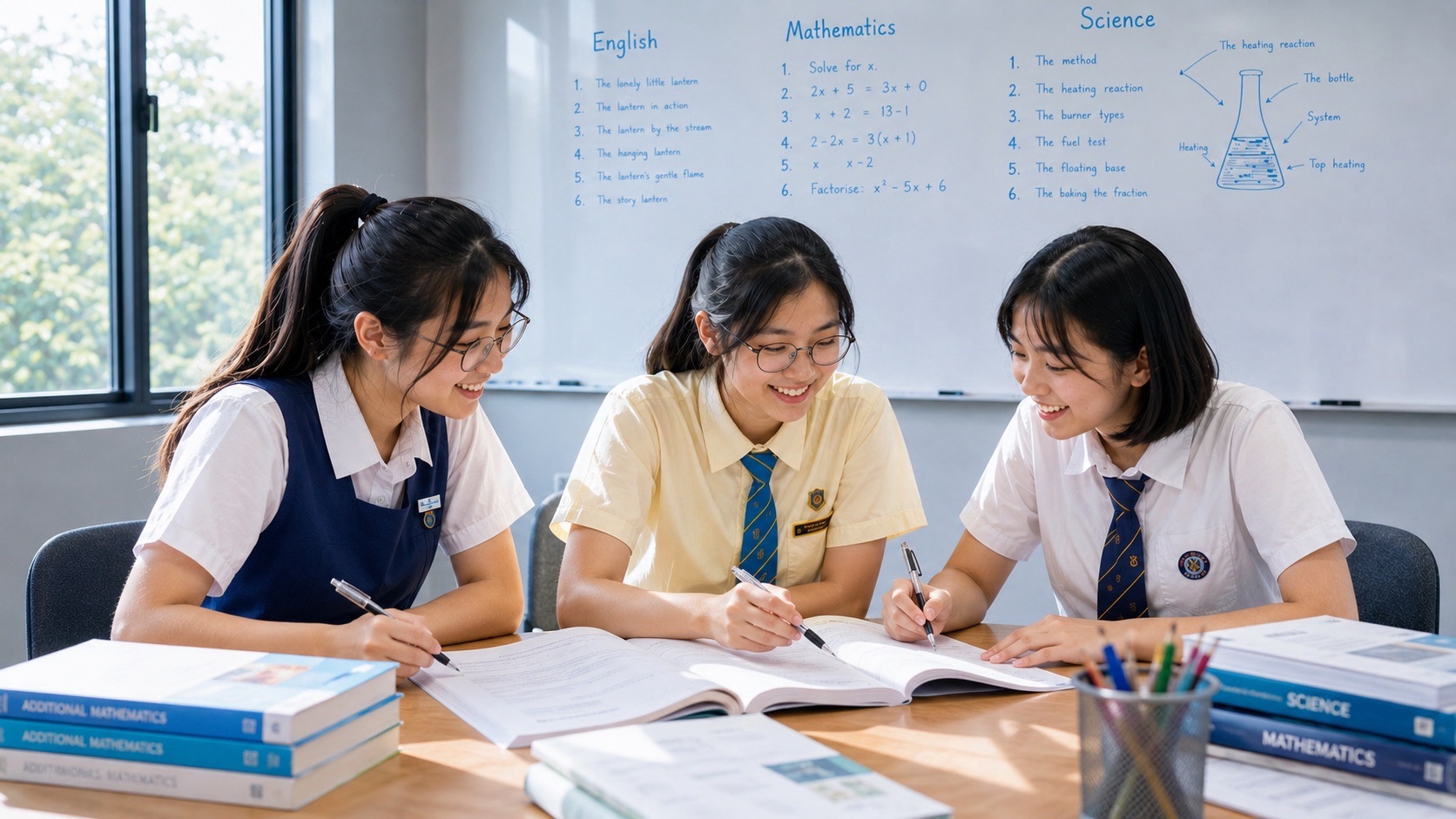
Primary school ends.
The subjects do not.
A child leaves one timetable, one set of teachers and one level of expected independence.
Then the same learner enters Secondary school and meets familiar words in unfamiliar forms.
English is still English.
Mathematics is still Mathematics.
Science is still Science.
But the operating conditions have changed.
Educational transition is not a reset. It is a continuity problem.
The important question is not merely whether Primary school content was completed.
It is whether the capabilities built there remain usable when the representations, pace, language, workload and expectations change.
This article looks at the Primary-to-Secondary transition as a system of handoffs.
What must survive?
What can change?
Where do learners most often lose continuity?
And how can we tell whether a student is genuinely ready for the next stage rather than merely finished with the previous one?
Quick Answer: What Should Survive the Transition?
The most important things to carry forward are not individual worksheets or memorised procedures, but durable capabilities.
- reading a task accurately;
- identifying what is known and unknown;
- retrieving essential knowledge;
- switching representations when needed;
- reasoning from evidence;
- communicating an answer clearly;
- checking work;
- recovering after an error;
- asking useful questions;
- working with increasing independence.
Subject knowledge matters.
But knowledge becomes more valuable when it is carried by these deeper operating skills.
The Transition Changes the Receiver
A Secondary 1 student is not simply a Primary 6 student with harder textbooks.
The learner is entering a different network.
There may be more teachers.
More subjects.
Longer chains of prerequisite knowledge.
More specialised vocabulary.
Less repeated prompting.
More need to organise materials and deadlines independently.
A child who functioned well when one teacher helped coordinate much of the school day may now need stronger internal coordination.
The receiver has changed.
The learning system has to hear that.
Completion Is Not Continuity
A student can finish Primary Mathematics and still enter Secondary school with fragile number sense.
Finish Primary English and still struggle to reconstruct implied meaning independently.
Finish Primary Science and still treat explanations as memorised phrases rather than evidence-linked models.
The syllabus has ended.
The capability may not yet be stable.
A curriculum endpoint is an administrative boundary. Learning has to survive beyond it.
Primary School Builds the Base Layer
Primary education introduces a large amount of foundational structure.
Students learn to read instructions.
Work with numbers and quantities.
Represent relationships.
Observe, compare and explain.
Organise ideas into writing.
Build vocabulary.
Retrieve facts.
Follow multi-step procedures.
Those skills are not disposable after PSLE.
They become the substrate on which more specialised Secondary work is built.
Secondary School Increases Resolution
Secondary education often asks the learner to preserve the same backbeats at higher resolution.
Primary Mathematics:
identify quantities, relationships and operations.
Secondary Mathematics:
represent relationships more formally through algebra, functions, graphs, geometry and increasingly abstract structures.
Primary Science:
observe, compare, classify, predict and explain.
Secondary Science:
use more formal models, variables, quantitative relationships, evidence evaluation and specialised disciplinary language.
Primary English:
read, infer, organise, communicate and adapt language to purpose.
Secondary English:
carry those capabilities across more complex texts, arguments, viewpoints, contexts and extended writing demands.
The function remains recognisable.
The representation becomes richer.
The English Handoff: Language Starts Carrying More of the School Day
English is not only an English subject.
It is also an interface through which many other subjects are received and answered.
A student may understand a scientific idea but misread the command word.
Understand a mathematical relationship but lose the meaning inside a dense word problem.
Know a historical event but fail to compare two sources precisely.
As schooling becomes more text-rich, language can become a bottleneck across the curriculum.
The Primary-to-Secondary English handoff therefore needs more than grammar accuracy.
- track references across longer passages;
- separate explicit information from inference;
- follow argument structure;
- detect the role of connectors and qualifiers;
- compress information without losing meaning;
- write for a specified purpose and audience.
The Mathematics Handoff: From Visible Models to Symbolic Compression
Primary Mathematics often makes relationships visible through models, diagrams, concrete contexts and arithmetic.
Secondary Mathematics increasingly compresses those relationships into symbols.
This transition can create a false impression that algebra is a completely new language unrelated to earlier Mathematics.
But many backbeats remain.
- part and whole;
- equality;
- ratio;
- rate;
- change;
- unknown quantity;
- constraint;
- inverse operations;
- pattern.
Algebra does not abolish these relationships.
It creates a more compact representation of them.
A learner who preserves quantity identity and relationship sense can cross the boundary more easily than one who treated Primary Mathematics as a collection of isolated procedures.
The Science Handoff: From Correct Facts to Model-Based Explanation
Primary Science builds habits of observation, comparison, prediction and explanation.
Secondary Science increases specialisation and formalism.
The learner encounters more technical vocabulary.
More quantitative relationships.
More explicit models.
More need to connect evidence to mechanism.
The critical continuity is not a long list of Primary facts.
It is the habit of asking:
- What was observed?
- What changed?
- What remained controlled?
- Which model explains the pattern?
- What evidence supports the conclusion?
- What are the limits of the claim?
Those questions scale upward.
The Hidden Handoff: From Teacher Coordination to Self-Coordination
One of the largest changes is not inside a subject at all.
It is who coordinates the learning.
When students are younger, adults often provide much of the external structure.
- reminders;
- materials;
- task breakdown;
- checking;
- time allocation;
- recovery after forgetting.
As students progress, more of that control needs to migrate inward.
The student must increasingly decide:
- what to revise;
- what they do not understand;
- when to ask for help;
- how to divide time;
- which mistakes are recurring;
- whether a method actually transfers.
Academic independence is partly the transfer of control from the environment into the learner.
A Student Can Be Strong and Still Have a Transition Failure
Transition problems are not only for weak students.
A high-performing learner may have been very effective inside a stable Primary environment.
Then Secondary school changes the cues.
More teachers.
Less redundancy.
Harder mixed questions.
More abstract language.
The learner may suddenly look less capable.
The underlying intelligence did not disappear.
The old operating strategy may no longer fit the new environment.
The Transition Audit
Before responding with “study harder”, inspect the joins.
- Knowledge: are important prerequisites actually missing?
- Retrieval: can the student recall them without notes?
- Representation: can the student move from words to diagrams, tables, graphs or algebra?
- Selection: can they choose the relevant method without a chapter label?
- Language: can they decode the more specialised wording?
- Organisation: can they coordinate several subjects and deadlines?
- Feedback: do they know how to use errors to change the next attempt?
The audit turns a vague transition problem into a repairable system.
Do Not Over-Repair the Wrong Layer
If a Secondary 1 student struggles with algebra because multiplication facts are slow, giving harder algebra may increase the visible problem.
If a student struggles with Science because technical language is blocking comprehension, reteaching the concept in equally dense language may not help.
If a student understands English texts but cannot manage deadlines, vocabulary worksheets may not solve the real bottleneck.
Repair the earliest load-bearing weak link.
Then test forward again.
The Bridge Task
A useful transition exercise is to take one familiar Primary skill and project it into a Secondary form.
For Mathematics:
bar model → algebraic equation
For Science:
fair comparison → explicit variable design
For English:
simple inference → viewpoint and evidence across a longer text
The student can see that the new task is not a foreign country.
It is a higher-resolution version of an older route.
The Support-Fade Problem
A support that helps in Primary school can become a dependency if it never fades.
Sentence frames.
Chapter labels.
Worked examples immediately beside every practice question.
Constant reminders.
Parent-managed schedules.
These can be excellent temporary infrastructure.
Success eventually requires the learner to internalise enough of their function.
Good scaffolding does not merely help the learner cross. It is designed so the learner eventually needs less of the scaffold.
The PSLE Is an Endpoint and a Diagnostic Snapshot
The 2026 PSLE syllabuses define end-of-primary assessment objectives for English, Mathematics and Science.
Those examinations tell us something about what the learner can do under PSLE conditions.
They do not freeze the learner’s future capability.
The next educational system will ask the same learner to operate under new conditions.
The useful question after the result is therefore not only:
What score did the student obtain?
Also ask:
Which capabilities are stable enough to carry forward, and which will become bottlenecks as the environment changes?
Secondary Assessment Is Also Changing
SEAB has published the 2027 Singapore-Cambridge Secondary Education Certificate syllabuses across G1, G2 and G3 subjects.
For students entering the new secondary assessment environment, this reinforces a broader point:
the institutional form can change while the learner still needs durable language, mathematical, scientific and self-management capabilities underneath it.
Preparation should therefore preserve both current syllabus accuracy and long-term capability.
Do Not Teach the Transition as Fear
“Secondary school is much harder” is too vague to be useful.
It can create anxiety without creating readiness.
A better representation is:
- some familiar skills will be used at higher resolution;
- some supports will reduce;
- some representations will become more abstract;
- more coordination will move to the student;
- new subject-specific knowledge will be added;
- errors will reveal which bridge needs strengthening.
That turns “harder” into a map.
Parent-Friendly Transition Check
- Can my child explain what they are learning without the notes?
- Can they start homework without someone identifying the first step?
- Can they organise tasks across several days?
- Can they tell whether an error came from knowledge, reading, selection or execution?
- Can they ask for help with a specific question?
- Can they use a familiar idea when the wording or representation changes?
These checks tell us more about continuity than simply completing more advanced worksheets early.
Tutor-Friendly Transition Check
- Which Primary skill is this Secondary task actually building on?
- Is the learner missing the old structure or only the new representation?
- What support can be faded?
- What should remain invariant across the transition?
- Can the learner explain the connection between the old and new form?
- Does the student leave the lesson more independent than they entered it?
Official Singapore Assessment References
- SEAB — PSLE Formats Examined in 2026
- SEAB — 2026 PSLE English Language Syllabus
- SEAB — 2026 PSLE Mathematics Syllabus
- SEAB — 2026 PSLE Science Syllabus
- SEAB — Secondary Education Certificate Syllabuses for School Candidates
Final Principle: Carry the Capability, Not Just the Certificate
Education contains many boundaries.
Primary to Secondary.
Lower Secondary to Upper Secondary.
School to examination.
Examination to further study.
Study to work.
The names change.
The timetables change.
The assessment systems change.
The learner should not have to restart from zero each time.
A strong education preserves the backbeats that matter while allowing the form of learning to become more sophisticated.
That is learning continuity.
The real transition succeeds when useful capability reaches the other side.