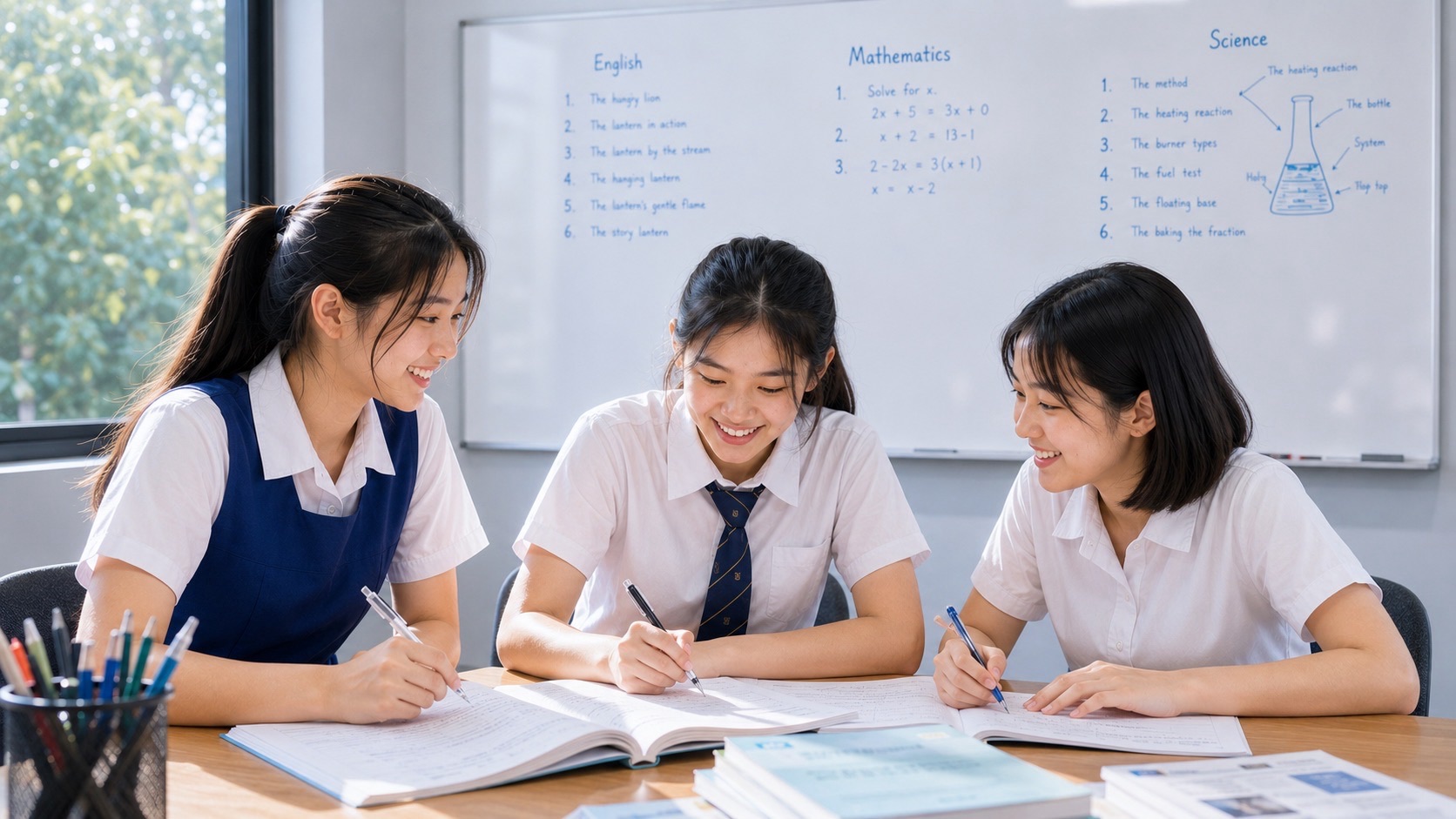
Secondary 1 Mathematics is not simply Primary 6 with harder numbers. It changes the language of Mathematics itself: specific arithmetic cases begin turning into variables, expressions, equations and general rules.
This rebuilt legacy Punggol page owns a distinct RFE: P6 → Secondary 1 algebraic generalisation bridge. The modern Punggol Secondary Mathematics estate already owns the broad commercial terms, so this older URL now focuses on the conceptual transition from concrete arithmetic cases to symbolic relationships.
eduKate teaches in groups of up to three students, generally for 90 minutes. A 3-pax class allows the tutor to compare several representations of the same relationship and identify whether a learner is manipulating symbols or actually understanding what they represent.
Location-integrity note: this is a legacy Punggol URL. Historical address claims in the old version should not be treated as current branch information. Current class location and availability should be confirmed directly.
The Current Secondary Context
Full Subject-Based Banding has been fully implemented in Singapore secondary schools since 2024. Students may offer subjects at G1, G2 or G3 subject levels depending on their placement and later progress. This page therefore does not pretend that every Secondary 1 learner follows one identical Mathematics pathway.
The mathematical bridge described here is broader: arithmetic becomes algebraic, representations become more symbolic, and students increasingly need to generalise relationships rather than solve only one numerical case.
From Number to Variable
Primary case:
3 bags each contain 5 apples. Total = 15.
Secondary generalisation:
If each bag contains x apples, 3 bags contain 3x apples.
The variable does not mean “mystery number” only. It can represent a quantity that may vary or remain unknown.
From Repeated Arithmetic to Expression
Primary:
5 + 5 + 5 + 5.
Secondary:
4 × 5.
Generalised:
4x.
Students learn that an expression compresses a relationship.
From Bar Model to Algebra
Bar models remain useful if the learner understands what each segment means.
Example:
One quantity is 7 more than another.
Primary representation:
shorter bar + 7 = longer bar.
Secondary representation:
x + 7.
The symbolic expression should preserve the same relationship the bar model made visible.
Equality Changes Meaning
Primary learners sometimes read:
3 + 4 = 7
as “do the calculation and write the answer”.
Secondary algebra requires:
left side has the same value as right side.
This makes statements such as:
2x + 3 = 11
meaningful rather than procedural.
Expression vs Equation
3x + 5 is an expression.
3x + 5 = 20 is an equation.
One represents a quantity; the other states that two quantities are equal.
This distinction becomes load-bearing in Secondary Mathematics.
Substitution
If:
y = 2x + 3
and x = 4, then:
y = 2(4) + 3 = 11.
Substitution connects the general rule back to a specific numerical case.
Generalisation From Patterns
Suppose a pattern contains:
- Figure 1: 4 tiles;
- Figure 2: 7 tiles;
- Figure 3: 10 tiles.
Students ask:
- What changes each time?
- What stays structurally constant?
- Can the nth case be described?
The move from examples to a rule is central to algebraic thinking.
Negative Numbers Enter More Fully
Secondary 1 students also meet denser work involving negative values, algebraic signs and order of operations.
Strong Primary arithmetic habits help, but sign meaning must now be separated carefully from operation symbols.
Fractions and Algebra
Weak fraction understanding becomes visible quickly in algebra.
If a learner does not understand equivalent fractions or the role of denominator, algebraic fractions later become procedural and fragile.
Therefore a Secondary 1 bridge may still require Primary prerequisite repair.
The P6→Sec1 Diagnostic
Equality
Can “=” be explained as same value?
Variable
Can a letter represent a quantity?
Expression
Can a relationship be written symbolically?
Equation
Can two equal quantities be represented?
Substitution
Can values be inserted correctly?
Pattern
Can a general rule be inferred?
Representation
Can diagrams/bars connect to algebra?
Six Common Sec 1 Transition Failure Modes
1. Letter = object label
The learner thinks x means a specific named item instead of a quantity.
2. Expression = equation
An equals sign is added unnecessarily.
3. Procedure without equality
Terms are “moved” across an equation without understanding balance.
4. Bar-model abandonment
Useful relational thinking disappears when symbols arrive.
5. Pattern by guess
A formula is guessed from numbers without structural reasoning.
6. Primary prerequisite gaps hidden
Fractions, negatives or ratio weaknesses are mistaken for new algebra problems.
What a 90-Minute 3-Pax Sec 1 Bridge Lesson Can Look Like
0–10 minutes: Primary relationship retrieval
Equality, ratio and bar-model reasoning return.
10–25 minutes: Variable introduction
Specific cases are rewritten generally.
25–40 minutes: Expression vs equation
Students classify symbolic statements.
40–55 minutes: Bar model → algebra
Representations are translated.
55–70 minutes: Substitution and checking
General rules return to numerical cases.
70–85 minutes: Pattern generalisation
Students derive a rule from structure.
85–90 minutes: Explain the bridge
Each learner states what a variable/expression represents.
Parent Evidence Checklist
- Can your child explain what a variable represents?
- Can they distinguish expression from equation?
- Can a Primary bar model be translated into algebra?
- Can substitution be checked?
- Do Primary fraction/ratio gaps still interfere?
- Can the learner explain rather than merely manipulate?
What Progress Looks Like
- symbols gain meaning;
- equality becomes relational;
- bar-model thinking transfers into algebra;
- substitution becomes reliable;
- pattern rules become structural;
- Secondary Mathematics feels like an extension of earlier reasoning rather than a completely new subject.
Frequently Asked Questions
Does this page claim one fixed Sec 1 Mathematics syllabus for every learner?
No. Under Full SBB, subject levels differ. This page focuses on broadly transferable algebraic-transition ideas.
Should students stop using bar models in Secondary 1?
No. They should use whichever representation clarifies the relationship, while becoming increasingly fluent with symbolic forms.
Does this page claim a current Punggol branch?
No. Current class location and availability must be confirmed directly.
Almost-Code Summary
PAGE_RFE = Punggol_Sec1_arithmetic_to_algebra_bridge
FLOW = arithmetic_case -> variable -> expression -> equation -> substitution -> generalisation
CLASS = max_3
LESSON = 90_minutes
LOCATION = legacy_Punggol_url_not_branch_claim
GOAL = symbolic_reasoning_grounded_in_primary_relationships