Paragraph expansion should add meaning, not repeat one idea in four slightly different sentences.
This rebuilt legacy “The Flow” page owns a distinct RFE: paragraph expansion without repetition. The broader Punggol Primary English estate already contains stronger general tuition owners, so this historical URL now focuses on a precise writing progression:
main idea → relevant detail or example → explanation → consequence or return.
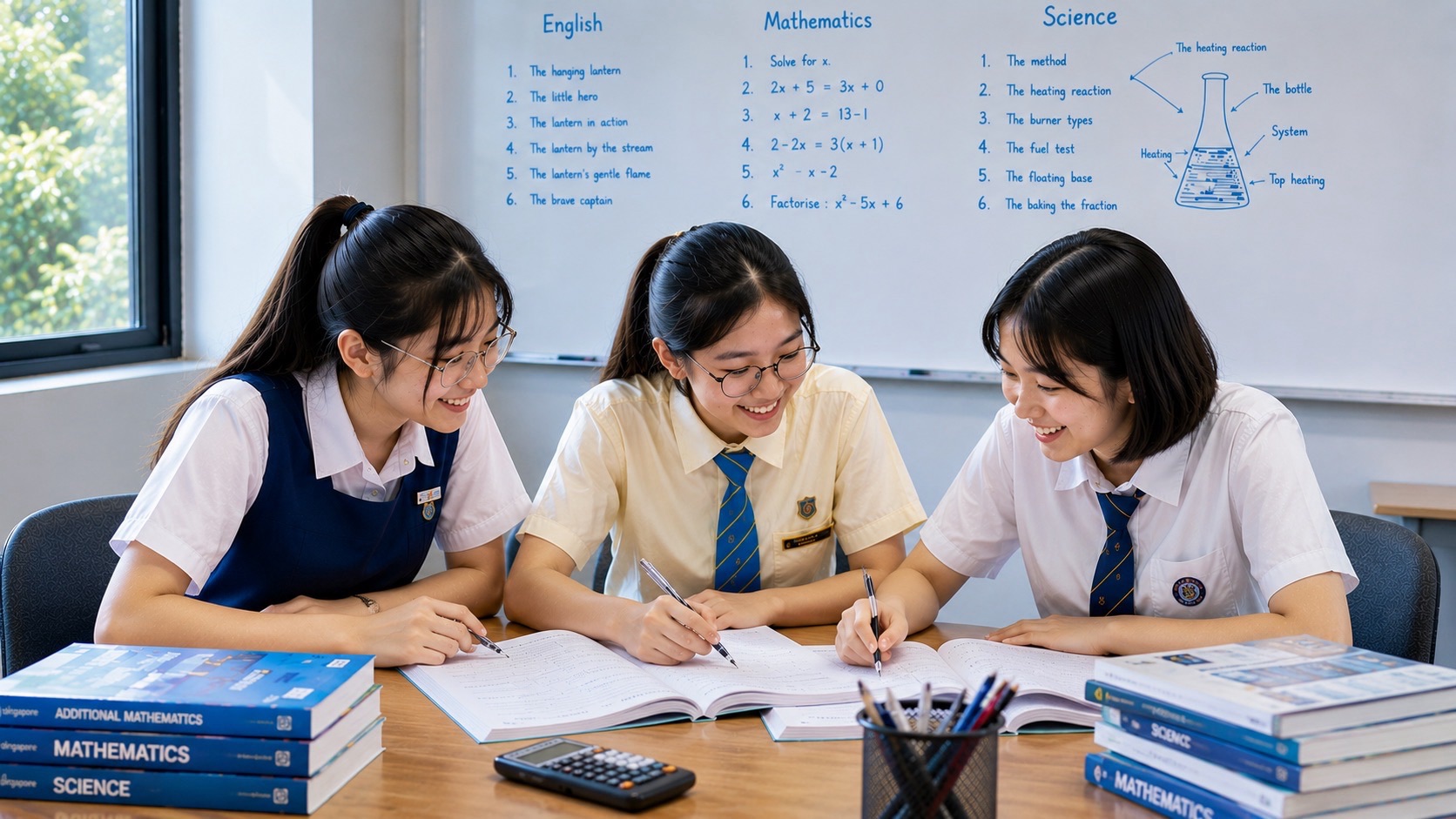
eduKate teaches in groups of up to three students, generally for 90 minutes. In a 3-pax English class, students can compare paragraph jobs, identify repeated meaning and test whether each sentence adds a genuinely new layer.
Location-integrity note: this legacy URL preserves historical “The Flow” wording only. It does not establish a current tuition centre at that location or at any old address. Current class location and availability should be confirmed directly.
The Current Primary English Context
MOE’s Primary English Language Syllabus 2020 develops reading, writing and oracy as connected capabilities, with vocabulary and grammar supporting purposeful communication. For 2026 PSLE candidates, English includes Writing, Language Use and Comprehension, Listening Comprehension and Oral Communication.
Families can verify current syllabus links through the MOE Primary subjects and syllabuses page and the SEAB PSLE Formats Examined in 2026 page.
Paragraph expansion supports composition and functional writing, but the paragraph must still serve the task rather than grow for length alone.
The Paragraph-Expansion Map
| Layer | Question |
|---|---|
| Main idea / event | What is this paragraph fundamentally doing? |
| Relevant detail | What specific information makes the idea clearer? |
| Example or evidence | What concrete instance supports it? |
| Explanation | Why does the detail matter? |
| Consequence / response | What changes or follows? |
| Return / link | How does the paragraph connect to the wider text? |
Not every paragraph needs every layer. The learner chooses what the paragraph job requires.
What Repetition Looks Like
Weak expansion:
I was very frightened. I was extremely scared. Fear filled me. I felt terrified and afraid.
Four sentences repeat one meaning.
Stronger expansion:
I froze when the lift stopped between floors. The lights flickered, and the emergency button did not respond. As the silence stretched, I realised that nobody outside knew we were trapped.
Each sentence adds event, condition or consequence.
Begin With the Paragraph Job
Possible jobs include:
- establish the situation;
- introduce a problem;
- show pressure increasing;
- explain a reason;
- give an example;
- show a consequence;
- resolve a conflict;
- reflect on what changed.
If the job is unclear, expansion often becomes random detail.
Main Idea or Central Event
Write the paragraph’s core in one sentence.
Example:
The team’s plan began to fail when the weather changed.
Every later sentence should clarify how, why or what followed.
Add Specific Detail
Useful detail answers:
- who;
- what;
- where;
- when;
- how;
- which feature matters.
Specific detail is not the same as decorative description. It should make the event or idea more precise.
Add Cause or Explanation
Ask:
Why did this happen, or why does this matter?
Example:
The field became slippery because the sudden downpour had soaked the grass.
The cause makes the next action understandable.
Add Consequence
A paragraph grows meaningfully when one event changes the next.
Use:
event → immediate effect → response → next state.
Example:
Unable to keep their footing, the players slowed down and abandoned the risky passing strategy they had practised.
The detail now alters the story.
Add an Example in Informational or Discursive Writing
Main point:
Regular reading can improve a learner’s vocabulary in context.
Example:
For example, a student who repeatedly encounters the word “reluctant” in stories sees not only its definition but also the situations, emotions and sentence patterns in which it is used.
Explanation:
This makes later retrieval more flexible than memorising the word as an isolated pair.
The paragraph develops rather than repeats.
Add Evidence, Then Explain It
For analytical writing:
claim → selected evidence → explanation of relationship → significance.
Do not add a quotation and assume it explains itself.
The explanation should show how the evidence supports the claim.
Use Questions as Temporary Scaffolds
After the main sentence, ask:
- What exactly happened?
- Why?
- What evidence or example shows it?
- What changed because of it?
- How does this connect to the next paragraph?
As independence grows, the questions should fade.
Paragraph Expansion in Narrative Writing
Narrative paragraphs can develop through:
- action;
- observation;
- character response;
- decision;
- consequence;
- purposeful dialogue.
Expansion should usually move the scene forward or deepen a meaningful moment.
Paragraph Expansion in Situational Writing
Functional writing can develop a content point by including:
- the required fact;
- the reason it matters;
- a relevant instruction or request;
- the next action expected from the reader.
Do not expand so much that the required information becomes hard to find.
Paragraph Expansion in Comprehension Answers
Some answers need more than one sentence; many do not.
Expand only when the question requires:
- two reasons;
- evidence and explanation;
- before/after comparison;
- several connected steps.
Answer sufficiency remains the governing constraint.
Use Sentence Relationships
Paragraphs develop through real relationships:
- cause;
- consequence;
- contrast;
- example;
- sequence;
- condition;
- clarification.
Connectors should make these relationships visible, not create them artificially.
Control Repeated Vocabulary
Repeating the key noun can maintain clarity, but excessive repetition becomes clumsy.
Use:
- clear pronouns;
- appropriate synonyms;
- related noun phrases;
- ellipsis where meaning remains clear.
Do not vary words so aggressively that reference becomes uncertain.
The Deletion Test
After drafting, remove one sentence mentally.
Ask:
Does the paragraph lose a new event, detail, example, explanation or consequence?
If nothing is lost, the sentence may repeat existing meaning.
The Movement Test
Compare the beginning and end of the paragraph.
What has changed?
- new information;
- character state;
- reader understanding;
- problem intensity;
- argument strength;
- next action.
A developed paragraph should usually move somewhere.
Paragraph Length Is Not a Fixed Rule
A paragraph should be as long as its job requires.
Some moments need three controlled sentences. Others need six or more.
Students should not add filler to meet an imagined paragraph length.
The Paragraph-Expansion Diagnostic
Job
Can the learner state what the paragraph does?
Core
Is there a clear main idea or event?
Development
Does each sentence add something new?
Relationship
Are cause, evidence, example or consequence clear?
Cohesion
Do references and connectors hold the paragraph together?
Economy
Can repeated meaning be deleted?
Transfer
Can the method work in a new genre or prompt?
Repair, Stabilise or Extend
Repair
Build complete sentences, sequence and one clear paragraph job.
Stabilise
Use main idea→detail→explanation→consequence across varied topics and remove question scaffolds gradually.
Extend
Control paragraph rhythm, implicit connections, evidence weighting and deliberate compression.
Six Common Paragraph-Expansion Failure Modes
1. Synonym repetition
The same idea returns in different words.
2. Detail dump
Facts are added without a controlling paragraph job.
3. Example without explanation
The reader sees an instance but not why it matters.
4. Connector decoration
Linking words appear without real relationships.
5. Paragraph drift
The writing begins on one point and ends on another.
6. Length target
Filler is added to make the paragraph look substantial.
What a 90-Minute 3-Pax Lesson Can Look Like
0–10 minutes: Paragraph-job retrieval
Students classify short paragraphs by function.
10–25 minutes: Repetition diagnosis
Weak paragraphs are reduced to their real core.
25–40 minutes: Expansion planning
Students choose detail, example, explanation and consequence.
40–60 minutes: Independent drafting
Each learner writes an original paragraph.
60–75 minutes: Deletion and movement tests
Repeated sentences are removed and paragraph change is checked.
75–90 minutes: Fresh genre transfer
The same method moves from narrative to informational, analytical or functional writing.
Why Three Students Helps
- Students see several valid paragraph developments.
- Peers detect repeated meaning.
- The tutor can preserve individual voice.
- Different examples and consequences can be compared.
- Every learner still drafts and revises independently.
Parent Evidence Checklist
- Can your child state the paragraph job?
- Does each sentence add new meaning?
- Are examples explained?
- Do events create consequences?
- Can repeated sentences be deleted?
- Does the method improve real school writing?
What Progress Looks Like
- paragraphs become fuller without becoming repetitive;
- main ideas remain central;
- examples and evidence gain explanations;
- cause-and-effect becomes clearer;
- low-value filler decreases;
- paragraph length follows purpose rather than a template.
Frequently Asked Questions
How many sentences should a paragraph have?
There is no universal number. The paragraph should complete one useful job with enough development and control.
Should every paragraph include an example?
No. Narrative, analytical, explanatory and functional paragraphs develop differently.
What if a child’s paragraph is still very short?
Identify whether the bottleneck is idea generation, vocabulary, sentence formation, cause/effect or fear of making mistakes before demanding more length.
Does this page claim a current centre at The Flow?
No. Current class location and availability must be confirmed directly.
Ten Checks for Meaningful Paragraph Expansion
- What is the paragraph job?
- What is the core idea or event?
- What specific detail is relevant?
- What example or evidence helps?
- Why does it matter?
- What consequence follows?
- Do the sentences connect?
- Is anything repeated?
- What changes from beginning to end?
- Can the method transfer?
Expand the Meaning, Not Merely the Word Count
main idea → relevant detail → example or evidence → explanation → consequence → return.
For related sentence work, see Primary English Tuition Waterway Point | Sentence Combining.
Almost-Code Summary
PAGE_RFE = paragraph_expansion_without_repetition
FLOW = main_idea -> detail -> example_or_evidence -> explanation -> consequence
TEST = deletion + movement
CLASS = max_3
LESSON = 90_minutes
LOCATION = legacy_The_Flow_url_not_branch_claim
GOAL = more_meaning_not_more_filler