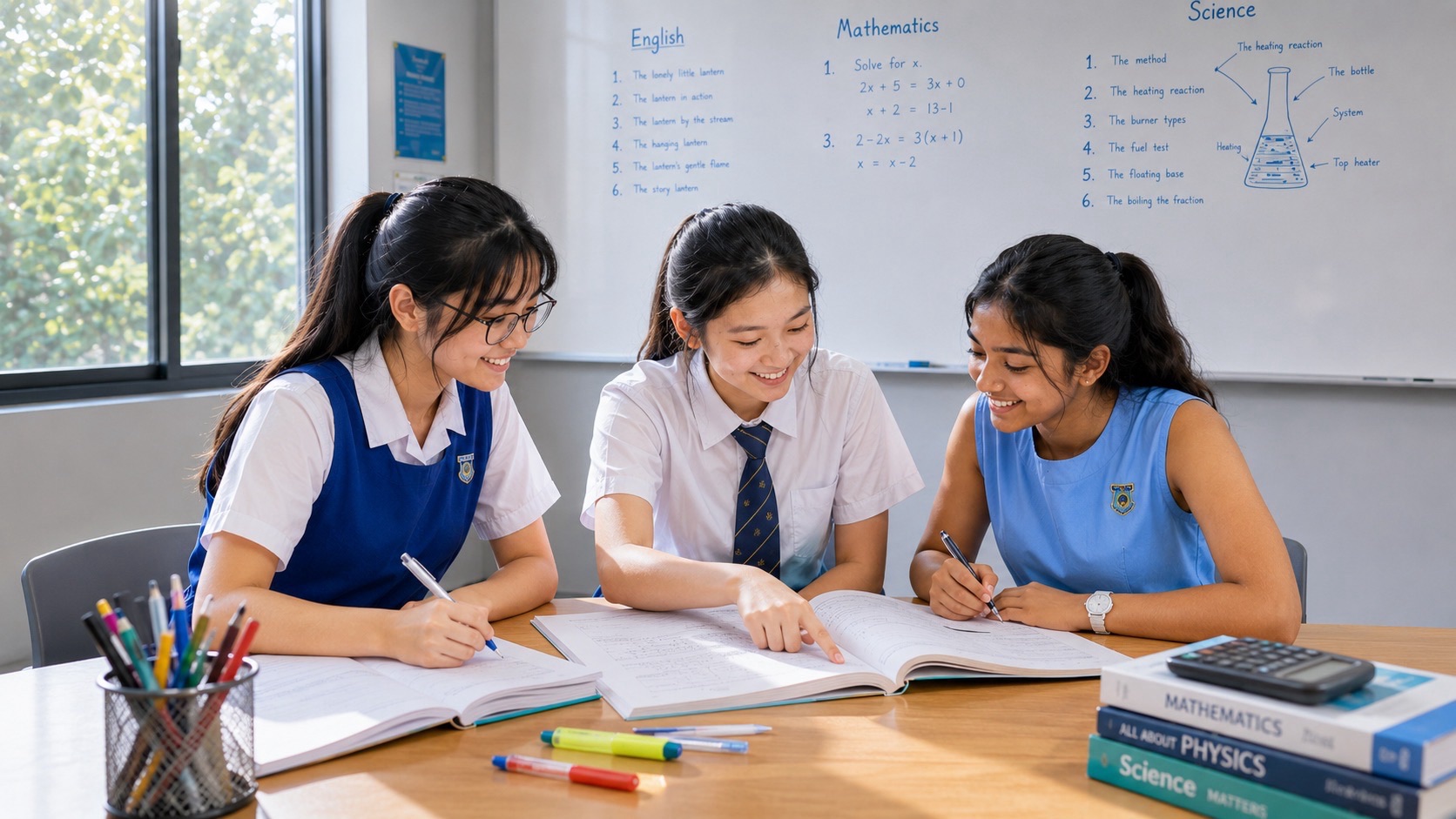
A student can leave Primary school with strong Mathematics results and still feel unexpectedly weak in Secondary 1.
The child has not suddenly become less capable. Often, the language of Mathematics has changed faster than the learner’s internal representations have adapted.
Primary Mathematics relies heavily on numerical relationships, models and concrete quantities. Secondary Mathematics asks students to work more comfortably with symbols, negative values, algebraic expressions, equations and graphs.
The first job is therefore to diagnose whether the difficulty is new content or a representation transition.
Arithmetic Success Does Not Guarantee Algebraic Fluency
A student may be fast and accurate with numbers while still feeling uncertain when letters stand for quantities.
In arithmetic, 7 + 5 asks for a result. In algebra, an expression such as 3x + 5 asks the learner to accept a structure that may not yet have a numerical answer.
That shift is conceptual, not cosmetic.
The Common Failure: Memorising Transformation Rules
Students often survive early algebra by learning verbal shortcuts: “move it across and change the sign”, “bring this term over”, “cancel this”.
These shortcuts can produce correct answers while hiding weak understanding of equivalence.
When later questions become less familiar, the student has no stable structure to reason from.
Look for the First Algebraic Breakdown
- Negative numbers are still unstable.
- Fractions create difficulty when variables appear.
- The student cannot explain what an algebraic expression represents.
- Equations are solved by memorised moves rather than balance or equivalence.
- Graphs are treated as pictures rather than relationships.
- The learner freezes when a question changes form even though the mathematics is similar.
These clues show whether the problem sits in arithmetic fluency, symbolic language or method selection.
Strong Primary Students Can Be More Surprised by the Transition
A learner who was accustomed to being fast may interpret early hesitation as failure.
Parents and tutors should normalise the need to slow down while a new mathematical language is being built. Speed can return after the structure becomes reliable.
Use Multiple Representations
Algebra becomes stronger when the learner can connect symbols to words, diagrams, tables and graphs.
If the student can explain the same relationship in several forms, the symbol is less likely to become an arbitrary rule.
Three-Student Tutorials Can Expose Different Transition Problems
One student may understand equivalence but make sign errors. Another may execute perfectly but not understand what the equation means. A third may understand both but struggle to choose a method independently.
These students can share one central problem while receiving different next prompts.
Do Not Overreact With More Worksheets
If the student is practising the wrong representation repeatedly, volume can automate fragility.
Repair the first wrong relationship, then use a small number of varied questions to test whether the repair transfers.
What Progress Looks Like
- The student explains why an algebraic transformation is valid.
- Negative numbers and fractions remain stable inside algebra.
- Symbols connect to quantities and relationships.
- Graphs and equations are increasingly linked.
- Unfamiliar forms cause less hesitation.
- Tutor prompts reduce.
The Better Parent Question
Instead of asking, “Why has my strong Primary student suddenly become weak at Mathematics?”, ask: Which part of the shift from numerical calculation to symbolic structure has not yet become fluent?
The transition is repairable when the new language is taught as mathematics rather than as a collection of rules.
Current route: This legacy Bukit Timah Sec 1 URL now owns the algebra-transition diagnosis rather than a current location programme claim. For current Mathematics navigation, use the Mathematics Article Directory and Tuition Programmes Directory.