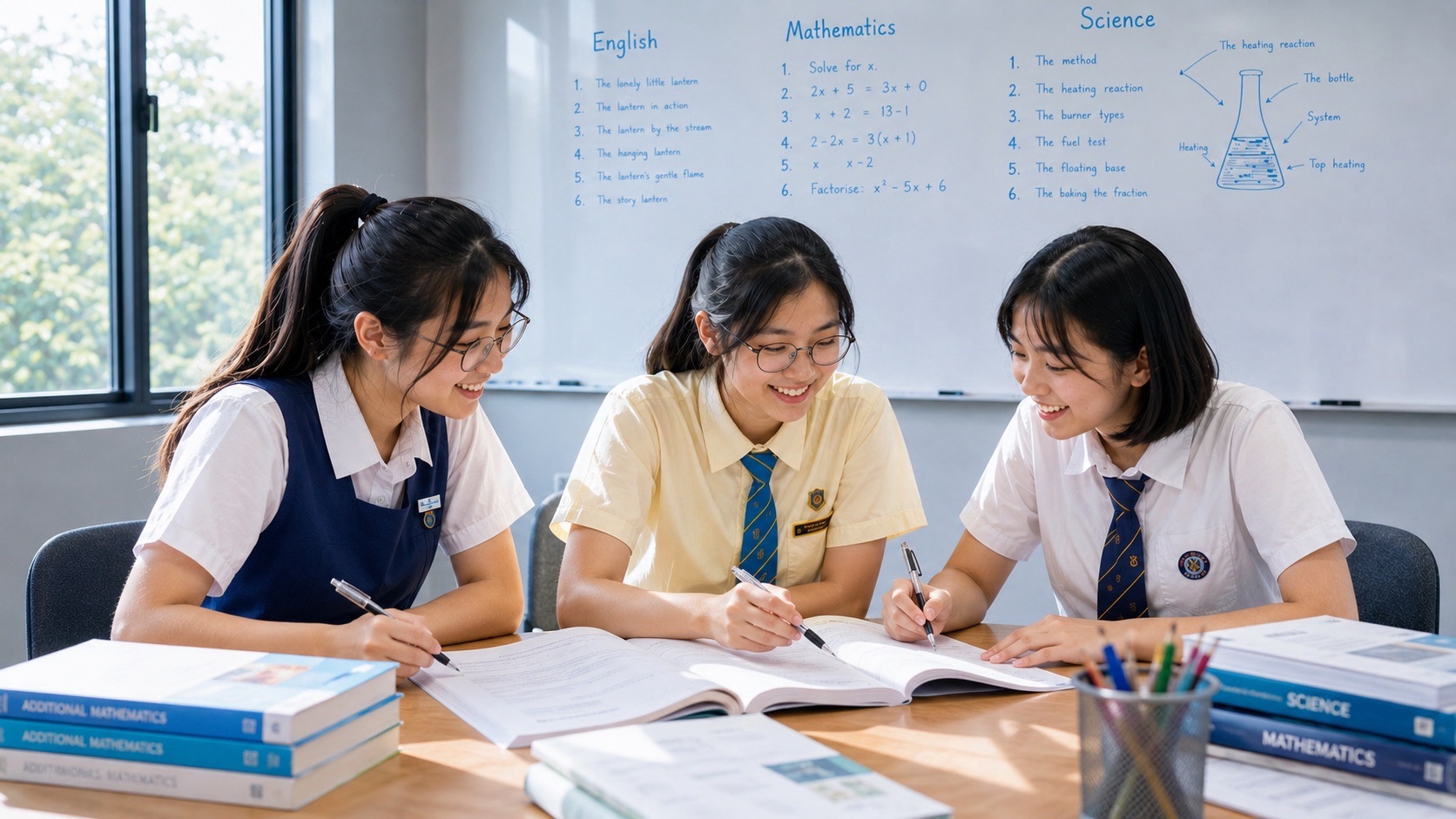
Model compositions are useful because they make good writing visible.
A student can see how an opening creates pressure, how a paragraph controls one scene, how dialogue changes the direction of an event, and how an ending resolves the central consequence.
But model compositions create a risk precisely because they are polished.
A learner may begin copying the visible surface—phrases, plot turns, character reactions and paragraph shapes—without understanding the decisions that made the writing work.
The stronger question for creative writing enrichment is therefore not whether models should be used. It is whether models are helping the student learn writing architecture or replacing the student’s own architecture.
A Model Should Be Studied, Not Worshipped
The useful part of a model composition is not that it shows “the correct story”.
It provides evidence of choices.
- Why did the writer begin here rather than earlier?
- Which details were left out?
- What job does each paragraph perform?
- Where does the main change occur?
- Why is one line of dialogue included while another conversation is summarised?
- What consequence gives the ending meaning?
When students analyse these decisions, a model becomes a craft laboratory rather than a template.
Independent Architecture Begins Before the First Sentence
A strong student should increasingly decide what the story is structurally before writing decorative language.
What is the central problem? What changes? Which event causes the next? Where should the story slow down? What can be omitted because it does not change the outcome?
This architecture determines whether the composition has direction.
Beautiful sentences cannot rescue a story that has no causal spine.
The Common Failure: Borrowed Plot, Borrowed Voice
Students who consume many model compositions can become skilled at producing stories that sound competent but feel interchangeable.
The same accident, apology, lesson and reflective ending reappear under different prompts. Vocabulary may be polished, but the writer is selecting from stored stories rather than building from the actual task.
This creates prompt fragility. When the examination prompt does not fit the stored plot, the learner either forces the story onto the prompt or becomes stuck.
Use Models After the Student Has Made a First Decision
One way to reduce imitation is to delay the model.
Let the student first interpret the prompt, choose a central change and sketch the architecture independently.
Then compare the learner’s plan with a model and ask what the model does differently.
This preserves ownership because the student already has a position to compare rather than an empty page waiting to absorb the model.
Compare Models Rather Than Presenting One Ideal
Two good compositions can answer the same prompt differently.
One may begin close to the central event. Another may build tension more slowly. One may use dialogue heavily; another may rely on interior thought and selective description.
Comparing several valid solutions teaches students that writing quality comes from controlled choices, not imitation of one approved script.
Three-Student Tutorials Make Architectural Choice Visible
In a three-student creative-writing tutorial, all three learners can work from the same prompt and produce different story maps.
The tutor can compare which plan has the clearest causal movement, which includes unnecessary scenes and which resolves the prompt most naturally.
The students see that difference does not automatically mean one person is wrong. The question is whether each choice serves the story.
Model Language Should Be Deconstructed
If a model contains an effective sentence, students can examine why it works.
Is the sentence short because the moment is urgent? Is a concrete verb doing more work than several adjectives? Does the image reveal character or merely decorate the paragraph?
The aim is not to add the sentence to a phrase bank. It is to extract a transferable principle.
Revision Is Where Architecture Becomes Ownership
Students often think revision means replacing weak words with better words.
Architectural revision asks larger questions:
- Does this scene change anything?
- Should these two paragraphs become one?
- Is the turning point too late?
- Does the ending follow from the character’s choices?
- Is the most important moment receiving enough space?
A student who can revise structure is becoming an independent writer rather than a producer of first drafts.
When Model Compositions Are Especially Useful
- The student has never seen how a particular writing move works.
- The learner needs a concrete example of paragraph function.
- The student is comparing two different structural solutions.
- The tutor wants to analyse revision choices.
- The model is used to extract principles rather than phrases.
When Models Are Becoming a Problem
- The student asks for the model before attempting the prompt.
- Stories repeatedly reuse the same plot.
- Memorised phrases appear regardless of context.
- The learner cannot explain why a borrowed technique works.
- Writing quality drops sharply when no model is provided.
- The student becomes afraid of producing an imperfect original idea.
What Progress Looks Like
- The student interprets prompts before searching memory for a story.
- Plans contain a clear causal spine.
- Paragraphs have distinct jobs.
- Scenes are selected rather than accumulated.
- Language choices serve meaning rather than decoration.
- Revision changes structure as well as wording.
- The learner can write an unfamiliar prompt without seeing a model first.
The Better Parent Question
Instead of asking, “Does my child need more model compositions?”, ask: Is the model teaching a transferable writing decision, or is it becoming a substitute for my child making that decision independently?
Good models reveal craft. Strong tuition eventually makes the model less necessary.
Current route: This legacy Bishan creative-writing URL now owns the model-vs-independent-architecture decision rather than a current branch-location claim. For current programme ownership, continue to Primary Creative Writing Tuition and the Tuition Programmes Directory.