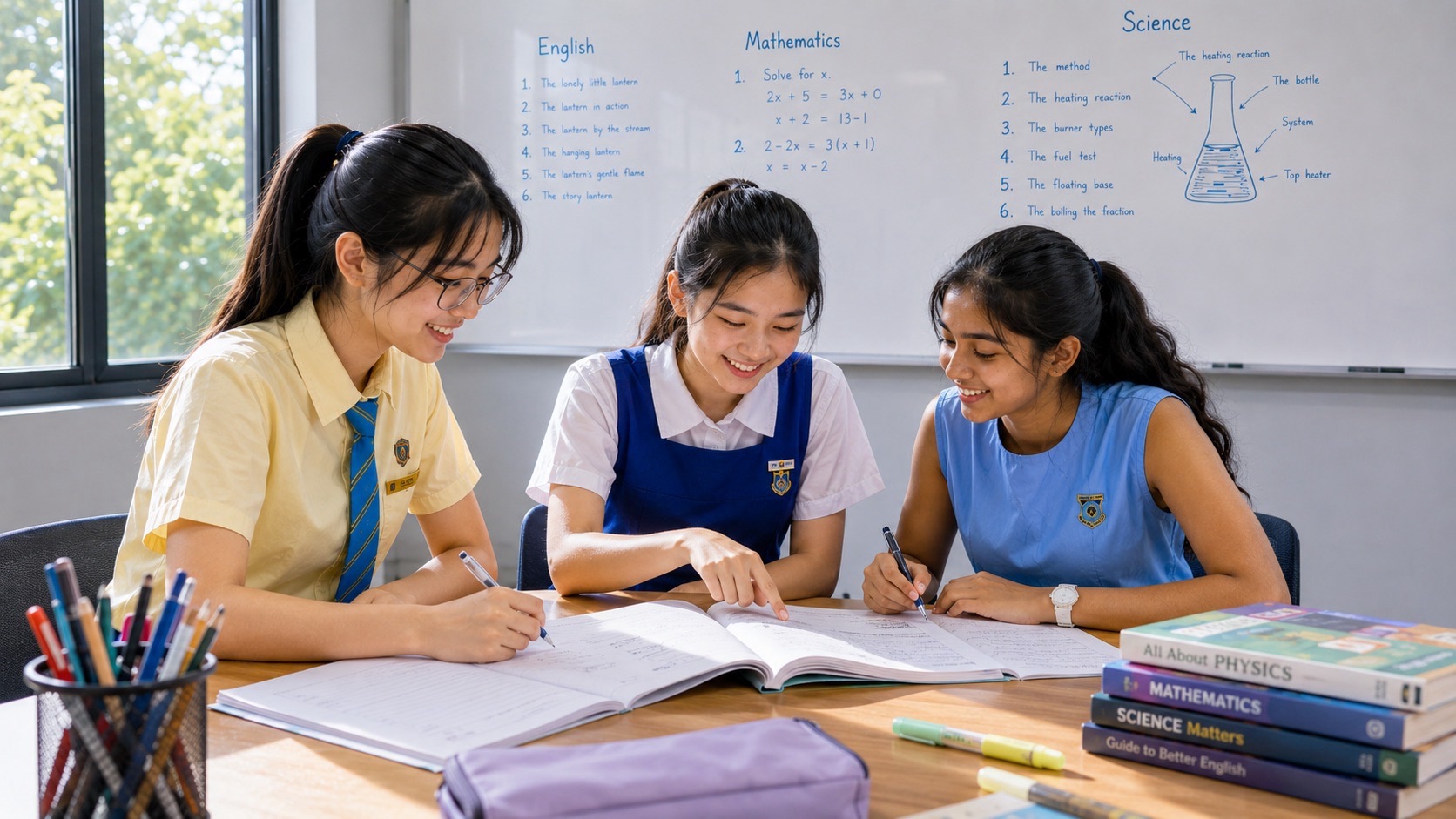
A small group becomes educationally valuable when three students can work on the same English task without being treated as if they have the same problem. The shared text creates common ground; the repair should still follow the learner state.
This 2017 Parkway Parade locality page now has one precise job: explain how one shared English task can branch into different next steps without turning a small group into three simultaneous private lessons.
Same wrong answer, different cause
Suppose all three students miss the same comprehension question. One may not know a word. One may understand every word but misread the pronoun reference. One may understand the passage and still give an answer that is too broad.
If the tutor gives all three the same correction, two students receive teaching for a problem they do not have.
Shared task, separate diagnosis
- Everyone attempts independently.
- The tutor inspects the first failure, not just the final answer.
- Students are grouped briefly by mechanism, not by score.
- Each learner receives the smallest useful intervention.
- The class returns to a shared comparison or transfer task.
The group stays coherent because students repeatedly leave and return to common work.
A reading example
One student struggles to identify the antecedent of “they”. Another identifies it but cannot infer motive. A third infers accurately but writes a vague response.
- Student A needs reference-chain repair.
- Student B needs evidence-to-inference work.
- Student C needs answer precision.
One passage has generated three different lessons.
A writing example
Three students may respond to the same composition prompt. One has weak relevance, one has strong ideas but poor sentence control, and one writes fluently but gives the turning point too little space.
The shared prompt makes comparison possible. The individual repair keeps feedback precise.
Why this is different from individual tuition
Individual tuition maximises one-to-one adaptation. A good small group adds another asset: contrast. Students see alternative interpretations, sentence choices, planning routes and errors that they would not produce themselves.
The group earns its place when those contrasts improve each learner’s own decisions.
The tutor needs a routing discipline
Without discipline, differentiated teaching can fragment the lesson. A useful routine is:
- common input;
- independent first attempt;
- brief branch;
- targeted repair;
- common return.
The return matters. Students should reconnect through explanation, comparison or a fresh task so the class remains a learning community.
Do not differentiate by giving “the weak student easier work” forever
Useful differentiation changes the support, representation or next step while preserving a path back toward the common capability. Permanent simplification can trap a learner in a lower-demand route.
The goal is to remove the obstacle, then reconnect the student to the shared standard.
Three students can create useful peer roles
- one explains an interpretation;
- one identifies the evidence;
- one tests whether the wording overstates the evidence.
Roles can rotate so every learner practises explanation, evidence and evaluation.
When branching has gone too far
If three students require entirely unrelated material for most of the lesson, the group may no longer be coherent. A small group works best when learners share enough of the same instructional problem for comparison and common return to remain useful.
What progress looks like
- feedback increasingly names mechanisms rather than grades;
- students can explain why their correction differs from a classmate’s;
- shared tasks generate useful comparison without forced uniformity;
- temporary support branches become shorter over time;
- students return to common work with greater independence.
Current routes
For current English resources, use the English Article Directory. For current programme information, use the Tuition Programmes Directory.
The point of a three-student class is not to make three learners identical. It is to let them share enough work to learn from one another while still receiving the repair their own reasoning requires.