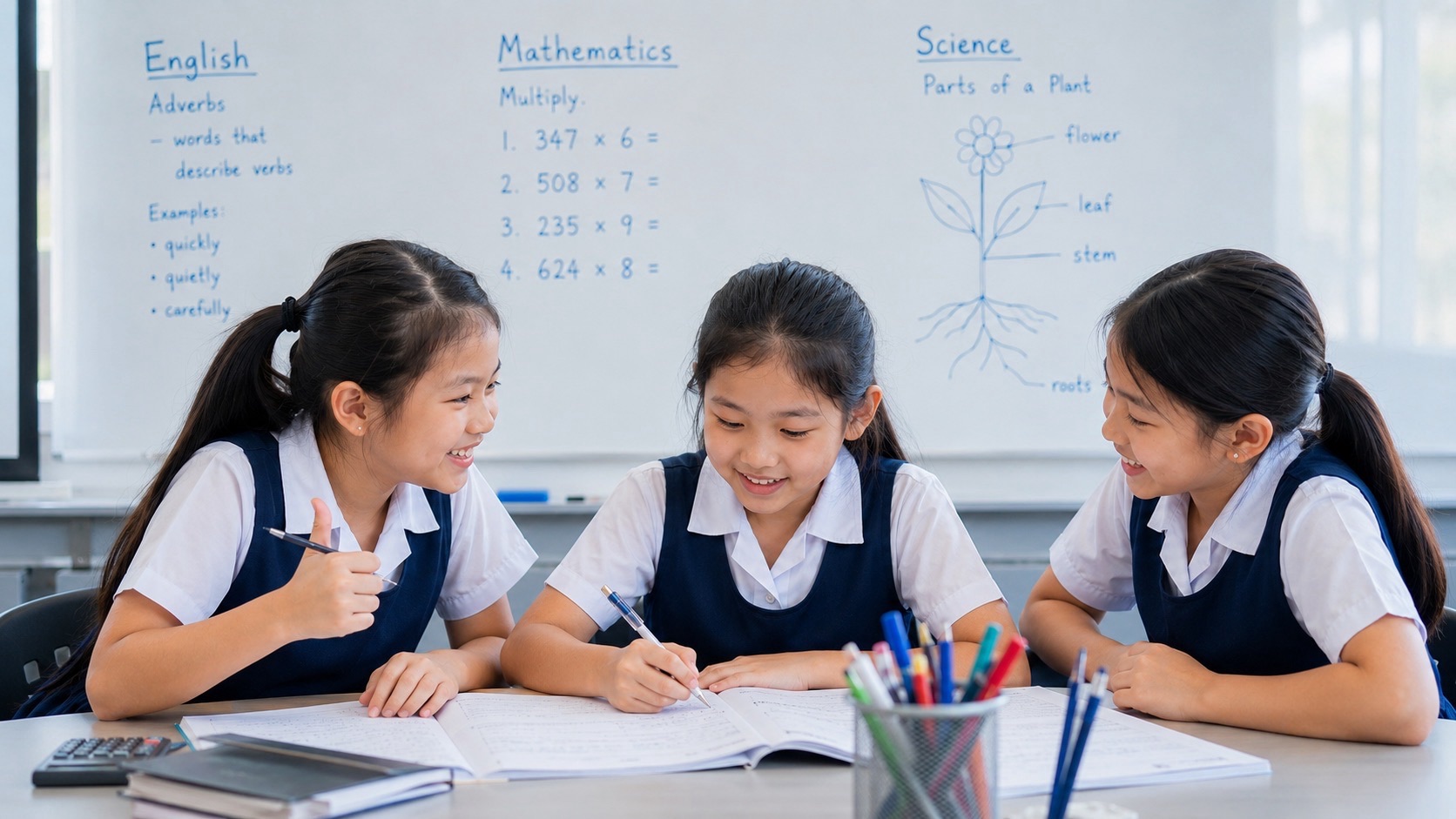
Bishan Primary Mathematics tuition should help a child understand why a method works, not simply memorise which button to press next.
Primary Mathematics is where many later learning habits are formed. If a child learns to guess, imitate a model answer and move on, Secondary Mathematics becomes harder. If a child learns to identify what a question is asking, choose a method, show complete working and check whether an answer makes sense, later Mathematics becomes much more manageable.
This page is for families searching from Bishan. It is not a claim that eduKate currently operates a Bishan branch. Current class locations and schedules are confirmed through the eduKate Singapore Contact page.
What we teach from Primary 1 to Primary 6
Primary Mathematics develops progressively. Early number sense, place value, the four operations and simple problem-solving become the base for fractions, decimals, ratio, percentage, geometry, measurement and multi-step word problems.
We work from the child’s current school level and current syllabus requirements, but we do not assume that the problem always belongs to the current chapter. A Primary 5 student struggling with percentage may actually have an older fractions problem. A Primary 6 student losing marks in problem sums may understand the arithmetic but fail to translate language into a mathematical model.
Diagnosis before more worksheets
When a student brings in weak work, we first ask what kind of error it is:
- Knowledge: the student does not know the concept.
- Representation: the student knows the concept but cannot turn the words into Mathematics.
- Procedure: the student chooses the right method but executes it unreliably.
- Attention: the student understands the work but repeatedly loses marks through avoidable mistakes.
- Transfer: the student can solve a familiar example but not a variation.
Each problem needs a different response. More practice helps only when it is the right practice.
Problem sums without fear
Longer Primary Mathematics questions often look complicated because the information is wrapped in language. We teach students to slow the question down: identify the quantities, find the relationship, decide what is unknown and choose a suitable representation.
That may involve a model, equation, table, diagram or carefully organised working. The tool matters less than whether the student can explain why it represents the problem correctly.
PSLE preparation
PSLE preparation should not begin with panic. The strongest preparation usually comes from three layers:
- repair missing foundations;
- build reliable topic-level methods; and
- practise mixed papers so the student must decide which method to use.
As the examination approaches, we also work on pacing, checking and deciding when to move on from a difficult question.
Small-group learning
In a small group, students can learn from the different ways classmates think while still receiving individual correction. The tutor should know who is rushing, who is hesitant, who is relying on memory without understanding, and who needs harder questions.
What progress looks like
- more complete working;
- fewer repeated errors;
- greater confidence in word problems;
- better explanation of methods;
- stronger recall of older topics; and
- less dependence on hints.
We do not use a fixed score promise. The useful goal is a student who can carry more of the Mathematics independently.
Current Bishan enquiries
This page has been completely rebuilt for 2026. The former The Sail/Marina Bay branch claim, old staffing claims, old telephone number and all historical photographs have been removed.
For current Primary Mathematics class details, use the eduKate Singapore Contact page.