When a Mathematics answer is wrong, the visible error often appears on the last line.
The real error may have happened much earlier.
A student may misread a condition, overlook a unit, translate the problem into the wrong representation, choose an unsuitable method or begin with an assumption that quietly distorts every later calculation.
This is why strong Maths tuition in Punggol should not treat every wrong answer as a calculation problem. The tutor needs to identify the first incorrect mathematical move.
The Calculation Can Be Perfect and the Solution Still Wrong
Suppose a student reads a word problem incorrectly but performs every arithmetic step flawlessly.
The final answer is still wrong because the calculation was applied to the wrong model.
This is an important distinction for parents because “practise your arithmetic” will not fix a student whose arithmetic is already adequate.
We separate the solution into stages:
- read the situation accurately;
- identify the relevant quantities and relationships;
- represent the problem in a usable form;
- select a valid method;
- execute the method accurately; and
- check the result against the original conditions.
Any one of these can fail.
Question Reading Is Part of Mathematics
Mathematics is not language-free.
Words indicate relationships: more than, less than, remaining, per, percentage of, in the ratio, difference, average, at least, no more than. Diagrams and tables also carry information that the student must interpret before calculating.
A strong student does not merely scan for keywords and trigger an operation. The student reconstructs what is happening.
That is why a tutor should sometimes ask the student to explain the problem in ordinary language before touching the calculator or writing an equation.
Representation Is Often the Hidden Middle Step
Many students know the relevant Mathematics but do not know how to represent the problem.
A diagram may reveal the relationship. A table may organise changing quantities. A bar model may clarify a Primary word problem. An equation may compress a Secondary relationship. A graph may show behaviour that is difficult to see from a formula alone.
Representation is not decoration. It is a thinking tool.
Students who skip this stage often try to calculate directly from the wording. That can work on familiar questions and fail badly when the structure is disguised.
Method Selection Matters More as Students Grow Older
During topic practice, the method is often obvious because the heading tells the student what chapter is being tested.
Examinations mix topics. The student must decide what mathematics belongs.
This is why a child can look strong in chapter worksheets and still struggle in tests. The difficulty is no longer executing the method; it is recognising the method inside an unfamiliar presentation.
Good tuition therefore includes mixed problems where the student must justify the route before using it.
Working Structure Is a Mathematical Skill
Messy working is sometimes dismissed as a presentation issue. It can become a reasoning issue.
If quantities are not labelled, units disappear, intermediate values are scattered and equations are not aligned, the student loses the ability to inspect the route.
Clear working externalises memory. It lets the student see what has already been established and where an error may have entered.
This becomes increasingly important in Secondary Mathematics and Additional Mathematics, where a solution may contain several transformations.
“Careless” Often Describes Several Different Errors
Parents frequently tell us a child is careless. The label is understandable but too broad for teaching.
- Was the wrong number copied?
- Was a sign lost?
- Did the student answer a different quantity from the one requested?
- Was an assumption made without checking a condition?
- Did time pressure cause the student to skip a verification step?
- Was the working so compressed that the student could not detect the mistake?
Each one suggests a different repair.
Primary and Secondary Mathematics Fail Differently
At Primary level, the first weak link may involve number sense, problem-language interpretation, units or representation.
At Secondary level, symbolic structure becomes more important. Negative numbers, algebra, equations, functions and graphs introduce new ways to represent relationships.
The same diagnostic principle still holds: locate the earliest incorrect move before prescribing more volume.
The 2026 PSLE Mathematics Framework Makes This Explicit
The 2026 PSLE Mathematics syllabus assesses not only facts and procedures, but also interpretation, application and mathematical reasoning, including selecting appropriate strategies. This is why a student may know the arithmetic and still need support with problem reading and method selection.
Parents can refer directly to the SEAB 2026 PSLE Mathematics syllabus.
What a Three-Student Tutorial Reveals
Three students can produce the same wrong answer for three different reasons.
One misreads the problem. One draws the wrong representation. One chooses the correct route but makes an execution error.
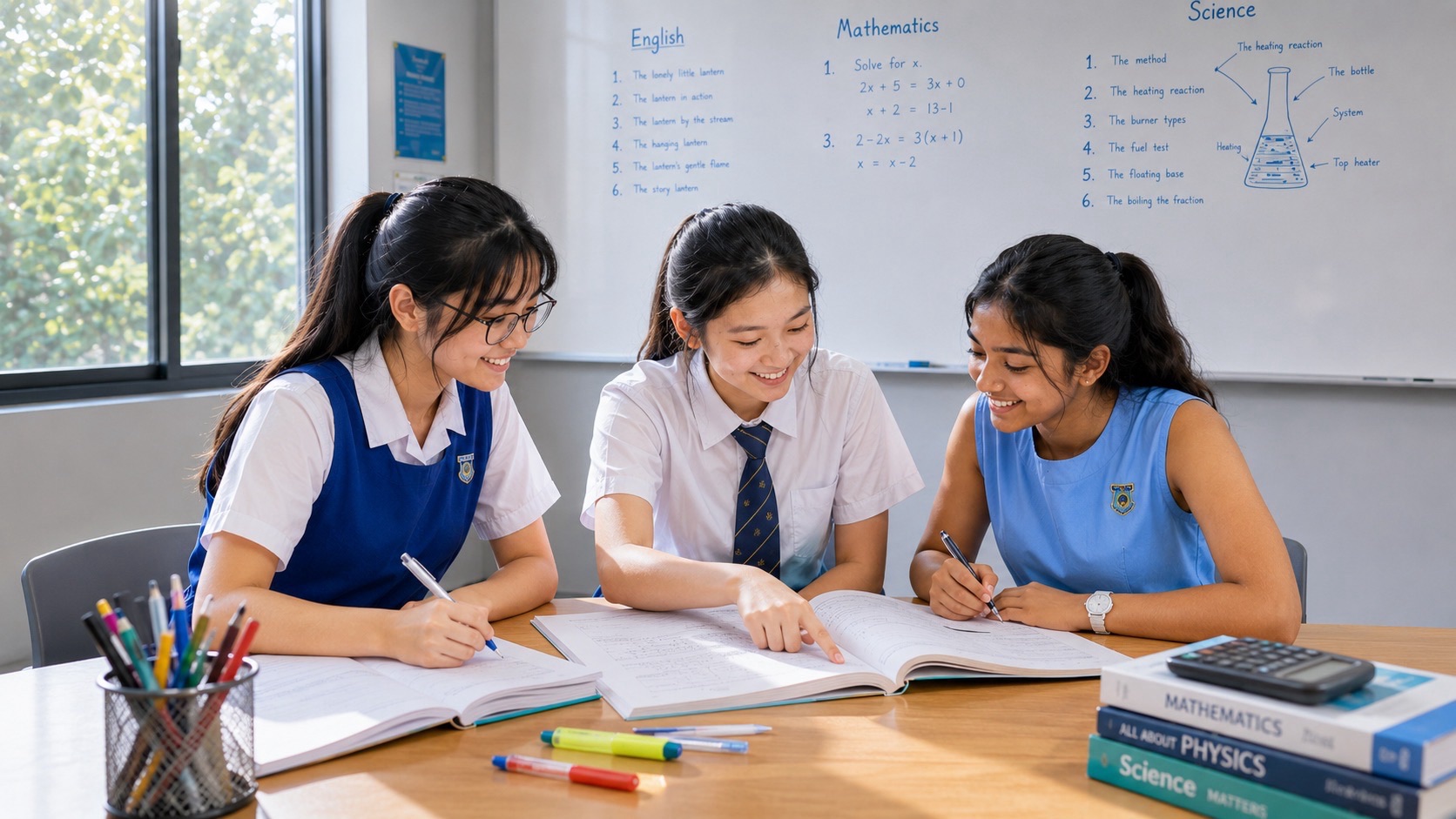
A small group gives the tutor enough time to inspect the route rather than only mark the result.
Peer comparison is also useful. A student can see how a classmate organised the same information differently and ask whether that representation made the structure easier to recognise.
Teach the Student to Audit the Solution
Checking should become more specific than “look through your work”.
- Did I answer the quantity requested?
- Are the units consistent?
- Does the sign make sense?
- Is the answer reasonable in size?
- Can I substitute the result back?
- Does the graph or diagram agree with the numerical answer?
Different problems support different checks. The goal is to build verification into the mathematical route rather than reserve it for the final thirty seconds.
What Progress Looks Like
- The student can explain the problem before calculating.
- Representations become more deliberate and less random.
- The student can justify method choice.
- Working becomes easier to inspect.
- “Careless” errors are broken into identifiable patterns.
- Mixed-topic questions create less hesitation.
- The student checks answers against the original conditions.
When More Practice Is the Right Answer
Once the route is correct, practice matters greatly.
Students need retrieval, fluency and exposure to variation. But practice becomes far more valuable when the tutor knows what is being stabilised.
Ten well-chosen questions around one diagnosed weakness can teach more than fifty random questions that reproduce the same misunderstanding.
The Better Parent Question
Instead of asking only, “How many questions will my child practise?”, ask: At which stage does the Mathematics first become wrong—reading, representation, method selection, execution or checking?
That question turns a wrong answer into a useful diagnostic.
Canonical route: For the current Punggol Mathematics programme, continue to Math Tuition Punggol. This legacy URL now owns the narrower job of locating errors that begin before calculation.
Deep routes: continue through the Mathematics Learning Library to trace errors back to the earliest broken dependency, and the Learning and Study Skills Library for correction and next-attempt routines. The Mathematics Article Directory opens the wider collection.