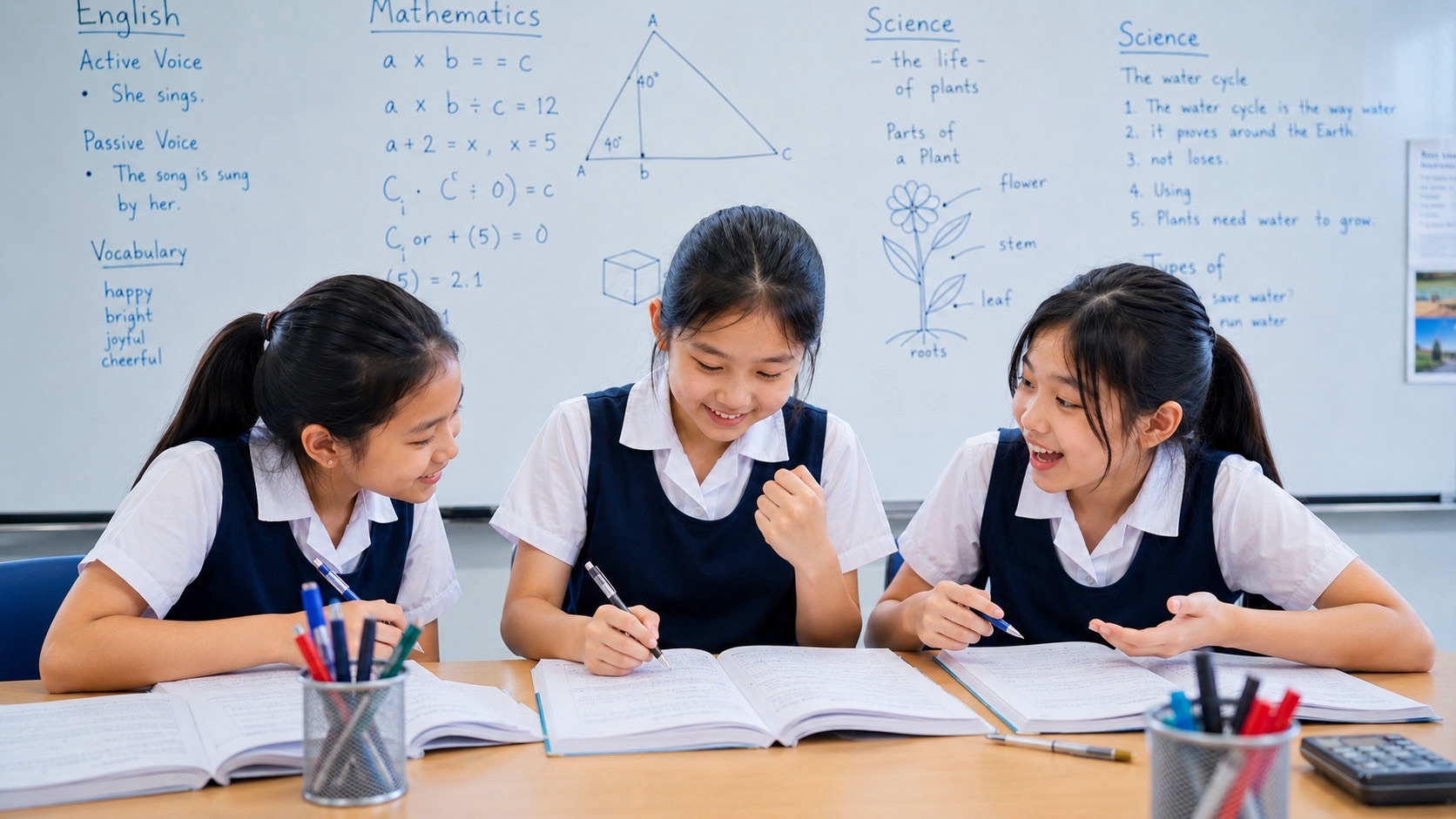
Punggol Primary English tuition should help a child become more capable with language across reading, writing, comprehension and communication.
English develops over time. A student cannot build strong composition writing without enough vocabulary and sentence control. A student cannot answer comprehension well without reading accurately. Grammar becomes more useful when it supports real communication rather than remaining a list of rules.
Our aim is to identify where the language system is weak and strengthen that part without losing sight of the whole.
Who this page is for
This page is for Punggol families with Primary 1–6 students who need help with one or more of the following:
- reading fluency or reading confidence;
- grammar and sentence structure;
- vocabulary growth;
- comprehension accuracy;
- composition planning and writing;
- oral expression; or
- PSLE English preparation.
Primary 1–2: build a comfortable language base
For younger Primary students, we focus on accurate reading, sentence formation, basic grammar, useful vocabulary and the habit of expressing a complete idea.
Confidence matters at this stage because students who become anxious about English may avoid reading and writing, which slows later development.
Primary 3–4: connect reading and writing
As passages become longer, students need stronger comprehension strategies. They begin to track sequence, motive, cause and effect, pronoun reference and implied meaning.
Writing also becomes more organised. Students learn that a paragraph should have a purpose and that detail is useful only when it supports the scene or idea.
Primary 5–6: precision and PSLE readiness
Upper Primary students need to combine several skills under time pressure. They must read carefully, retrieve meaning accurately, organise composition ideas efficiently and control grammar and vocabulary well enough to express what they mean.
Revision therefore alternates between targeted skill repair and mixed examination practice.
Comprehension
We teach students to identify what the text states directly, what must be inferred and what evidence supports the answer.
Students learn to answer the exact question rather than copy a large part of the passage and hope the answer is hidden inside it.
Vocabulary and grammar
Vocabulary grows through repeated meaningful use. Grammar becomes reliable through application in sentences, comprehension and writing.
We therefore connect these skills rather than treating them as isolated lists.
Composition
Good composition writing needs a coherent situation, believable characters, clear sequence, controlled pacing and an ending that resolves the central problem.
We teach planning, paragraph control, useful description, dialogue, vocabulary choice and revision. Difficult words are not rewarded for being difficult; they are useful when they express the idea accurately.
Oral communication
Students should be able to respond clearly, extend an idea and support an opinion with relevant detail. We work on structure, clarity and confidence rather than rehearsed performance alone.
Small-group learning
A useful small group allows discussion and peer learning while still giving the tutor enough visibility to identify each student’s weak points. The tutor should know who needs more reading, who needs sentence repair and who is ready for more demanding work.
What progress looks like
- clearer sentences;
- more accurate comprehension answers;
- better vocabulary use;
- more organised compositions;
- fewer repeated grammar errors;
- greater reading stamina; and
- more independent performance under examination conditions.
We do not promise a fixed grade. We focus on building language skills that become increasingly reliable and transferable.
Current Punggol Primary English enquiries
This page has been fully rebuilt for 2026. The old 2015 “new syllabus” wording, extreme examination-preparation language, old class claims, old telephone number and every photograph have been removed.
For current Punggol Primary English class availability and schedules, use the eduKate Singapore Contact page.