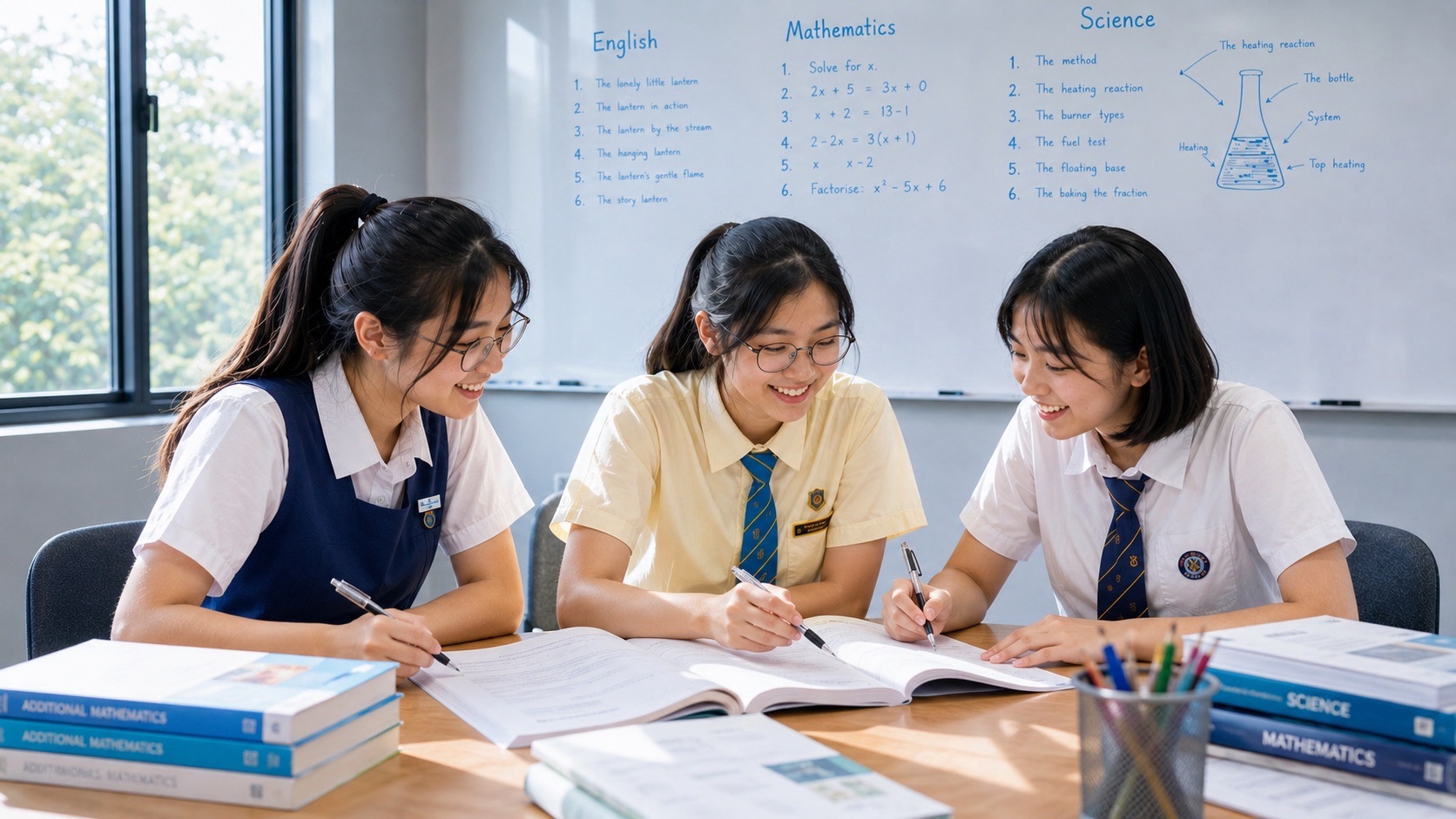
Parents often look at tuition-class photos before they ever speak to a tutor.
That is understandable. A photograph gives immediate information: the room, the number of students visible, how closely the tutor sits to the work, whether students appear to be writing, discussing or listening.
But a photograph is also dangerously easy to overread.
This legacy eduKate Punggol photo page has therefore been rebuilt as a parent evidence guide rather than preserved as a large 2017 gallery. The old images no longer meet the estate’s current image standard. More importantly, the useful question is not “Does the class look good?” It is “What can this image genuinely tell me about the learning environment, and what still needs separate evidence?”
A Photo Can Show the Physical Moment
A classroom photograph can provide some straightforward evidence.
- How many students are visible at that moment?
- Is the tutor physically close enough to inspect work?
- Are students writing, reading, discussing or waiting?
- Does the room appear organised for the stated class format?
- Can the student’s work plausibly be observed in real time?
These are legitimate observations. They are simply limited.
A Photo Cannot Show the Quality of the Explanation
Two tutors can sit beside a student in almost identical photographs and provide completely different teaching.
One may simply give the answer. Another may identify the first incorrect move, ask the student to explain the reasoning, change the representation and then test whether the correction transfers.
The image cannot show that distinction.
Teaching quality exists in the sequence of decisions, questions and feedback between frames.
A Photo Cannot Prove Personalisation
A small group can look personalised because there are few students in the room.
That does not prove that the tutor is actually differentiating the next step.
Three students might all receive the same worksheet, same explanation and same correction. Or the tutor may use one shared task while giving Student A a prerequisite repair, Student B a method-selection question and Student C an extension challenge.
The photograph shows the group size. It does not show the decision architecture.
A Happy Face Is Not a Learning Metric
Positive class culture matters. Students learn better when they feel safe enough to ask questions, make mistakes and attempt difficult work.
But a smiling student does not prove that learning occurred, just as a serious-looking student does not prove the lesson was poor.
Photos capture expressions for a fraction of a second. Parents should avoid converting that instant into a story about confidence, motivation or results.
A Worksheet in a Photo Does Not Prove Rigour
Pages full of difficult-looking questions can make a programme appear academically demanding.
Rigour is not the visual density of the worksheet. It is whether the task is appropriately challenging, whether the student understands the underlying concept, whether errors are diagnosed correctly and whether the learning transfers later.
A simple question used to expose a misconception may be more rigorous than a page of advanced questions completed by imitation.
Before-and-After Photos Are Especially Weak Evidence
Education does not have a reliable visual before-and-after equivalent.
You cannot see durable inference, mathematical reasoning, scientific explanation or independent revision in a portrait. These capabilities must be inferred from work, behaviour over time and performance in changed tasks.
A student may look exactly the same after making a major cognitive gain.
What Stronger Evidence Looks Like
If a photograph creates interest, the next step should be evidence that is closer to the learning process.
- How does the tutor diagnose a weak link?
- What happens after a student gives a wrong answer?
- How are three students with different needs handled?
- What prompts are removed as the student becomes more independent?
- How is progress tested in a new task?
- What observable changes should appear before a grade moves?
These questions move from appearance toward mechanism.
The Most Useful Classroom Image Shows Context, Not a Claim
A good current classroom image can help a parent understand the setting: three students at a table, the tutor close to the work, ordinary learning happening in a real space.
The image should not need an exaggerated caption that claims the photograph proves excellence, confidence or future results.
Context is enough. The article, consultation and student work should carry the educational reasoning.
Why eduKate Removed the Old Gallery From This Page
This page originally contained a large collection of older classroom and travel photographs. That material reflected an earlier version of the site rather than the current evidence standard.
Preserving a historical gallery simply because it already existed would make the page visually busy while doing little to help a parent decide whether tuition is a good fit today.
The stronger use of the URL is to explain how visual evidence should be interpreted.
Current Image Standards Matter
When classroom images are used elsewhere in the current eduKate estate, they should reflect the current small-group environment rather than an outdated operating model.
This matters because images communicate operational claims even when the caption does not. An old six-student classroom image can contradict a current three-student tutorial model simply by being present.
Visual consistency is therefore part of factual consistency.
What Parents Should Notice in a Current Small-Group Photo
If you encounter a current classroom image, use it as one small piece of context.
- Does the visible group size match the stated class model?
- Can the tutor plausibly see individual work?
- Does the setup support discussion and independent work?
- Is the photo clearly educational rather than unrelated lifestyle imagery?
- Is the caption modest about what the image proves?
Then move beyond the image and ask how the teaching actually works.
Do Not Confuse Marketing Resolution With Learning Resolution
A beautiful website can communicate care, taste and organisation. It cannot substitute for learner evidence.
The same is true of classroom photography. A high-resolution image is not high-resolution teaching.
Learning resolution comes from whether the tutor can see the child’s exact weak link, respond appropriately and verify that the repair holds later.
The Better Parent Question
Instead of asking, “Do the tuition photos look impressive?”, ask: What can I verify about the class from the image, and what important claims still require better evidence?
That keeps a photograph in its proper role: useful context, not proof by itself.
Current route: For current subject and level programmes, use the Tuition Programmes Directory. For the current comparison of one-to-one, three-student and larger formats, see Singapore Small-Group Tuition | What 1-to-1, 3-Student and Larger Classes Actually Change.
Deep routes: use the Parent Learning Support Directory for evidence-based class-fit decisions and the Learning and Study Skills Library for observable signs of learning progress. For current programme and locality information, use Singapore Tuition Programmes and Locations.