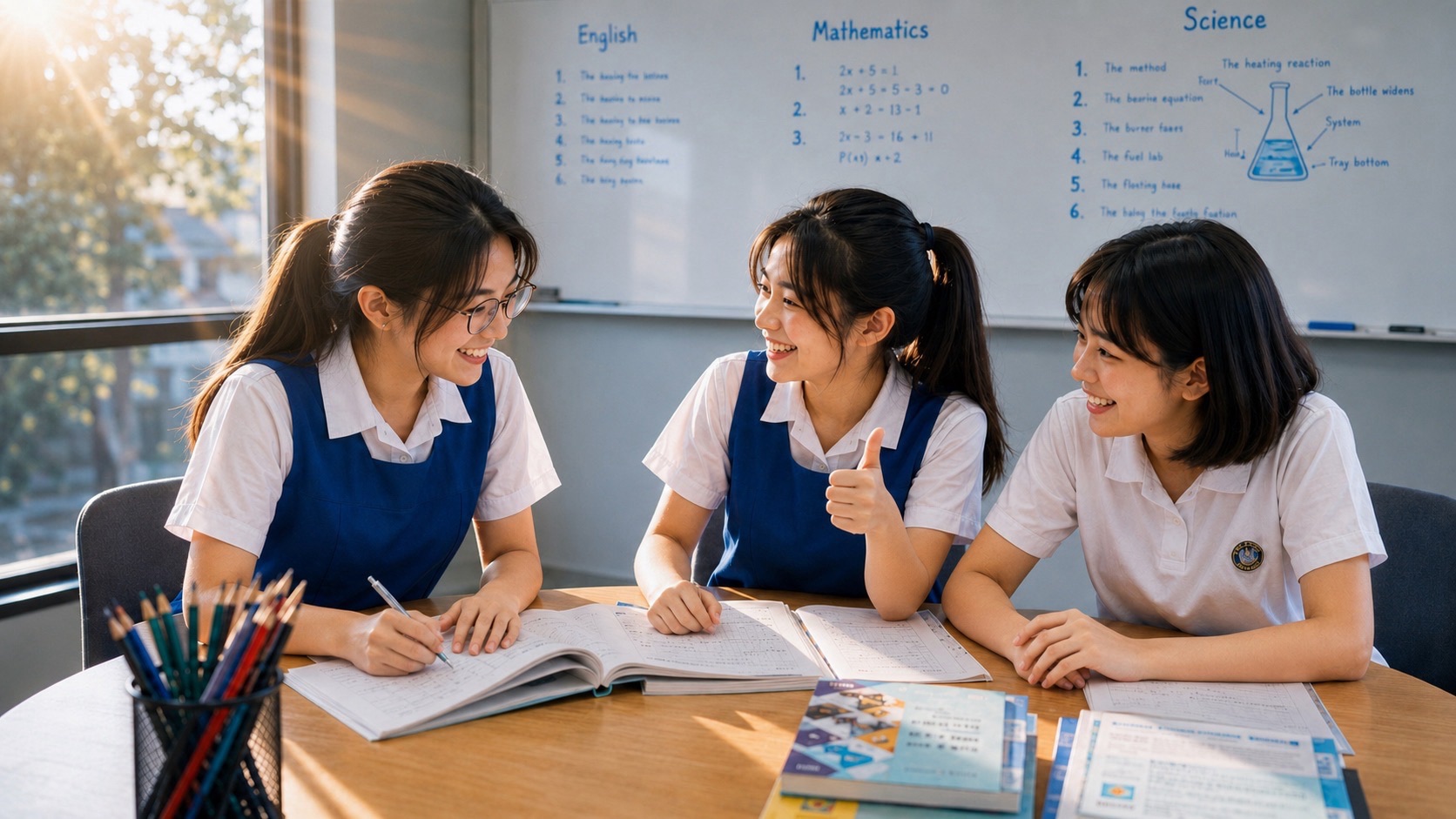
Quick Read: A strong creative-writing lesson does not begin with “write something interesting”. It teaches the student how to move from a prompt to a workable story, from a workable story to a controlled draft, and from a draft to a better second version. The useful sequence is simple: read the task → generate possibilities → choose one causal route → build scenes → draft → inspect → revise → edit.
This page began in 2017 as a short classroom note called Lesson in Creative Writing 190617. Its title and URL are preserved as part of the eduKateSingapore archive. The library edition expands the original lesson into a complete reference chapter for upper-primary and early-secondary writers, parents and teachers who want to understand what actually happens between seeing a composition prompt and producing a finished piece of writing.
The focus keyword for this page is creative writing lesson, supported naturally by composition writing process, how to plan a composition, story planning, draft and revision, vocabulary for composition, show don’t tell, dialogue in composition and creative writing practice. eduKateSingapore keeps this page as a library lesson rather than a broad Creative Writing hub; the wider English-writing route belongs to the federation’s English specialist estate.
The Central Idea: Writing Is a Sequence of Decisions
A blank page feels difficult because it contains too many possibilities. The student may know hundreds of words and still not know which story to tell. Good teaching therefore reduces the number of decisions that must be made at one time. First decide what the task allows. Then decide what changes. Then decide whose experience matters. Then decide the order in which the reader should discover the events. Language becomes much easier to control after the story has a stable skeleton.
This is why “be creative” is incomplete advice. Creativity is not the absence of structure. A pianist improvises inside rhythm and harmony; an architect designs inside gravity, materials and use; a writer creates inside audience, purpose, sequence, causality and language. The student becomes freer when the constraints are understood because the mind no longer has to keep every possible story alive.
A useful composition is not a pile of beautiful sentences. It is a controlled sequence in which each sentence helps the reader understand what changed, why it changed and why it matters.
1. Read the Prompt as a Set of Constraints
Before inventing a story, identify what cannot be ignored. A writing prompt usually gives some combination of topic, pictures, situation, audience, form or required idea. Students often lose relevance because they treat the prompt as decoration: they notice one picture, begin a favourite story and hope the connection will be accepted later. A better approach is to turn the prompt into a short constraint sheet.
| Question | What the writer should decide |
|---|---|
| What is the topic? | Write the topic in one plain sentence. Do not replace it with a vaguely related theme. |
| What material is compulsory? | Identify any picture, phrase, situation or form that must clearly matter in the story. |
| What can vary? | Character, setting, sequence, motive, consequences and point of view may often be chosen freely. |
| What would make the response irrelevant? | List the tempting story routes that mention the prompt but do not actually develop it. |
| What must the reader understand by the end? | State the central change: what was different after the event? |
A student can do this in less than a minute once the habit is established. The purpose is not to create bureaucracy before writing. It is to prevent ten minutes of fluent but unusable prose.
2. Generate Several Story Possibilities Before Choosing One
The first idea is often the most obvious idea because it is the easiest for the brain to retrieve. That is not automatically bad, but it means many students in the same class may produce nearly identical plots. A short possibility stage improves originality without requiring extravagant plots.
- Write three possible situations in one line each.
- For each situation, identify the main character’s immediate goal.
- Add one obstacle that makes the goal difficult.
- Add one consequence if the character makes the wrong choice.
- Choose the route that gives the clearest cause-and-effect chain, not necessarily the most dramatic route.
For a prompt about an unexpected discovery, for example, one student may find a wallet, another may discover a damaged bird nest, and another may find an old box of letters while clearing a storeroom. The surface events differ, but the writing problem is the same: a discovery changes what the character knows, and that new knowledge forces a decision.
The strongest school composition is often built from an ordinary event with a precise consequence. A missed bus can expose responsibility. A forgotten key can change a family’s evening. A broken model can force a student to choose between concealment and honesty. Small events become meaningful when decisions have consequences.
3. Choose a Causal Route, Not Just a Sequence of Events
Many weak stories are chronological but not causal. “I woke up. I ate breakfast. I went downstairs. I met my friend. We walked to the park. Something happened.” The events are in order, yet one event does not create the next. The reader is waiting for the story to begin.
Causality gives narrative energy. Try to connect scenes with “because”, “therefore”, “but” or “so”. The character misses the bus because she returns for a forgotten file. She takes an unfamiliar route therefore. She notices a younger child alone at the interchange, but stopping to help may make her even later. She chooses to help, so the original problem becomes a moral decision rather than merely a transport delay.
| Weak event chain | Stronger causal chain |
|---|---|
| A happened. Then B happened. Then C happened. | A created B; B forced a decision; the decision produced C. |
| Many scenes have equal importance. | One or two turning points receive most of the narrative space. |
| The climax appears suddenly. | Earlier choices make the climax feel earned. |
| The ending simply stops. | The ending shows the consequence of the decisive choice. |
4. Build the Story Around a Change of State
A story needs movement that is more than physical movement. Ask what is true at the beginning and what becomes true at the end. The change may be external: a lost item is found, a competition is completed, a misunderstanding is resolved. It may also be internal: a character becomes less certain, more responsible, more forgiving or newly aware of a consequence.
Write the beginning state and ending state before drafting. “At first, Mira believes the damaged display is someone else’s problem. By the end, she accepts responsibility for helping repair it because she realises her earlier joke caused the accident.” That single contrast gives the writer a direction. Every major scene should help move the character from the first state to the second.
5. Give the Character a Goal, an Obstacle and a Reason
Characters become believable when they want something specific. “Ben was nervous” is a description. “Ben wanted to return the borrowed camera before anyone noticed the cracked screen” is a story engine. The goal creates direction; the obstacle creates tension; the reason creates emotional weight.
- Goal: What does the character want right now?
- Obstacle: What prevents an easy success?
- Reason: Why does this matter to the character?
- Choice: What must the character decide rather than merely endure?
- Consequence: What changes because of that decision?
This model also prevents melodrama. A student does not need a robbery, hospital emergency and thunderstorm in the same composition. One clear goal under pressure can generate enough conflict for an effective story.
6. Plan Scenes, Not Paragraph Counts
Students are sometimes taught to produce a fixed number of paragraphs. Paragraphing matters, but the deeper unit is the scene. A scene occurs in a particular place and time, has a local purpose, and changes something. When the purpose, place, time or speaker relationship changes substantially, a new paragraph or scene may be needed.
A useful five-scene plan might be: normal situation, disturbance, escalation, decisive moment, consequence. This is not a mandatory template. It is a thinking aid. Some stories need three substantial scenes; some need six shorter ones. What matters is that the middle of the story is not an empty bridge between an opening and a climax.
7. Start Close Enough to the Trouble
Long school-morning openings consume words without creating narrative pressure. The writer describes the alarm clock, breakfast, weather, uniform and bus ride even though the real story concerns an argument at recess. A more efficient opening begins near the moment when the ordinary situation becomes unstable.
Instead of announcing that it was “a bright and sunny day”, establish a useful detail: the untouched presentation model on the table, the message that has not been answered, the teacher counting down the minutes, the rain beginning just as the class carries equipment outdoors. Setting earns its place when it changes what the character can do.
Three jobs an opening can perform
- Create a question the reader wants answered.
- Establish a pressure, deadline, promise or expectation.
- Place an ordinary detail that will matter later.
An opening does not need to explain the whole background. It needs to make the reader willing to enter the next paragraph.
8. Use Concrete Detail Before Decorative Description
Description is strongest when it helps the reader see, infer or anticipate. A classroom can be “beautiful”, but the word tells little. The half-erased diagram on the board, chairs pushed back after rehearsal and one torn strip of masking tape beneath the display give the reader usable evidence.
Concrete nouns and precise verbs usually carry more meaning than strings of adjectives. “The trolley rattled across the uneven tiles” is more vivid than “the old, noisy, shaky trolley moved slowly.” Precision creates economy. This is the same principle explored across eduKateSingapore’s vocabulary library: learn what a word specifically does before using it for display.
9. Show and Tell Are Both Tools
“Show, don’t tell” is useful when it reminds students to provide evidence, but taken literally it creates bloated writing. Narratives need both summary and scene. Tell the reader what does not deserve many lines; show the moment where judgement, emotion or consequence matters.
| Use summary when… | Use scene when… |
|---|---|
| Time must move quickly. | A decision changes the direction of the story. |
| Routine actions need only context. | The reader must infer emotion from action or dialogue. |
| Background can be compressed. | An important misunderstanding begins or is resolved. |
| Repeated actions do not need replaying. | The climax depends on physical detail or timing. |
A balanced story may summarize a week of preparation in two sentences, then spend three paragraphs on the five minutes when the project fails. Narrative time is elastic. The writer decides where the reader should slow down.
10. Dialogue Must Change Something
Dialogue is not valuable because speech marks look lively. It is valuable when one speaker’s words change another person’s knowledge, intention or emotion. A conversation that merely repeats facts already known to the reader wastes space.
Before keeping a line of dialogue, ask what it accomplishes. Does it reveal a misunderstanding? Does it expose a motive? Does it force a decision? Does it create contrast between what the character says and what the character actually feels? If removing the line changes nothing, the line is probably decorative.
Keep speech believable. Children do not normally deliver perfect paragraphs while frightened or angry. Shorter exchanges can carry more pressure. Surround important speech with physical action so the reader knows who is controlling the scene, avoiding eye contact, hesitating or leaving.
11. Vocabulary Should Increase Precision, Not Difficulty
A large vocabulary gives the writer options, but the best option is not the rarest word. The useful question is: which word makes the scene more exact? “Walked” may be correct. “Trudged” adds effort and fatigue. “Sauntered” adds relaxed confidence. “Crept” adds caution or secrecy. Each word changes the inference.
This is why vocabulary is best learned in semantic neighbourhoods rather than isolated lists. Compare words that are close enough to be confused, then learn the difference in tone, intensity, grammar and collocation. The Vocabulary Article Directory and eduKate Vocabulary Learning System organise that work as a library rather than a bag of impressive phrases.
12. Control Sentence Length for Pace and Clarity
Sentence variety is not a decorative requirement. It helps the writer manage information. Longer sentences can connect observation, explanation and consequence. Short sentences can mark a decision or interruption. The effect comes from contrast, not from making every tense moment consist of fragments.
When revising, underline the grammatical subject of each sentence. If five sentences begin with “I”, the problem is not that the pronoun is forbidden; the problem is that the writer may be reporting actions from the same distance. Change the focus: the door slammed, the queue shifted, someone called a name, the phone vibrated. Variation should come from changing what the sentence is about.
13. Build a Climax From Earlier Pressure
A climax feels strong when the reader understands what is at stake before it arrives. If a story suddenly introduces a dangerous event in the final third, the action may be exciting but structurally weak. Earlier scenes should establish the object, promise, deadline, relationship or fear that gives the climax meaning.
Suppose the story concerns a class exhibition. Early details establish that the display was built by a quiet student who rarely volunteers ideas. A careless joke causes the model to be moved. Later, it is damaged. The climax is not merely “the model broke”; it is the moment the narrator decides whether to admit what happened before the judging begins. The physical accident matters because a social and moral consequence was prepared earlier.
14. End With Consequence, Not a Moral Sticker
A story does not need to finish with “I learnt that honesty is the best policy.” If the events have shown the cost of concealment and the relief or difficulty of admitting the truth, the reader already understands the lesson. A quieter ending is often stronger: a repaired object, a changed relationship, a returned message, a new routine, a character making a different choice the next day.
The ending should answer the story’s main question while leaving a little space for the reader. Resolution is not the same as over-explanation.
15. The First Draft Is Evidence, Not the Final Product
Young writers often treat finishing the last sentence as finishing the composition. Professional writing works differently: the draft reveals what the writer actually built. Revision begins when the whole piece can be inspected at once.
Separate revision from editing. Revision changes meaning, order, emphasis, detail or logic. Editing corrects grammar, spelling, punctuation and presentation. If the story has no clear turning point, fixing commas first will not solve the important problem.
| Revision question | What it may change |
|---|---|
| Where does the story truly begin? | Cut or compress the warm-up. |
| What does the character want? | Clarify motive or stakes. |
| Which scene changes the direction? | Expand the turning point. |
| Where is the causal link missing? | Add the reason one event produces the next. |
| Which paragraph repeats information? | Delete or merge. |
| Which detail earns its space? | Keep evidence; remove decoration. |
| Does the ending show consequence? | Replace a generic moral with a visible change. |
16. Edit in Passes Rather Than Hunting Everything at Once
A student who tries to check spelling, tenses, punctuation, relevance and vocabulary simultaneously usually checks none of them well. Use passes. Each pass has one job.
- Meaning pass: Is the response relevant and complete?
- Structure pass: Does each major event cause or prepare the next?
- Character pass: Are goals, choices and consequences visible?
- Sentence pass: Are fragments, run-ons or unclear pronouns present?
- Verb pass: Are tense changes intentional and controlled?
- Word-choice pass: Replace vague or inaccurate words, not merely simple ones.
- Surface pass: Check spelling, capitals, punctuation and paragraphing.
This method turns editing into diagnosis. The student can see recurring error types rather than receiving one large red cloud of corrections.
17. A Complete Worked Example: From Prompt to Plan
Practice prompt: Write a story about a time when a small mistake became more serious than expected. You may imagine that the pictures show a roll of tape, a model bridge and a mobile phone.
A weak planning response might be: “I broke a model. I was scared. I said sorry.” The route is relevant but underdeveloped. A stronger plan asks why the model matters, what caused the damage, why admitting it is difficult and what happens if the truth is delayed.
| Planning element | Worked decision |
|---|---|
| Character | Aisha, responsible for setting up a class engineering display. |
| Goal | Finish the exhibition setup before visiting parents arrive. |
| Small mistake | She uses the wrong tape to secure a cable and ignores a loose edge. |
| Escalation | Someone trips over the cable; the bridge model falls and cracks. |
| Pressure | The model belongs to Ethan, who has spent weeks rebuilding it after an earlier failure. |
| Choice | Aisha can blame the crowded room or admit she noticed the loose cable. |
| Consequence | She admits the mistake, helps repair the bridge and changes the setup checklist. |
Model composition: The Loose Edge
By four o’clock, the classroom no longer looked like a classroom. Desks had been pushed against the walls. Cardboard towers stood beside trays of seedlings. A line of paper circuits blinked beneath the windows. In the centre, Ethan’s bridge rested on two wooden blocks, its thin beams painted grey and its deck no wider than my hand.
“Please don’t move that table,” Ethan said for the third time. He was crouched beside the bridge, checking the tiny weights that would be used during the demonstration. “The left side took me all morning to realign.”
I raised both hands. “I heard you the first two times.”
He gave me the look people give when they do not entirely believe you, then carried a box of labels to the corridor.
My job was simpler: tape the extension cable along the floor so no one would trip when parents entered the room. I had nearly finished when the roll of black floor tape ran out. On the teacher’s table lay another roll—thin, clear tape used for paper displays.
I knew it was wrong for the job. I also knew we had twelve minutes before the first visitors arrived.
“Just for today,” I muttered.
I pressed the clear tape over the final stretch of cable. It held. Mostly. One corner lifted when I rubbed my shoe across it, but a message buzzed on my phone before I could fix it. Our form teacher wanted the welcome slides opened on the projector. I pushed the loose edge down with my thumb and hurried away.
The next ten minutes disappeared into small emergencies. Someone had forgotten scissors. The projector refused to recognise the laptop. Two labels were on the wrong exhibits. When I finally looked back at the cable, three parents were already entering the room.
The loose corner had lifted again.
I saw it. That detail would matter later.
A younger boy walked beside his mother, staring at the paper circuits rather than the floor. His shoe caught the cable. The extension cord snapped sideways. The table leg jolted.
Ethan’s bridge slid.
For one strange second, it seemed to pause at the edge. Then the model struck the floor.
The sound was small—a dry crack beneath the chatter—but Ethan heard it from the corridor.
He stopped in the doorway.
One support beam had split. The deck leaned at an angle.
“Who moved the table?” he asked.
Nobody answered. The boy’s mother apologised quickly, pulling her son closer. “He didn’t see the wire. I’m so sorry.”
I looked at the cable. The clear tape had curled into itself like a transparent leaf.
I could have said nothing. The room was crowded. The boy had tripped. The tape had failed. Each fact was true, and together they could form a convenient story in which the mistake belonged to nobody in particular.
Ethan knelt beside the bridge and lifted the broken beam. He did not look angry. That was worse.
“I checked the floor earlier,” he said quietly. “It was fine then.”
My phone was still in my hand. On the screen, the projector message glowed above the time: 4:13 p.m.
“I used the wrong tape,” I said.
Ethan looked up.
The teacher turned from the doorway.
“The black roll finished,” I continued. “I used the clear one. I saw the edge lifting before the visitors came, but I went to fix the projector first.”
For several seconds, all I could hear was the electric fan.
Ethan placed the broken beam on the table. “You saw it lifting?”
I nodded.
He closed his eyes briefly, then exhaled. “Help me.”
We moved the damaged bridge to the back table. The demonstration would have to change. Ethan fetched glue and two spare strips of wood from his project box. I found the proper floor tape in the next classroom and secured every cable twice. The younger boy returned with his mother and offered Ethan a packet of tissues, which made no practical sense but somehow made everyone less tense.
The bridge was not ready for the first group. Ethan explained the design using photographs on his tablet instead. Twenty minutes later, the glue had set enough for the model to stand. The crack was still visible if you knew where to look.
After the last visitors left, I expected Ethan to lecture me. Instead, he pointed to the setup checklist taped beside the door.
“Add cable check,” he said.
I took a pen. Under projector, labels and display cards, I wrote: Floor cables—proper tape, check again before opening.
Ethan read the line and nodded once.
The next morning, the repaired bridge was back in the centre of the room. The left support carried a thin pale scar. I noticed it every time I passed. Not because the bridge was ruined—it wasn’t—but because the mark showed exactly where a small shortcut had travelled farther than I expected.
Why the model works
The story stays small. Nobody is hospitalised; there is no villain; the setting is ordinary. The pressure comes from a chain of choices. Aisha knows the tape is unsuitable, sees the edge lift, receives another task, delays the repair, then faces a second choice after the accident. The climax is therefore moral as well as physical. The ending does not announce a lesson; the checklist and repaired bridge show the consequence.
Notice also the distribution of detail. The opening establishes the bridge because it will matter. The tape is introduced before the accident. The phone message explains the distraction. The younger boy is not blamed. The final scar on the bridge returns the reader to the central object. This is narrative cohesion: details are planted, used and sometimes echoed.
18. Revision Demonstration: Improving a Weak Paragraph
First draft: “I was very scared when the bridge fell down. Ethan was very angry and I felt extremely guilty. I did not know what to do and my heart was beating very fast. The atmosphere was very tense and everyone was shocked.”
The paragraph names emotions repeatedly but gives little evidence. Revision can convert some labels into actions and decisions:
Revised: “Ethan lifted the broken beam without speaking. I stared at the strip of clear tape curled beside the cable. When he asked who had moved the table, the explanation I had prepared disappeared. I could hear the fan above us and the message alert still vibrating in my hand.”
The revised version is not “better” because it contains harder words. It is better because each detail belongs to the situation. The tape connects guilt to cause. The silence changes the social pressure. The vibrating phone connects the present moment to the earlier distraction.
19. Common Creative-Writing Failure Modes
| Failure mode | What it looks like | Repair |
|---|---|---|
| Prompt decoration | A picture is mentioned once and then forgotten. | Make the prompt element cause, constrain or resolve an event. |
| Event pile | Many incidents occur without causal links. | Choose one central complication and let consequences grow from it. |
| Thesaurus writing | Rare words appear where simple words would be more accurate. | Choose by meaning, tone and collocation. |
| Emotion labels | Every feeling is named directly. | Show important emotions through decisions, action and speech; summarise minor ones. |
| Dialogue padding | Characters exchange greetings and obvious information. | Keep speech that changes knowledge, intention or conflict. |
| Sudden climax | A dramatic event appears without preparation. | Plant the object, risk or relationship earlier. |
| Moral ending | The final paragraph explains the lesson mechanically. | Show the changed behaviour, relationship or consequence. |
20. A 30-Minute Creative Writing Practice Cycle
- 5 minutes — possibility field: generate three routes and choose one.
- 5 minutes — structure: write beginning state, turning point, decisive choice and ending state.
- 12 minutes — draft one key scene: do not try to write the whole story every practice session.
- 5 minutes — revision: improve causality, detail and character evidence.
- 3 minutes — language check: inspect verbs, sentence boundaries and one recurring grammar weakness.
Short scene practice is useful because writing development does not require producing a full composition every time. A student can practise openings on Monday, dialogue on Wednesday and endings on Friday, then combine those skills in a full piece later. This creates more correction cycles with less fatigue.
21. How Parents Can Discuss a Draft Without Rewriting It
A parent can help most by asking questions the student must answer. “What does the character want here?” “Why does this event happen?” “Which detail will matter later?” “What changes because of this conversation?” These questions preserve authorship. Replacing every weak sentence with an adult sentence may improve the page while weakening the writer.
Choose one or two priorities per draft. If the story structure is unstable, correct structure first. If the student already has a coherent story but repeats vague verbs, work on vocabulary. If sentences run together, focus on sentence boundaries. Correction becomes more effective when it is diagnostic rather than comprehensive.
22. How Teachers Can Use This Page as a Library Lesson
This article can be split across several lessons. One session can stop after prompt constraints and possibility generation. Another can compare event chains with causal chains. A third can use the model composition for annotation: circle planted details, underline decisive choices, mark where narrative time slows and identify the final consequence. Students can then imitate the structure with different content rather than copying phrases.
The goal is transferable control. A model text is useful when students can name what it is doing and reproduce the function in a new situation.
Frequently Asked Questions
What is the best way to plan a composition?
Use a compact plan built around change: beginning state, character goal, obstacle, turning point, decisive choice and ending state. Add only the details needed to support that chain. A plan should reduce cognitive load, not become a second essay.
Should students memorise model compositions?
Model texts are better used for analysis than memorisation. Study how an opening creates a question, how a detail is planted, how dialogue changes a scene and how an ending shows consequence. Then reproduce the method with different characters, settings and events.
Is “show, don’t tell” always correct?
No. Good narratives alternate summary and scene. Show moments that require evidence or emotional weight; tell background and routine efficiently. The skill is deciding what deserves narrative space.
How can vocabulary improve creative writing?
Vocabulary helps when it makes meaning more precise. Learn word families, collocations, tone and contrasts between near-synonyms. A smaller vocabulary used accurately is more powerful than a long list inserted mechanically.
How often should a student write a full composition?
Full pieces are useful, but they should be combined with shorter deliberate practice. Rewriting one paragraph, building three openings or revising one scene can create faster feedback cycles than producing complete stories continuously.
Library Routes
- First Principles of Creative Writing — the eduKateSingapore library route into story construction.
- Vocabulary Article Directory — word-choice reference shelves for writers.
- eduKate Vocabulary Learning System — how vocabulary becomes usable language rather than a memorised list.
- Singapore Learning Library — the wider eduKateSingapore reference collection.
- SETC English Atlas — the federation’s deeper English-language and writing route.
Library note: The original 2017 page was a compact list of steps for attempting a composition. This edition preserves the legacy title and URL while turning that classroom note into a deep reference lesson on relevance, causal planning, scene construction, vocabulary, dialogue, revision, editing and independent writing.
23. A Creative Writing Diagnostic Rubric
A rubric is useful only if it points toward the next repair. Instead of reducing writing to one overall impression, inspect separate systems. A student may have imaginative ideas but weak causality, or strong sentence control but flat character decisions. The diagnosis should determine the next practice task.
| Dimension | Secure | Needs repair |
|---|---|---|
| Relevance | The prompt shapes the story and remains meaningful throughout. | The prompt is mentioned but does not influence events. |
| Causality | Major events grow from earlier choices and conditions. | Events are merely placed one after another. |
| Character | Goals, choices and consequences reveal motive. | Characters mainly react to external events. |
| Scene control | Important moments receive detail; routine is compressed. | Every event receives the same amount of space. |
| Language | Words are accurate, natural and appropriately varied. | Rare or memorised expressions are inserted without fit. |
| Sentence control | Sentence boundaries and references remain clear. | Run-ons, fragments or unclear pronouns interrupt meaning. |
| Ending | The ending shows what changed. | The story stops or adds a generic moral. |
Choose the weakest one or two dimensions, not all seven. Improvement accelerates when practice has a narrow target.
24. Seven Days of Creative Writing Practice
- Day 1 — Prompt reading: take five prompts and write only the constraint sheet for each.
- Day 2 — Possibility generation: create three different story routes from one prompt.
- Day 3 — Causality: turn a simple event list into a because–therefore–but–so chain.
- Day 4 — Scene writing: write only the decisive scene, keeping the rest as notes.
- Day 5 — Vocabulary: revise one scene by replacing vague verbs with precise ones only where meaning improves.
- Day 6 — Revision: take an older draft and change structure before touching grammar.
- Day 7 — Full transfer: write a fresh composition and mark where each week’s skill appeared.
The sequence deliberately separates skills before recombining them. A student who always practises the full task may repeat the same weaknesses without isolating them long enough for repair.
25. What Independence Looks Like
The final objective is not a student who can write only after a parent, tutor or model text supplies the route. Independence appears when the writer can diagnose the task, generate more than one possibility, choose a structure, notice when a draft has drifted and repair the page without waiting for an external correction.
That is the deeper meaning of a creative-writing lesson. The lesson is not the story produced on one afternoon. It is the installation of a repeatable decision process that can travel into the next prompt.