Secondary Mathematics often becomes difficult before the student has reached a genuinely difficult chapter.
The first problem is frequently the handover itself.
A student leaves Primary 6 able to calculate with familiar numbers and procedures, then enters Secondary school and meets a more formal mathematical language: negative values, algebraic notation, equations, coordinate graphs, longer chains of reasoning and questions that expect the student to select a method without being told which chapter it came from.
That change is easy to underestimate. The student may still be “doing Mathematics”, but the operating rules have shifted. A good Punggol Secondary Mathematics tuition programme therefore should not begin by racing ahead. It should first establish whether the student has successfully crossed from Primary arithmetic into Secondary mathematical structure.
The Visible Mark Is Not Always the Real Problem
Suppose a Secondary 1 student loses marks in algebra. It is tempting to conclude that the student is “weak in algebra”. That diagnosis may be too broad to be useful.
The actual weakness could be:
- poor control of negative numbers;
- fragile fraction operations;
- confusion between an expression and an equation;
- weak understanding of the equal sign;
- difficulty reading symbols as relationships rather than decoration;
- poor organisation of multi-step working; or
- a habit of memorising “move it across” rules without understanding inverse operations.
If the tutor simply assigns more algebra questions, the student may rehearse the same unstable mental move more efficiently. Practice is useful only after the method being practised is sound.
Arithmetic Must Become Structure
In Primary school, a relationship such as 3 × 7 = 21 can remain largely numerical. In Secondary Mathematics, the same structure can appear as 3x = 21. The student now has to understand that x stands for an unknown value, multiplication may be written without a multiplication sign, the equal sign represents a balanced relationship, and any valid operation must preserve that relationship.
The calculation has not disappeared. It has been embedded inside a system.
This is why some students who were comfortable with Primary Mathematics suddenly feel as if Secondary Mathematics is a different subject. Their arithmetic knowledge may be adequate, but they have not yet learned to read the new representation fluently.
The Handover Has Four Parts
We usually think about the Primary-to-Secondary Mathematics transition through four linked changes.
1. Numbers become signed and relational
Negative numbers, directed quantities and rational values require more than a new set of rules. Students need a stable sense of order, magnitude and operation. A sign error in Secondary Mathematics can travel through an entire solution.
2. Words become symbols
A phrase such as “three more than twice a number” must be translated into an algebraic form. Translation is a mathematical skill. If the student cannot move reliably between ordinary language and symbols, the question can fail before any calculation begins.
3. Procedures become justified operations
Shortcuts such as “change side, change sign” can be seductive because they appear fast. They become dangerous when the structure grows more complex. We prefer students to understand the operation first, then compress it into efficient working only after the reason is secure.
4. Familiar question types become mixed problems
Students must increasingly decide which relationship matters. A question may combine ratio, algebra, geometry or graph interpretation. The problem is no longer merely “Can you perform the method?” It is “Can you recognise when the method belongs here?”
Why Small Groups Help Us See the Handover
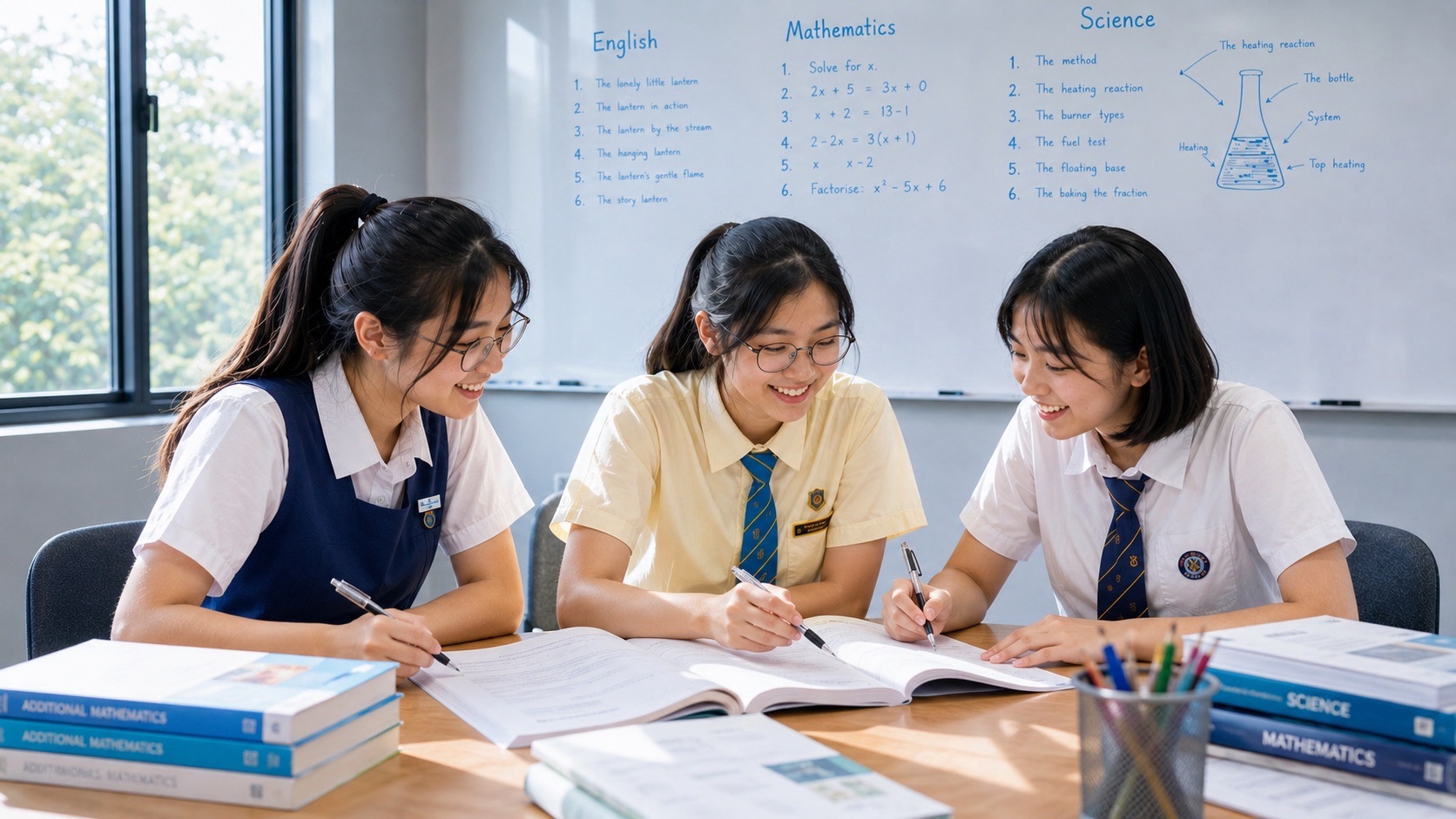
In a three-student tutorial, a tutor can inspect the line where the reasoning changes direction. That is much more useful than saying, “Be careful.”
One student may expand a bracket correctly but then combine unlike terms. Another may know the algebra but copy a negative sign incorrectly. A third may understand both yet fail to begin because the written question has not been translated into a mathematical relationship.
All three may produce the wrong answer. They do not need the same correction.
A small group also gives students useful comparison. They hear another learner explain a method, see a different representation and discover that a clean solution is not simply “more working”; it is better-organised thought.
Catch Up, Keep Up or Move Ahead?
Secondary Mathematics tuition should not assume every student is on the same route.
The repair route
The student is already losing control. Homework takes too long, simple sign errors repeat, algebra feels opaque or recent test performance has dropped. The priority is to locate the earliest unstable prerequisite and repair it before more topics pile on top.
The stabilisation route
The student generally understands lessons but performance is inconsistent. One paper is comfortable; another collapses when topics are mixed. The job is to improve retrieval, method selection, checking and working discipline so that knowledge becomes dependable.
The extension route
The student is secure and needs greater depth. We can ask for cleaner explanation, less routine applications, alternative methods and stronger transfer to unfamiliar problems. Moving ahead should mean deeper control, not simply finishing chapters earlier.
2026: Two Secondary Examination Contexts Are Now Visible
Parents sometimes encounter both older O-Level language and newer G1/G2/G3 terminology in 2026. That is because Singapore is in a transition period. The 2026 GCE O-Level examinations remain in place for the relevant graduating cohorts, while Full Subject-Based Banding has been fully implemented from the 2024 Secondary 1 cohort. From 2027, the Singapore-Cambridge Secondary Education Certificate replaces the N- and O-Level certificates for graduating Full SBB cohorts.
The terminology changes. The learning principle does not: a Mathematics programme must meet the student at the correct subject level and current state, then build a stable route forward.
For current official examination information, parents can check the SEAB 2026 O-Level syllabus list and MOE’s Full Subject-Based Banding transition information.
What a Good Mathematics Lesson Should Leave Behind
The student should leave with more than completed questions. There should be a change in control.
- The student can explain why the method works.
- The student can recognise the conditions under which it should be used.
- The student can present working in a form that can be checked.
- The student can detect an unreasonable answer.
- The student can retrieve the idea again after a delay.
- The student can use it when the question looks different.
That is the difference between finishing a topic and owning it.
A Better Parent Question
Instead of asking only, “How far ahead is the tuition class?”, ask: What is my child’s first unstable mathematical connection, and how will the tutor know when it has been repaired?
That question protects the purpose of tuition. It keeps attention on learning rather than volume.
Canonical route: For the current programme owner, continue to Secondary Math Tuition | Punggol. This legacy article now serves the narrower Primary-to-Secondary handover job rather than duplicating that programme page.