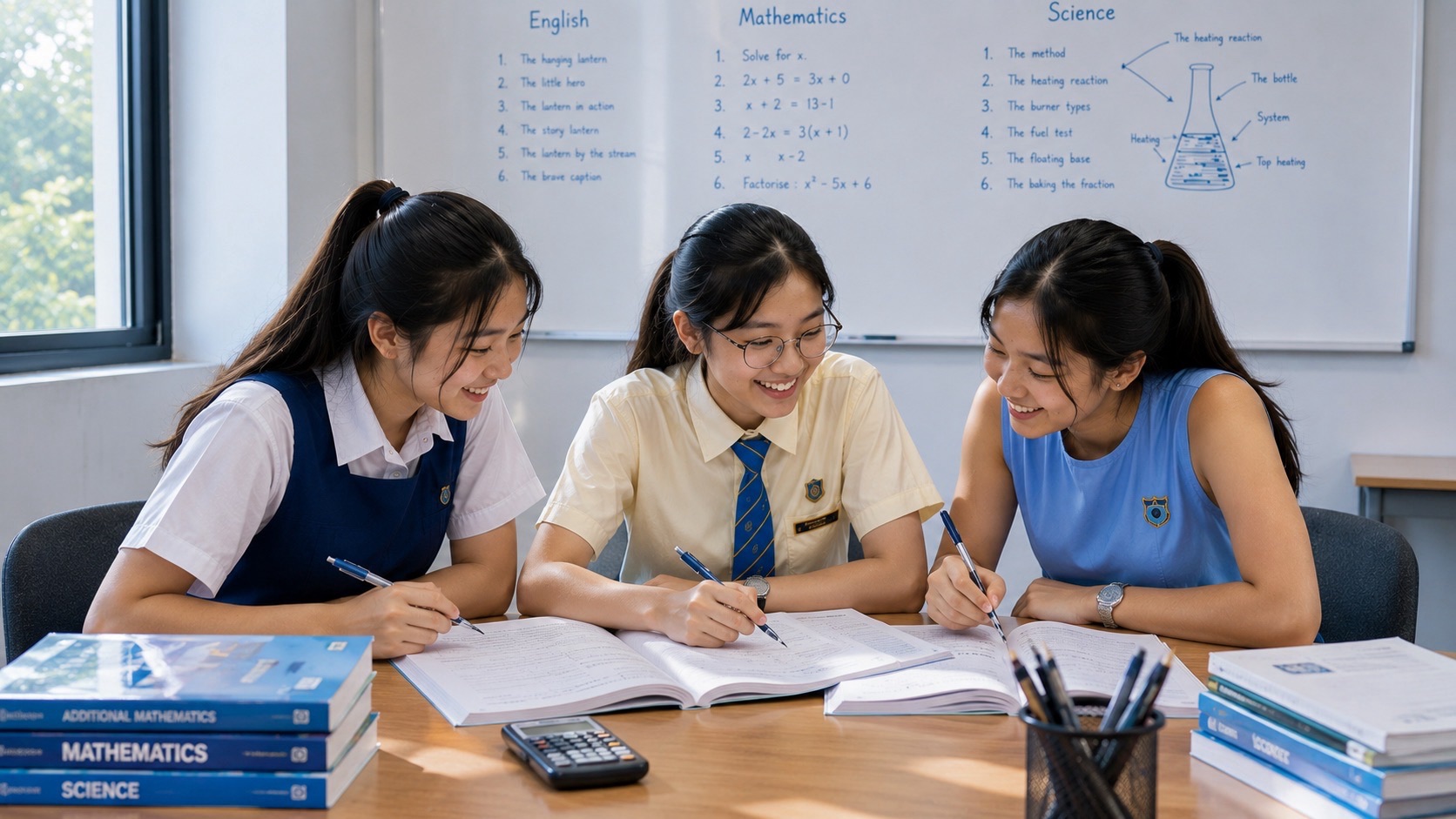
Punggol E and Add Maths Small Group Tuition for Edgefield Secondary School. This 2017 page reflects an earlier Punggol arrangement near Edgefield Secondary; current class locations and availability are confirmed on the Contact page. Our Edgefield Secondary A & E Maths tuition focuses on strengthening understanding and examination readiness for students who need clearer control of their Mathematics topics.
For current class locations and availability, use the Contact page.
Our lessons covers MOE syllabus Add and E Math in small group tuition classes
Information of our tuition centre:- small group format of 3 students.
- teach from scratch
- practice papers for examinations
- learn and understand math the easy way
- seasoned tutor teaches hard questions that are typical
- students build towards independent examination performance.
We make it easy to understand Math in our tuition, and then take it to the level where students can solve demanding examination questions more independently.


Sec 3–4 Mathematics Requires Integration, Not Just Coverage
Upper Secondary Mathematics becomes difficult because concepts interact. Algebra appears inside graphs, trigonometry, functions and calculus. A student may know each chapter separately yet struggle when an examination question combines them.
E-Math and A-Math Share Infrastructure
| Shared skill | Why it matters |
|---|---|
| Algebraic fluency | supports equations, functions, trigonometry and calculus |
| Graph interpretation | supports coordinate geometry and function behaviour |
| Equation solving | appears across both E-Math and A-Math |
| Notation control | reduces sign, bracket and substitution errors |
| Checking | catches implausible or incomplete results |
A-Math Weakness Is Often Earlier Than the A-Math Topic
A student can appear weak in differentiation when the real failure occurs after differentiating, during factorisation or equation solving. Another may struggle with trigonometric identities because algebraic manipulation is fragile. Diagnosis should move backwards until the first failed dependency is found.
Upper Secondary Revision Should Be Mixed
Blocked chapter practice is useful while learning a new method. Examination readiness requires mixed practice because the student must classify the question before solving it. The method should not be given away by the worksheet title.
A Strong E/A-Math Lesson Cycle
- Identify the first weak dependency.
- Repair the concept or procedure narrowly.
- Retrieve after a delay.
- Mix with a neighbouring topic.
- Use an unfamiliar examination-style question.
- Check whether the same error returns.
Timed Performance Is a Separate Skill
A learner may understand the Mathematics and still lose marks through slow method selection, over-checking or getting trapped on one difficult question. Once the concepts are secure, paper pacing and recovery should be trained explicitly.
Historical Edgefield Boundary
This legacy URL reflects an earlier local service page near Edgefield Secondary School. It is not affiliated with the school and should not be read as current branch information. Its present role is an upper-secondary Mathematics learning guide.
End State: Integrated Mathematical Control
The goal for Sec 3–4 is not simply to finish E-Math and A-Math syllabuses. It is to build enough connected mathematical control that the learner can identify, combine and execute methods under unfamiliar examination conditions.
Upper Secondary Mathematics Has a Dependency Spine
As Mathematics becomes more advanced, later topics reuse earlier ones more aggressively. Functions depend on algebra. Calculus depends on functions and symbolic fluency. Trigonometric equations depend on algebraic control. Weakness can therefore travel through the syllabus instead of staying inside one chapter.
Diagnose the First Failing Line
When a student gets a difficult question wrong, inspect the working line by line. The first incorrect line is often more informative than the final answer. It shows whether the breakdown began with interpretation, method selection, algebra, substitution, calculation or checking.
E-Math Can Hide A-Math Weaknesses—and the Reverse
A student may score well in E-Math because routine procedures are fluent yet struggle in A-Math because abstraction and symbolic manipulation are weaker. Another may enjoy A-Math algebra but lose E-Math marks in data interpretation, geometry or real-world modelling. The subjects overlap, but they are not interchangeable.
The Mixed-Paper Transition
- Learn a method in isolation.
- Retrieve it after a delay.
- Mix it with a near-neighbour topic.
- Apply it in an unfamiliar context.
- Use timed paper sections to test recognition and execution.
A-Math Revision Should Protect Algebra
When time becomes limited, students often focus only on advanced chapters. That is risky if algebra is still fragile. A short daily algebra retrieval set can preserve the infrastructure used by many higher-level questions.
What Progress Looks Like
- fewer repeated algebraic errors;
- faster method recognition;
- less dependence on worked examples;
- more stable performance when topics are mixed;
- better recovery after a difficult question.
Worked Diagnostic: Differentiation Error or Algebra Error?
A student differentiates correctly, obtains an expression for the gradient, then solves the resulting equation incorrectly because factorisation is weak. Calling this “weak calculus” sends revision to the wrong place. The first failing line is algebra, so the repair should start there.
Paper Strategy Should Protect Secure Marks
Upper Secondary students need an abandon-and-return rule for hard questions. One difficult A-Math item should not consume time needed for several secure E-Math or A-Math marks elsewhere. Examination control is part of mathematical performance.
Final Readiness Test
- Can the learner solve without a chapter label?
- Can working be followed and checked?
- Can the method survive a change in representation?
- Can the student recover after a failed first attempt?
- Can the same mathematics be executed accurately under time?