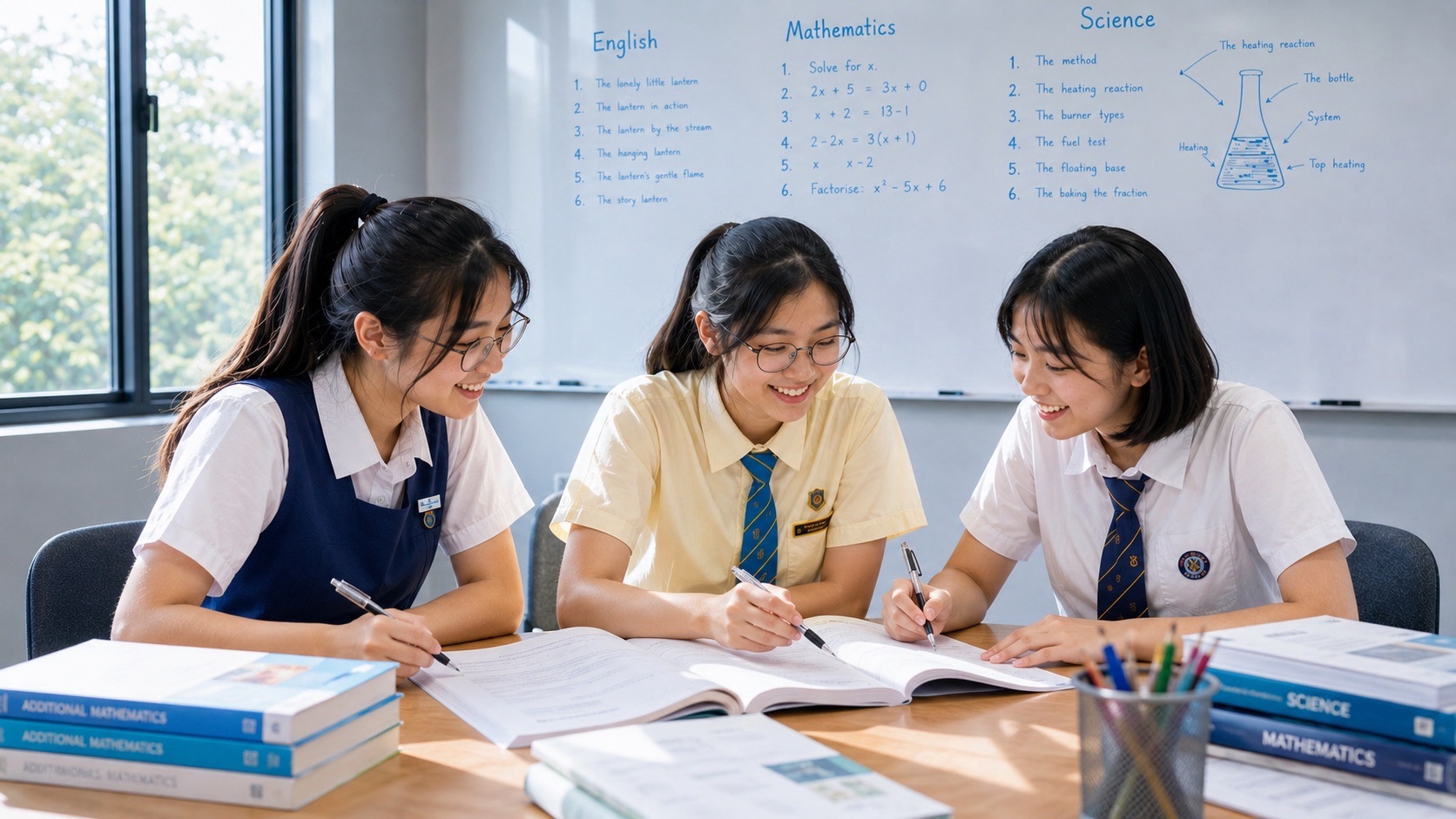
Punggol Additional Mathematics tuition should make A-Math feel structured, not mysterious.
Additional Mathematics often becomes difficult because several smaller weaknesses accumulate. A student may think the problem is differentiation, trigonometry or logarithms when the real issue began earlier with algebraic manipulation, indices, equations or functions. Our approach is to find the earliest weak link and repair it before asking the student to carry more complexity.
Who this is for
This page is for Secondary 3 and Secondary 4 students in Punggol who need stronger algebra, clearer methods, better retention or more reliable examination working.
Why A-Math can feel difficult
A single A-Math question may combine several ideas. If one component is unstable, the whole problem feels harder. We therefore distinguish between a conceptual gap, a procedural error, difficulty recognising the right method, and an examination-execution problem.
What we teach
We work from the current syllabus and the student’s own school materials. Depending on the student’s course, this can include algebraic manipulation, equations and inequalities, functions, logarithms and indices, coordinate geometry, trigonometry, differentiation, integration and applications.
The aim is to show how the topics connect. Differentiation depends on algebra. Trigonometric manipulation depends on identities and symbolic control. Integration becomes more manageable when the student can recognise the form of an expression before choosing a method.
How lessons work
- Diagnose: inspect recent work to locate the first unreliable step.
- Rebuild: explain the idea in simpler language and connect it to prior knowledge.
- Model: show complete working and explain why each step is valid.
- Practise: increase difficulty only after the core method is stable.
- Transfer: change the surface form so the student must recognise the underlying structure.
- Refine: improve timing, presentation and checking once the Mathematics is secure.
Small-group tuition, properly used
A small group is useful only when the tutor still knows what each student needs. Students can learn from one another, but they also need individual correction, targeted questions and work selected around their own weak points.
What progress should look like
- fewer repeated algebra errors;
- cleaner and more complete working;
- better recognition of question type;
- less dependence on worked examples;
- stronger recall across chapters; and
- greater confidence with unfamiliar questions.
We do not present a fixed score or guaranteed outcome. The useful measure is whether the student is becoming more accurate, more independent and more capable of handling unfamiliar Mathematics.
Current Punggol A-Math enquiries
This page has been fully rebuilt for 2026. The old guaranteed-results language, fixed mark-improvement claim, 24/7-support wording, old syllabus year and all photographs have been removed.
For current Punggol Additional Mathematics class availability and schedules, use the eduKate Singapore Contact page.