Secondary Science Intensive lessons for GCE O levels. Physics, Chemistry and Biology.
Tuition for Secondary Science are designed to have maximum effect to eke out the most learning in the shortest amount of time.
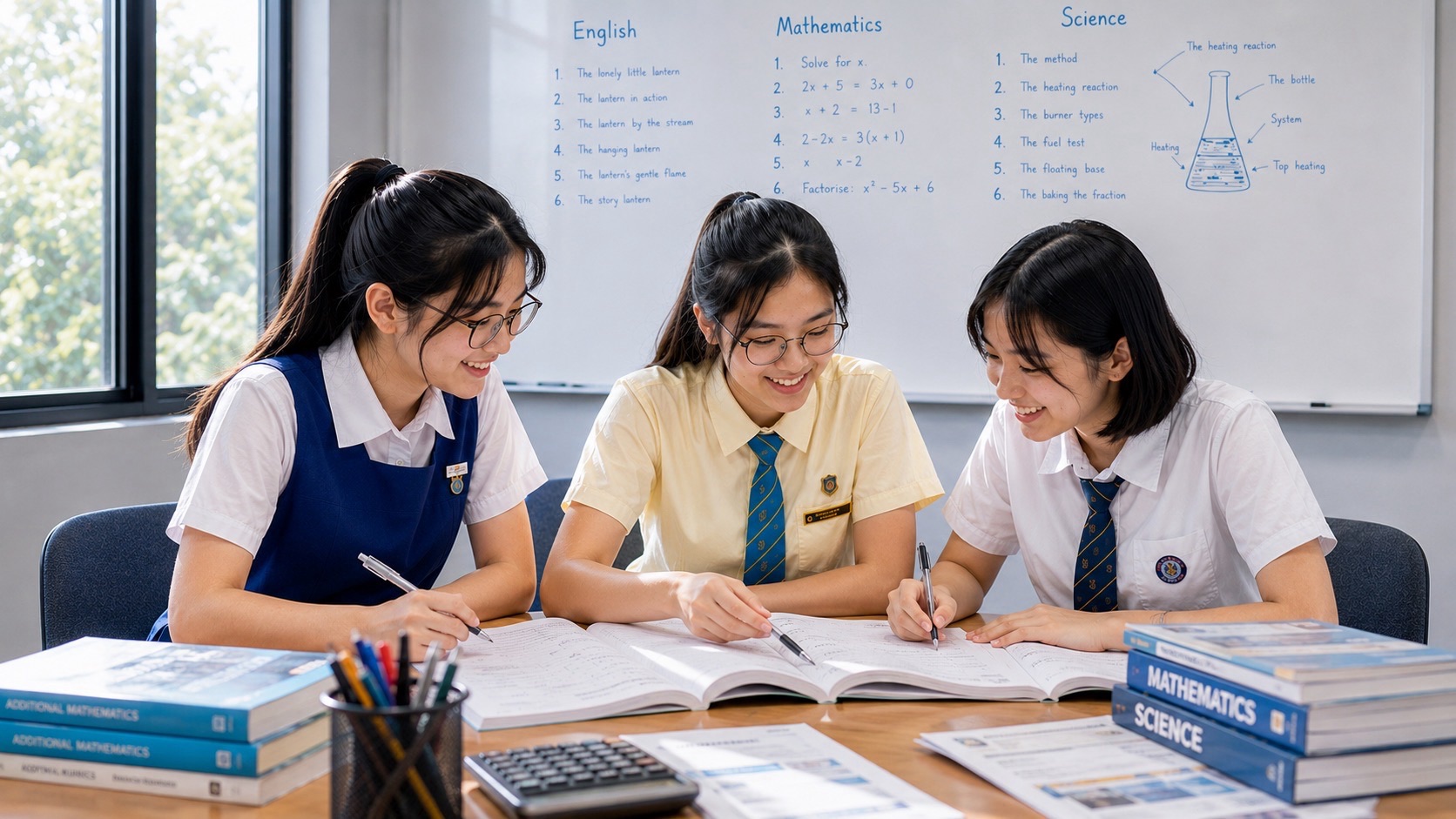
Our Punggol tuition centre conducts small group intensive tuition for English, Mathematics and Science in July for students who needs the last bit of loving and gain the confidence to attempt a successful bid in the O levels.
 Our tutors provide close support during lessons and examination preparation.

Our Science lesson teaches students from scratch, and been doing that two decades ago. SEAB MOE Syllabus is a given, plus surpassing that curriculum just for the heck of it.
Because, why not? You deserve the best.
“Begin at the beginning and go on till you come to the end”-The King.
Experienced Science and Mathematics teaching should be judged by stronger understanding, clearer reasoning and increasingly independent examination performance rather than a guaranteed distinction.
For current class information, use the eduKate Singapore Contact page.


Intensive Science Revision Should Be Selective
Near a major examination, “intensive” should not mean doing everything faster. It should mean selecting the weaknesses with the highest mark cost, repairing them efficiently and testing whether the repair transfers under time pressure.
Science Weaknesses Usually Fall Into Four Layers
| Layer | Typical symptom |
|---|---|
| Concept | the scientific idea itself is not understood |
| Representation | graphs, diagrams, equations or apparatus are misread |
| Explanation | the concept is known but the mechanism is expressed vaguely |
| Execution | knowledge is secure but time, checking or question-reading fails |
Physics: Relationship Before Formula
Students often memorise equations without recognising when they apply. Revision should connect quantity, unit, graph and physical relationship so that formula selection becomes a reasoning step rather than a guessing step.
Chemistry: Particle and Reaction Models Must Stay Connected
Many Chemistry errors occur when symbolic equations are manipulated without a clear particle or reaction model underneath. Good intensive revision alternates between representation and meaning: what do the symbols stand for, what changes, what is conserved and what evidence shows the reaction occurred?
Biology: Structure, Function and Mechanism
Biology revision can become a long list of facts. The stronger method is to connect structures to functions, functions to processes and processes to observable consequences. That makes unfamiliar application questions easier to navigate.
A Final-Stage Science Revision Cycle
- Use a recent paper to classify lost marks.
- Repair the highest-frequency conceptual or representation gap.
- Practise explanation in complete causal chains.
- Mix topics so chapter cues disappear.
- Return to timed questions and compare error recurrence.
What Intensive Revision Should Avoid
- full papers every day without error analysis;
- memorising model answers without understanding mechanisms;
- adding advanced content when core concepts remain unstable;
- assuming a poor mark in one paper means the whole subject is weak.
Historical Punggol Boundary
This 2017 page records an earlier Punggol intensive-revision context. Current local-service information belongs on eduKatePunggol.com; this page now serves as a Secondary Science revision reference.
End State: Fewer Predictable Science Losses
The aim of intensive revision is not to cover more pages. It is to reduce the number of ways secure knowledge can fail to become marks.
A Science Revision Map Should Separate Recall From Explanation
Students often know a fact but cannot use it to explain a new situation. Intensive revision should therefore separate three states: recognise the concept, retrieve it without notes, and apply it in unfamiliar evidence. Each stage requires a different kind of practice.
Data Questions Need a Read-Then-Explain Sequence
- Read axes, units, labels and conditions.
- State the pattern without explaining it.
- Identify the relevant scientific concept.
- Explain the mechanism that could produce the pattern.
- Check whether the conclusion goes beyond the data.
Practical Questions Test Experimental Thinking
Students should know why a variable is changed, what is measured, which conditions need control and how reliability can be improved. Memorising one “fair test” sentence is weaker than understanding why the comparison would become invalid if another variable changed at the same time.
Scientific Explanations Need Mechanism Chains
A useful response often follows: condition → scientific process → immediate effect → observable result. This structure reduces vague answers because each link has to earn its place.
Common Final-Stage Science Errors
- using the right keyword in the wrong mechanism;
- describing a graph instead of answering the question;
- ignoring units or experimental conditions;
- stating correlation as certain causation;
- memorising a model answer that does not fit the changed context.
A Ten-Day Intensive Cycle
- Days 1–2: classify errors from recent papers.
- Days 3–4: repair the highest-leverage concepts.
- Days 5–6: practise explanation and data interpretation.
- Days 7–8: mix topics and unfamiliar contexts.
- Days 9–10: timed paper sections and targeted checking.
The Best Intensive Revision Is Finite
Intensive support should end when the student can recognise the scientific structure, retrieve the needed knowledge and express the explanation independently. More hours are not the end goal; fewer predictable failure modes are.
Worked Diagnostic: Same Wrong Answer, Different Repairs
Suppose two students both miss a heat-transfer question. Student A cannot identify conduction. Student B names conduction correctly but writes a vague explanation that never connects energy transfer to the observed temperature change. The mark loss looks similar, but the repairs are different: Student A needs concept reconstruction; Student B needs explanation precision.
The Transfer Check
After repair, change the apparatus, material or context. If the student only succeeds on the original question, the learning is still tied to surface cues. True recovery means the mechanism can be recognised in a new situation.
Final-Week Science Priorities
- keep secure concepts active with light retrieval;
- repair only the highest-frequency weak mechanisms;
- practise data interpretation and experimental reasoning;
- protect sleep and concentration;
- avoid introducing large new content blocks at the last minute.