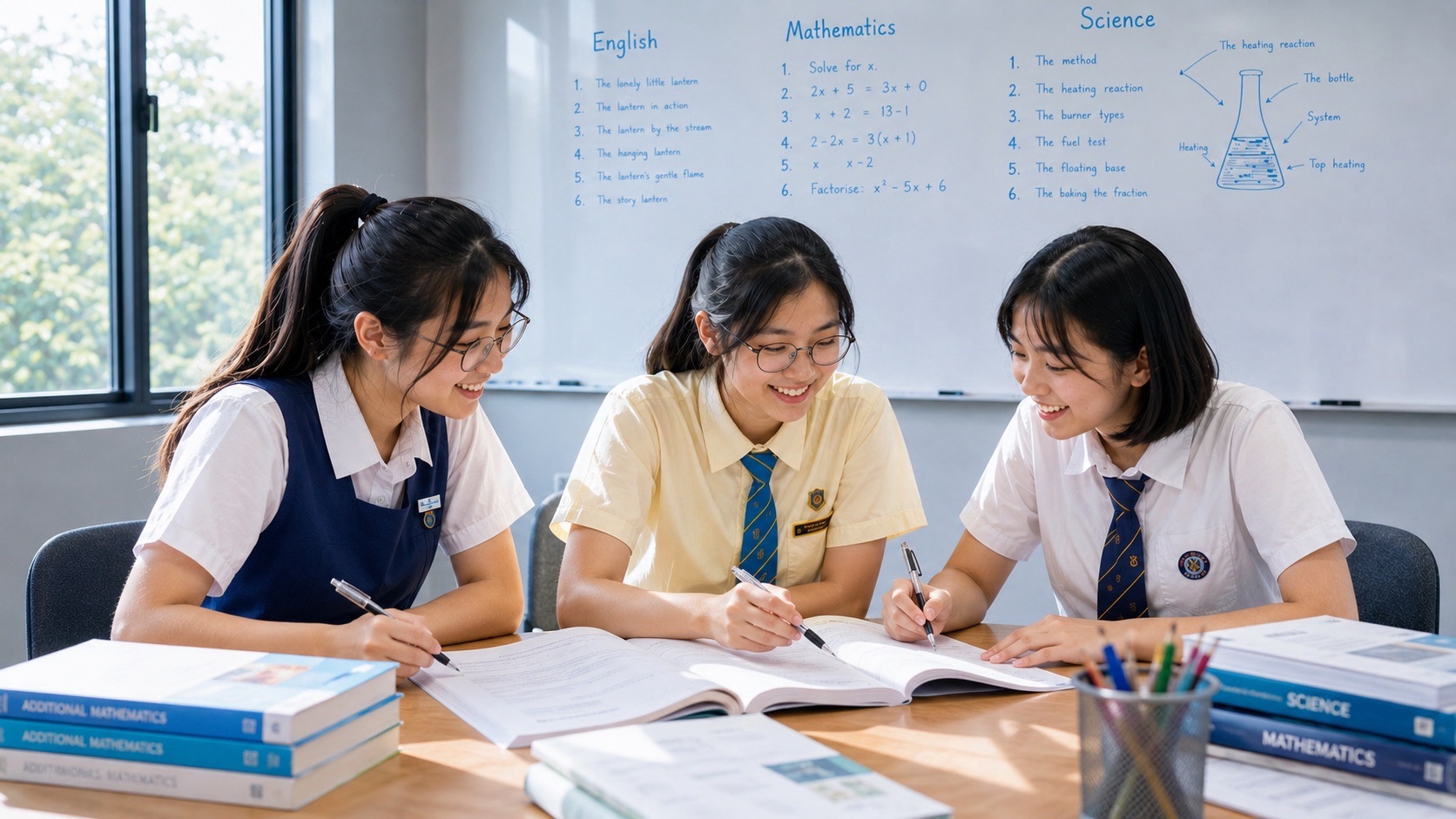
Choosing a Punggol tuition centre should begin with the child’s actual learning problem, not the longest subject list or the loudest promise.
English, Mathematics and Science each fail in different ways. A student may need stronger reading and sentence control, better mathematical representation, or clearer scientific reasoning. A useful tuition programme should be able to identify which problem is present before deciding what to teach next.
This page is a 2026 parent guide for Punggol families. Current eduKate class locations, schedules and availability are maintained on the eduKate Singapore Contact page.
Start with diagnosis
An overall mark is only a starting signal. Parents should ask what the tutor believes is causing the mark.
For English, the issue may be reading, vocabulary, grammar, comprehension, composition or oral communication. For Mathematics, it may be concept knowledge, representation, procedure, transfer or careless execution. For Science, it may be misconceptions, vocabulary, evidence use, experiments or incomplete explanations.
Small groups should remain genuinely individual
A small class is useful only when the tutor still knows which student has which weakness. Students can learn from discussion and comparison, but feedback should remain specific.
The advantage is not simply fewer students. It is better visibility into how each learner is thinking.
English tuition: build the language chain
Reading supports comprehension. Vocabulary supports both reading and writing. Grammar supports sentence control. Composition brings several of those skills together. Good English teaching identifies the earliest weak link rather than treating every problem as a writing problem.
Mathematics tuition: make structure visible
Students need to understand what quantities mean, how they relate and which representation makes the problem clearer. Good Mathematics teaching moves from concept to method, then from method to transfer across unfamiliar questions.
Science tuition: connect evidence to explanation
Students should understand concepts, interpret diagrams and experiments, use scientific vocabulary precisely and connect evidence to mechanism and conclusion. Model answers should support understanding, not replace it.
Ask how progress is measured
Useful indicators are visible in the student’s work:
- fewer repeated errors;
- clearer explanations;
- better organisation;
- stronger transfer to unfamiliar questions;
- more accurate self-correction; and
- less dependence on tutor prompting.
Ask how support fades
Tuition should not make a student permanently dependent on tuition. At first, the tutor may model and prompt heavily. Over time, those supports should reduce so the learner plans, explains, checks and corrects more independently.
Near examinations
Good exam preparation becomes more selective. Weak concepts are repaired first, recurring mistakes are tracked, and mixed practice tests whether the student can recognise what to do without being told the chapter or skill in advance.
What parents should be cautious about
Be cautious of fixed grade guarantees, universal claims that one method suits every learner, and old location or schedule information that is no longer maintained. The best fit depends on the child’s needs, the tutor’s ability to diagnose them and whether progress becomes observable over time.
Current Punggol enquiries
This page has been fully rebuilt for 2026. The old “top end” wording, fixed six-student claim, 2017 schedule, “latest syllabus” claim, historical telephone number and every photograph have been removed.
For current eduKate English, Mathematics and Science class locations and availability, use the Contact page.