This page began in May 2017 as “Punggol Sec 2 Mathematics Tuition Streaming Year”.
The old version treated Secondary 2 as a streaming year, advertised six-student classes and an 18-year tutor, promised A1-oriented outcomes, published an old phone number and framed the year around getting students into upper-secondary Mathematics and Science options.
That educational system has changed.
The stronger question is:
What mathematical capabilities should a Secondary 2 student actually have under control before upper-secondary Mathematics increases the dependency, abstraction and examination load?
This 2026 rebuild owns that readiness portfolio.
Quick answer: Secondary 2 is a consolidation-and-readiness year, not a streaming verdict
MOE has fully implemented Full Subject-Based Banding since 2024. The old Express, N(A) and N(T) course labels have been phased out; students can take subjects at G1, G2 or G3 levels according to strengths and learning needs.
From 2027, the Singapore-Cambridge Secondary Education Certificate replaces the old N- and O-Level certificates for the relevant graduating cohort.
Official source: MOE — Full Subject-Based Banding and SEC changes.
So the old idea that one Secondary 2 examination permanently sorts a student into a fixed stream is no longer the correct frame.
Readiness still matters enormously.
But it should be read from evidence of capability, not from an obsolete streaming label.
The readiness portfolio
Before upper secondary, inspect at least seven mathematical systems.
| Capability | Readiness evidence | Warning signal |
|---|---|---|
| Algebra | manipulates expressions/equations accurately and explains transformations | procedures collapse when signs or fractions appear |
| Representation | switches words ↔ algebra ↔ graph ↔ diagram | needs one familiar representation |
| Proportion | recognises direct/inverse relationships and units | uses memorised formulas without interpreting quantities |
| Geometry | reasons from properties rather than appearance | trusts diagram shape over given conditions |
| Trigonometric reasoning | connects ratios to right-triangle relationships | memorises SOHCAHTOA without selecting correctly |
| Statistics/probability | calculates and interprets representations | computes correctly but draws unsupported conclusions |
| Retrieval/transfer | old topics survive delay and mixing | high chapter scores, weak cumulative papers |
Secondary 2 exposes the dependency graph
At Secondary 1, many ideas can still be taught in relatively separate blocks.
By Secondary 2, the blocks interact more visibly.
For example:
- quadratic work depends on algebraic expansion and factorisation;
- graphs depend on equations, coordinates and interpretation;
- trigonometric work depends on geometry, ratios and accurate calculator use;
- surface area and volume depend on formula meaning, units and spatial representation;
- probability and statistics depend on careful interpretation as well as arithmetic.
When several dependencies converge, weak foundations become much easier to see.
The first question is not “Which topic is weak?”
Ask:
Which underlying capability is causing losses across several topics?
If the same sign-control error appears in algebraic fractions, quadratics and coordinate work, the issue is not three weak chapters.
It is one shared dependency with several visible symptoms.
Algebra readiness: the central infrastructure test
Algebra is not the whole of Secondary 2 Mathematics.
It is one of the most important shared infrastructures for what comes next.
Test whether the learner can:
- expand and factorise accurately;
- solve linear and simultaneous equations;
- work with algebraic fractions;
- rearrange formulae;
- interpret variables inside a relationship;
- check solutions by substitution or another valid method.
A student who memorises algebra moves without understanding invariants will struggle as expressions become denser.
Quadratics: readiness is more than factorising
A quadratic expression can be:
- expanded;
- factorised;
- solved when placed inside an equation;
- represented as a graph;
- used later inside more advanced mathematical structures.
The readiness test is whether the student can distinguish those jobs.
“Factorise” is not the same instruction as “solve”.
Students who blur the object and the operation accumulate avoidable errors.
Algebraic fractions: a compression test for prerequisite control
Algebraic fractions are useful diagnostically because several dependencies collide:
- ordinary fraction structure;
- factorisation;
- common factors;
- restrictions and valid operations;
- sign control.
A learner may look “careless” when the real issue is that too many prerequisite operations remain non-automatic.
Simultaneous equations: one relationship is not enough
Simultaneous equations require the student to coordinate multiple constraints.
The mathematical object is not simply two equations.
It is the set of values that satisfies both relationships at the same time.
This becomes an important bridge to later mathematical modelling.
Graphs: connect equation, shape and information
Graph work should not be taught as plotting after calculation.
Ask students to move through:
equation → features → table → graph → interpretation → equation.
Then ask what remains invariant when the representation changes.
This is a key upper-secondary readiness skill because later Mathematics becomes increasingly representation-dense.
Direct and inverse proportion: formula choice should follow relationship recognition
A learner may remember a proportional formula and still not know whether the situation is proportional.
Before calculation, ask:
- If one quantity doubles, what should happen to the other?
- What remains constant?
- Does zero have a meaningful role?
- Which graph shape would fit?
Relationship recognition is more transferable than formula recall.
Trigonometric ratios: SOHCAHTOA is a retrieval cue, not the model
Mnemonic knowledge is useful.
It does not replace triangle interpretation.
The student must identify:
- the relevant angle;
- opposite, adjacent and hypotenuse relative to that angle;
- which ratio links the known and unknown quantities;
- what the calculator result represents.
Change the orientation of the diagram.
If performance collapses, the learner may have memorised the picture rather than the relationship.
Geometry: properties must beat appearance
Secondary 2 geometry requires a stronger distinction between:
- what the diagram seems to show;
- what the given information actually guarantees.
A line that looks perpendicular may not be stated as perpendicular.
Two lengths that look equal may not be equal.
Read the constraints, not the artwork.
Mensuration: units reveal whether the model is understood
Surface area and volume require more than memorising formulae.
Students should know:
- which dimension is being measured;
- why area uses square units;
- why volume uses cubic units;
- which surfaces are included;
- whether a compound object needs decomposition.
Unit mistakes are often model mistakes in disguise.
Statistics: calculating the centre is not interpreting the data
Mean, median and mode compress information differently.
Students should ask:
- What does this measure preserve?
- What does it hide?
- How do unusual values affect it?
- Which comparison is justified?
Upper-secondary readiness includes interpreting mathematical summaries, not only producing them.
Probability: the sample space must be controlled
Probability becomes unreliable when students count outcomes without checking whether they are:
- complete;
- distinct;
- equally likely where assumed;
- conditioned by previous events.
The arithmetic can be correct while the sample space is wrong.
The readiness mistake: using one high grade as proof
A high Secondary 2 Mathematics grade is useful evidence.
It is not the complete readiness portfolio.
Ask whether the performance:
- survives unfamiliar questions;
- survives a delayed retest;
- survives mixed topics;
- survives reduced tutor support;
- contains clear working rather than lucky answers.
One examination can reveal performance.
Repeated transfer reveals capability more strongly.
Readiness is not the same as acceleration
A student can be ready for greater challenge without needing to race through upper-secondary chapters.
Challenge can come from:
- unfamiliar problems;
- multiple representations;
- proof-like explanations;
- method comparison;
- modelling;
- error analysis.
Depth is another direction of progress.
Readiness for Additional Mathematics should be evidence-based
Additional Mathematics increases symbolic density and dependency load.
Before a learner enters that environment, useful evidence includes:
- stable algebraic manipulation;
- comfort with functions and graphs;
- accurate equation solving;
- ability to persist through multi-step problems;
- willingness to check and diagnose errors;
- retrieval of older Mathematics without complete re-teaching.
School-specific subject offering and eligibility decisions should always be checked with the student’s school. This article describes learning readiness, not an admissions rule.
Full SBB makes capability language more important
When students can take subjects at different G-levels, a broad label such as “Secondary 2 Mathematics student” is less informative than before.
Useful questions become:
- What subject level is the student actually taking?
- Which mathematical dependencies are stable?
- Where is stretch appropriate?
- Where is repair required?
Support should fit the actual learner state.
The mixed-paper test
Topic worksheets tell the learner which tool is likely required.
Mixed papers remove that cue.
They test:
- recognition;
- selection;
- retrieval;
- switching;
- time allocation.
A student preparing for upper secondary should increasingly handle mixed mathematical environments.
The delay test
Wait one or two weeks after a repair.
Then retest without notes.
If the capability disappears, the student may have completed practice without consolidating memory.
Secondary 2 is an excellent year to build this retrieval discipline before examination stakes increase.
The representation-switching test
Take one relationship and express it in different forms.
- words;
- equation;
- table;
- graph;
- diagram.
Ask what remains the same.
Students who can switch representations are better prepared for later Mathematics because the same idea often appears under multiple surfaces.
The error-recurrence test
One correction is not enough.
Track whether the same error returns.
| Error | First repair | Changed retest | Returned? |
|---|---|---|---|
| sign loss | equation work | quadratic question | yes/no |
| wrong trig ratio | triangle labelling | rotated diagram | yes/no |
| graph misread | feature identification | different axes/context | yes/no |
This is readiness evidence.
The workload test
A student can appear mathematically weak because the whole weekly system is overloaded.
Before adding intensive tuition, check:
- school homework volume;
- CCA;
- sleep;
- other tuition;
- commute;
- time available for corrections.
More Mathematics hours do not guarantee more retained Mathematics.
The student should learn to report the weak layer
“I am bad at Math” is too coarse.
Better:
I understand simultaneous equations, but I lose accuracy when fractions are introduced.
Or:
I can use SOHCAHTOA, but I choose the wrong ratio when the triangle is rotated.
Precise self-diagnosis is part of upper-secondary readiness.
The tutor should report capability, not only syllabus position
Weak report:
We have finished Quadratics and Trigonometry.
Stronger report:
The student retrieves factorisation independently and transfers to simple quadratics, but trigonometric ratio selection still depends on familiar diagram orientation.
The second report gives a decision.
A Secondary 2 readiness dashboard
| Green | Amber | Red |
|---|---|---|
| retrieves after delay | needs brief cue | requires re-teaching |
| selects method in mixed work | sometimes chapter-dependent | cannot identify method |
| switches representations | one representation weak | works only in one form |
| explains reasoning | procedure stronger than explanation | memorised steps only |
| self-checks recurring errors | checks when prompted | does not detect pattern |
Use the dashboard to decide where the next teaching hour should go.
What should happen before Secondary 3
- Audit inherited algebra and number weaknesses.
- Repair recurring dependencies narrowly.
- Mix topics so method selection becomes visible.
- Retest after delay.
- Strengthen graph and representation switching.
- Build a personal error taxonomy.
- Confirm the student can work with less tutor prompting.
This produces a much stronger handover than simply finishing a list of chapters early.
The historical 2017 photographs
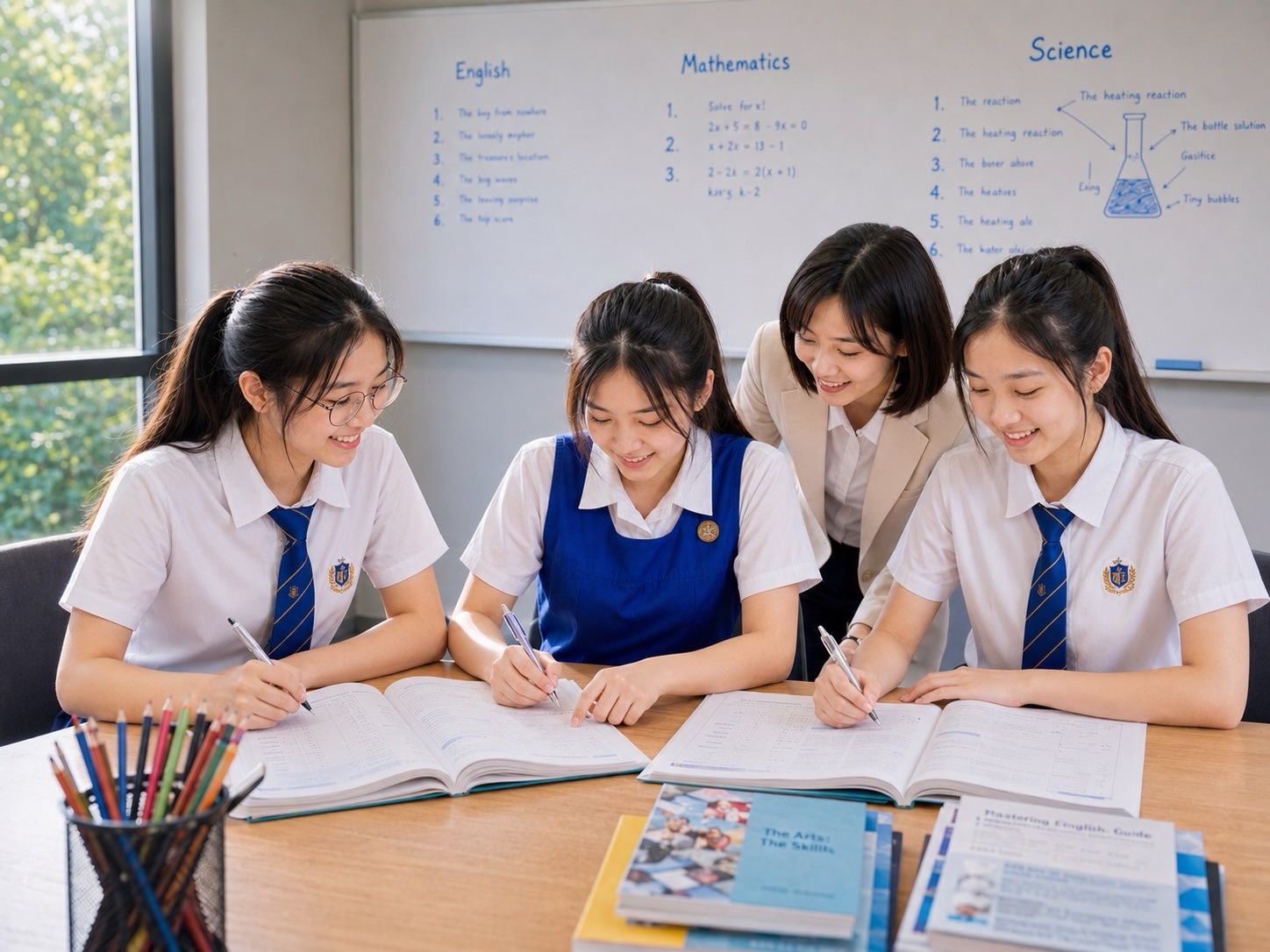
The original page contained Secondary Mathematics resource and graph-work photographs. They are retained as historical eduKate programme provenance, not as evidence of current class size, tutor roster or resource edition.


What this page no longer claims
- Secondary 2 is not described as a current “Streaming Year”.
- No six-pax class claim is presented as current.
- No 18-year tutor count is used as proof of quality.
- No A1 outcome is promised.
- No old phone number is published.
- No school subject-offering decision is implied from this article alone.
Frequently asked questions
Is Secondary 2 still a streaming year?
No. Full Subject-Based Banding has replaced the old course-stream framework. Students can take subjects at G1, G2 or G3 levels according to strengths and learning needs.
What should a student be good at before Secondary 3 Mathematics?
Stable algebra, representation switching, graphs, proportional reasoning, geometry, trigonometric foundations, statistics/probability interpretation, cumulative retrieval and method selection are all high-value readiness signals.
Does a high Secondary 2 grade guarantee A-Math readiness?
No. It is useful evidence, but readiness is stronger when the Mathematics also survives delay, mixed questions, changed representations and reduced support. School-specific subject offering should be checked directly with the school.
Should Secondary 2 tuition teach Secondary 3 topics early?
Only when current capabilities are stable. Depth, mixed transfer and prerequisite repair can be more valuable than simply increasing syllabus distance.
The Secondary 2 readiness principle
The old question was:
Which stream will this student enter?
The better learning question is:
Which mathematical dependencies are stable enough to carry the next level of abstraction, and which ones need repair before the load increases?
That question remains useful regardless of label.
Official and related routes
- MOE — Full Subject-Based Banding and SEC changes
- SEAB — 2027 G2 SEC syllabuses
- SEAB — 2027 G3 SEC syllabuses
- eduKatePunggol — Secondary 2 algebra readiness before Secondary 3
- eduKateSG — Secondary 2 algebraic dependencies and progression
- eduKateSingapore — Secondary 1 coverage versus mastery
Historical note: first published on 1 May 2017 as a “Streaming Year” Secondary 2 Mathematics tuition page with six-pax, A1, tutor-experience and old contact claims. Rebuilt in 2026 as eduKateSingapore’s capability-readiness owner before upper-secondary Mathematics under Full Subject-Based Banding.