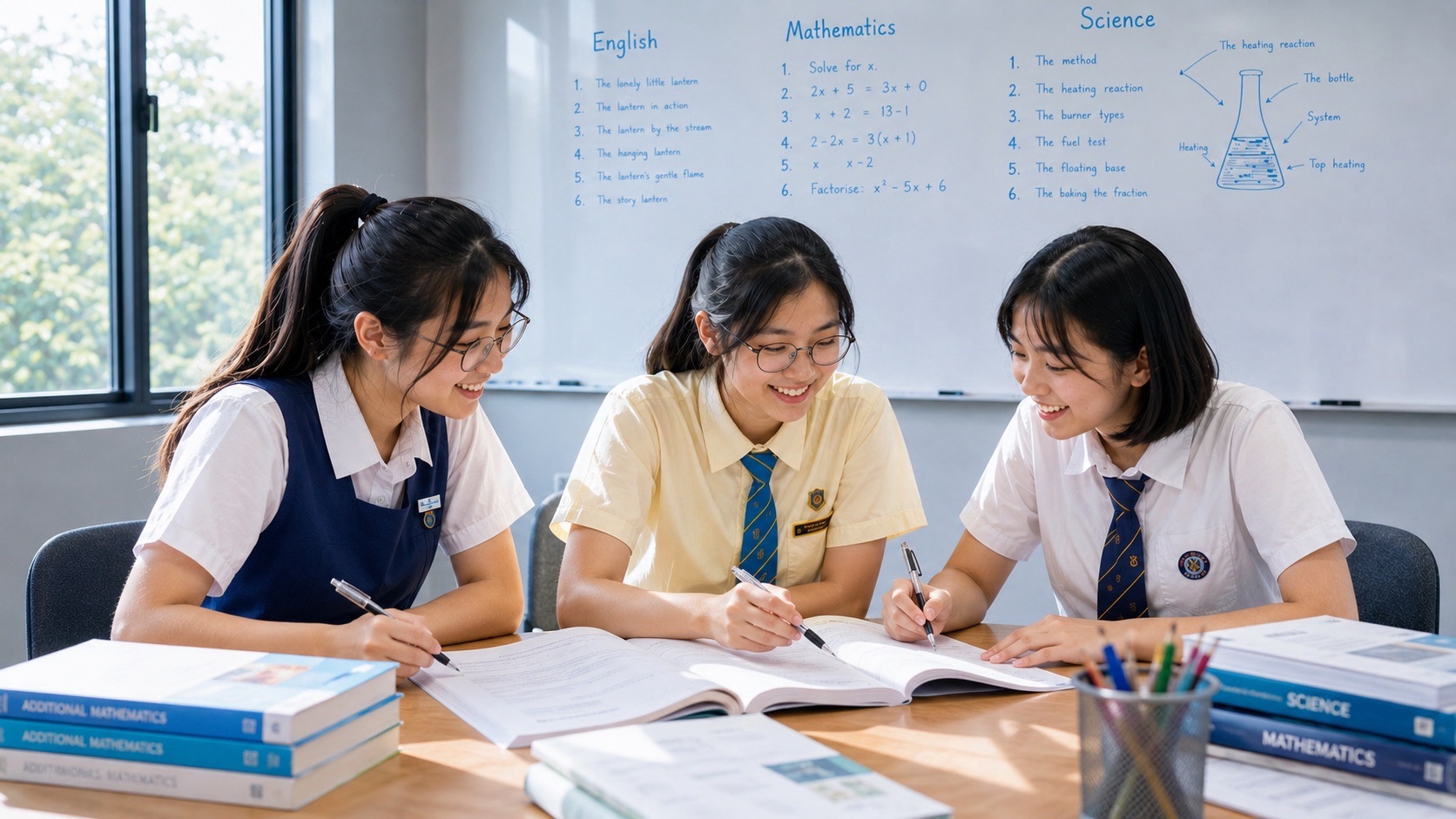
Originally published 6 October 2015 as a Punggol Additional Mathematics tuition page built around the former 4047 course. Rebuilt in 2026 as a durable learning architecture for Secondary Additional Mathematics. Obsolete tutor, class-size, package, timetable and contact claims have been retired.
Quick answer: Additional Mathematics becomes manageable when students stop treating it as a collection of difficult chapters and instead build a connected mathematical system. Algebra is the main operating language; geometry and trigonometry add spatial relationships; calculus describes change and accumulation; transfer determines whether the learner can recognise these structures when the question changes.
For current eduKate enquiries, use the Contact page. For current examination routes, use the SEAB 2027 SEC G3 syllabus page. In 2027, G3 Additional Mathematics is listed as K341, with 4049 shown as the reference code for 2026 and earlier.
Additional Mathematics is a dependency system
A difficult A-Math question is often not failing at the visible topic. Differentiation can fail because algebra is weak. Trigonometric identities can fail because factorisation is weak. Coordinate geometry can fail because equation solving is weak. Kinematics can fail because the student can differentiate but cannot interpret what the derivative represents.
A useful diagnostic order is:
prerequisite → concept → representation → method selection → execution → transfer → examination control.
The three large mathematical territories
The current SEC G3 Additional Mathematics syllabus is organised around three broad areas: Algebra, Geometry and Trigonometry, and Calculus. These areas are not independent. They call one another constantly.
- Algebra provides symbolic control.
- Geometry and Trigonometry provide spatial relationships, identities and coordinate structure.
- Calculus provides a language for rates of change, gradients, accumulation and motion.
1. Algebra is the spine
Students sometimes think of algebra as one chapter among many. In Additional Mathematics, it is closer to infrastructure. If algebraic manipulation is slow or unreliable, the cost appears everywhere else.
- expanding and factorising expressions;
- solving equations and inequalities;
- manipulating indices, surds and logarithmic expressions;
- handling polynomials;
- working with functions;
- rearranging formulae;
- maintaining sign discipline across several steps.
The goal is not symbol pushing for its own sake. Algebra lets the learner preserve relationships while transforming their representation.
Equivalence: the hidden rule behind algebra
Many memorised shortcuts become dangerous when students forget what makes them valid. For example, “move a term across the equals sign and change the sign” can produce correct answers, but it hides the deeper operation: the same inverse operation is being applied to both sides of an equation.
A stronger learner asks: what transformation preserves equivalence?
Quadratics: a major diagnostic junction
Quadratic work connects factorisation, equations, inequalities, graphs and later calculus. Weakness here can have several different causes.
- factorisation is incomplete or slow;
- sign errors accumulate;
- the learner does not understand what a root represents;
- the graph and equation are not connected conceptually;
- the student can solve a familiar form but cannot recognise a disguised quadratic structure.
Do not repair all five with more identical quadratic worksheets. Identify the layer first.
Functions: from formula to mathematical object
A function should not be treated merely as a formula into which numbers are substituted. Students need to understand input, output, domain, range, composition, inverse relationships and graphical behaviour at the level required by their course.
Useful questions include:
- What quantity is the input?
- What does the output represent?
- Which x-values are allowed?
- What transformation changes one graph into another?
- What does an intercept or turning point mean?
2. Geometry and trigonometry: represent before calculating
Geometry and trigonometry become much easier when the diagram is treated as a mathematical model rather than a picture to stare at.
- mark what is given;
- identify the quantity required;
- state the relationship or theorem;
- decide which representation exposes the structure;
- solve symbolically where useful;
- substitute carefully;
- check whether the result is geometrically plausible.
Trigonometric identities: prove, do not merely manipulate
Identity questions often expose whether the learner understands equality. The task is not to change both sides until they look similar by accident. A disciplined proof usually starts from one side and applies valid identities until the required form appears.
- choose the side with more structure;
- look for a common identity or factor;
- avoid changing both sides simultaneously unless the reasoning remains explicit;
- keep each transformation visible;
- check domain restrictions when division is involved.
Coordinate geometry: algebra made visible
Coordinate geometry is a good example of subject integration. A line is simultaneously a geometric object and an algebraic relationship. Gradient, midpoint, distance and equation work should therefore connect the diagram to the symbols.
Students who memorise coordinate formulae without seeing the geometry often struggle when the question is rearranged.
3. Calculus: a language of change
Calculus is often the most visibly new part of Additional Mathematics, but its conceptual entry point is simple: differentiation describes rate of change and gradient; integration reverses differentiation and can represent accumulated quantity or area.
The current K341 syllabus includes differentiation and integration, stationary points, applications to gradients, tangents and normals, rates of change, maxima and minima, definite integrals and applications to straight-line motion.
Derivative as gradient and rate
A derivative should not first exist in the learner’s mind as a list of rules. The rules become more useful once the learner understands what the derivative represents.
- for a graph, it gives the gradient at a point;
- for a changing quantity, it gives an instantaneous rate of change;
- for displacement, its derivative gives velocity;
- for velocity, its derivative gives acceleration.
Stationary points: zero gradient is only the beginning
Solving f′(x)=0 locates stationary x-values. It does not automatically tell the learner whether each point is a maximum, minimum or stationary point of inflexion. Classification needs further reasoning from gradient change, second derivative information or the behaviour of the curve.
Useful companion: Graph Intercepts, Stationary Points and Asymptotes.
Integration: reverse process and accumulation
Students should understand both the procedural and representational sides of integration. Procedurally, it reverses differentiation. Geometrically, a definite integral can represent signed area under a curve within the syllabus context.
A common weakness appears when students can integrate an expression but cannot interpret what the integral means in the problem.
Kinematics: calculus must return to the world
Straight-line motion questions test more than differentiation and integration. The learner must track what each function represents and interpret signs and turning points physically.
- displacement describes position relative to an origin;
- velocity describes rate of change of displacement;
- acceleration describes rate of change of velocity;
- zero velocity can indicate a momentary rest or change in direction;
- negative velocity represents direction, not “bad speed”.
The transfer problem
Many students can solve a chapter exercise because the heading tells them which method to use. Examinations remove that cue.
Transfer means being able to answer:
- What kind of mathematical object is this?
- Which relationship is hidden here?
- Which prior topic is being called?
- Which representation would make the structure clearer?
- What method is admissible, and why?
Blocked practice first, mixed practice later
When a new technique is being learned, closely matched questions help stabilise the procedure. Once fluency develops, practice should become mixed so that method selection becomes part of the task.
A useful progression is:
- worked example;
- matched example;
- same method with changed values;
- same concept with changed representation;
- mixed-topic set;
- unfamiliar multi-step problem;
- timed examination application.
Retrieval: can the mathematics still be called up?
Understanding a worked solution today does not guarantee access next month. Important methods should return after delays.
- close notes before beginning a revision question;
- mix older chapters into current practice;
- retry previously corrected questions after one or two weeks;
- use cumulative short quizzes;
- explain a method before seeing the answer key.
Error classification is more useful than “careless”
- Prerequisite: earlier Mathematics is missing.
- Concept: the relationship is misunderstood.
- Representation: words, graph or diagram were translated wrongly.
- Selection: the wrong method was chosen.
- Execution: the correct method was performed inaccurately.
- Transfer: the idea was not recognised in a changed problem.
- Control: timing, checking or stress disrupted otherwise secure knowledge.
The classification should change the next action. Otherwise it is only a label.
A weekly Additional Mathematics cycle
- Learn: understand one new relationship.
- Derive or justify: know why the method is allowed.
- Practise: stabilise execution.
- Retrieve: work without the model.
- Vary: change representation or context.
- Mix: combine with older topics.
- Diagnose: classify the first failed step.
- Repair: revisit the earliest weak dependency.
- Retest: return after a delay.
Secondary 3: build structure before speed
The first year of A-Math should establish algebraic reliability and conceptual relationships. Rushing ahead while factorisation, equations or functions remain unstable creates a debt that calculus will later collect.
Secondary 4: integrate and execute
By the final year, students should increasingly work with mixed sets, past-paper structures, timing and error recurrence. Full papers are useful when the learner already has enough syllabus coverage for the paper to diagnose integration and execution rather than simply missing content.
Responsibility transfer
A-Math tutoring should not make the tutor a permanent calculator beside the learner. Control should move outward:
- tutor identifies the weak layer;
- tutor models the repair;
- student explains the method;
- student attempts independently;
- student checks and classifies the error;
- student chooses the next practice target;
- student performs under examination conditions without rescue.
What parents can measure beyond marks
- Can the student explain why a method works?
- Can algebra be executed without repeated sign errors?
- Does learning survive a two-week delay?
- Can the learner recognise a method in a mixed set?
- Are recurring errors reducing?
- Can the student identify what went wrong before being told?
- Is timed performance becoming more stable?
What not to conclude
- A-Math is not difficult only because calculus is new.
- More advanced questions do not repair weak algebra automatically.
- Fast manipulation is not proof of understanding.
- One correct worked example is not proof of retention.
- A poor result should not be reduced to “carelessness” without diagnosis.
- No tuition programme can responsibly guarantee an examination grade.
Current official route
SEAB lists Additional Mathematics K341 for 2027 SEC G3 school candidates, with 4049 as the reference subject code for 2026 and earlier. Students should always use the syllabus for their own examination year.
Clementi+ Depth: Additional Mathematics as a Dependency Graph
Additional Mathematics is often described as a difficult subject because the questions are harder. That is only partly true. The deeper reason is that A-Math compresses many earlier dependencies into each problem. A calculus question may require factorisation, functions and sign discipline before differentiation even begins. A trigonometric proof may fail because algebraic equivalence is weak. A coordinate-geometry problem may expose a gradient or equation gap from much earlier learning.
The mature way to study A-Math is therefore to treat it as a dependency graph rather than a chapter list. When performance drops, trace backward to the first unstable node.
Four Learner Profiles Behind A-Math Difficulty
Profile 1: Conceptually strong, algebraically fragile
This learner understands what differentiation or trigonometry means but loses marks through factorisation, signs, fractions or rearrangement. The visible topic is not the first failure. The repair is algebraic fluency under the exact operations the advanced topic requires.
Profile 2: Procedure fluent, transfer weak
This student can complete a page of derivative questions because the heading announces the method, but cannot recognise a rate-of-change problem when differentiation is hidden inside a context. The repair is mixed practice and representation change.
Profile 3: Fast but brittle
This learner works quickly on familiar questions but small changes in wording or structure trigger errors. The repair is slower comparison work: what changed, which invariants remain, and why is the original method still valid—or no longer valid?
Profile 4: Accurate untimed, unstable in papers
This student understands the Mathematics but loses control under mixed-paper timing. The bottleneck may be method selection, retrieval latency, checking discipline or time allocation rather than content knowledge.
The A-Math Dependency Graph
- Arithmetic and fractions → algebraic fractions
- Expansion and factorisation → quadratics, identities, partial fractions
- Equations and inequalities → functions, coordinate geometry, optimisation
- Functions and graphs → calculus, transformations, inverse/composite reasoning
- Geometry and ratios → trigonometry
- Algebra + trigonometry → identities and equations
- Functions + algebra → differentiation and integration
- Calculus + interpretation → kinematics, rates, maxima and minima
This graph explains why a learner can feel as though “everything is weak” when only one or two high-leverage dependencies are unstable.
Worked Case: Differentiation Failure That Is Really Algebra
A student differentiates correctly but cannot simplify the resulting expression or solve the stationary-point equation. Repeating derivative rules will not fix the mark loss. The correct repair is the algebra that occurs after differentiation: factorisation, equation solving and sign control.
Worked Case: Trigonometric Identity Failure
The learner knows standard identities but manipulates both sides randomly. The missing idea is proof discipline. Start from the more complex side, preserve equality step by step, factor when useful and stop when the target form is reached. The job is not “make both sides look similar”; it is show an equivalence chain.
Worked Case: Coordinate Geometry as Two Representations at Once
A line is both a geometric object and an equation. If a student memorises gradient and distance formulae without seeing the geometry, changed questions feel unfamiliar. A stronger method moves between diagram, coordinates, gradient and algebraic equation until all representations agree.
Worked Case: Kinematics Must Return to Meaning
Students can differentiate displacement to obtain velocity and still misinterpret negative values, zero velocity or turning motion. Every derivative and integral must return to the physical quantity it represents. Symbolic success without interpretation is incomplete.
Secondary 3: Build the Spine Before Acceleration
The first A-Math year should prioritise reliable algebra, functions, graphs and proof habits. Teaching ahead can be useful only when the current dependency stack is secure. Racing into calculus while quadratics and functions remain brittle creates learning debt that compounds in Secondary 4.
Secondary 4: Integrate the Graph
By Secondary 4, students should increasingly work in mixed sets. The chapter heading disappears, so selection becomes part of the Mathematics. Past papers are useful because they force retrieval across the dependency graph, but repeated paper errors should still be traced backward rather than filed under “careless”.
The Transfer Test
A method is not secure until it survives at least four changes:
- Changed values: same structure, different numbers.
- Changed representation: equation becomes graph, diagram or verbal condition.
- Changed context: same relationship appears in kinematics, geometry or optimisation.
- Changed competition: several plausible methods appear and the learner must select the best one.
If performance collapses only when the label is removed, the issue is method recognition rather than concept absence.
Repair, Stabilise or Extend?
- Repair: a prerequisite or concept is missing.
- Stabilise: the method is understood but retrieval or execution is inconsistent.
- Extend: standard work is secure and the learner needs unfamiliar synthesis, proof or greater efficiency.
- Integrate: individual chapters are secure but mixed-paper method selection remains weak.
An Eight-Week A-Math Cycle
Weeks 1–2: Dependency audit
Use recent marked work to classify losses by algebra, concept, representation, method selection or execution. Identify the smallest high-leverage repair.
Weeks 3–4: Stabilise the repair
Use closely matched practice until execution becomes reliable, then remove worked examples and add delayed retrieval.
Weeks 5–6: Transfer and mix
Change representation and combine topics. Require the learner to state why the chosen method applies before calculating.
Weeks 7–8: Examination execution
Use timed mixed sections and full-paper fragments. Track retrieval latency, unfinished items, repeated algebra losses and checking behaviour.
The A-Math Progress Dashboard
- Algebra: factorisation, rearrangement and fractions are low-friction.
- Functions: equations and graphs are connected.
- Proof: identities preserve equivalence explicitly.
- Calculus meaning: derivative and integral results are interpreted.
- Selection: the method can be identified without a chapter cue.
- Transfer: the idea survives changed representations and contexts.
- Retrieval: earlier topics remain available after delay.
- Execution: accuracy and completion hold under time.
- Independence: the learner can identify the first failed dependency.
Parent and Tutor Decision Guide
- Calculus looks weak: test algebra and functions before adding more calculus drills.
- Student scores well in topical work but poorly in papers: increase mixed retrieval and method selection.
- Student is slow: identify whether the delay is algebra, recall, representation or over-checking.
- Student makes many “careless” errors: classify the exact recurring operation instead of using a generic label.
- Student wants harder work: extend only if standard dependencies remain stable after delay.
Expanded FAQ
Is A-Math mainly difficult because of calculus?
No. Calculus is visibly new, but algebra, functions, trigonometry and representation often determine whether calculus can be executed reliably.
When should full-paper practice begin?
When enough syllabus coverage and topic stability exist for mixed-paper errors to be informative. Before that, targeted repair and mixed mini-sets may produce more learning per hour.
What is the best sign that A-Math is becoming secure?
The learner can recognise the underlying relationship in a changed problem, choose a method, execute with low algebraic friction and explain why the solution is valid.
Clementi+ End State: A Connected A-Math System
The mature Additional Mathematics learner no longer experiences each chapter as a separate difficulty. Algebra, functions, graphs, geometry, trigonometry and calculus become connected representations of relationships. When a problem fails, the learner can trace the dependency, repair it and return to the full problem with greater control.
Clementi+ note: this extension adds learner profiles, an explicit dependency graph, worked failure cases, Secondary 3→4 progression, transfer tests, an eight-week cycle, Repair/Stabilise/Extend/Integrate routing and a progress dashboard above the existing A-Math architecture.
Connected routes
Continue through the Mathematics Learning Library for school-aligned mathematics, the Mathematics Article Directory for the wider mathematics estate, or the Complete eduKateSingapore Content Index for deep retrieval.