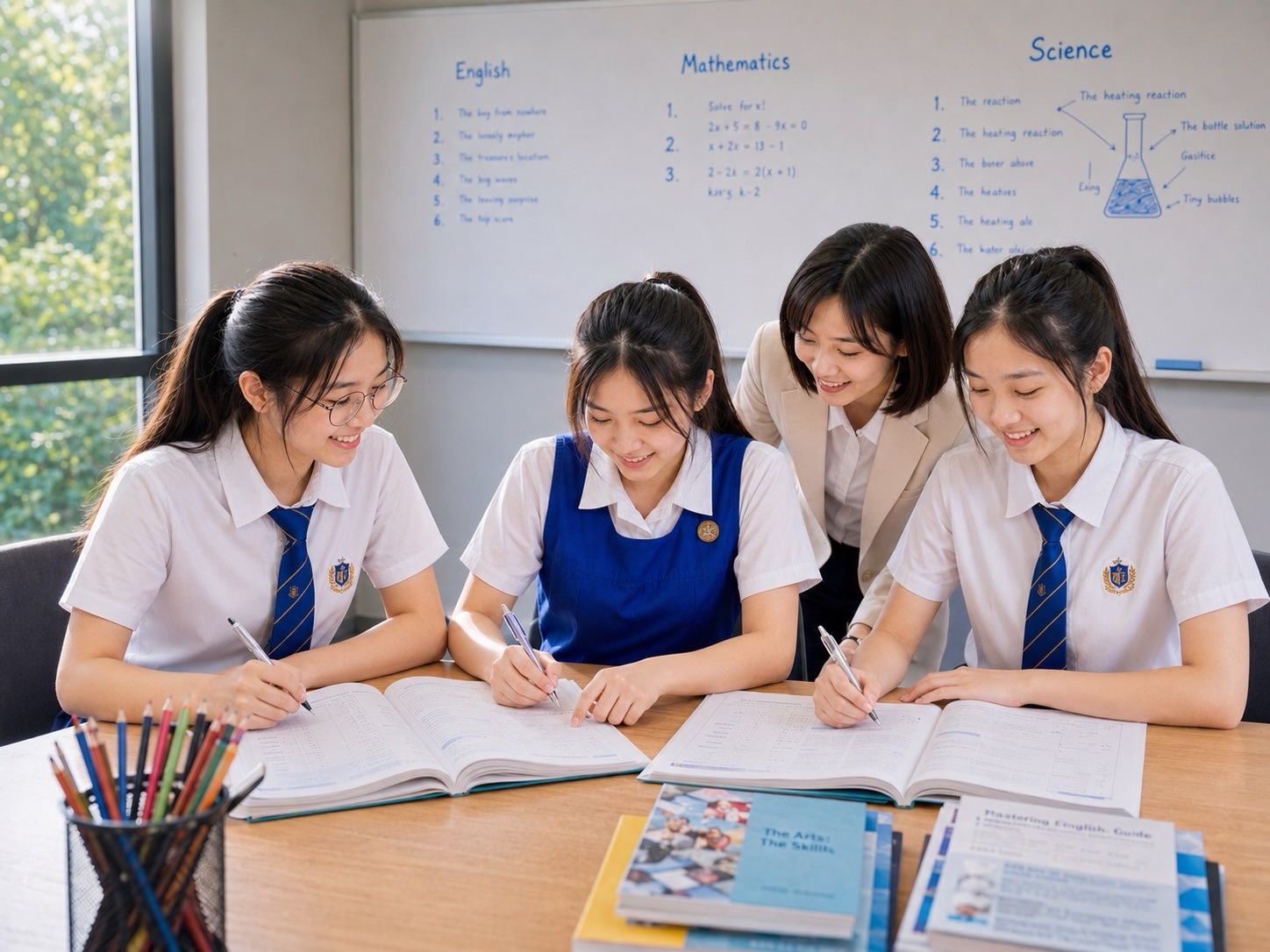
Quick Read: English in Singapore is not simply “British English used in Asia”. It is part of a multilingual national system. Singapore has four official languages—Malay, Mandarin, Tamil and English—while Malay is the national language. In schools, English is the medium of instruction and students also learn an official Mother Tongue Language under Singapore’s bilingual education policy.
This legacy page keeps its original title and URL and now functions as an eduKateSingapore library reference for English language in Singapore, Singapore English, Standard Singapore English, Singlish vs Standard English, bilingual education Singapore, English in Singapore schools, English vocabulary and English communication. The deeper teaching of English grammar, writing forms, literature, speaking and international examinations belongs to the federation’s English specialist estate; this page explains the Singapore language environment itself.
The Constitutional Language Framework
Singapore’s Constitution states that Malay, Mandarin, Tamil and English are the four official languages, and that Malay is the national language. The current text can be read at Singapore Statutes Online, Article 153A. This distinction matters: official language, national language and medium of instruction are not interchangeable labels.
| Term | Singapore context |
|---|---|
| Official languages | Malay, Mandarin, Tamil and English. |
| National language | Malay. |
| School medium of instruction | English. |
| Mother Tongue Languages in the school system | Chinese Language, Malay Language and Tamil Language are the official MTLs used in the mainstream bilingual framework. |
The Ministry of Education describes bilingualism as a cornerstone of the education system. Its current education overview states that the medium of instruction is English while students learn a Mother Tongue Language. See MOE’s education overview.
Why English Has Several Jobs at Once
English in Singapore performs overlapping functions. It is a school subject, the medium through which most other school subjects are taught, a common language across communities and a major language of higher education, business, science, technology and international communication. These functions reinforce one another.
A child therefore encounters English not only during English lessons. Mathematics instructions, Science explanations, project work, digital research, presentations and classroom discussion all depend on English literacy. Weakness in English can become a hidden load inside other subjects because the learner must decode the language before solving the subject problem.
In Singapore, English is both something students learn and the main language through which much other learning becomes accessible.
Singapore Is Deliberately Multilingual
The importance of English does not make Singapore monolingual. The education system is built around bilingualism, and language learning also carries cultural and community functions. A student may use different languages with grandparents, classmates, teachers, friends, media and online communities.
This means language proficiency should not be imagined as one language replacing another. Multilingual speakers often distribute vocabulary, emotion, identity and expertise across languages. The educational challenge is to build strong formal English while sustaining meaningful access to Mother Tongue languages and other community languages.
Standard Singapore English and Colloquial Singapore English
Singapore English exists across registers. At the formal end is Standard Singapore English, used in school writing, official communication, professional documents, formal presentations and most examination contexts. At the colloquial end are informal Singapore English varieties commonly grouped under the label Singlish.
The difference is not simply “correct English versus bad English”. Register is about suitability to context. Informal local speech can carry identity, humour, solidarity and cultural meaning. Formal Standard English is required when communication must be widely intelligible across audiences or meet institutional conventions.
| Situation | Likely language expectation |
|---|---|
| PSLE or SEC examination writing | Standard English. |
| Formal email to a school or employer | Standard English. |
| Academic report | Standard English with precise subject vocabulary. |
| Conversation among close friends | Informal English or code-switching may occur naturally. |
| Comedy, dialogue or local fiction | Colloquial Singapore English may be used deliberately for voice. |
| Public presentation | Usually Standard English, adjusted to audience and purpose. |
Code-Switching Is a Skill When It Is Controlled
Many Singaporeans move between languages and varieties depending on context. A speaker may use more formal English with a teacher, local colloquial features with friends and another language with family. This shifting is often called code-switching or style-shifting.
The educational goal is not to erase informal language. It is to make the student able to choose. Problems arise when a learner cannot switch into the register required for an examination, report, interview or formal presentation.
A useful question for students is therefore: Who is my audience, what is my purpose and what language does this situation require?
English as the Language of School Learning
Because English is the medium of instruction, academic English develops across subjects. The vocabulary of Science differs from the vocabulary of History; Mathematics uses ordinary words such as difference, product, factor and mean in specialised ways; Geography and Social Studies require explanation, evidence and evaluation.
A learner may speak fluent conversational English while still needing help with academic language. This is normal. Everyday fluency and disciplinary literacy overlap but are not identical.
| Everyday language | Academic extension |
|---|---|
| show | demonstrate, indicate, illustrate |
| change | increase, decrease, transform, vary |
| because | due to, because of, results from, is caused by |
| important | significant, essential, influential |
| look at | observe, examine, analyse |
| say | state, argue, explain, suggest, claim |
The aim is not to replace simple English automatically. Academic vocabulary should be used when it expresses the relationship more precisely.
English in Primary School
At Primary level, English development involves listening, speaking, reading, viewing, grammar, vocabulary and writing working together. A student who reads widely gains word knowledge and sentence patterns; vocabulary supports comprehension; grammar supports precise expression; oral language supports idea development.
These components should not be treated as isolated worksheets. A new word met in reading can be discussed orally, examined for word family and collocation, retrieved later and finally used in writing.
English in Secondary School
Secondary English becomes increasingly inferential and audience-aware. Students are expected to interpret viewpoints, understand purpose, summarise information, distinguish claims from evidence and produce writing for different situations. The language problem shifts from “Can I make a correct sentence?” toward “Can I control meaning across a whole text?”
This is also where background knowledge matters more. A comprehension passage about technology, culture or public life becomes easier when the reader already understands the topic well enough to focus on the writer’s language and argument.
Vocabulary in Singapore English Education
Vocabulary should be understood as a network, not a spelling list. A learner needs meaning, word class, collocation, tone, register, word family and context. The same word may behave differently across subjects or registers.
For example, significant in everyday academic writing can mean important; in Statistics, statistical significance has a technical meaning. Force in ordinary conversation can mean compulsion; in Physics, force is a technical quantity. Good vocabulary learning notices these shifts.
eduKateSingapore’s Vocabulary Article Directory is built around this deeper model of word knowledge.
Grammar Is a System of Relationships
Grammar is sometimes taught as a list of prohibitions: do not split this, never start with that, remember this tense rule. A more useful approach sees grammar as the system that tells readers how ideas relate. Subject-verb agreement identifies grammatical number; tense locates events; articles manage reference; conjunctions link clauses; pronouns track participants.
The purpose of grammar is intelligibility and control. A student should be able to explain why one structure fits better rather than merely memorise a correction.
Reading Builds More Than English Marks
Reading increases access to vocabulary, syntax, background knowledge and models of explanation. A child reading about volcanoes gains Science knowledge as well as English. A historical novel can build concepts that later make History passages easier. A mystery trains prediction and evidence. A biography exposes chronology, cause and consequence.
This is why reading should not be confined to “English books”. Knowledge and language grow together.
Writing Is a Test of Integrated Language
Writing exposes the whole system. The student must retrieve vocabulary, build grammatical sentences, organise ideas, maintain reference, anticipate an audience and decide what information can be left implicit. A weakness in any one layer can limit the whole piece.
Revision should therefore diagnose the layer. A story with weak causality does not need ten more adjectives. A report with unclear pronouns does not need a more dramatic conclusion. Repair the earliest broken link.
Speaking and Listening Are Not Secondary Skills
Oral communication builds the ability to organise thought in real time. Listening requires attention to emphasis, inference and intent. Discussion helps learners test whether an idea is clear before writing it.
Students who are reluctant to speak may still have strong ideas, so oral teaching should not confuse speed or confidence with depth. Give preparation time, structure and multiple routes into participation.
Singlish and Standard English: A Better Classroom Explanation
Students sometimes receive the message that local colloquial English must simply be “removed”. A more precise message is that language varieties belong to contexts. A phrase that builds warmth among friends may be unsuitable in a formal report. A local particle can carry subtle social meaning in conversation but will not normally belong in examination prose.
This approach respects linguistic identity while teaching register control. The student learns to expand the repertoire rather than replace one voice with another.
Common Singapore English Learning Challenges
| Challenge | What may be happening | Useful repair |
|---|---|---|
| Article errors | The learner’s other language may use reference differently. | Teach a/an/the through identifiable vs non-identifiable reference. |
| Tense inconsistency | The student tracks events but not grammatical time consistently. | Build timelines and edit verbs in a separate pass. |
| Preposition errors | Prepositions are conventional and resist direct translation. | Learn phrases and collocations, not isolated prepositions. |
| Over-formal vocabulary | The student associates difficulty with quality. | Teach register, collocation and precise simple alternatives. |
| Weak inference | The student locates facts but does not combine evidence. | Ask what the text shows, what is inferred and what evidence supports it. |
| Oral-to-written transfer | Conversational structures appear unchanged in formal prose. | Compare spoken and written versions of the same idea. |
English for International Students in Singapore
Students entering Singapore from another education system may face two tasks at once: learning subject content and adapting to the English used to teach and assess it. Conversational fluency can develop faster than examination literacy. Vocabulary, question language and expected answer structures therefore deserve explicit attention.
The goal is not accent elimination. Intelligibility, comprehension, register and control matter more than imitating one prestige accent.
English and Artificial Intelligence
AI tools make fluent text cheap, which makes language judgement more important, not less. Students need to recognise when a sentence is vague, when a source is unsupported, when vocabulary is inflated and when a generated explanation does not fit the task.
English proficiency now includes the ability to question language produced by machines. A learner who cannot evaluate tone, meaning and evidence may accept polished errors simply because they sound confident.
A Practical English Development Loop
- Read: encounter language in meaningful texts.
- Notice: identify useful words, structures or argument moves.
- Understand: explain meaning and function.
- Retrieve: recall without the text in front of you.
- Use: apply in speech or writing.
- Receive feedback: compare intended meaning with what the audience understood.
- Revise: repair the weakest layer.
- Transfer: use the skill in a new topic or genre.
This loop is more durable than completing disconnected grammar and vocabulary exercises because each stage feeds the next.
Frequently Asked Questions
Is English the national language of Singapore?
No. Singapore’s Constitution names Malay as the national language. English, Malay, Mandarin and Tamil are the four official languages.
Is English the medium of instruction in Singapore schools?
Yes. MOE describes English as the medium of instruction, while students also learn a Mother Tongue Language under the bilingual policy.
Is Singlish wrong English?
Singlish is a colloquial Singapore English variety with social and cultural functions. The practical educational distinction is register: formal school, academic and professional contexts normally require Standard English.
Why can a student speak English fluently but still struggle with comprehension or writing?
Conversational fluency and academic literacy are related but different. Academic tasks require specialised vocabulary, inference, text organisation and precise written control.
Should students stop using Singlish at home?
The educational objective is not to police family conversation. It is to ensure students can shift into Standard English when the context requires it.
How can vocabulary improve across subjects?
Read widely, learn words with their context and collocations, retrieve them later and reuse them in several subjects. Knowledge and vocabulary reinforce each other.
Source Notes and Library Routes
- Singapore Statutes Online — Constitution, Article 153A — official languages and national language.
- Ministry of Education — What Education in Singapore Looks Like — bilingualism and English as the medium of instruction.
- Vocabulary Article Directory — eduKateSingapore’s vocabulary shelf.
- Singapore Learning Library — the wider public-reference collection.
- SETC English Atlas — deeper grammar, reading, writing, oral and English examination routes.
Library note: This page began in 2015 as a short overview of English in Singapore. The 2026 library edition preserves its title and URL while rebuilding it as a national language reference: constitutional status, bilingual education, school language, Standard Singapore English, Singlish, code-switching, academic English, vocabulary, grammar, reading, writing and register control.