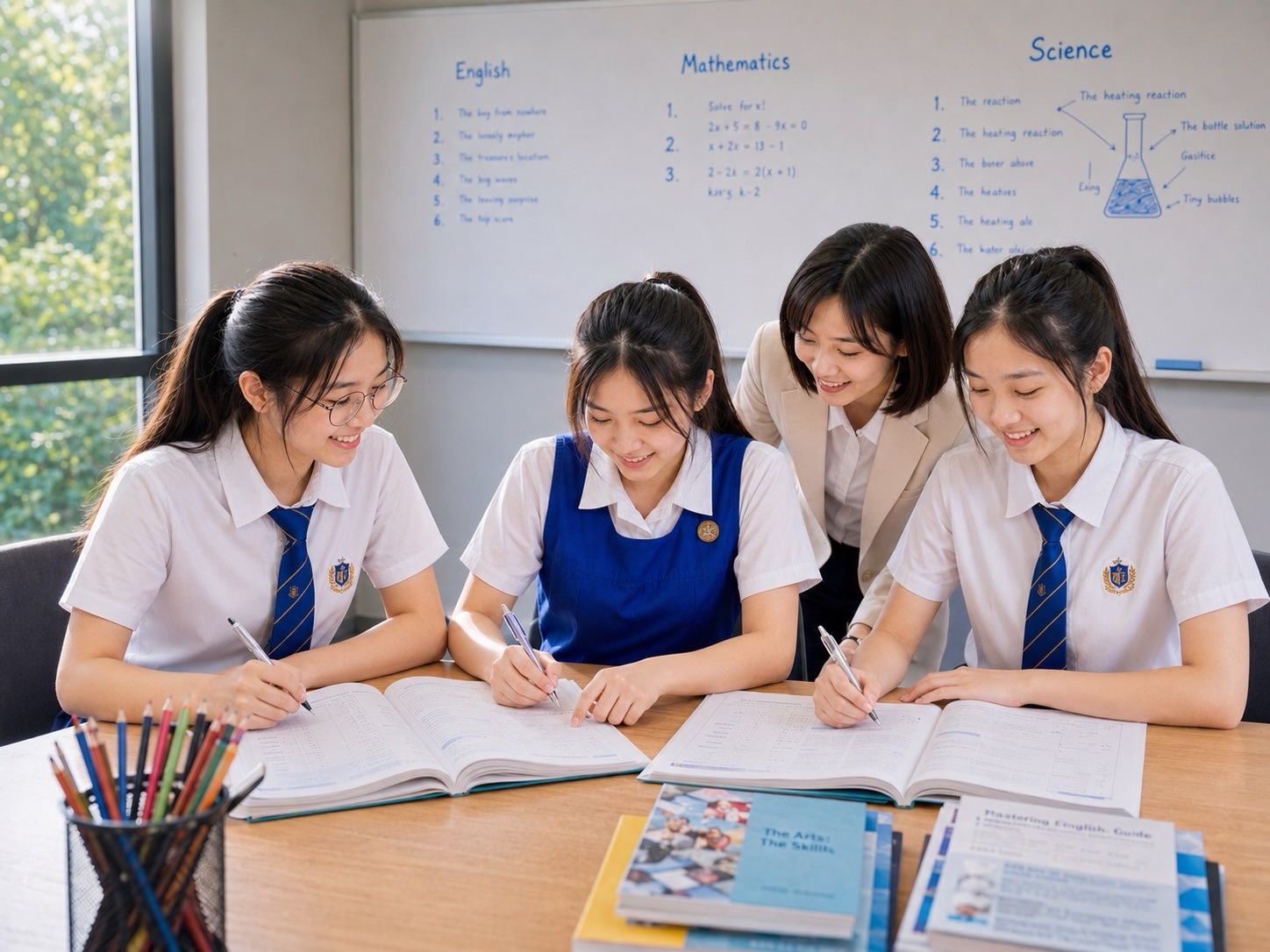
Originally published 7 February 2015 as an eduKate Yishun tuition page. Rebuilt in 2026 as a Primary 3 Science foundation guide aligned to Singapore’s current Primary Science progression.
Quick answer: Primary 3 is the start of the formal MOE Primary Science progression. The important job is not to memorise a long list of facts. Students should learn to observe carefully, classify using stated properties, describe life cycles, reason about magnets, distinguish evidence from inference and explain simple relationships clearly.
Archive boundary: this URL previously advertised an old eduKate Yishun centre and included grade, address and staffing claims. It is not a current centre listing. For current eduKate enquiries, use the Contact page.
Why Primary 3 matters
MOE’s Primary Science syllabus is organised from Primary 3 to Primary 6 so that concepts develop coherently across the themes of Diversity, Cycles, Systems, Interactions and Energy. At P3, the listed topics include diversity of living and non-living things, diversity of materials, life cycles in plants and animals, and interaction of forces through magnets.
This makes P3 a transition from everyday curiosity to disciplined scientific thinking. The child still explores the familiar world, but now must make observations explicit, use properties consistently and support explanations with evidence.
Observation comes before explanation
A young learner often jumps directly from seeing something to explaining it. Science introduces a useful pause.
- Observation: what can be seen, measured or directly described.
- Inference: what the observation may mean.
- Question: what further evidence would strengthen the explanation?
For example, “the leaf is drooping” is an observation. “The plant does not have enough water” is an inference that may be reasonable but should still be tested against the situation.
Classification is rule-based thinking
Classification is one of the earliest forms of scientific reasoning. The important question is not only which group an object belongs to, but which property defines the group.
- What property are we using?
- Does every member of the group satisfy it?
- What object would not belong?
- Could the same object be grouped differently for another purpose?
This prevents students from treating categories as arbitrary labels.
Living and non-living things
Students should learn to identify characteristics associated with living things and use those characteristics carefully. The deeper lesson is that scientific categories depend on observable or defensible criteria rather than intuition alone.
If a student says something is living “because it moves”, test the rule. Cars move too. The question becomes: which set of characteristics is more reliable?
Materials: properties determine use
When learning about materials, connect properties to purpose.
- transparent or opaque;
- waterproof or absorbent;
- flexible or rigid;
- strong or fragile;
- good or poor conductor at later levels where appropriate.
A useful reasoning chain is: required job → useful property → suitable material. This turns recall into design thinking.
Life cycles: sequence, change and continuity
Life-cycle questions should not become picture memorisation. Students should identify stages, sequence changes and recognise that different organisms can have different life-cycle patterns.
- What stage comes first?
- What changes between stages?
- Which features remain recognisably linked to the organism?
- How is one organism’s cycle similar to or different from another’s?
This begins a broader scientific idea: systems change through time while preserving continuity.
Magnets: observe the interaction
Magnetism is useful because children can observe attraction and repulsion directly. The learner should move beyond “magnets stick” to more precise statements about which materials respond, how poles interact and how distance can affect the observable force.
A strong investigation changes one condition at a time where possible and records the outcome rather than relying on memory.
The Primary 3 inquiry loop
- Notice: what happened?
- Describe: what can be stated directly?
- Compare: what changed?
- Ask: what might explain the difference?
- Test: what evidence would help?
- Explain: what conclusion is supported?
- Limit: what remains uncertain?
Science vocabulary should attach to concepts
Technical words are useful when they make a relationship more precise. They become weak when learned as isolated spellings. Ask the student to define a term, recognise it in a new example, use it in an explanation and distinguish it from a neighbouring idea.
Question reading is already part of Science
- State: give the requested fact.
- Describe: say what is observed.
- Compare: identify the relevant similarity or difference.
- Explain: connect reason and result.
- Predict: say what is likely to happen based on the relationship.
Students should learn early that knowing the topic is not enough if the answer performs the wrong job.
A P3 error ledger
- Knowledge: fact or concept missing.
- Classification: grouping rule inconsistent.
- Observation: relevant detail missed.
- Inference: conclusion unsupported.
- Sequence: life-cycle order misunderstood.
- Relationship: cause/effect not connected.
- Language: idea known but expressed too vaguely.
From P3 to P4
The strongest preparation for P4 is not rushing ahead through every future chapter. It is making P3 habits stable: careful observation, consistent classification, evidence-based explanation, accurate question reading and the ability to retrieve old ideas after a delay.
How parents can see genuine progress
- the child explains the rule used for classification;
- observations and guesses are kept distinct;
- new examples can be handled without copying the original worksheet;
- the learner asks more precise “why” and “how do we know?” questions;
- corrections survive after a delay;
- less adult prompting is required for familiar routines.
Knowledge routes from this page
- Biology: living things and life cycles.
- Materials science: properties and uses.
- Physics foundations: magnetic interactions.
- Scientific inquiry: observation, comparison and evidence.
- English: precise description and explanation.
- Learner development: curiosity becoming disciplined inquiry.
What not to conclude
- Do not use this page as a current Yishun centre listing.
- Do not promise a PSLE result from P3 tuition.
- Do not reduce Science to worksheets or vocabulary lists.
- Do not treat every plausible inference as proven.
- Do not rush past observation and classification; they are foundations for later Science.
Current curriculum reference: MOE Primary Science Teaching & Learning Syllabus, Primary Three to Six.
Primary 3 Science Is the Beginning of Formal Scientific Thinking
Primary 3 is where many children first meet Science as a school subject with explicit concepts, observations, classifications and explanations. The goal should not be to turn curiosity into memorisation. It should be to give curiosity a method.
This independent eduKate guide is for Yishun families and does not imply affiliation with any school. The child’s own observations, questions and marked schoolwork should guide support.
Start With Noticing
Science begins with careful observation. Ask children to describe colour, shape, texture, movement, size, sequence and change before offering an explanation. “The leaf became yellow” is an observation. “The plant lacked something it needed” is already an interpretation.
Observation and Inference Are Different
Primary 3 is a good stage to separate what is directly seen from what is inferred. The child can observe wet ground and infer that it may have rained, but the rain itself was not observed.
This distinction becomes important later in experiments and open-ended questions.
Questions Should Be Testable Where Possible
Children ask many good questions. Help them distinguish questions that can be investigated through observation or simple testing from questions that require reading, expertise or broader research.
Classification Is Reasoning With Criteria
Grouping is not just sorting by appearance. A classification uses a stated property and applies it consistently. Students should be able to explain why an item belongs in one group rather than another.
One Object Can Belong to Different Valid Groups
A material can be grouped by colour, hardness, transparency or whether it is magnetic. The classification changes when the criterion changes. This teaches children that categories depend on the question being asked.
Living and Non-Living Things Need Evidence
Students should not rely only on movement. Some living things do not move visibly, and some non-living things move. Use several characteristics and reason from evidence.
Plant Parts Need Functions
Roots, stems, leaves and flowers should be connected to what they do. Structure-function thinking is more durable than memorising labelled diagrams.
Animal Features Need Purpose
Ask how a body part helps the animal move, obtain food, protect itself or live in its environment. Avoid turning every feature into a memorised sentence without context.
Life Cycles Need Sequence and Change
Students should identify stages and describe what changes from one stage to the next. Life cycles are not merely circular diagrams to memorise.
Compare Life Cycles
Compare two organisms. Which stages are similar? Which differ? Does the young resemble the adult? Comparison builds transfer rather than isolated recall.
Magnets Are Best Learned Through Interaction
Children should test attraction and repulsion, identify magnetic materials and observe that magnetic effects can act without direct contact in some situations.
The observation should come before the formal statement whenever safe and practical.
Magnetic and Non-Magnetic Are Material Properties
Students should classify based on the test result, not on whether an object looks metallic. This teaches evidence-based classification.
Materials Have Properties
Hardness, flexibility, transparency, absorbency and other properties help determine how materials are used. Ask the child to connect the property to the object’s function.
Choosing Materials Is a Design Problem
If designing a raincoat, window or container, which properties matter? Science becomes practical when the learner uses properties to justify a choice.
Heat Can Be Observed Through Change
Children can notice warming, cooling, melting or drying in everyday life. Keep explanations at the appropriate level while encouraging careful observation and comparison.
Light Helps Us See
Students can investigate shadows, transparency and how blocking light changes what is visible. The aim is to build a simple relationship between source, object and observation.
Shadows Need Conditions
A shadow changes when the position of the light source, object or screen changes. Ask children to predict before moving the setup.
Prediction Should Come Before Testing
Prediction is valuable because it makes the child’s current model visible. After the test, compare the outcome with the prediction and ask what should change in the explanation.
Fair Comparisons Can Begin Simply
Primary 3 children can understand that if several things change at once, it becomes hard to tell what caused the result. Keep one main difference and compare.
Recording Observations
Simple tables, labelled drawings and short sentences help students preserve evidence. The record should be clear enough that someone else can understand what happened.
Drawing Is a Scientific Tool
A useful Science drawing shows relevant features and labels. It does not need artistic shading or decoration. Clarity matters more than beauty.
Tables Need Headings
Teach students to label what each column represents. Organised data make comparison easier and prepare the child for later graph work.
Science Language Should Become More Precise Gradually
Children may begin with everyday language. The teacher can refine it into more precise scientific vocabulary without making the child afraid to speak. Meaning should lead terminology.
Explain Using Cause and Effect
Use simple chains: because this changed, that happened. This prepares the child for the more demanding open-ended explanations of upper primary.
Avoid Keyword Dumping Early
If children learn that Science answers are lists of special words, later reasoning becomes harder. Encourage complete relationships even when the vocabulary remains simple.
Reading Science Questions
Ask what is given, what changed and what is being asked. This small reading routine prevents the child from answering from memory without using the evidence.
Build an Error Ledger Gently
Record only repeated patterns: missed comparison, vocabulary confusion, ignored evidence, incomplete explanation. The ledger is for diagnosis, not punishment.
Correction Should Include Retelling
After a correction, ask the child to explain the idea in their own words. This reveals whether the learner understood or merely copied.
Use Home Science
Cooking, plants, shadows, magnets, containers and weather all create opportunities for observation. The adult does not need to turn every activity into a formal experiment. One good question can be enough.
A Primary 3 Lesson Rhythm
- observe or retrieve;
- ask a question;
- teach one concept;
- compare examples;
- record evidence;
- explain in words;
- apply to a new situation.
Small-Group Primary Science
Three students may notice different features of the same setup. Comparing observations teaches children that evidence can be shared and interpretations can be checked.
Parents: Ask Before Telling
Instead of immediately supplying the fact, ask what the child notices and what they think will happen. This gives the learner practice constructing a model.
What Progress Looks Like
- more careful observations;
- more consistent classification;
- better life-cycle comparisons;
- clearer cause-and-effect language;
- more evidence-based predictions;
- greater willingness to revise an idea after testing.
Preparing for Primary 4
By the end of Primary 3, the child should be comfortable observing, grouping, comparing, predicting and explaining simple relationships. These habits make later experimental and open-ended work much easier.
Final Guide
Primary 3 Science should protect curiosity while adding discipline. Notice carefully, classify with criteria, predict before testing, record evidence and explain what the evidence means. That is the beginning of scientific thinking.
Build an Observation Journal That Children Actually Use
A Primary 3 observation journal should be light enough to maintain. One page can contain date, object or phenomenon, three observations, one question and one prediction. Drawings are welcome when they record relevant features.
The journal develops attention over time and gives the child evidence of how questions become more precise.
Teach Measurement as More Precise Observation
“The plant grew” is an observation. “The plant grew three centimetres in five days” is more precise. Simple measurement introduces the idea that Science can quantify change.
Repeat Observations Over Time
One observation can miss a pattern. Watching the same plant, shadow or weather feature across several days teaches children that some scientific questions require patience.
Classification Trees
Children can build simple decision trees: Does it have this property? If yes, move here; if no, move there. This introduces structured classification without advanced terminology.
Criteria Should Be Observable
A classification criterion should be something the child can identify consistently. “Nice-looking” is subjective; “has wings” or “is magnetic” is clearer.
Use Mystery Objects
Describe properties without naming the object and ask the child to infer which category it belongs to. This makes classification depend on evidence.
Life-Cycle Cards
Give stages out of order and ask students to sequence them, then explain one change between each pair. This is stronger than simply copying a circular diagram.
Compare Young and Adult Forms
Some young organisms resemble adults; others look very different. Comparison helps students notice patterns across species.
Use School-Garden Science
A garden or park can support observation of leaves, insects, seeds, shade, moisture and change. Children should observe without disturbing living things unnecessarily.
Build Responsibility Into Nature Study
Scientific curiosity should include care. Do not remove organisms simply to inspect them if observation can happen safely where they are.
Magnet Investigation: Predict, Test, Sort
Choose safe household objects, predict which will be attracted, test them and sort by evidence. Then compare predictions with results.
Investigate Distance
Students can observe whether magnetic interaction changes with distance in a safe simple setup. The goal is not advanced measurement but recognising that conditions affect observations.
Material Choice Challenge
Ask which material would suit a window, towel, umbrella or container and why. The child must connect property to function.
Transparency Comparison
Compare transparent, translucent and opaque examples at an appropriate level. Let the child describe what can be seen through each before naming categories.
Absorbency Investigation
Compare equal-sized samples under similar conditions. Ask what should be kept the same for the comparison to be meaningful. This introduces fair testing naturally.
Shadow Investigation
Change distance between light source and object and observe what happens to the shadow. Predict first, then record the result.
Use Before-and-After Drawings
Draw a setup before and after a change. Side-by-side visuals help children describe differences precisely.
Introduce Simple Variables Through Language
Use phrases such as “the thing we changed”, “the thing we observed” and “the things we kept the same” before requiring formal terminology. Meaning should precede labels.
Prediction Is Not Guessing Randomly
Ask the child to give a reason based on previous observation or a known property. A prediction can be uncertain while still being evidence-based.
Use Unexpected Results Productively
If the result differs from the prediction, do not rush to label the child wrong. Ask what new information the result provides and whether the test should be repeated.
Repeat When Reliability Matters
Children can understand that one unusual result may be a mistake or an exception. Repeating a simple observation can show whether the pattern is consistent.
Use Simple Data Tables
Record object, prediction and result in three columns. Tables help children see patterns across several tests.
Move From Table to Statement
After recording, ask the child to write one sentence describing the pattern. This connects data with language.
Use “I Notice / I Think / I Wonder”
This three-part routine separates observation, interpretation and question. It is simple enough for Primary 3 and builds habits that remain useful later.
Science Reading
Short non-fiction texts can extend classroom topics. Ask the child to identify one new fact, one word and one question rather than completing a long worksheet.
Science Vocabulary in Context
Words such as classify, observe, predict, attract and absorb should appear in complete sentences and real activities. Vocabulary becomes memorable when attached to action.
Oral Explanation Before Written Explanation
Let the child explain what happened aloud, then improve the wording. Writing becomes easier when the reasoning already exists in speech.
Use Correction as Conversation
Ask which part of the answer is supported and which part needs changing. This teaches children to revise ideas rather than fear correction.
A Weekly Discovery Cycle
- observe something;
- record it;
- ask a question;
- predict;
- test or research safely;
- compare result with prediction;
- explain one conclusion.
The Parent’s Role
Parents provide safety, materials and questions. They do not need to turn every exploration into a lecture. The child should retain ownership of noticing and wondering.
The Tutor’s Role
The tutor makes the child’s thinking visible, introduces precise language at the right time and connects one observation to a broader concept without overwhelming the learner.
Final Primary 3 Standard
Primary 3 Science is successful when the child becomes more observant, more systematic and more willing to revise an idea after evidence. That is a stronger foundation than memorising isolated model answers.
Primary 3 Science FAQ
Should children memorise Science notes at Primary 3?
Some vocabulary and facts need remembering, but meaning should come first. Let children observe, compare and explain before expecting large amounts of recall.
What if a child gives the wrong prediction?
Use the result as feedback. Ask what the child observed and what new prediction would make sense now. Wrong predictions are valuable when they lead to model revision.
Worked Example: Classification
Give four objects and ask for two different valid ways to group them. The child must state the criterion each time. This teaches that categories depend on the property being considered.
Worked Example: Life Cycle
Provide mixed-up stages and ask the child to sequence them, then explain one change between each stage. Sequence plus change is stronger than memorising a circle.
Worked Example: Magnets
Ask for predictions before testing several safe objects. After testing, sort by evidence and discuss any surprising result. The child learns that appearance is not proof.
Primary 3 Inquiry Checklist
- observes before explaining;
- uses a consistent sorting rule;
- makes a prediction with a reason;
- records a result clearly;
- compares result with prediction;
- can change an idea after evidence.
A Primary 3 Scientific Thinking Ladder
- Notice carefully.
- Name the property or change.
- Compare with another case.
- Ask a question.
- Make a prediction with a reason.
- Observe or test safely.
- Record what happened.
- Explain what the evidence suggests.
This ladder turns curiosity into a repeatable process without making Primary 3 Science overly formal.
Use Familiar Phenomena to Build Transfer
Once a child understands absorbency with paper and cloth, ask about towels and raincoats. Once magnetic testing is understood with classroom objects, ask how the same evidence could be used with a new object. Transfer begins with small context changes.
Use Child-Generated Questions
Invite the child to choose one question from the observation journal for further investigation. Ownership increases attention and teaches that Science begins with questions, not only teacher instructions.
Use “What Evidence Changed My Mind?”
After a surprising result, ask what specific observation caused the student to revise the original idea. This introduces evidence-based belief change in age-appropriate language.
The Final Primary 3 Goal
By the end of Primary 3, the child should not merely know more Science facts. The child should have a stronger method for learning Science: observe, compare, predict, test, record and revise.
A Primary 3 Discovery-to-Inquiry Handbook
Primary 3 is the right stage to move gently from free curiosity toward structured inquiry. The child should still enjoy noticing and asking questions, but can now learn that good investigations have a focus, a prediction, a method and a record of what happened.
From “Why?” to an Investigable Question
A broad question such as “Why do plants grow?” can become “Does this plant grow differently in two light conditions?” The narrower question is easier to observe and record. Adults can help children shrink questions without taking ownership away.
From Prediction to Reason
Ask the child to complete “I think ___ because ___.” The reason may be simple. Its purpose is to reveal the child’s current model so the result has something to compare against.
From Activity to Evidence
After testing, record one or two observations that answer the original question. Avoid adding unrelated details. Children begin learning that evidence should be relevant, not merely abundant.
From Evidence to Conclusion
Use a simple sentence: “The results suggest ___ because ___.” This introduces the idea that conclusions depend on observations and may need revision if later evidence changes.
From One Trial to Repetition
If the result is surprising, repeat the observation where safe and practical. Children learn that one result can be checked rather than accepted automatically.
From Words to Tables
When several objects or days are compared, organise the observations in a simple table. This reduces memory load and makes patterns easier to see.
From Tables to Patterns
Ask what happened most often, which value changed or which group shared a property. Pattern recognition is the bridge from recording to reasoning.
From Pattern to New Question
Every conclusion can create another question. If one material absorbed more water, what other materials might behave similarly? If one shadow changed, what would happen if the light moved farther away? Inquiry becomes cyclical.
The Primary 3 Inquiry Notebook
- question;
- prediction and reason;
- what was changed or compared;
- observation or measurement;
- conclusion;
- new question.
The notebook should remain simple. Its purpose is to organise thinking, not to imitate an adult laboratory report.
A Final Parent Rule
When the child gives an answer, ask “What did you observe that makes you think that?” This keeps reasoning connected to evidence and helps scientific habits become part of ordinary conversation.
A Final Primary 3 Inquiry Project
Choose one safe everyday question that can be observed across several days—for example, how a plant changes, how a shadow moves, or which material property affects a simple use. Let the child own as much of the process as possible.
- Write the question.
- Make a prediction with a reason.
- Decide what will be observed or compared.
- Record results with drawings, words or simple measurements.
- Describe the pattern.
- State what the evidence suggests.
- Ask one new question.
The project should remain small. Its purpose is to let the child experience the whole inquiry cycle from question to evidence to revised thinking. When Primary 3 students begin to see that Science is a way of finding out rather than a book of answers, later formal learning has a stronger foundation.
A Final Primary 3 Mini-Inquiry
Choose a safe question such as whether two materials absorb water differently. Ask the child to predict which will absorb more and explain why. Use equal-sized samples and the same amount of water so the comparison is easier to interpret.
After observing, record the result in a simple table or labelled drawing. Then ask the child to compare prediction and result. If the outcome differs, the correct response is not embarrassment; it is curiosity about what the evidence now suggests.
Next, change the context without changing the reasoning. Ask which material would be better for a towel or rain cover and why. The child now uses the observed property to make a practical decision.
This small inquiry contains the whole Primary 3 scientific cycle: question, prediction, controlled comparison, observation, record, conclusion and transfer. Repeating the same thinking architecture across different topics is more valuable than racing through advanced content.
The Final Parent Prompt
When the child gives an answer, ask one final question: “What did you observe that makes you think that?” Over time, this simple prompt teaches that Science claims should connect to evidence.
A final classroom habit can be to end each investigation with two sentences: “The evidence showed ___” and “Now I wonder ___.” The first sentence anchors the child in what was actually observed; the second preserves curiosity and points toward the next question.
This simple ending balances discipline and discovery. Science does not stop when an answer is found. New evidence often creates a better question, and Primary 3 is an ideal stage to make that cycle feel normal.
The best Primary 3 Science questions often begin with familiar objects because the child can focus on the reasoning instead of struggling to understand the context. Once the inquiry pattern is secure, the same habits can be carried into less familiar topics.
That is why a small investigation with leaves, magnets, shadows or absorbent materials can be educationally powerful. The content may be simple, but the child is rehearsing observation, prediction, evidence, comparison and revision of ideas.
Those habits compound. By Primary 4 and beyond, the topics become more complex, yet the learner already knows how to approach a question as something that can be examined rather than merely remembered.
Primary 3 Science is strongest when children learn that a surprising result is an invitation to look again. Repeating an observation, checking the setup and comparing evidence teach that Science grows through careful revision rather than instant certainty. That attitude matters beyond any single topic. It prepares the learner to approach future questions with curiosity, patience and a willingness to change an explanation when the evidence improves.
Primary 3 Science should leave the child with a repeatable way to investigate the world: observe carefully, compare consistently, predict with a reason, record evidence, revise the explanation and ask a better next question. When that cycle becomes familiar, later formal Science feels like an extension of existing habits rather than a completely new subject.
The final Primary 3 inquiry habit is to separate what was observed from what is believed. Children should increasingly be able to say, “I observed this, so I think this,” and then change the second part if later evidence disagrees. That small distinction is one of the foundations of scientific reasoning.
Scientific thinking grows when evidence can change the child’s explanation.
Evidence should guide explanation, comparison and revision of ideas.
Good Science questions grow from careful observation, evidence and curiosity.
Evidence guides better explanations.