This page is no longer a 2015 Yishun centre advertisement.
It was first published in February 2015 with an old Yishun address, tutor-specific claims and promises about achieving an A*.
Those operational details are obsolete and have been retired.
The URL survives because the educational question underneath it is still useful:
What should a good Primary 6 Science tutor actually do when PSLE is close enough that every lesson now has to produce transferable, independent performance?
This 2026 rebuild owns that job.
It is not another generic PSLE Science syllabus page. eduKate already has those.
This is the tutor-diagnosis and independence page.
Quick answer: the tutor should find the first failing layer
A Primary 6 student can lose the same five marks for very different reasons.
- The concept was never understood.
- The concept was understood but could not be retrieved.
- The question was misread.
- The evidence in a diagram or table was not noticed.
- The right concept was named but the causal mechanism was not explained.
- The student knew the answer but expressed it too vaguely.
- The student ran out of time.
All seven can produce a wrong answer.
They do not need the same teaching.
The tutor’s first job is not to add more questions. It is to identify the earliest point at which the student’s Science system stops working.
The 2026 PSLE Science paper changed
PSLE Science is examined under a revised format from 2026 and assesses the 2023 Primary Science syllabus.
SEAB states that candidates are assessed in two broad areas:
- Knowledge with Understanding — scientific facts, concepts and principles.
- Application of Knowledge and Scientific Inquiry — applying ideas, predicting, forming hypotheses, analysing information, evaluating observations and methods, and communicating explanations and reasoning.
Official source: SEAB — PSLE Formats Examined in 2026.
The current paper in one table
| Booklet | Item type | Questions | Marks |
|---|---|---|---|
| A | Multiple-choice | 30 | 60 |
| B | Structured | 10–11 | 40 |
The whole paper is 1 hour 45 minutes. Booklet A contains 30 MCQs worth 2 marks each. Booklet B contains 10–11 structured questions worth 2–5 marks each.
That format matters because a tutor is preparing the child for two related but different behaviours.
- In MCQ, the child must discriminate between plausible alternatives.
- In structured questions, the child must construct enough scientific reasoning to make the answer visible.
A tutor should begin with marked work, not assumptions
If a parent says, “My child is weak in Science,” that is too compressed to teach from.
Bring one recent school paper.
Bring one ordinary homework set completed without heavy adult help.
Then inspect the work.
- Which topics lose marks?
- Which question structures create failure?
- Are mistakes repeated?
- Can the student explain why the marked answer is wrong?
- Can the student self-correct without seeing the model answer?
- Does the student change the answer correctly when the context changes?
The paper is not merely a score.
It is a trace of the learner’s reasoning.
The eight P6 Science layers we diagnose
1. Concept knowledge
Does the student know the scientific relationship being tested?
A learner cannot reason accurately from a concept that was never secured.
2. Retrieval
Can the student produce the concept without notes, tutor cues or seeing the same worksheet format?
Recognition during revision is weaker than independent retrieval during an examination.
3. Question reading
Does the child know what the command word is asking?
- state;
- describe;
- explain;
- compare;
- predict;
- suggest;
- give a reason.
A scientifically knowledgeable child can still lose marks by answering a different question from the one printed.
4. Evidence extraction
Can the student identify the relevant information in a table, graph, apparatus diagram, sequence, photograph or experimental description?
Science questions often hide the evidence inside a representation.
5. Mechanism
Can the student explain why the observed result follows from the scientific idea?
This is where keyword-only learning often breaks.
6. Scientific communication
Can the student express the relationship clearly enough that the reasoning is visible?
A correct thought hidden inside vague language is difficult to credit.
7. Transfer
Can the learner use the same idea after the surface details change?
Transfer is the difference between memorising a model answer and understanding a scientific relationship.
8. Examination execution
Can the student maintain these abilities through a 1 hour 45 minute paper, recover from a difficult item and finish with enough attention to check useful things?
The open-ended answer chain
Many weak Science answers contain a keyword but no chain.
For example:
“Because of evaporation.”
That may name a relevant process.
It does not necessarily explain the result.
A useful answer architecture is:
condition/evidence → scientific concept → mechanism → observed outcome.
The exact wording changes with the question.
The causal discipline remains.
Example: do not stop at the concept name
Suppose a question describes water disappearing more quickly from one setup than another.
Weak answer:
“Evaporation.”
Stronger reasoning identifies:
- the changed condition;
- how that condition affects evaporation;
- why more water therefore changes state over the same period;
- how that produces the observed difference.
The tutor should teach the relationship, not one sentence template.
Keywords are retrieval hooks—not complete answers
Words such as heat, energy, oxygen, friction, pollination or condensation can point toward a scientific model.
The model still has to be connected to the evidence.
A keyword is useful when it opens the reasoning. It fails when the student treats the word itself as the reasoning.
MCQ is a misconception detector
Booklet A is not merely the “easy” part of the paper.
Strong MCQs are designed so that wrong options correspond to plausible errors.
After a wrong MCQ, do not only record the correct letter.
- Why did the chosen option look attractive?
- What concept or representation was misread?
- What evidence rules the distractor out?
- Would the student make the same error if the diagram changed?
The wrong option tells the tutor something about the learner’s internal model.
Structured questions expose the reasoning chain
Booklet B requires the learner to make more of the thinking visible.
This is where we inspect:
- precision of terms;
- cause and effect;
- use of experimental evidence;
- comparison language;
- graph interpretation;
- whether the conclusion actually answers the question.
Model answers can help after the student attempts the question.
They become harmful when copied before the learner understands why each clause is necessary.
Experiments are not a list of memorised phrases either
Students often memorise:
“Keep all variables the same except…”
That is useful language.
The child still has to understand the logic of a fair comparison.
- What is being changed?
- What is being measured?
- What must remain controlled?
- What evidence would support the hypothesis?
- What result would weaken it?
- Is the method capable of answering the stated question?
That is scientific inquiry rather than phrase recall.
Observation and inference must stay separate
Observation:
The water level decreased by 3 cm.
Inference:
Some of the water may have left the setup through a particular process.
The second statement interprets the first.
Students who collapse observation into inference often overclaim what an experiment shows.
Graphs and tables need a reading routine
- Read the title or stated variable.
- Identify axes or columns.
- Check units.
- Look for trend or comparison.
- Locate the evidence needed by the question.
- Only then explain.
This slows the student down by a few seconds to prevent a larger wrong-answer pathway.
Primary 6 Science is cumulative
PSLE does not test only concepts learned in Primary 6.
The 2023 Primary Science syllabus is organised around five connected themes:
- Diversity;
- Cycles;
- Systems;
- Energy;
- Interactions.
MOE explicitly notes that these themes should not be treated as isolated blocks. Scientific ideas connect across them.
Official source: MOE — Primary Science Teaching and Learning Syllabus 2023.
This means a P6 tutor has to repair older weak links when they appear.
Do not protect the P6 timetable by ignoring a P4 gap
If the current question depends on an earlier concept, the tutor has two choices.
Patch around the gap.
Or repair it.
Near PSLE, time is scarce, so repair must be selective.
But pretending the prerequisite is secure does not save time if the same gap causes failure in five later topics.
Repair the earliest weak link with the largest downstream cost.
A P6 tutor should maintain an error ledger
| Error | Failure layer | Repair | Retest |
|---|---|---|---|
| Named concept but no mechanism | Explanation | Causal-chain practice | Different context |
| Wrong variable identified | Inquiry | Experimental-design comparison | New setup |
| Graph read from wrong axis | Representation | Axis/unit routine | New graph |
| Old concept forgotten | Retrieval | Spaced short recall | Several days later |
| MCQ distractor repeatedly chosen | Misconception | Contrast correct/incorrect model | Changed distractor set |
The ledger prevents a tutoring programme from becoming a stream of disconnected corrections.
Corrections need a return date
A corrected answer on Tuesday can look perfect because the explanation is fresh.
The useful question is whether the repair survives.
- same day: can the child explain the error?
- several days later: can it be retrieved?
- later still: can it transfer to a changed question?
- under time: can it survive examination conditions?
This is the lag-time problem applied to Science.
Related eduKate guide: Understanding Lag Time in Studies.
Small-group tuition should make thinking observable
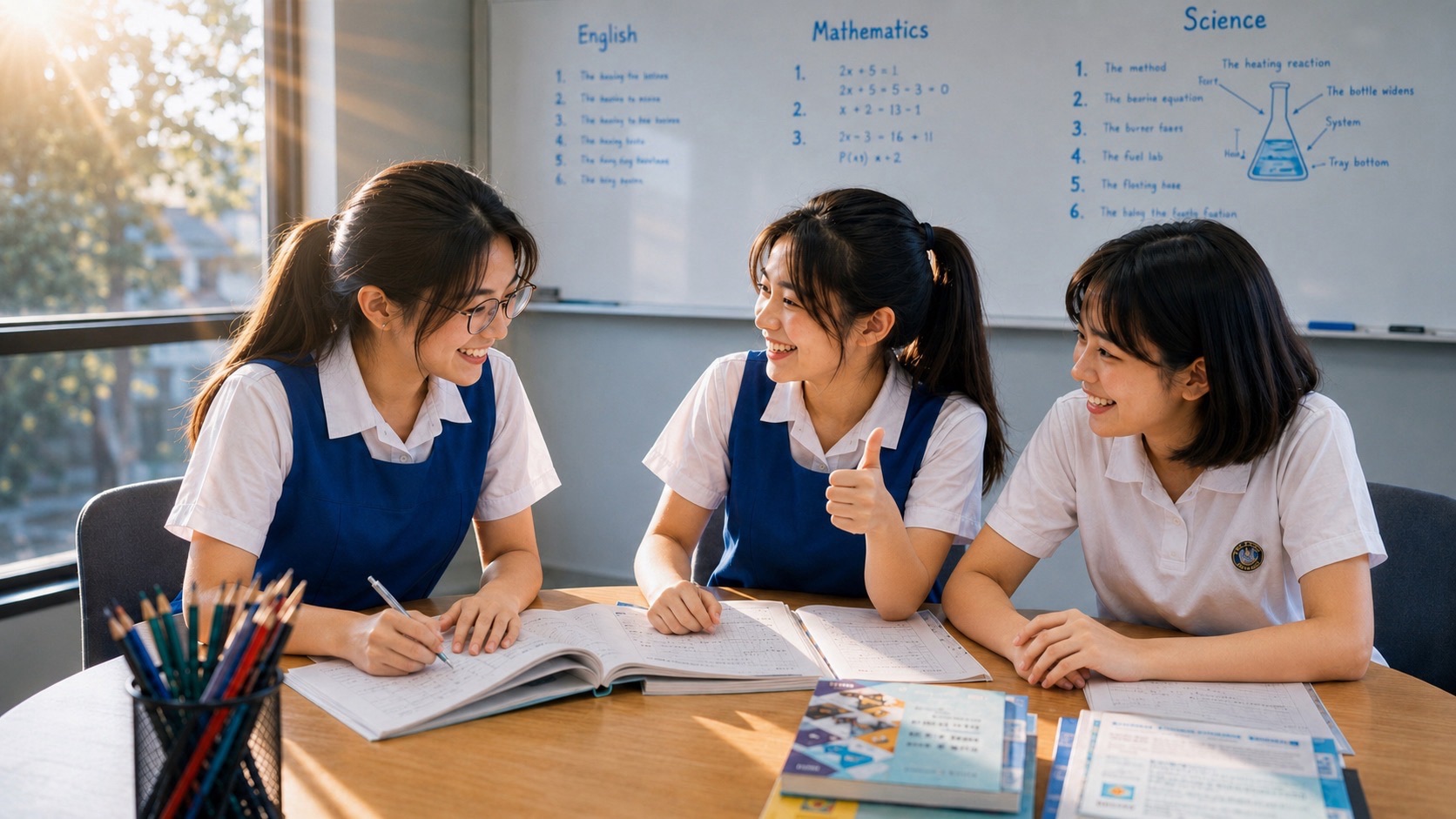
eduKate’s small-group model is useful when the tutor can inspect individual reasoning closely while students also hear alternative questions and explanations from peers.
The mechanism is not “three chairs = better learning”.
The mechanism is:
- individual errors remain visible;
- questions can be answered before confusion compounds;
- students can compare reasoning;
- the tutor can vary prompts by learner;
- support can be faded deliberately.
A small group delivering one generic explanation to everyone can still miss the learner.
The tutor should not become the student’s external brain
This is the central P6 danger.
A tutor can become very good at rescuing the child.
A prompt is given.
The student answers.
The page looks successful.
Then the examination removes the tutor.
P6 tuition succeeds when the child can increasingly reproduce the reasoning without the tutor present.
Use a fading-support ladder
- Tutor models the reasoning.
- Student completes a similar example with explicit prompts.
- Prompt becomes a question rather than an instruction.
- Student attempts independently.
- Context changes.
- Retrieval is delayed.
- Question appears inside a mixed timed set.
Each step removes part of the support.
Full papers are integration tests
A full PSLE Science paper tests more than Science content.
- retrieval across themes;
- switching between MCQ and structured reasoning;
- reading unfamiliar representations;
- time allocation;
- attention after fatigue;
- recovery after a difficult question.
That is why full papers matter.
But they should not replace targeted repair.
paper → diagnose → repair → retrieve → transfer → next paper.
Do not turn P6 Science into model-answer transcription
Model answers are useful for comparing precision after an attempt.
They are dangerous when the student memorises the surface wording without the relationship.
A tutor should ask:
- Which part of this sentence carries the scientific mechanism?
- Which words are specific to this experiment?
- Which relationship would remain if the objects changed?
- Can you answer the same concept in a new setup?
If not, the answer has not transferred.
The student should learn to distinguish knowledge from answer construction
Sometimes the concept is correct but the answer is weak.
Sometimes the writing sounds scientific but the concept is wrong.
These two failure modes require different repairs.
- Knowledge problem: rebuild the model.
- Communication problem: make the existing model visible accurately.
PSLE Science vocabulary should increase precision, not decoration
Scientific terms are useful because they preserve specific relationships.
The student should know:
- what the term means;
- what it does not mean;
- what evidence would justify using it;
- which nearby term could be confused with it.
Precision beats “scientific-sounding” language.
What parents in Yishun should bring to a first tutoring discussion
- A recent marked Science paper.
- A second older paper if available, so repeated errors can be seen.
- Ordinary homework or worksheets completed independently.
- A short description of what happens when the child gets stuck.
- The school’s current assessment schedule.
This is far more useful than saying only “Science is around AL5”.
What parents should ask a Science tutor
- What is the first demonstrated weak layer?
- How will we know it is repaired?
- When will the repair be retested?
- How will prompts be reduced?
- How are MCQ misconceptions treated?
- How are structured explanations taught?
- How does the programme move from topic practice to mixed PSLE execution?
A good answer should describe a learning mechanism, not only the number of worksheets used.
The local label should not create school assumptions
“Yishun Primary 6 Science” tells us the family’s locality and level.
It does not tell us:
- the child’s exact weak topics;
- school pacing;
- current attainment;
- whether tuition is needed;
- which tutor is the right fit.
Diagnosis must come from the learner’s evidence.
This page does not represent a current Yishun centre address
The old 2015 page referred to a tuition location at 664 Yishun Avenue 4 and named individual tutors.
Those statements are historical and have been removed from current use.
For current eduKate locations, class availability or enrolment, use the site’s current Contact page.
What the final phase should look like
As PSLE approaches, tutor behaviour should change.
| Earlier repair | Later PSLE phase |
|---|---|
| Explicit concept teaching | Mixed retrieval |
| Guided explanation | Independent answer construction |
| Topic sets | Cross-theme transfer |
| Immediate feedback | Delayed retest |
| Untimed thinking | Timed integration |
| High tutor support | Low tutor support |
The student should increasingly become the operator.
What improvement should look like before marks rise
- The child can explain why a previous answer was wrong.
- Old misconceptions occur less often.
- Answers contain clearer causal chains.
- Graphs and diagrams are read more systematically.
- Experimental variables are identified more accurately.
- Fewer tutor prompts are needed.
- Delayed retrieval improves.
- The same idea transfers to unfamiliar contexts.
These are leading indicators.
The examination score is the later compressed output.
When tuition is not the first answer
A child may not need another class if the real problem is:
- sleep loss;
- unfinished school corrections;
- lack of regular revision;
- poor organisation of materials;
- an overloaded weekly schedule.
Support should match the bottleneck.
Adding tuition to a scheduling problem can make the schedule worse.
Frequently asked questions
What is the 2026 PSLE Science format?
One written paper of 1 hour 45 minutes: Booklet A has 30 multiple-choice questions worth 60 marks; Booklet B has 10–11 structured questions worth 40 marks.
Should a P6 Science tutor focus on keywords?
Keywords can support precision, but the student must connect evidence, concept, mechanism and outcome. A keyword without the reasoning chain is often incomplete.
Should my child do full papers every week?
Only when full papers are producing useful integration and execution evidence. If one repeated prerequisite or reasoning failure dominates, targeted repair may have higher value before the next full paper.
What should I send a tutor before the first lesson?
A recent marked paper is usually the highest-value starting document because it shows what happened under real school conditions.
Does eduKate still operate at the old 664 Yishun Avenue 4 address?
This page is a historical 2015 URL and should not be used as a current location listing. Use eduKate’s current Contact page for present-day information.
The tutor should become less necessary as PSLE approaches
That sounds strange for a tuition page.
It is the correct educational target.
The examination is independent.
The child must read.
Retrieve.
Interpret.
Explain.
Check.
And recover without someone beside them.
A strong Primary 6 Science tutor does not merely make today’s question easier. The tutor makes tomorrow’s independent question more solvable.
Official and related routes
- SEAB — PSLE Formats Examined in 2026
- MOE — Primary Science Teaching and Learning Syllabus 2023
- eduKate — Primary 6 PSLE Science in Yishun
- eduKate — PSLE Science Open-Ended Questions
Historical note: first published in February 2015 as a commercial Yishun Primary 6 Science tuition page. Rebuilt in 2026 to retire obsolete address, tutor and grade-guarantee language while preserving the local search intent and giving the page a distinct educational job: what a P6 Science tutor should diagnose, repair and deliberately transfer back to the learner.
PSLE Science Tutoring Should Train Scientific Reasoning
Primary 6 Science tuition is most useful when it helps a student move from memorised facts to evidence-based explanation. The learner should be able to identify the relevant concept, read the information in the question, explain the mechanism and connect it to the result.
This independent eduKate guide is for Yishun families and does not imply affiliation with any particular school. The student’s current schoolwork and the official PSLE Science requirements should determine preparation.
Use the Current 2026 PSLE Science Format
SEAB’s 2026 PSLE Science format is revised and assesses both knowledge with understanding and application of knowledge with scientific inquiry. The current official format should guide paper practice rather than older assessment assumptions.
Knowledge Is Necessary but Not Sufficient
Students need accurate facts, concepts and principles. But the exam also requires them to apply those ideas in words, diagrams, tables and graphs, and to interpret or evaluate information and methods.
The Evidence–Concept–Mechanism–Result Chain
Teach students to organise explanations around four questions: what evidence is given, which concept applies, what mechanism connects the cause, and what result follows?
This structure reduces keyword dumping.
Question Scope Comes First
Before answering, identify whether the question asks for a reason, comparison, prediction, conclusion, variable, improvement or explanation. Correct Science that answers the wrong task can still lose marks.
Read Experimental Setups Systematically
Identify what changes, what is measured, what is kept the same and what relationship is being tested. Students should understand why controls matter: they help make causal interpretation more defensible.
Predictions Need Reasons
A prediction should state what will happen and explain why using the relevant scientific relationship. Pattern spotting alone is not enough when the question requires reasoning.
Conclusions Need Boundaries
Students should conclude only what the data support. One experiment does not automatically justify a broad claim about every condition.
Graphs Are Evidence
Read title, axes, units, scale and trend before answering. Students should distinguish one data point from an overall pattern and avoid claiming more than the graph shows.
Tables Need Comparison Language
When two conditions are compared, the answer should preserve both sides. Students often describe only one condition and leave the comparison implicit.
Science Vocabulary Should Carry Relationships
Words such as evaporation, conductor, friction and adaptation need to be connected through precise verbs: increases, reduces, transfers, prevents, allows, absorbs, loses. Scientific language becomes powerful when the relationship is explicit.
Systems Thinking
Many Primary Science topics are systems. Ask what enters, what changes, what moves and what leaves. This works for circuits, plant transport, digestion, water and ecosystems.
Energy Transfer
Students should trace where energy begins, how it is transferred and what change results. This helps connect heat, light and electrical contexts.
Forces Need Objects and Effects
When discussing forces, identify which object experiences the force and what changes: motion, direction, shape or interaction. Vague language makes reasoning harder to mark and harder to understand.
Life Science Needs Structure–Function Links
Students should connect structures to what they enable. Roots, leaves, vessels and organs should not be memorised as labels without function.
Cycles Need Sequence and Cause
For life cycles and physical cycles, track what changes at each stage and what condition produces the change. Sequence alone is weaker than sequence plus mechanism.
Classification Requires Consistent Criteria
Students should state the property being used to group organisms or materials and apply it consistently. Changing the criterion halfway through produces an invalid classification.
Experimental Improvement Questions
When proposing an improvement, connect the change to the weakness. If measurement is inconsistent, improve the measuring method. If a variable is uncontrolled, specify what should be kept constant.
Repeated Trials Have a Reason
Repeating measurements can expose random variation and improve reliability. Students should understand the purpose rather than memorise a fixed number of repetitions.
Open-Ended Answers Should Be Complete, Not Long
Extra facts can create contradiction. The student should include enough scientific reasoning to answer the task and then stop.
Multiple Choice Still Requires Reasoning
Eliminate options using concepts and evidence. When two options remain, identify the exact statement that distinguishes them.
Build a Science Error Ledger
- knowledge;
- question scope;
- evidence reading;
- mechanism;
- comparison;
- variable control;
- graph interpretation;
- overwriting;
- time.
Correct, Then Retest
A model answer seen immediately can create false confidence. After correction, return to a similar question later. The delayed answer shows whether the scientific relationship was actually learned.
Use Mixed Topic Practice
Students should eventually face unfamiliar combinations without chapter labels. This trains concept recognition and transfer.
Timed Science Sections
Once understanding is stable, use short timed sections to diagnose whether reading, decision-making or writing speed is the bottleneck. A student who knows the Science but writes too much needs different support from a student who cannot identify the concept.
Tutor Feedback Should Name the Missing Link
“Incomplete” is less useful than “you named the concept but did not explain the mechanism” or “you explained the process but did not connect it to the result”. Specific feedback creates a specific repair.
Small-Group Science
In a three-student group, different reasoning errors become visible. One child may overgeneralise, another may omit evidence, another may know the concept but write too vaguely. Comparing these answers teaches students what complete scientific reasoning looks like.
Parents: Ask the Child to Explain
Ask why, what evidence supports that answer, and what would happen if one condition changed. These questions reveal whether the child can use the concept beyond the original worksheet.
Final-Phase PSLE Science Revision
Use retrieval, concept maps, mixed sets, recurring-error review and short timed sections. Avoid memorising long model paragraphs that may not match the exact evidence in the real question.
A Final Answering Routine
- identify the relationship asked;
- locate the evidence;
- select the concept;
- explain the mechanism;
- connect to the result;
- remove irrelevant statements.
What Progress Looks Like
- faster concept recognition;
- better graph and table reading;
- more precise variables;
- shorter but more complete explanations;
- fewer repeated answer-scope errors;
- better transfer to unfamiliar contexts.
Final Guide
A strong PSLE Science tutor teaches the student to think with evidence. Facts matter, but the examination increasingly becomes manageable when the child can connect evidence, concept, mechanism and result with precision.
2026 Science Preparation Should Match the Revised Assessment
The official 2026 PSLE Science materials emphasise knowledge with understanding and application with scientific inquiry. That means revision should include both retrieval of concepts and practice interpreting, analysing, evaluating and communicating reasoning from unfamiliar information.
Use Retrieval Grids
Create a grid with one prompt from each major topic: explain a process, label a system, identify a variable, interpret a graph, predict an outcome. Complete different rows across the week to keep the syllabus active.
Use Concept Contrasts
Compare easily confused ideas directly. Evaporation versus boiling. Conductor versus insulator. Pollination versus fertilisation. Mass versus weight where relevant to the syllabus context. Contrast exposes the feature that defines each concept.
Use Counterfactual Questions
Ask what would happen if one condition changed. Counterfactuals force the student to use the mechanism rather than repeat the original example.
Use Evidence Annotation
Before writing, mark the graph point, table entry or diagram feature that matters. This reduces the tendency to answer from memory without using the provided information.
Use Two-Pass Answer Review
First check the Science: is the concept and mechanism correct? Then check the task: did the answer address the exact comparison, prediction or explanation requested?
Use Short Timed Open-Ended Sets
Three or four open-ended questions under a modest time limit can reveal whether the child overwrites, hesitates on concept selection or spends too long interpreting diagrams.
Final PSLE Science Readiness Check
- core concepts can be retrieved without notes;
- graphs and tables are read accurately;
- variables are identified precisely;
- mechanisms are explained rather than named;
- answers stay within scope;
- mixed-topic questions are recognised;
- timed execution remains concise.
Final Perspective
PSLE Science readiness is not a collection of model answers. It is the ability to use scientific knowledge on the evidence in front of the student and communicate the reasoning clearly enough for another reader to follow.
PSLE Science FAQ
Should students memorise model answers?
Use model answers to study precision and structure, not as scripts to reproduce regardless of evidence. The real paper changes context, data and relationships. Students should reconstruct the answer from the concept and evidence in front of them.
Why do students lose marks even when they know the concept?
Common reasons include ignoring evidence, failing to compare both conditions, omitting the mechanism or answering a broader question than the one asked. Diagnose the missing link rather than reteaching the entire topic.
How should open-ended answers be checked?
Ask whether the answer contains the required evidence, concept, mechanism and result. Remove statements that do not help answer the specific task.
Worked Example: Evidence Before Explanation
If a graph shows one condition increasing faster than another, the student should first state the relevant pattern, then explain it using the scientific concept. Beginning with a memorised explanation before reading the graph often leads to mismatch.
Worked Example: Variable Control
If two setups differ in both light and water, a conclusion about light alone is weak. The student should identify the second changed condition and explain why keeping it constant would make the comparison stronger.
Worked Example: Concision
A student writes six sentences for a short explanation, two of which contradict the main idea. Rewrite the answer using only the causal chain needed. Precision often improves when unnecessary material is removed.
Final PSLE Science Operating Manual
- Read the exact task.
- Mark the evidence.
- Select the concept.
- Explain the mechanism.
- Connect to the result.
- Check scope and remove excess.
A Final PSLE Science Teaching Guide
The last stage of PSLE Science preparation should keep three systems active: concept retrieval, evidence interpretation and concise explanation. If one system is weak, the student may appear to “know Science” in revision but still struggle in the paper.
Use short mixed sets rather than endless full papers when the goal is diagnosis. One graph, one experiment, one comparison and one mechanism question can quickly reveal where reasoning breaks.
Final Three-Part Review
- Retrieve one core concept without notes.
- Interpret one unfamiliar piece of evidence.
- Write one complete explanation using the evidence.
If the student can do all three reliably across topics, the Science system is becoming examination-ready.
The Final Tutor Test
Remove the tutor’s prompts. The student should be able to identify the task, find the relevant evidence, select the concept and build the explanation independently. That is the point where support has transferred.
The Final Transfer Test
A Science skill is secure when the student can use it after the surface changes. Replace the familiar diagram, alter one experimental condition, change the graph scale or combine two topics. If the learner still identifies the relevant evidence and mechanism, the concept is becoming portable rather than worksheet-specific.
That portability is the final goal of PSLE Science preparation: not memorising one answer, but carrying scientific reasoning into a question the student has never seen before.
The final PSLE Science habit is to keep every answer anchored to evidence and mechanism. That discipline travels across topics and unfamiliar contexts.
Scientific reasoning must remain evidence-led.