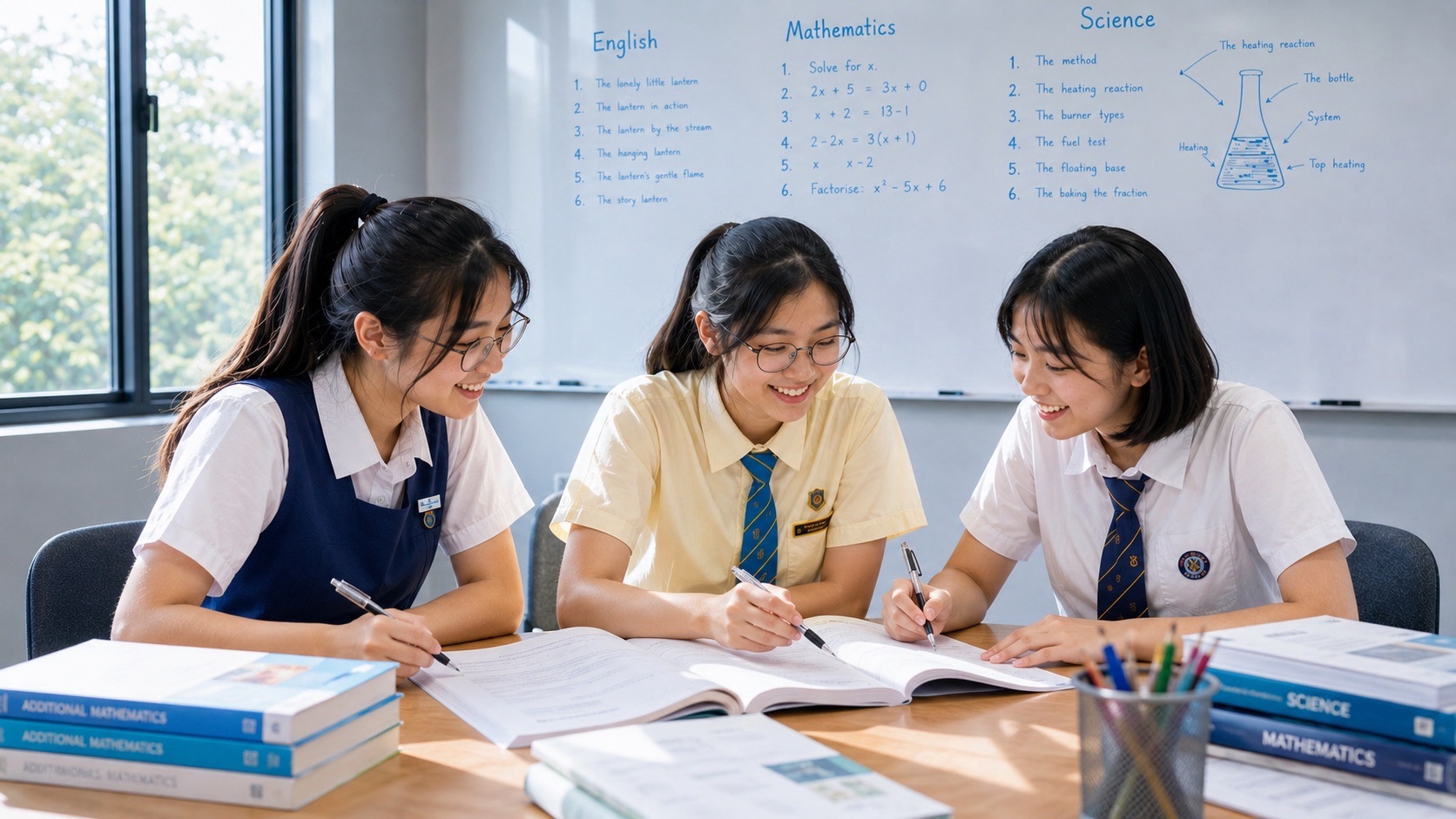
Originally published 26 February 2014 as an eduKate Yishun Mathematics tuition page. Rebuilt in 2026 as a reader-facing Mathematics learning and transition guide for families connected with Orchid Park Secondary School and the wider Yishun area.
Quick answer: A Secondary Mathematics student does not improve simply by doing more sums or studying ahead. The useful job is to identify the earliest weak link—concept, representation, algebraic language, method selection, fluency, transfer, working accuracy or examination execution—and repair that layer before increasing load.
Important archive note: This URL previously advertised an eduKate Yishun tuition location at 664 Yishun Avenue 4. It should not be used as a current centre, telephone or class listing. eduKate Singapore is not part of, endorsed by, or affiliated with Orchid Park Secondary School. The school name is used here only because this historical URL was written for families in that locality. For current eduKate locations and enquiries, use the current Contact page. For current school information, use the official Orchid Park Secondary School website.
Why this old local tuition page is worth keeping
Local tuition pages become obsolete quickly when addresses, tutors, examinations and school structures change. But the educational question underneath this 2014 page remains durable: what does a Secondary Mathematics student actually need when Mathematics begins to become more abstract?
That question deserves its own job. This page therefore no longer competes as a generic Yishun sales page. It functions as a school-localised Mathematics navigation guide: understand the current secondary context, diagnose the learner, repair the right mathematical capability and route current operational enquiries elsewhere.
Orchid Park Secondary School in 2026: the context has changed
Orchid Park Secondary School’s current website describes a school operating under Full Subject-Based Banding (Full SBB), with mixed form classes and subject levels matched more closely to students’ strengths, interests and learning needs. The school explicitly states that the old Express, Normal (Academic) and Normal (Technical) streams are being removed under Full SBB. See the school’s Full Subject-Based Banding overview.
There is also a cohort transition to understand. Students in older upper-secondary cohorts in 2026 can still be sitting legacy GCE O-Level or N-Level examinations, while the Secondary Education Certificate (SEC) framework begins from 2027. Families should therefore identify the student’s actual cohort and subject level rather than assume that one old label describes everyone in the school.
For 2026 O-Level school candidates, SEAB lists Mathematics 4052 and Additional Mathematics 4049. From 2027, the SEC lists G3 Mathematics K310 and G3 Additional Mathematics K341, while G2 Mathematics is K210 and G1 Mathematics is K110. The labels are changing, but the deeper mathematical capabilities remain recognisable: conceptual understanding, technique, problem solving, reasoning and communication.
What Secondary Mathematics is trying to build
Primary Mathematics often gives students relatively concrete representations and familiar problem structures. Secondary Mathematics increases abstraction. Algebra becomes a language for relationships. Graphs represent changing quantities. Geometry demands more formal reasoning. Statistics and probability require interpretation as well as calculation.
SEAB’s 2026 O-Level Mathematics syllabus is useful because its assessment objectives expose the full job. It does not assess only routine technique. It separately emphasises using standard techniques, solving problems in varied contexts, and reasoning and communicating mathematically.
Read the official 2026 Mathematics 4052 syllabus for the current formal requirements.
The eight Mathematics layers we diagnose
1. Foundational knowledge
Can the student retrieve the prerequisite arithmetic, fractions, ratio, percentage, geometry and basic algebra needed for the current topic? A Secondary problem can look new while failing because of an older Primary-level gap.
2. Concept meaning
Does the learner know why the mathematics works? A student may remember a formula and still misunderstand the quantity represented by it. Concept weakness often becomes visible when the question changes shape.
3. Representation
Can the learner move between words, equations, diagrams, graphs, tables and geometric figures? Many Secondary questions are difficult because the mathematics has to be translated before it can be calculated.
4. Algebraic language
Algebra is not arithmetic with letters pasted on top. It is a symbolic language for quantities, relationships and generalisation. Weakness in substitution, manipulation, signs, equality or expression structure can spread into equations, functions, coordinate geometry, trigonometry and Additional Mathematics.
5. Method selection
The student may know several methods but fail to recognise which one fits. This is a discrimination problem: identify the mathematical structure before executing the technique.
6. Fluency
Correct but painfully slow execution creates a later bottleneck. Some procedures need to become sufficiently fluent that working attention is available for reasoning rather than consumed by every small transformation.
7. Transfer and reasoning
Can the student use known mathematics when the context is unfamiliar, several topics are combined, or the solution is not signposted? This is where routine practice stops being enough.
8. Examination execution
Can the student operate under time, organise working, preserve method marks, move on from a blocked question, check signs and units, and return intelligently? Examination performance is a separate layer from mathematical understanding.
“Careless mistakes” should be decomposed
The 2014 page repeatedly referred to “silly mistakes.” That phrase is too weak if the same errors recur.
- Wrong sign after expansion → algebraic control problem.
- Copied a number incorrectly → transcription/attention problem.
- Correct method but arithmetic error → fluency or checking problem.
- Wrong formula → retrieval or selection problem.
- Correct answer with no required working → examination communication problem.
- Missed a condition in the wording → reading/representation problem.
- Repeatedly runs out of time → execution and pacing problem.
The repair should match the error mechanism. “Be more careful” is not a complete intervention.
Secondary 1: algebra is the transition language
Secondary 1 Mathematics is often the first place where a student who was comfortable with Primary arithmetic discovers that mathematical objects can stand for relationships rather than only known numbers.
Useful questions at this stage include:
- Does the student understand what a variable represents?
- Is the equal sign treated as a relationship rather than a signal to calculate?
- Can verbal relationships be translated into expressions?
- Are negative signs and brackets stable?
- Can the learner explain why like terms can or cannot be combined?
If these foundations are fragile, teaching more advanced equations quickly can create a tower built on symbolic confusion.
Secondary 2: connect topics instead of storing them separately
By Secondary 2, students benefit from seeing connections: algebra with graphs, ratio with similarity, equations with geometric unknowns, statistical summaries with interpretation.
A learner who stores each chapter as an isolated procedure may do well on topic worksheets yet struggle in mixed assessments. Mixed practice becomes increasingly important because it forces selection before execution.
Secondary 3: the system branches, but the foundations still travel
At upper secondary, subject level and school programme determine the exact route. Students taking more demanding Mathematics or Additional Mathematics encounter greater symbolic density and longer chains of reasoning. But the prerequisite system remains the same: algebraic fluency, representation, method selection and accurate working.
Additional Mathematics should not be treated as a completely separate species of subject. It amplifies the cost of weak algebra. If manipulation is unstable, every later topic becomes harder than its underlying concept requires.
Secondary 4: integration and execution
By the examination year, the problem is no longer merely whether each chapter was once understood. The student has to retrieve across the whole course, select among methods, connect topics and operate under exam constraints.
This is when full-paper practice becomes valuable—provided it is followed by diagnosis.
The full-paper error ledger
After a paper, record more than the score:
- topic;
- question type;
- first failing step;
- error class;
- whether the student could self-correct;
- time spent;
- repair chosen; and
- whether the same failure returns in a later paper.
The ledger converts repeated examination practice into a learning system. Without it, students can accumulate papers while repeating the same error architecture.
Working is mathematical communication
The old page valued neat and logical working. That remains useful, but not because neatness is a personality virtue.
Working serves several jobs:
- it preserves the reasoning chain;
- it reduces working-memory load;
- it makes an error locatable;
- it communicates method to the examiner;
- it allows the student to resume after interruption; and
- it makes checking possible.
Organised working is therefore an external memory and communication system, not cosmetic handwriting.
Teach ahead only when the lower floor is stable
The old tuition page promoted teaching ahead of school. Advance exposure can be useful: it lowers novelty when a topic appears in class and creates more time for later practice. But it is not automatically better.
If the student is carrying unresolved prerequisites, advancing can hide the original gap under more content. A better rule is:
- secure prerequisite;
- teach new concept;
- retrieve after a delay;
- vary the question;
- test transfer;
- then advance.
Distance ahead is less important than depth that survives.
Small-group tuition: the useful mechanism
A small group can be effective when it allows the tutor to inspect individual working while still creating enough peer interaction to compare methods and questions.
The mechanism is not the number of chairs by itself. A small group is useful if:
- the tutor can see where each learner’s working diverges;
- students can ask without waiting through a large class queue;
- feedback is specific to the error;
- stronger students are not merely accelerated past weak foundations;
- weaker students are not publicly labelled by their mistakes; and
- support reduces as independent competence improves.
A group can be small and still deliver generic teaching. Diagnose the mechanism, not the marketing label.
What parents should bring to a Mathematics conversation
If a student is struggling, three pieces of evidence are far more useful than “Math is weak”:
- one recent marked school paper;
- one piece of ordinary homework completed without heavy adult help; and
- a description of what happens when the child gets stuck.
From those, a tutor can begin separating concept, transfer, accuracy, speed, reading and examination-execution problems.
How to measure real improvement
- fewer prompts to start a question;
- fewer repeated algebraic errors;
- more accurate translation from words to equations;
- better selection of methods in mixed practice;
- successful retrieval after a delay;
- less collapse when questions are unfamiliar;
- working that is easier to inspect and resume;
- improved accuracy under time;
- better self-correction before marking; and
- the student can state what needs repair next.
The final item marks an important transfer of responsibility: the learner is beginning to navigate Mathematics rather than simply receive instruction.
2026 → 2027 examination transition
Families reading old tuition pages must take special care during this transition period. In 2026, some upper-secondary students are still completing legacy GCE O-Level or N-Level syllabuses. SEAB’s new Secondary Education Certificate syllabuses begin from 2027, including G1, G2 and G3 Mathematics routes.
The safest practice is always to identify the student’s exact cohort, subject level and current syllabus code from the school or SEAB. Do not infer examination requirements from a 2014 blog post—or even from another student one year older.
Knowledge routes from this page
- Mathematics: concept, method, algebra, transfer, reasoning and communication.
- Learning science: retrieval, spaced return, mixed practice and feedback.
- Metacognition: error classification, checking and next-step selection.
- Assessment: separating subject knowledge from examination execution.
- Secondary transition: Primary arithmetic → algebraic language → integrated reasoning.
- Singapore curriculum: Full Subject-Based Banding and the 2026→2027 examination transition.
- Parent decision support: what evidence to bring before adding more tuition or more worksheets.
What not to conclude
- Do not treat this page as a current eduKate Yishun centre listing.
- Do not infer any affiliation between eduKate and Orchid Park Secondary School.
- Do not assume every Orchid Park student follows the same Mathematics subject level.
- Do not use the old Express/N(A)/N(T) labels as though they describe all current lower-secondary students.
- Do not call every lost mark “careless.”
- Do not teach ahead merely to accumulate syllabus distance.
- Do not assume more worksheets repair every Mathematics weakness.
- Do not confuse tutor-supported performance with independent competence.
For current eduKate operations, use our Contact page. For the current school’s own information, use the official Orchid Park Secondary School website.
Frequently asked questions
Does eduKate currently run a tuition centre at 664 Yishun Avenue 4?
This article is an archive URL and should not be used as a current location listing. Please use the current eduKate Contact page for present locations and availability.
Is eduKate affiliated with Orchid Park Secondary School?
No. This is an independent eduKate Singapore educational article written for families in the locality. School information should be verified through the school’s official MOE website.
What is the first thing to check when a Secondary student is weak in Mathematics?
Use actual work to find the earliest demonstrated failure: prerequisite, concept, representation, algebra, method selection, fluency, transfer or exam execution. Begin repair there.
Should a student do full papers every week?
Only when full papers are producing useful integration and execution evidence. If one foundational weakness repeatedly causes failure, targeted repair may be more efficient before another full measurement.
A Secondary Mathematics Guide Should Diagnose the First Weak Link
For students connected with Orchid Park Secondary School or the wider Yishun area, the useful question is not whether they need “more Maths”. The useful question is where Mathematics first becomes unreliable. A student may be comfortable with arithmetic but weak in algebraic manipulation. Another may know procedures yet fail to interpret graphs. Another may understand class examples but struggle when several topics are mixed. These are different problems and need different repairs.
This guide should therefore be read as an independent learning framework, not as a claim of affiliation with Orchid Park Secondary School. School teaching, school assessment and external tuition are separate systems. The student’s marked work is the evidence that connects them.
Secondary Mathematics Is a Transition From Arithmetic to Structure
Primary Mathematics often gives students visible quantities and concrete contexts. Secondary Mathematics increasingly asks them to operate on symbols, generalise patterns and coordinate several representations of the same relationship. Numbers become variables. Tables become graphs. repeated arithmetic becomes algebraic structure.
A student can therefore enter Secondary 1 with good Primary results and still find the transition difficult. The issue may not be intelligence. It may be that symbolic language, negative numbers, algebraic conventions or graph interpretation have not yet become fluent.
Full Subject-Based Banding and Mathematics
Singapore secondary schools now operate under Full Subject-Based Banding. Students may study subjects at G1, G2 or G3 levels according to readiness and school arrangements. The level is important because it affects pace, depth and assessment demand, but it should not become a fixed judgement about the whole learner.
Good support begins from the Mathematics the student is actually expected to do now, then builds toward the next realistic level of independence and transfer.
The Five Layers of Secondary Mathematics Performance
- Prerequisites: arithmetic, fractions, ratio, percentage, negative numbers and basic geometry.
- Representation: converting words into diagrams, equations, tables or graphs.
- Method: knowing which procedure or concept fits the structure.
- Execution: carrying out algebra, arithmetic and notation accurately.
- Transfer: recognising the same Mathematics when the surface of the question changes.
A wrong final answer can begin at any of these layers. The tutor’s task is to identify the earliest failure rather than merely correct the final line.
Signed Numbers: Small Errors With Large Consequences
Negative numbers are a common early bottleneck. Students may know a rule such as “minus times minus gives plus” without understanding the difference between a negative number and the operation of subtraction. Later algebra amplifies this weakness because signs appear inside brackets, equations, coordinates and expressions.
Repair should include number-line meaning, opposites, directed change and carefully controlled symbolic practice. The goal is not only rule recall; it is reliable interpretation.
Fractions Remain a Secondary Mathematics Issue
Students sometimes believe fractions belong to Primary school. In reality, weak fraction fluency can damage algebra, ratio, probability, speed, similarity and later Additional Mathematics. A student who hesitates when simplifying or operating on fractions spends working memory on old skills that should already be automatic.
When algebraic fractions appear, the hidden prerequisite is ordinary fraction structure. Repair the earlier system if needed.
Algebra: Meaning Before Manipulation
Algebra is not simply arithmetic with letters. It is a language for relationships. A variable can represent an unknown, a changing quantity or a general value. An equation states that two expressions are equal. Manipulation preserves that equality while changing form.
Students who memorise “move this across and change the sign” can solve routine equations but often struggle when the form changes. A stronger model is balance: whatever operation is applied to one side must preserve equality on the other.
Graphs: Connect Equation, Table and Shape
Graph work becomes easier when students stop treating equations, tables and plotted lines as separate topics. They are different representations of the same relationship. The equation describes the rule, the table samples values and the graph shows the pattern spatially.
Ask the student to move both directions: from equation to graph and from graph back to equation or interpretation. This builds representation flexibility.
Geometry: Diagram Reading Is a Mathematical Skill
Geometry questions often fail before any formula is used. The student misreads the diagram, assumes a line is parallel because it looks parallel, misses a given angle relationship or does not identify which theorem applies. Good geometry begins with disciplined reading.
Students should mark known information, label unknowns, identify constraints and write the theorem or relationship that justifies each major step. This prevents visual guessing.
Word Problems: Translate Before Calculating
Secondary word problems add more variables and less obvious relationships. The student should not rush directly to an operation. First identify quantities, units, unknowns and constraints. Then choose a representation. An equation, table, diagram or graph often reduces the language load.
Translation is a separate skill from calculation. If translation is weak, more arithmetic practice will not solve the main problem.
The Error Ledger
Keep a short record of repeated errors. Each entry should contain the topic, exact error, cause, correction rule and whether the same error returned later. “Careless” should be replaced with something observable: copied 6 as 8, lost negative sign, expanded bracket incorrectly, omitted unit, used wrong scale or answered for the wrong variable.
An error ledger turns mistakes into a dataset. Patterns become visible.
Retrieval Before Revision Notes
Before opening notes, ask the student to reconstruct what is known. Write the formula. Sketch the graph. State the theorem. Solve one basic example. Retrieval exposes what remains available without support. Only then should the learner reopen notes to repair gaps.
Rereading can create familiarity without access. Examinations require access.
Topical Practice, Then Mixed Practice
Topical practice is useful while learning a method because it reduces decision load. Mixed practice becomes essential afterwards because it forces recognition. A student needs to decide whether the question requires algebra, ratio, geometry, statistics or a combination.
The transition should be deliberate: learn, stabilise, mix, time, transfer.
What a 90-Minute Small-Group Lesson Can Do
A focused lesson can begin with retrieval, diagnose one recurring weakness, teach the missing concept, guide a small number of examples, move into independent work and finish with mixed transfer. The tutor can compare three students’ methods and use differences to make reasoning visible.
The small-group advantage is not simply fewer students. It is the ability to observe starts, reasoning and error recovery closely enough to adjust the next question.
Lower Secondary: Build the Algebraic Floor
In Secondary 1 and 2, students should protect arithmetic fluency while building algebra, graphs, geometry and statistical reasoning. Weaknesses at this stage become expensive later because upper-secondary Mathematics assumes symbolic competence.
Do not rush into harder material merely to feel advanced. Depth at the lower-secondary foundation often produces faster progress later.
Upper Secondary: Integrate and Execute
By Secondary 3 and 4, students face larger topic networks, more demanding applications and examination time pressure. The programme should increasingly use mixed sets, timed sections and full-paper review. The question changes from “Can you do this chapter?” to “Can you recognise and execute the right Mathematics when the chapter label disappears?”
If the Student Also Takes Additional Mathematics
Additional Mathematics increases the value of a secure algebraic base. Manipulation, functions, equations, graphs and later topics become harder when ordinary algebra is unstable. Students should not treat E-Math and A-Math as completely separate worlds; they share representations and symbolic habits.
Parents: Read Marked Work, Not Just the Score
A score says how much was lost. The script says why. Look for clusters. Are errors concentrated in one topic? Does the student leave working incomplete? Are wrong answers caused by signs, algebra, reading or time? Does the same error recur after correction?
That evidence is more useful than a broad statement that the child “needs more practice.”
A Student Self-Diagnostic
- Which three topics currently cost me the most marks?
- Which old prerequisite keeps returning?
- Can I explain my method without looking at notes?
- Do I know when to use each method?
- What error do I repeat under time pressure?
- Can I check whether an answer is reasonable?
- What should I practise next, and why?
Final Guide
Secondary Mathematics improves fastest when the student stops treating every wrong answer as the same problem. Find the earliest weak link, repair the prerequisite, practise the method, retrieve it after a delay, mix it with other topics and then test execution under time.
That is the purpose of this Orchid Park Secondary School Yishun Mathematics Learning Guide: not to imitate school, but to help students and families read Mathematics performance accurately and build forward from evidence.
The Mathematics Repair Ladder
When a secondary student is behind, the fastest route forward is usually not to begin with the hardest current worksheet. Build a repair ladder. Start with the earliest prerequisite that is visibly unstable, then move upward only when the student can retrieve and use it without heavy prompting.
- Number sense and signed numbers.
- Fractions, ratio and percentage.
- Algebraic notation and manipulation.
- Equations and inequalities.
- Graphs and coordinate relationships.
- Geometry and measurement.
- Statistics and probability.
- Mixed problem solving and examination execution.
The exact order varies by syllabus and learner, but the principle is stable: do not build a higher skill on a missing lower dependency.
Use Worked Examples Properly
Worked examples are useful when the student studies the decisions, not merely the final steps. Cover the solution and ask what should happen next. Explain why that operation is legal. Compare two methods. Identify which line contains the key transformation. Then close the example and solve a near-transfer question independently.
Copying a worked solution creates movement on the page but little diagnostic information. The student must predict before revealing the next step.
Mathematical Communication Protects Marks
Clear working is not only for the marker. It reduces the student’s own error rate. One transformation per line, aligned equal signs, labelled diagrams and explicit units make it easier to inspect the chain. Messy working increases the probability that a correct idea will be lost during execution.
Students should therefore treat page organisation as part of Mathematics, especially in multi-step algebra and geometry.
Estimate Before Exact Calculation
Estimation gives the student a reference point. If a calculated probability exceeds 1, a length becomes negative or a percentage answer is wildly larger than the quantities involved, the result should trigger inspection. Estimation is not an optional Primary-school habit; it remains a powerful secondary checking tool.
Build Formula Knowledge Through Meaning
Formulas are easier to retrieve when students know what the symbols represent and why the relationship has the form it does. Area formulas can be connected to decomposition. Gradient can be connected to change in one coordinate relative to another. Speed connects distance and time. Memorisation still matters, but meaning creates recovery routes when memory momentarily fails.
Use Interleaving Near Examination Time
As assessments approach, practise choosing among methods. A mixed set might contain algebra, graphs, geometry and statistics without announcing the topic. This creates the recognition demand that appears in real papers. Students who perform strongly only when the chapter title is visible are not yet examination-ready.
A Timed-Section Protocol
- Choose one section of realistic difficulty.
- Set the actual proportional time allowance.
- Work without notes.
- Mark questions where time was lost.
- Classify every error after the timer ends.
- Redo only the failed questions untimed.
- Repeat a similar section several days later.
This separates knowledge repair from execution training.
What to Do After a School Test
Do not file the paper after looking at the mark. Reconstruct the loss. Which errors were concept errors? Which were signs, units or arithmetic? Which questions were left blank? Which were solved correctly after the test? A question corrected immediately without help may signal an execution problem; a question still impossible after the test points to a deeper gap.
How Parents Can Ask Better Mathematics Questions
Instead of “Why are you careless?”, ask “Which error repeats?” Instead of “Do you understand?”, ask “Can you explain the method without looking?” Instead of “Have you practised enough?”, ask “Can you solve this when the question looks different?” These questions produce evidence.
The Secondary 1-to-4 Continuum
Secondary Mathematics should become progressively more independent. In Secondary 1, the student may still need explicit routines for algebra and working. By Secondary 2, mixed-topic transfer should increase. In Secondary 3, the workload and abstraction rise, especially for students taking Additional Mathematics. By Secondary 4, revision must integrate retrieval, mixed practice, timing and exam recovery.
The destination is not a student who can only solve familiar worksheets. It is a student who can recognise structure under pressure.
Final Parent Checklist
- Can the student explain the three biggest current weaknesses?
- Are old prerequisites being repaired where necessary?
- Is practice moving from topical to mixed?
- Are repeated errors being logged?
- Is working clear enough to inspect?
- Is timed practice used after understanding, not instead of it?
- Is the student becoming more independent in deciding what to revise?
If those answers are improving, Mathematics is becoming a system the student can operate rather than a sequence of chapters to survive.
The Final Transfer Test
A Mathematics skill is not secure merely because the student can repeat yesterday’s example. The final test is transfer. Present the same underlying relationship with different numbers, different wording, a different diagram or inside a mixed paper. If the student still recognises the structure and chooses the correct method, the learning is becoming usable.
This should shape revision. Do not spend the entire week repeating near-identical questions. Begin with controlled practice, then deliberately vary the surface. Remove the chapter heading. Mix in unrelated topics. Ask the student to explain why a method applies before calculating.
Secondary Mathematics becomes much more manageable when students understand that the syllabus contains recurring structures rather than thousands of unrelated questions. The tutor’s job is to help the learner see those structures, execute them accurately and recognise them again under unfamiliar conditions.
Final principle: Mathematics support should reduce dependence over time. The student should gradually need fewer hints, choose methods more independently, notice unreasonable answers sooner and route revision from marked evidence. The strongest sign of progress is not that tuition worksheets look easier; it is that unfamiliar school questions become more manageable because the learner now has a reliable way to think, check and recover.