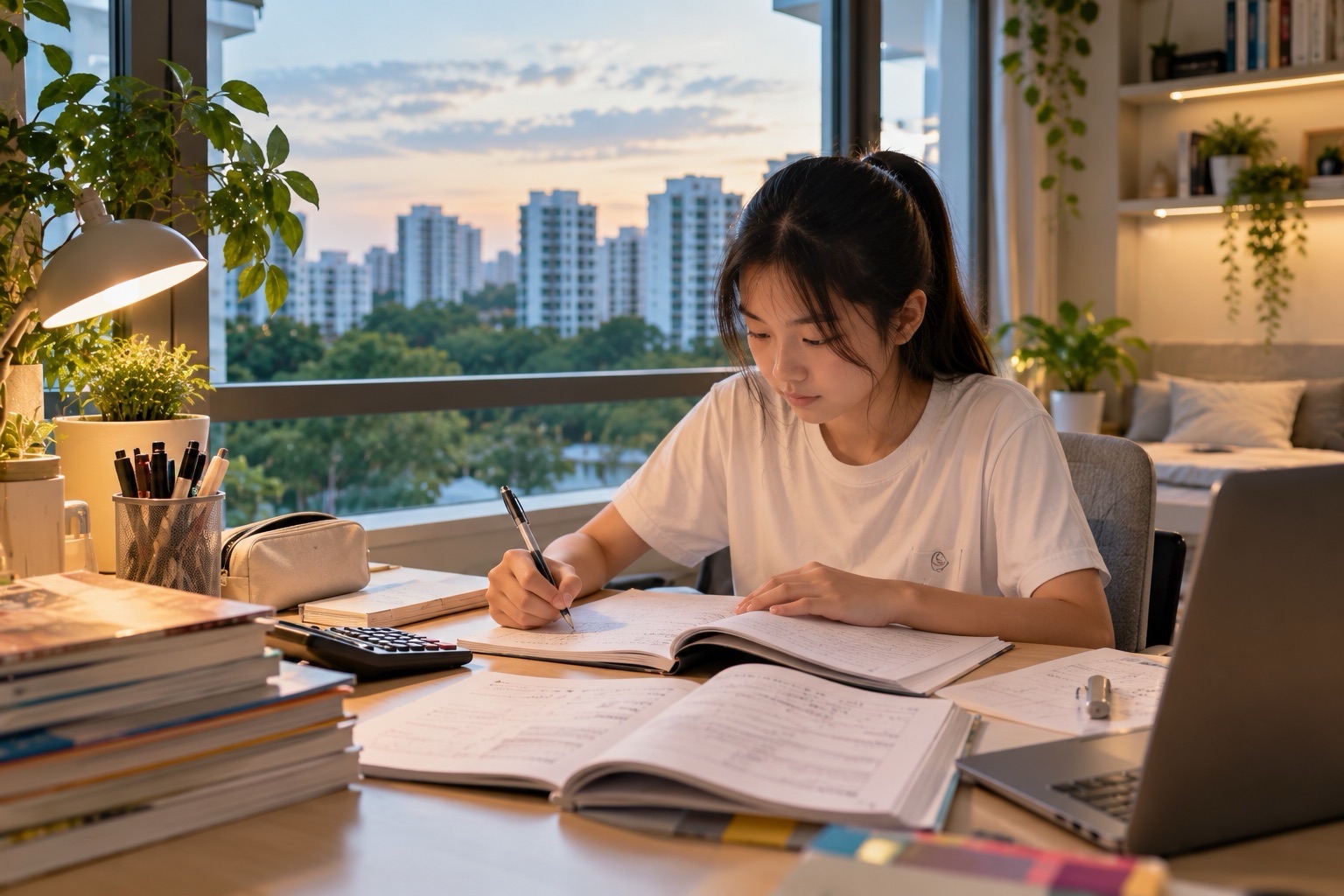
Secondary Art in Singapore is no longer well described as “coursework plus drawing”. Under the 2027 Singapore–Cambridge Secondary Education Certificate, G1, G2 and G3 Art are separate subject-level routes with different assessment structures, but all three treat art as a disciplined process of observing, interpreting, making, refining, communicating and reflecting.
This guide is for students and parents searching for Secondary Art Singapore, SEC Art, G1 Art, G2 Art, G3 Art, Art coursework, Art portfolio, visual analysis, exploratory sketching, Art examination format and how to prepare for Secondary Art. It uses the current 2027 SEAB syllabuses as the reference point and distinguishes what is common across levels from what changes.
The most important shift in understanding is this: the portfolio is evidence of artistic thinking, not merely a folder of attractive finished pieces. SEAB’s current syllabuses repeatedly emphasise exploration, process, visual language, media, artistic intent, reflection and the respectful use of sources.
The 2027 SEC Art structure at a glance
| Level | Paper 1 | Paper 2 | Key portfolio scale |
|---|---|---|---|
| G1 Art K126 | Art Examination, 40%, 1h 30m | Portfolio, 60%, 18 hours within 8 weeks | 10 screens + 2 artworks of different media |
| G2 Art K236 | Visual Response, 50%, 2h 15m | Portfolio, 50%, 30 hours within 12 weeks | Up to 10 screens + commentary on 2 works, max 500 words / under 8 A4 pages |
| G3 Art K347 | Visual Response, 50%, 2h 15m | Portfolio, 50%, 30 hours within 12 weeks | Up to 15 screens + commentary on 3 works, max 800 words / under 10 A4 pages |
These are 2027 school-candidate arrangements. Students should always check the SEAB syllabus for their actual examination year before making submission decisions.
1. What all three Art routes have in common
Across G1, G2 and G3, Art is built around three broad learning domains: perceive, communicate and appreciate. Students observe and analyse visual information, develop ideas through making, and reflect on their own and others’ work.
- Perceive: observe, gather, organise and interpret visual information.
- Communicate: develop and express ideas through visual and tactile forms.
- Appreciate: reflect, evaluate, discuss and connect art with context and culture.
This means a strong student is not simply technically skilled. Technical control must serve an idea.
2. The portfolio is a record of decisions
A portfolio should make the student’s thinking inspectable. It can contain research, drawings, experiments, in-progress work, journal material, refinements and resolved outcomes, depending on the level and syllabus rules.
The weak portfolio shows many pages but little movement. The strong portfolio shows why an idea changed, how a material behaved, what visual problem was discovered, what reference influenced the work and what decision followed.
3. Research must feed making
Students often paste artist references into a journal and assume research is complete. Research is useful only when it changes what the student notices, tries or understands.
Instead of writing “I like this artist’s colours”, identify the visual mechanism. Is the palette restricted? Is contrast used to separate subject and ground? Is repetition creating rhythm? Is scale used to make an ordinary object feel monumental? Then test the idea in the student’s own work without copying the artist’s image.
4. Citation is part of the art process
The current G2 and G3 assessment objectives explicitly require attribution and citation of sources. G1 likewise requires respectful use and attribution of information. This matters because contemporary art learning often uses online images, museum collections, photography, digital references and artist research.
Record source URLs, artist names, artwork titles and access information as the research happens. Do not try to reconstruct provenance the night before submission.
5. G1 Art K126: Paper 1
For 2027, G1 Art Paper 1 is a compulsory 1 hour 30 minute Art Examination worth 40%. It has three sections: objective-style questions, short-answer questions and a short art task.
The paper assesses understanding of art forms and media, visual qualities and design concepts, context and artistic processes. The practical section asks the candidate to interpret a visual stimulus and respond with a concept sketch and brief explanation.
6. G1 Art K126: Paper 2 Portfolio
G1 Paper 2 is worth 60% and is completed in 18 hours within 8 weeks. Part A consists of 10 screens of visual materials. The submission must explore two or more art forms and media, and one must be Design. Part B requires two artworks of different media, separate from those selected for the visual-materials submission.
This makes G1 Art strongly practice-based. The student needs enough breadth to explore media while still showing coherent personal development.
7. G1 portfolio priorities
- Show where the idea came from.
- Explore more than one medium.
- Include Design as required.
- Use visual language deliberately.
- Show technical experimentation.
- Produce two resolved works of different media.
- Respect and acknowledge sources.
- Keep the portfolio personal rather than template-driven.
8. G2 Art K236: Paper 1 Visual Response
For 2027, G2 Art Paper 1 is worth 50% and lasts 2 hours 15 minutes. Section A is Visual Analysis based on an unseen visual stimulus. Section B is Exploratory Sketching in response to visual material.
The student therefore needs both verbal and visual reasoning. Looking carefully, interpreting, discussing and sketching are not separate subjects; they form one chain from observation to idea.
9. G2 Art K236: Paper 2 Portfolio
G2 Paper 2 is worth 50% and is completed in 30 hours within 12 weeks. Part A permits a maximum of 10 screens illustrating artistic exploration and processes across at least two art forms and media. Part B is a commentary on two works, capped at 500 words and under eight A4-sized pages when images are included.
The commentary is not an artist biography. It is evidence that the student can articulate artistic growth, intention, connections and learning.
10. G3 Art K347: Paper 1 Visual Response
For 2027, G3 Art Paper 1 is also worth 50% and lasts 2 hours 15 minutes. The structure is Visual Analysis followed by Exploratory Sketching, but the expectations are deeper. SEAB’s criteria include close visual analysis, exploration of visuals and ideas, creative synthesis, artistic perception and visual communication, and personal interpretation.
The candidate must move beyond description. “There is a red shape in the centre” is observation. “The saturated central red isolates the figure from the muted background and creates visual dominance” begins analysis.
11. G3 Art K347: Paper 2 Portfolio
G3 Paper 2 is worth 50% and is completed in 30 hours within 12 weeks. Part A allows up to 15 screens showing artistic exploration across at least three art forms and media. SEAB specifies that the selection includes at least one Fine Art form and one from either Design or Time-based categories. Part B requires commentary based on three works, capped at 800 words and under ten A4-sized pages when images are used.
The portfolio is internally assessed by the school and externally moderated by the examination authority.
12. G2 and G3 are similar in structure but not identical in load
Parents may see “50% Paper 1, 50% Paper 2” and assume the routes are effectively the same. They are not. G3 requires broader portfolio coverage and a longer commentary. The sophistication of analysis and synthesis is also calibrated to the subject level.
Choose the subject level according to school placement, learner readiness and the wider curriculum, not because one percentage table looks familiar.
13. Visual analysis: describe before interpreting
Good visual analysis starts by separating what is visible from what is inferred. Describe significant visual qualities first: composition, colour, line, form, texture, scale, spatial arrangement, contrast, repetition and material cues.
Then interpret. What effect do these choices produce? What idea may they communicate? What alternative reading is possible? This order makes the analysis evidence-based.
14. Train the eye with ten-minute studies
Choose one unfamiliar artwork and spend ten minutes on three layers:
- Two minutes: list only observable features.
- Four minutes: explain relationships among those features.
- Four minutes: propose meaning, intention or context with visual evidence.
Repeated short analysis is more effective than waiting until the examination year to practise long responses.
15. Exploratory sketching is not polished drawing
SEAB’s G2 and G3 syllabus descriptions make clear that exploratory sketches are for purposeful ideation and concept development. They are not intended as finished rendered outcomes.
This is important. Students who spend too much time shading the first idea may produce a beautiful sketch while showing very little exploration.
16. The five-sketch method
- Sketch the obvious response.
- Change viewpoint.
- Change scale.
- Change relationship or juxtaposition.
- Combine the strongest elements into a new composition.
The first sketch clears the obvious idea. The next three create alternatives. The fifth begins synthesis.
17. Annotation should reveal decisions
Useful annotations are concise and causal: “cropped the figure to create pressure at the edge”; “repeated verticals to echo enclosure”; “switched from pencil to ink because the hard contour better supports the mechanical theme”.
Weak annotation merely describes what can already be seen.
18. A portfolio should contain failed experiments
Failure can be evidence of artistic learning if it changes the next decision. A material test that cracked, bled or collapsed can show that the student understands the medium more deeply after repair.
Do not manufacture fake failure after the work is complete. Preserve genuine process evidence as it happens.
19. Breadth and coherence must coexist
Portfolio requirements encourage work across multiple art forms and media. Breadth is useful because it forces the student to discover how an idea changes when represented through different materials.
But ten unrelated experiments do not form a strong portfolio. The student should be able to explain the thread connecting exploration, influence, decision and outcome.
20. Photography is evidence, not decoration
Photographs of artwork should be clear, evenly lit and faithful enough for assessment. Process photography should show meaningful stages. A close-up can reveal texture or technical detail. A wider shot can establish scale.
Avoid heavy filters that change the artwork’s colour or hide weaknesses.
21. Digital art still needs process evidence
Digital work can create a false impression of instant completion because intermediate states are easy to overwrite. Save versions. Capture layers or iterations where appropriate. Record why major changes were made.
The goal is not to expose every click. It is to preserve the stages that demonstrate artistic reasoning.
22. AI-generated imagery and academic honesty
Generative AI creates a new attribution and authorship problem. Students must follow school and examination rules for the use of digital tools and external sources. If AI-assisted material is permitted in a learning context, the student should still be able to distinguish generated source material from original making and document its role honestly.
Do not assume that because a tool is available it is acceptable in examination coursework.
23. Build a personal visual library
Students who wait for inspiration during coursework are at a disadvantage. Build a visual library throughout Secondary school: photographs, object studies, textures, spaces, figures, maps, packaging, local architecture, nature, museum visits and visual notes.
Record why an image matters. A useful visual library is a collection of observations, not merely a folder of attractive pictures.
24. Observation is a trainable art skill
Drawing from observation is valuable even for students whose final work is digital, photographic or design-based. It slows perception and forces the student to notice proportion, edge, negative space, light and structure.
The companion guide Drawing for Beginners | Observation, Line, Shape, Value and Practice develops this foundation without turning drawing into a talent test.
25. Composition is visual argument
Where elements are placed tells the viewer what to notice and how to move through the image. Balance, emphasis, scale, cropping, overlap, rhythm and contrast are not decorative rules. They organise attention.
When students say a composition “looks nicer”, ask what changed in attention or meaning.
26. Material choice should serve intent
Charcoal, ink, acrylic, collage, photography, digital illustration, sculpture and time-based media each have different expressive and technical properties. A strong student does not choose medium only from comfort.
Ask what the idea needs. Sharp control? Layering? Transparency? Fragility? Repetition? Motion? Surface? Scale?
27. Personal voice does not mean autobiographical confession
A personal artistic response can emerge through subject choice, visual language, cultural context, humour, material preference, design values or the way the student frames a question. Students do not need to reveal private experiences to prove authenticity.
Personal voice means that the work contains choices the student can account for.
28. Art conversations matter
Talking about art helps students test interpretations and learn subject language. A critique should not become a popularity vote. Peers can ask what the work is trying to do, what visual evidence supports that intention and what alternative might strengthen it.
The student remains the decision-maker. Feedback is evidence, not command.
29. The critique protocol
- State what you notice without judgement.
- State what relationship or effect you infer.
- Ask the artist what intention matters most.
- Identify one choice that supports that intention.
- Identify one tension or unresolved area.
- Offer an alternative as an option, not an instruction.
30. Time management for portfolio work
Coursework deadlines create a predictable danger: students spend too long researching and too little time making, or rush to a final piece before enough exploration exists.
| Phase | Approximate emphasis | Question |
|---|---|---|
| Observe / research | Early, bounded | What do I need to understand? |
| Generate | Broad | How many genuinely different directions exist? |
| Experiment | Hands-on | What can this medium do? |
| Select | Critical | Which direction best serves the intention? |
| Refine | Sustained | What is still visually unresolved? |
| Document / comment | Continuous + final | What evidence shows growth? |
31. The commentary should explain growth
For G2 and G3, commentary is part of the portfolio. The writing should connect artistic intent, influence, choices, experimentation, feedback, setbacks and development.
Do not fill the word count with biography or generic statements about creativity. Every paragraph should help the assessor understand the student’s artistic decisions.
32. A commentary paragraph structure
- State the artistic question or intention.
- Identify a specific influence or experiment.
- Explain what changed in the work.
- Evaluate whether the change succeeded.
- State what the next decision became.
33. Exam preparation for Visual Analysis
Build a weekly unseen-image routine. Use painting, photography, installation, design, illustration and mixed media rather than only familiar textbook works. Practise moving from description to analysis to interpretation within a fixed time.
Students should also learn to tolerate ambiguity. More than one interpretation may be defensible if it is grounded in visual evidence.
34. Exam preparation for Exploratory Sketching
Practice idea generation under short time limits. Give one stimulus and require six thumbnail compositions in fifteen minutes. Then select two, enlarge them and annotate the visual decisions.
This trains fluency without rewarding the student for polishing the first idea.
35. Do not outsource the portfolio
External tuition or coaching can teach observation, technique, art history, visual language and critique. It should not manufacture coursework. Examination portfolios must remain the candidate’s authenticated work under the applicable school and examination rules.
A student who submits work they cannot explain has lost the educational purpose even before questions of academic integrity arise.
36. Choosing Secondary Art
Students should choose Art because they are willing to make, observe, revise and reflect over time — not because Art is assumed to be an “easy” subject. Coursework spreads effort across weeks and demands sustained independent organisation.
Art can be a strong subject for learners who think visually and enjoy ambiguity, but the assessment still requires discipline, deadlines, writing and evidence.
37. Art beyond Secondary school
Secondary Art can lead toward design, architecture, animation, fine art, media, photography, user experience, advertising and many other routes, but subject choice should not be treated as a binding career contract.
Students considering specialised arts pathways should inspect current portfolios, entry tests and institution-specific admission requirements.
38. The deeper goal: see, make and explain
The strongest Art student does three things repeatedly: sees more carefully, makes more deliberately and explains choices more precisely. Technique matters because it gives the student control. Research matters because it expands the visual vocabulary. Reflection matters because it turns experience into the next decision.
That is why the portfolio matters. It is not simply proof that artworks exist. It is the trace of an artist learning how to think through visual form.
Frequently asked questions
Is Secondary Art mostly coursework?
It depends on the subject level. In 2027 G1 Art, the portfolio is 60%. In G2 and G3 Art, Paper 1 and the Portfolio are each 50%.
How many portfolio screens are required?
For 2027, G1 requires 10 visual-material screens; G2 allows up to 10; G3 allows up to 15. The associated artwork and commentary requirements differ by level.
Do students need to be good at realistic drawing?
Observation and drawing are important foundations, especially for exploratory sketching, but Secondary Art assesses broader visual thinking, media, design, ideas, process, interpretation and communication.
Can AI be used for an Art portfolio?
Use only what the current school and examination rules permit, and maintain clear authorship and attribution. Do not assume unrestricted use.