By Secondary 4, Mathematics is no longer mainly a question of how many chapters a student has covered.
The chapters have to work together, quickly enough and accurately enough, when the question does not announce where it came from.
A student can know algebra, graphs, geometry, statistics and probability separately yet lose marks because recognition is slow, the wrong method is selected, working becomes opaque, or checking arrives too late. Final-year Mathematics is therefore a conversion problem: turn knowledge into dependable marks.
Quick Read for Parents
- Secondary 4 Mathematics should become increasingly mixed, diagnostic and examination-specific.
- Preparation must follow the student’s actual cohort and subject level.
- Mathematics and Additional Mathematics remain separate subjects.
- Recognition and method selection often become as important as knowing the procedure itself.
- Full papers measure integration and timing; targeted sets repair specific weak processes.
- The aim is stable execution, checking and recovery under realistic conditions.
The One-Sentence Answer
Strong Secondary 4 Mathematics tuition should identify exactly where mathematical knowledge fails to convert into marks, repair that process, and repeatedly test the repair in unfamiliar mixed-paper conditions.
The Final-Year Problem: Chapters Disappear
In chapter practice, the student already knows the family of method likely to be useful. In an examination, that label disappears. The student must identify the quantities, recognise the relationship, choose a representation, select a method, execute it and decide whether the result is plausible.
Eight Final-Year Mathematics Patterns Worth Diagnosing
- Topical work is strong but mixed papers collapse.
- Algebraic errors appear late in long solutions.
- The calculator is trusted more than mathematical sense.
- Geometry becomes theorem guessing.
- Statistics is calculated but not interpreted.
- Probability answers rely on intuition.
- Working is correct but difficult to audit.
- One hard question consumes too much time.
Method Selection: The Hidden Final-Year Topic
- What mathematical objects or quantities are present?
- What relationship connects them?
- Which representation exposes that relationship most clearly?
- Which method follows from that representation?
- What independent check is available?
Practice Papers: Diagnose Before Prescribing Another One
- Measure with a suitable timed paper or section.
- Classify the loss: concept, recognition, method, execution, representation, checking or timing.
- Repair the weak process.
- Retest with changed surface features.
- Reintegrate into mixed examination work.
Checking Should Use Different Evidence
- Substitute a solution into the original relationship.
- Estimate magnitude or direction.
- Compare graph behaviour with algebraic expectations.
- Check geometric conditions.
- Verify units and dimensions.
- Use an alternative route where its cost is sensible.
Mathematics Is Not Additional Mathematics
Students taking both subjects benefit from connections, but the syllabus jobs remain distinct. This page owns Secondary 4 Mathematics. Additional Mathematics has its own algebraic depth, functions, trigonometry and calculus demands and should not be folded into a generic Mathematics page.
Why Three Students Works Well in Final-Year Mathematics
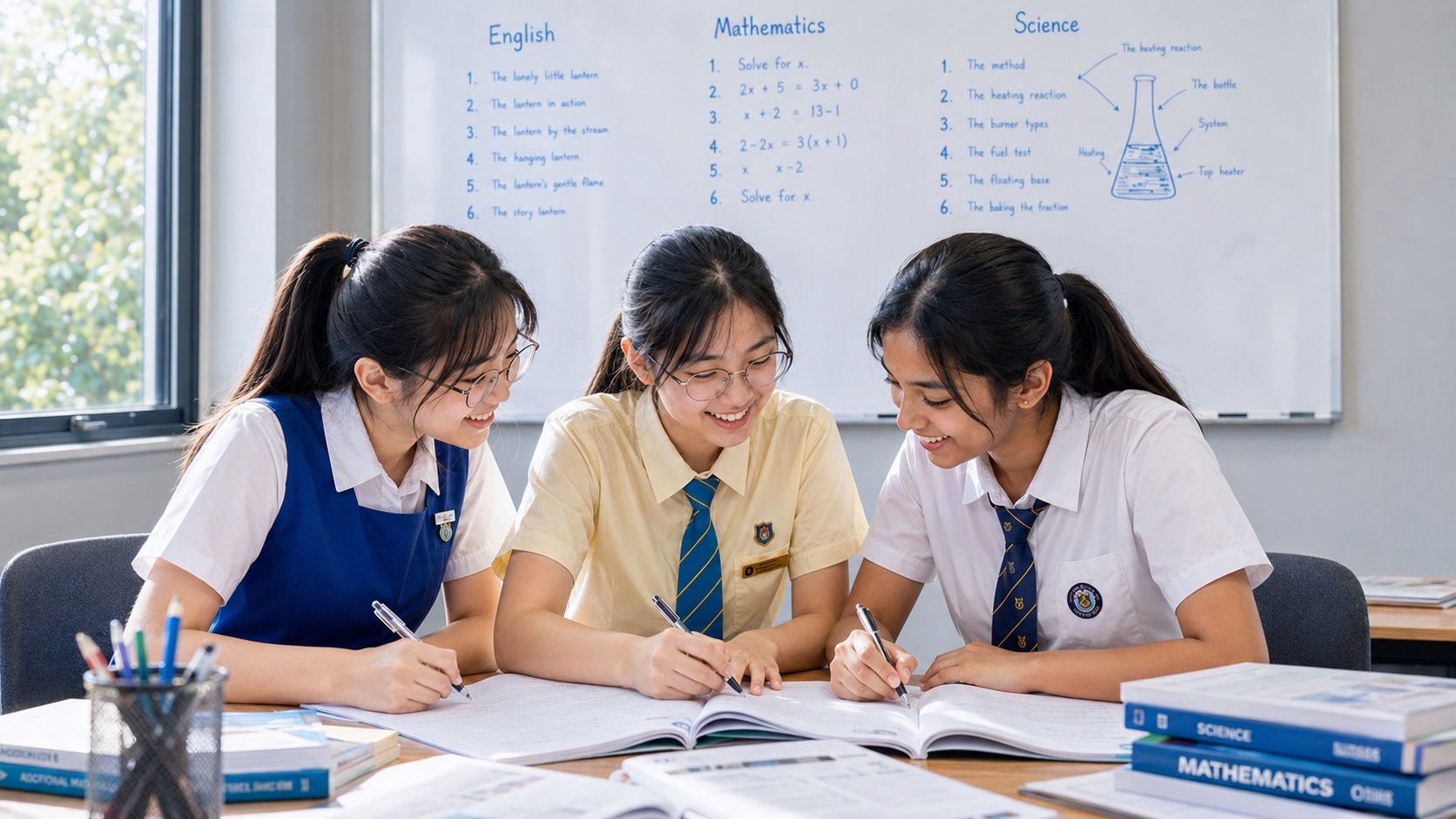
Three students allows genuine comparison of solution routes while keeping every line of working visible. The tutor can see not merely whether an answer is wrong, but where recognition, selection or execution first diverged.
Jurong WestOS Carries the Town Context
The broader local architecture belongs in Jurong WestOS. This page stays focused on final-year Mathematics and the conversion of mathematical knowledge into marks.
What Improvement Should Look Like
Final-year Mathematics improvement should become more predictable. The student recognises structures earlier, chooses methods with less trial-and-error, preserves clean working, catches implausible answers and recovers from difficult items without destabilising the paper.