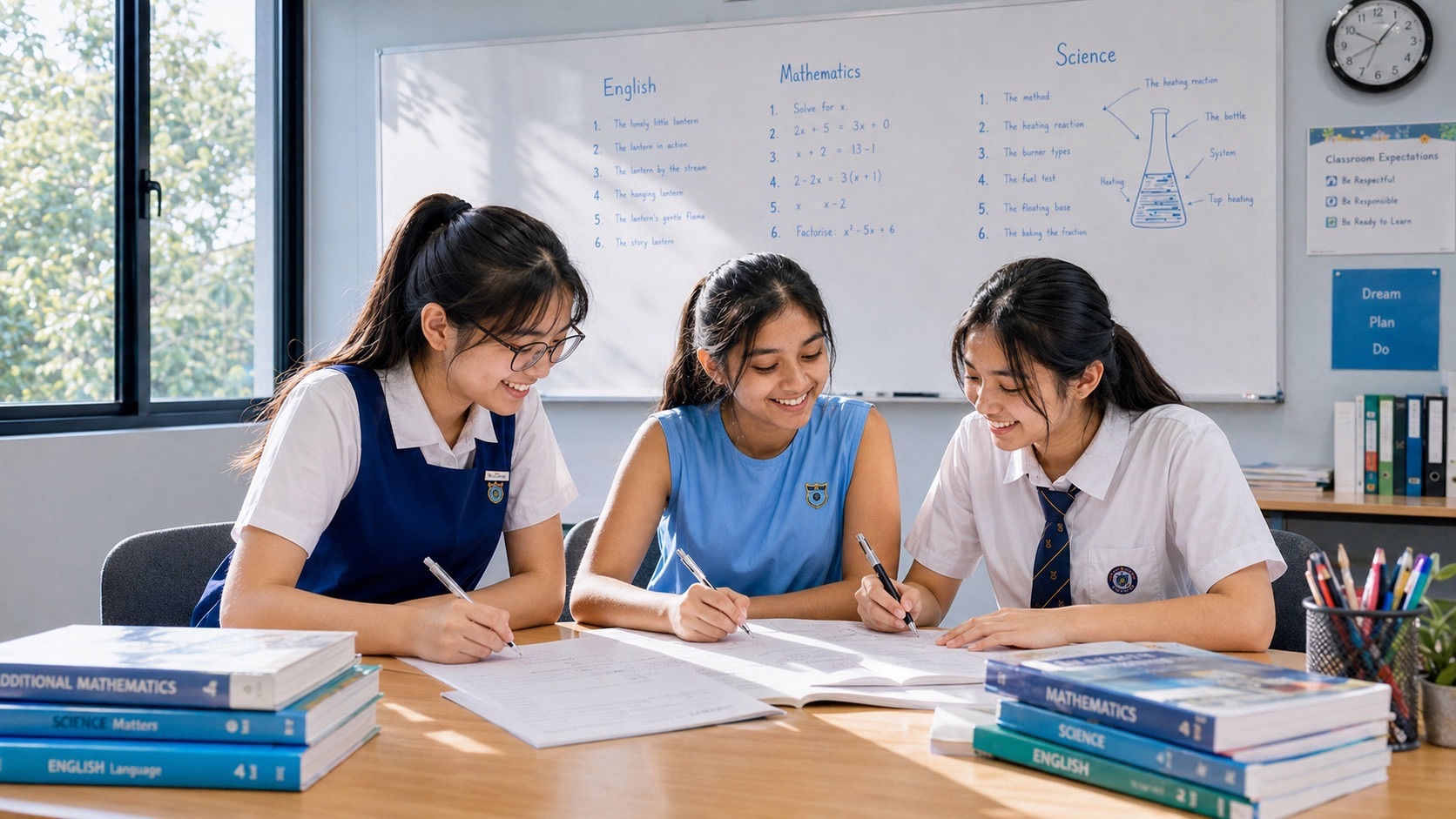
Secondary 4 Mathematics is not the year to discover whether a student has ever learned algebra, graphs, geometry or statistics. It is the year to discover whether those ideas can now be retrieved and coordinated reliably under examination conditions.
A student may know every chapter separately and still underperform on a mixed paper. Another may understand difficult problems but lose too many routine marks. A third may calculate accurately when untimed yet become inefficient because every unfamiliar question feels as though it has to be solved from first principles.
The final-year job is therefore reliability: recognise structure early, choose a defensible method, execute cleanly and check in a way that can genuinely catch mistakes.
Quick Read for Parents
- Students graduating in 2026 remain in the final legacy N-/O-Level examination cohort before SEC begins from 2027.
- Preparation should follow the student’s actual 2026 Mathematics syllabus and school entry.
- The final year needs both targeted repair and realistic mixed-paper practice.
- Weaknesses should be diagnosed as concept, recognition, method-selection, execution, representation, checking or timing problems.
- Mathematics and Additional Mathematics are separate subjects and should remain separate in tuition architecture.
- The aim is smaller performance variance, not simply a larger stack of papers.
The One-Sentence Answer
Strong Secondary 4 Mathematics tuition should make accumulated mathematical knowledge sufficiently reliable that unfamiliar wording, mixed topics and time pressure no longer decide the result more than understanding does.
The 2026 Cohort Needs the Correct Examination Frame
Singapore’s secondary examination system is transitioning to the Singapore-Cambridge Secondary Education Certificate from the 2027 graduating cohort. A student graduating in 2026 remains in the final legacy N-/O-Level system.
That means families should not automatically replace 2026 preparation materials with SEC materials intended for later cohorts. The student’s school entry and current SEAB syllabus remain the correct reference.
SEAB: 2026 GCE O-Level Syllabuses for School Candidates
A Mathematics Score Is a Compressed Signal
Two students can receive the same score and need completely different teaching.
One may lose marks because algebraic transformations are unstable. Another may calculate well but select methods poorly. Another may understand the mathematics yet misread diagrams, units or statistical representations. A fourth may know the content but run out of time because every problem is approached too cautiously.
Before increasing paper volume, we ask where the chain broke.
Eight Secondary 4 Patterns That Need Different Repairs
1. Chapter practice is strong but mixed papers are weak
This is often a recognition problem. The student knows methods when the chapter name gives the method away, but mixed work requires independent classification of the problem.
2. Routine marks are disappearing
This can signal unstable fluency, weak checking or excessive attention spent on difficult items. Final-year performance needs a dependable floor as well as a high ceiling.
3. Algebra collapses after several lines
The first line may be correct while a sign, factor, index or denominator is lost later. We locate the first unreliable transformation rather than describing the whole solution as careless.
4. Graph questions are treated as picture reading
The student needs to connect equations, variables, gradient, intercepts and plotted data rather than respond only to the visible shape.
5. Geometry becomes formula hunting
Upper-secondary geometry depends on conditions. The student should identify what is given and what can be deduced before deciding which theorem or formula applies.
6. Statistics is calculated but not interpreted
A numerical summary only becomes useful when the student understands what it says about the data and what it does not say.
7. Timing problems appear only in full papers
The bottleneck may be recognition, excessive checking, slow algebra, poor calculator habits or refusal to move on from one difficult item. Each cause needs a different response.
8. Additional Mathematics methods are leaking into Mathematics indiscriminately
Students who take both subjects can benefit from shared algebraic understanding, but assessment assumptions and permitted methods should remain syllabus-specific.
Recognition: The Hidden Examination Skill
A mixed paper removes chapter labels. The student therefore needs to recognise mathematical structure before selecting a method.
We make that step explicit. What quantities are involved? What relationship connects them? Which representation makes the relationship clearest? Which method naturally follows?
Algebra: Preserve Meaning Across Every Line
Final-year algebra should be readable enough that a student can diagnose their own mistake. Each transformation should have a reason. Equality should be preserved. Brackets and signs should remain visible.
Graphs, Geometry and Data: Relationships Before Recipes
A graph is a representation of a relationship, geometry depends on conditions, and statistics requires interpretation beyond arithmetic. In each case, the student becomes more reliable when the underlying relationship is identified before a procedure is selected.
Practice Papers: Measure, Diagnose, Repair, Retest
- Measure: complete a suitable paper or section under known conditions.
- Diagnose: classify lost marks by process.
- Repair: work directly on the weak concept or method.
- Retest: use a fresh problem with a changed surface.
- Reintegrate: return to mixed-paper conditions.
Checking: Use a Different Evidence Route
- Substitute a solution back into the original equation.
- Estimate magnitude before trusting a calculator result.
- Compare a graph with algebraic expectations.
- Check theorem conditions explicitly.
- Verify dimensions and units.
- Use an inverse operation or alternate method where economical.
Why Three Students Works Well in Secondary 4 Mathematics
Final-year Mathematics needs both individual accountability and method comparison. In a three-student setting, the tutor can inspect the route each learner takes and identify the first point where working becomes unreliable.
What Parents Can Do in the Final Year
- Use the correct 2026 syllabus.
- Look at the first wrong line.
- Separate Mathematics from Additional Mathematics.
- Keep an error ledger.
- Use mixed practice.
- Protect routine and sleep.
Choa Chu KangOS Carries Place; This Page Carries Final-Year Mathematics
The broader local story belongs in Choa Chu KangOS. This page stays focused on the Secondary 4 Mathematics learner.
What Improvement Should Look Like
Secondary 4 improvement should look increasingly predictable. The student recognises familiar structures inside unfamiliar wording, preserves algebra through several lines, reasons from geometric conditions, protects routine marks and checks in ways that genuinely catch errors.
Frequently Asked Questions
Is 2026 still an O-/N-Level year for Secondary 4?
Yes. SEC replaces the separate N- and O-Level examinations from the 2027 graduating cohort.
Should Secondary 4 Mathematics be mostly full papers?
No. Full papers are necessary for calibration, but targeted repair should occur between them.
The Final-Year Mathematics Job Is Reliability
Secondary 4 Mathematics should not turn the student into someone who has seen every possible question. That is impossible.
It should turn the student into someone who can meet an unfamiliar question, recognise enough structure to start, choose a sensible method, preserve the mathematics through several steps and test whether the answer deserves belief.