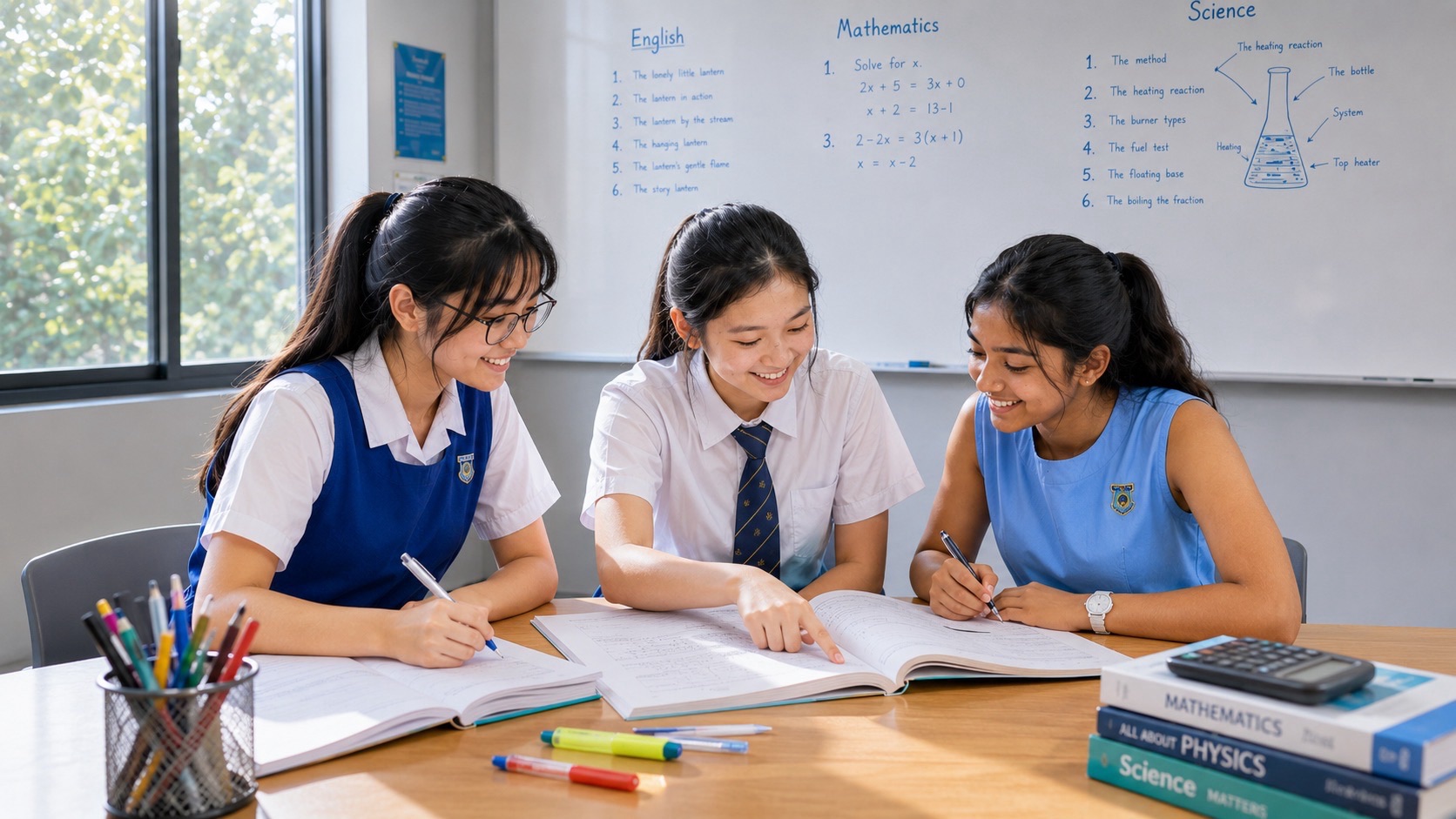
Secondary 4 English tuition in Marine Parade is usually searched by families who want focused examination preparation across editing, situational writing, continuous writing, reading comprehension, summary, listening comprehension and oral communication. Around Marine Parade, Parkway Parade, Parkway Centre, Katong and the East Coast, students can choose from O-Level English tuition, secondary English enrichment, intensive revision classes and small-group coaching. The useful difference is not how many examination papers a class completes. It is whether the teaching can identify the exact language or execution problem behind lost marks and convert corrections into repeatable performance.
For students sitting the 2026 GCE O-Level English Language syllabus 1184, SEAB requires candidates to take four papers. Paper 1 assesses Writing through Editing, Situational Writing and Continuous Writing. Paper 2 assesses comprehension of visual and written texts, including summary. Paper 3 assesses Listening Comprehension, and Paper 4 assesses Oral Communication. These components look separate on the timetable, but they share underlying capabilities: vocabulary, grammar, purpose, audience, evidence, inference, organisation, fluency and self-monitoring.
At eduKate Singapore, 3-pax Secondary 4 English tuition is designed around that interaction. The tutor can inspect a recent school or preliminary paper, hear why an inference was chosen, compare timed and untimed writing, identify repeated editing patterns, and see whether a student’s oral answer develops beyond the first point. One learner may read well but write under-evidenced comprehension answers. Another may have strong ideas but weak situational-writing register. Another may know grammar rules yet miss errors under time pressure. The final year needs targeted diagnosis, not indiscriminate volume.
The 2026 O-Level English Job
The 2026 O-Level English Language syllabus 1184 assesses communication across writing, reading, listening and speaking. Paper 1 includes Editing, Situational Writing and Continuous Writing. Situational Writing requires a 250–350 word response suited to purpose, audience and context, while Continuous Writing requires one response of 350–500 words from a choice of topics. These requirements reward both language accuracy and deliberate communication.
Students and parents can refer to the official 2026 GCE O-Level English Language syllabus 1184 and SEAB’s 2026 O-Level syllabus page.
Paper → Error pattern → Diagnosis → Repair → Retest → Timed transfer
Secondary 4 Is a Performance Year, but Learning Must Continue
The final year creates pressure to complete full papers constantly. Full papers are useful for pacing, stamina and mixed transfer, but they are weak teaching tools if errors are not analysed.
If a student repeatedly loses marks in summary because relevant points are missed, another full paper will not automatically fix selection. If situational writing loses marks through tone, more writing without register analysis may reinforce the pattern. The paper should generate a teaching decision.
Classify the Error Before Prescribing Practice
- Reading error: the passage or question is misunderstood.
- Evidence error: the student chooses weak or irrelevant textual support.
- Expression error: the idea is understood but written vaguely or incompletely.
- Structure error: paragraphs, summary points or writing sections are badly organised.
- Register error: language does not fit audience, purpose or context.
- Grammar/editing error: recurring sentence patterns remain unstable.
- Time error: correct capability exists but cannot be deployed within examination conditions.
These categories help separate “weak English” into teachable parts.
Paper 1 Editing: Recognise Patterns Under Time Pressure
Editing tests whether students can identify grammatical errors inside continuous prose rather than isolated sentences. This matters because context can hide the error. Students need to read for meaning and grammar simultaneously.
We track recurring error families rather than treating each mistake as unique: agreement, tense, word form, article, preposition, pronoun reference and sentence structure. Once a pattern is identified, focused practice is followed by mixed-text retesting.
Situational Writing: The Communication Contract
Situational Writing is best understood as a communication contract. The student has a role, an audience, a purpose, required information and a context. Every major decision should serve that contract.
We teach a pre-writing audit: who am I, who is the reader, what outcome is needed, what information must be included, what tone fits and how should the response be organised? This reduces the common problem of technically fluent writing that misses a content point or sounds inappropriate.
Continuous Writing: Relevance Before Sophistication
Students often enter Secondary 4 with a library of techniques and model phrases. The danger is forcing those techniques into a topic that requires a different kind of thinking.
We begin with the central job of the chosen question. Narrative tasks need causality, control and pacing. Argumentative tasks need a defensible position, development and qualification. Reflective tasks need insight. Descriptive tasks need selective detail and perspective. Style is added only after the form is understood.
Argument: Development Is More Valuable Than Point Count
Many examination essays contain several valid points but shallow development. We prefer fewer points developed through explanation, example, consequence and connection.
Students also learn to qualify claims and address counterarguments where appropriate. This makes writing more accurate and helps prevent absolutist statements that collapse under obvious exceptions.
Comprehension: Read the Question as Carefully as the Passage
Strong readers often lose marks because they rush the question. Command words and phrasing indicate the response job: identify, explain, infer, compare, show how, or support with evidence.
We teach students to classify the question before searching the passage. This narrows attention and reduces indiscriminate copying.
Inference and Language Effect
Inference should be supported by textual evidence. Language-effect questions go further: students must explain what a particular word, phrase or image contributes to meaning, tone or reader response.
We discourage circular explanations that merely replace one word with a synonym. The answer should show the effect created in context.
Summary: Relevance, Compression and Control
Summary requires three separate capabilities: identify relevant points, avoid duplication, and compress meaning accurately. Students who understand the passage may still lose marks if selection is weak or paraphrasing changes the original meaning.
We teach a two-stage process. First collect and verify the content points. Then compress them, combine related ideas and check that the grammar remains clear.
Listening Comprehension: Active Attention
Listening can be improved through attention strategy. Students learn to track main ideas, sequence, contrast, attitude and specific details without trying to memorise every word.
We also analyse error patterns. Does the student miss numbers, names, changes of opinion, information near the end or details after an unfamiliar word? Targeted listening practice follows the pattern.
Oral Communication: Develop and Adapt
Strong oral responses are developed rather than memorised. Students practise answering the actual question, explaining the reason, giving a relevant example and responding flexibly to follow-up prompts.
Reading aloud is also connected to meaning. Phrasing, stress and pace should reflect sentence structure and communicative intention, not theatrical performance.
Vocabulary: Precision Beats Prestige
At examination level, an advanced word used inaccurately is worse than a precise familiar word. We work on connotation, collocation, tone and register so students can choose language for fit.
Vocabulary work is integrated with reading and writing. A word should be recognised, understood, compared and retrieved in a fresh context.
Time Management: Protect the Whole Examination
Time management is not simply speed. Students need to allocate enough time to planning, writing and checking without allowing one difficult section to consume the whole paper.
- know a rough section budget;
- move on when an item exceeds its sensible share;
- mark uncertain answers for return;
- protect checking time;
- use checking categories rather than rereading passively.
Timing is layered onto accurate methods. There is little value training faster mistakes.
Checking: Make It Procedural
For Paper 1, students can check task fulfilment and structure before surface accuracy. For Paper 2, they can check whether every answer addresses the exact question, whether summary points fit the focus and whether unanswered items remain. For editing, they can verify the grammatical relationship rather than rely on sound alone.
A checking procedure is more reliable than the vague instruction “look through your work”.
Why Three Students Works Well in Secondary 4 English
- every student can explain comprehension reasoning;
- situational-writing plans can be audited before drafting;
- continuous-writing outlines can be challenged for relevance and logic;
- editing errors can be tracked by pattern;
- oral responses receive enough time for precise feedback;
- timed work can be reviewed for execution rather than only score;
- corrections can be retested in new contexts.
A Strong Secondary 4 Revision Cycle
- Diagnose: analyse recent school or preliminary work.
- Prioritise: choose recurring high-cost errors.
- Repair: reteach the underlying reading, writing or grammar process.
- Practise: build accuracy in focused tasks.
- Mix: reintroduce the skill into examination-style work.
- Time: test it under realistic pacing.
- Retest: confirm that the correction survives later.
Marine Parade Families: Comparing Secondary 4 English Tuition
Marine Parade, Parkway Parade, Parkway Centre and Katong offer many O-Level English tuition and Secondary English revision options. Parents will encounter terms such as comprehension techniques, summary skills, situational writing, argumentative writing, editing, oral coaching, intensive revision and small-group tuition. The labels are less important than what happens after an error.
Ask whether marked papers are classified by error type. Ask whether essay feedback changes the next essay. Ask how summary selection is taught. Ask whether oral responses are developed rather than scripted. Ask how timing is introduced and how corrected weaknesses are retested.
For related eduKateSingapore routes, see Secondary 3 English Tuition Marine Parade, Secondary English Tuition | Marine Parade — 3-Pax Small Groups and the English Article Directory.
What Parents Should Bring to a Secondary 4 Diagnostic Review
- the latest school or preliminary English paper;
- one recent situational writing piece;
- one continuous writing essay;
- a summary exercise;
- teacher comments or correction codes;
- examples of recurring editing errors;
- information about unfinished sections and timing;
- notes on oral confidence or reading-aloud difficulty.
What Parents Can Do During the Final Year
- Ask about the error, not only the mark. “Why did this answer lose credit?”
- Protect correction time. A paper is not finished when it is marked.
- Keep reading alive. Examination practice should not replace all ordinary reading.
- Use error logs selectively. Track recurring patterns, not every minor mistake.
- Practise oral conversation naturally. Discuss reasons, examples and alternative views.
- Protect sleep and routine. Attention, memory and emotional regulation affect language performance.
How We Know Examination Preparation Is Working
- editing errors become less repetitive;
- situational writing fulfils purpose and audience more reliably;
- continuous writing stays relevant and structurally controlled;
- comprehension answers use stronger evidence;
- summary selection improves before compression;
- oral responses become more developed and adaptive;
- time management leaves protected checking time;
- corrections survive when retested;
- performance becomes less dependent on familiar passages or topics.
Frequently Asked Questions
How many O-Level English papers should a Secondary 4 student do?
There is no universal number. Full papers are useful for mixed practice, timing and stamina, but targeted repair may be more valuable when one recurring weakness causes repeated losses.
Should students memorise essay introductions and model phrases?
Students can learn from strong examples, but memorised language should not replace relevance, structure and purpose. Techniques are useful when the student understands what function they perform.
Why does my child understand comprehension but still lose marks?
Understanding and answer construction are separate stages. The student may select weak evidence, infer too broadly or express the idea incompletely.
What should happen in the final weeks before the examination?
Revision should narrow toward recurring errors, stable writing plans, realistic pacing, oral readiness and sleep. Avoid introducing a large collection of new techniques unless they solve a specific problem.
The Goal Is Reliable Language Under Examination Conditions
The best Secondary 4 English preparation does not make the student dependent on more prompts. It makes the student more self-regulating: read the question carefully, locate evidence, choose an appropriate register, plan before writing, edit by category and manage time deliberately.
Those capabilities serve the 2026 O-Level English Language examination, but they also survive it. They are the same foundations students need for post-secondary reading, writing and communication.
That is the purpose of Secondary 4 English tuition for Marine Parade students: convert accumulated language ability into calm, precise and repeatable examination performance.