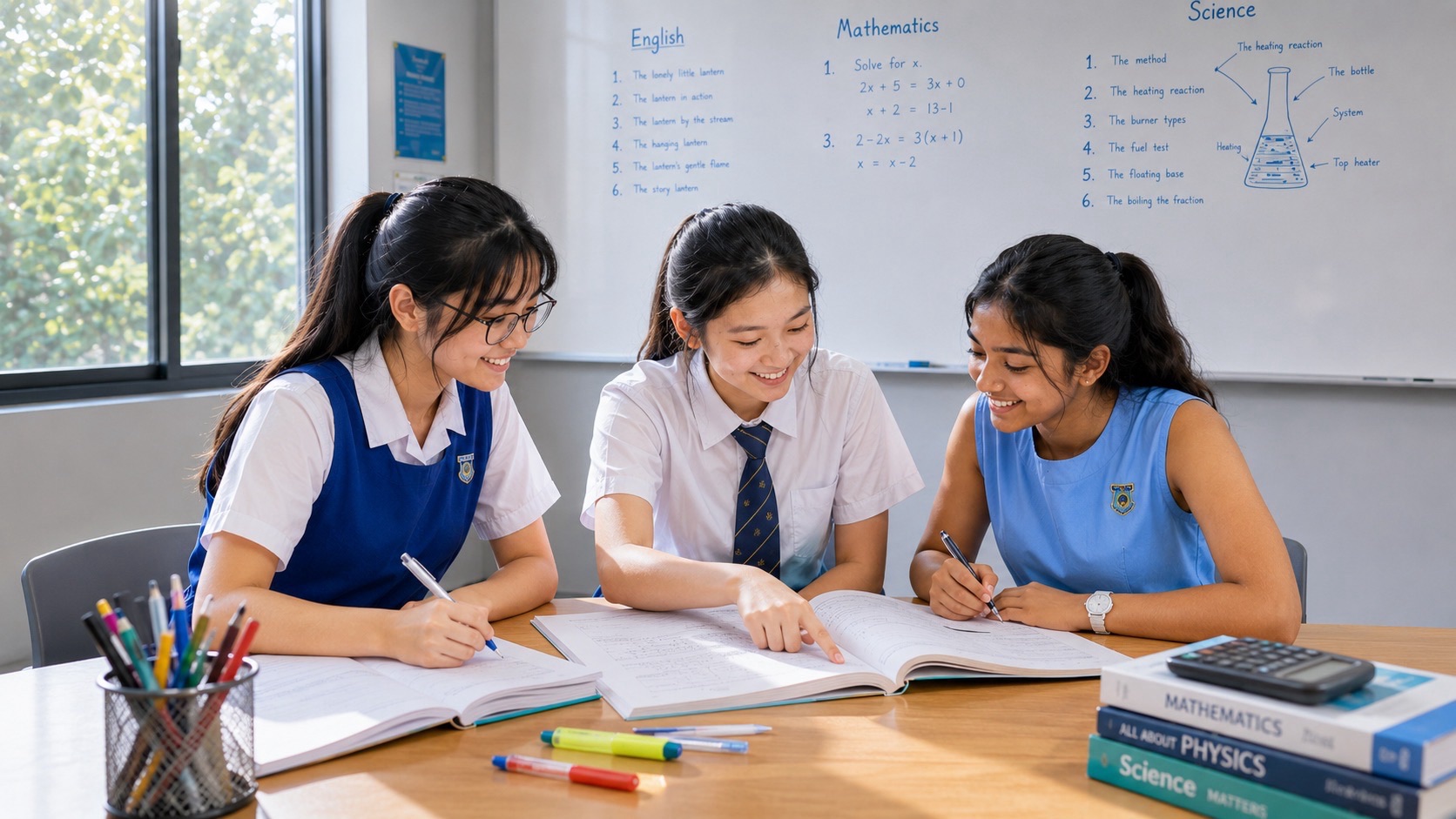
SECONDARY 3 · ENGLISH · TENGAH · SEC 2027 PATHWAY · SMALL-GROUP TUITION
Secondary 3 English Tuition Tengah
Secondary 3 is where English stops being mainly about developing ability and starts becoming a problem of turning that ability into dependable judgement.
A Sec 3 student in 2026 is also in an important transition cohort. Students graduating in 2027 will sit under the Singapore-Cambridge Secondary Education Certificate framework, at their respective G1, G2 or G3 subject levels under Full Subject-Based Banding.
The deeper educational issue is not the certificate name. It is that the student is entering the final two-year stretch where reading, writing, speaking, source judgement and examination control have to become reliable enough to perform under real stakes.
Quick Read for Parents
- Sec 3 in 2026 leads into the first SEC graduating cohort in 2027.
- English now demands judgement. Students must decide what evidence matters and which interpretation is defensible.
- Writing architecture becomes central. Good sentences are not enough if the argument or narrative lacks structure.
- Source and viewpoint awareness matter more. Students need to evaluate claims without collapsing into “everything is opinion”.
- Exam control should begin before Sec 4. Time, planning, checking and recovery from difficult tasks are trainable capabilities.
- Transfer matters. Reasoning should survive when the topic, source or task changes.
The One-Sentence Answer
Good Secondary 3 English tuition helps a student turn accumulated language ability into controlled judgement: read critically, build a defensible interpretation, organise ideas for a real audience and execute reliably under increasing examination pressure.
The Larger Story: Language Becomes Intellectual Responsibility
By Secondary 3, students are no longer simply learning to express themselves. They are learning that language can clarify, distort, persuade, conceal, qualify and connect.
claim → evidence → reasoning → qualification → judgement
Strong English therefore means more than sounding sophisticated. It means making meaning accurately enough that another person can inspect the reasoning.
The 2026–2027 SEC Context
Full Subject-Based Banding has been fully implemented since 2024. From 2027, graduating students will receive the Singapore-Cambridge Secondary Education Certificate and sit examinations at the subject levels they offer.
Parents should therefore use current MOE and SEAB information rather than older descriptions built entirely around the former stream architecture.
MOE Full Subject-Based Banding
MOE announcements on the SEC transition
Why Sec 3 Is Not Just “More Difficult Sec 2”
Sec 2 develops control over viewpoint, paragraph function and evidence. Sec 3 raises the stakes by asking those capabilities to sustain longer and more demanding tasks.
The central shift is from local correctness to global coherence. A paragraph can be good and the essay can still fail if the paragraphs do not build toward a clear whole.
Eight Secondary 3 Patterns That Need Different Repairs
1. Strong claims, weak reasoning bridges
The student has examples but does not explain why they support the claim. The missing work is reasoning, not vocabulary.
2. Source evaluation is reduced to “reliable” or “biased”
Source quality depends partly on the job. An official source may own a current policy date; a resident may better represent lived experience. Students need to match source authority to the claim.
3. Inference is dramatic but not defensible
One striking sentence can tempt the student to over-interpret. A sound inference should remain consistent with the wider text.
4. Paragraphs are individually good but globally repetitive
The essay lacks progression. Each paragraph may be competent, but the whole piece does not move the argument forward.
5. Timed writing is much weaker than untimed work
This is an examination-conversion problem. The capability exists, but planning, retrieval or checking is not yet robust under pressure.
6. Oral responses sound natural but stop too early
The student needs a real-time development habit: position, reason, example, qualification or reflection.
7. Vocabulary is rich but register is unstable
The same word does not suit every audience or purpose. Precision includes register, tone and context.
8. The student defends the first interpretation after later evidence contradicts it
Mature reading requires updating. A reader forms a model, encounters more evidence and revises the model when necessary.
Argument: A Strong Claim Carries Its Own Support
- a claim precise enough to examine;
- evidence or an example that is genuinely relevant;
- an explanation of why that evidence supports the claim;
- awareness of limitations or competing considerations where appropriate;
- a clear relationship to the larger question.
Students often lose control at the third point. They provide an example and assume the example speaks for itself. We teach them to make the reasoning bridge visible.
Source Evaluation: Credibility Depends on the Job
One source is not simply “reliable” for everything. A scientific paper may be appropriate for a causal technical claim. A government page may be the owner of a current policy detail. A news report may reconstruct an event while still depending on primary sources underneath.
This distinction protects students from two opposite errors: believing every polished source, or dismissing every source as biased.
Comprehension: Inference Must Survive the Whole Text
Weak inference often comes from taking one sentence too seriously and the rest of the text not seriously enough. A defensible interpretation should fit the relevant evidence across the passage.
Writing: Architecture Before Ornament
Does the opening establish a useful direction? Does each paragraph advance that direction? Are examples doing analytical work? Is there progression rather than repetition? Does the conclusion follow from what the essay established?
Vocabulary becomes a finishing tool. Precise words sharpen sound structure; they cannot substitute for one.
Oral Communication: Judgement in Real Time
Speaking compresses interpretation, selection and expression into seconds. A strong oral response needs enough structure to remain clear without sounding memorised.
Task Reading: Know What the Task Is Asking You to Produce
Purpose → Audience → Evidence → Structure → Language
This is not a rigid formula. It is a reminder that language choices should come after the student understands what the communication needs to achieve.
Transfer: Can the Judgement Survive a New Context?
Real mastery appears when the student can use the same reasoning principle on a new source, unfamiliar topic or different writing task. Transfer prevents English preparation from becoming a collection of brittle templates.
Catch Up, Keep Up or Move Ahead?
Catch Up
The student may still have weak comprehension, paragraph control or vocabulary relationships from earlier Secondary years. Repair those before layering heavy timed work on top.
Keep Up
The student is broadly capable but needs stronger reasoning bridges, source judgement, organisation and examination reliability.
Move Ahead
Stronger students can work on nuanced counter-argument, source triangulation, economy, tone and sustained interpretation across complex texts.
Why Three Students Matters
Three students create enough intellectual difference for genuine discussion while preserving enough tutor bandwidth for close observation.
One student may have a strong claim with weak evidence. Another may have excellent evidence but bury it in vague writing. A third may be cautious and accurate but under-develop the point. Those differences become teaching material.
How TengahOS Becomes Useful at Secondary 3
TengahOS can support more demanding language work: compare official updates with media reporting and resident reaction, evaluate which source should support a factual claim, or distinguish what is known, inferred, predicted and valued.
What Parents Can Do at Home
- Ask what evidence supports a strong opinion.
- Compare two sources on the same issue and ask what each is best placed to know.
- Ask the student to explain the job of each paragraph in an essay.
- When reading news, distinguish event, interpretation and prediction.
- Have the child summarise an argument they disagree with fairly before criticising it.
- Introduce timed practice early enough that pacing can be trained calmly.
What Progress Should Look Like
- claims become more precise;
- evidence is selected for relevance rather than quantity;
- inferences remain consistent with the whole text;
- paragraphs build a clearer overall line of argument;
- vocabulary becomes more audience-aware;
- source credibility is judged in relation to the claim;
- timed writing loses less quality than untimed writing;
- the student can revise an interpretation when later evidence contradicts it.
The Progression from Sec 2 to Sec 4
- Sec 2: control viewpoint, evidence and paragraph function.
- Sec 3: sustain those capabilities across argument, source judgement and increasing examination pressure.
- Sec 4: convert the whole system into reliable final-year performance.
See Secondary 2 English Tuition Tengah and continue to Secondary 4 English Tuition Tengah.
Frequently Asked Questions
Will Sec 3 students in 2026 take the SEC?
Students graduating in 2027 are the first cohort under the Singapore-Cambridge Secondary Education Certificate framework and will sit examinations at their respective subject levels.
Should Sec 3 students already be doing timed work?
Yes, but timed practice should not replace targeted work on comprehension, argument, paragraph structure and source evaluation. Timing is a layer added to capability, not a substitute for it.
Should model essays be memorised?
Models are useful for studying structure and language choices. Memorising whole essays is brittle if the student cannot adapt the reasoning to a new purpose or prompt.
The Deeper Idea
By Secondary 3, English education is increasingly about intellectual responsibility.
The student is learning that a persuasive sentence is not enough, a confident interpretation is not enough and a polished source is not enough.
Meaning has to remain answerable to evidence.
The closer the student gets to the final examination, the more important it becomes that language remains a tool for judgement rather than performance alone.