SECONDARY 3 · ADDITIONAL MATHEMATICS · JURONG WEST · 2027 SEC PATHWAY · SMALL-GROUP TUITION
Secondary 3 Additional Mathematics Tuition Jurong West
Secondary 3 Additional Mathematics becomes manageable when a student understands that an expression can change form without changing the mathematical relationship underneath.
This is one of the quiet shocks of A-Math. The symbols move. Terms are expanded, factorised, substituted, rearranged or represented on a graph. Yet the student must preserve what is mathematically true through every transformation.
A learner who sees only symbol movement can become lost very quickly. A learner who sees the invariant relationship underneath has something stable to reason from.
Quick Read for Parents
- Sec 3 A-Math is a major abstraction shift. Algebra becomes a working language, not merely a procedure.
- Transformations must preserve equivalence. Students need to know what a mathematical move changes and what it leaves intact.
- Recognition matters. The first difficulty is often identifying the structure before choosing the method.
- Functions connect variables. Students should move between algebraic and graphical representations without losing the relationship.
- Method selection matters more than formula accumulation.
- For the 2027 SEC, SEAB lists Additional Mathematics at both G2 and G3 subject levels for school candidates.
The one-sentence answer
Good Secondary 3 Additional Mathematics tuition helps students transform symbols, equations and representations while preserving the mathematical relationship that makes the transformation valid.
The central idea: form can change while structure remains
Consider a quadratic expression written in expanded form and the same expression written in factorised form.
The surface has changed. The mathematical object has not.
One form may make coefficients easy to compare. Another may expose roots. A graph may reveal intercepts and shape. Each representation makes different information easier to see.
The A-Math student therefore learns two jobs at once:
- transform the expression correctly;
- choose the form that reveals the relationship needed for the question.
Algebraic manipulation: every move should have a reason
Expanding, factorising, simplifying and rearranging are not decorative skills.
Each transformation should do a job. It may expose a common factor, isolate a variable, reveal a repeated structure, prepare an equation for solving, or make comparison possible.
Students who manipulate symbols mechanically often make two kinds of error: an illegal transformation, or a legal transformation that makes the problem harder.
We therefore ask: “What does this move reveal?”
Functions: one quantity moves with another
A function describes dependency. As one quantity changes, another responds according to a defined relationship.
This is where Jurong West’s idea of flows becomes mathematically useful. A flow is not random movement. Something changes according to constraints and relationships.
Likewise, in a function, the output does not wander freely. It is constrained by the rule connecting it to the input.
Students should learn to ask:
- What is changing?
- What depends on that change?
- What rule connects the two quantities?
- How does the graph show the same relationship?
Graphs: another view of the same relationship
A graph is not an illustration added after the algebra. It is another representation of the same mathematical relationship.
Students become stronger when they can move in both directions:
- equation → graph;
- graph → algebraic meaning.
A root may appear as an algebraic solution and also as an intercept. A change in parameter may alter an equation and visibly change the graph. The representation changes, but the underlying relationship remains connected.
Quadratics: several forms, one mathematical object
Quadratics are one of the clearest places to teach representation deliberately.
An expanded expression, factorised expression, equation and graph may all describe the same mathematical object from different angles.
A student who treats these as disconnected chapters has to memorise more. A student who sees them as related representations can reason across them.
Trigonometry: preserve the relationship while the diagram changes
Trigonometric work becomes difficult when students search for a formula before identifying the geometric relationship.
A diagram can be rotated. The labels can change. The question can present the information in a less familiar arrangement. None of that changes the underlying relationship among sides, angles and ratios.
The stronger student learns to reconstruct the relationship before selecting the tool.
Method selection: knowing a technique is not the same as knowing when it belongs
Many Sec 3 students can complete a question once someone tells them the first step.
This is an important diagnostic clue. The missing capability may be recognition rather than knowledge.
We therefore separate two questions:
- Can the student execute the method?
- Can the student recognise independently that this is the method to use?
The second question is what eventually allows A-Math to survive mixed examination work.
What tends to break first
A low mark can come from several different failure points.
- Algebraic fluency: manipulation remains too slow or unreliable.
- Equivalence: a transformation changes the expression incorrectly.
- Recognition: the student cannot identify the structure independently.
- Representation: algebra and graphs remain disconnected.
- Method boundary: the learner knows several techniques but cannot tell when each applies.
- Working-memory load: too much attention is spent on basic manipulation, leaving too little for strategy.
- Checking: transformed expressions are accepted without verification.
“Weak in A-Math” is therefore too broad to guide a repair.
A parent diagnostic that works surprisingly well
If your child says, “I understand when the teacher explains it, but I cannot start by myself,” do not immediately assume laziness or lack of practice.
Give one question and ask the child to do only this:
- Do not calculate yet.
- Identify the mathematical form.
- State what is known.
- State what must be found.
- Name two possible starting methods.
- Explain which one is likely to reveal the required structure faster.
If the child can continue after this classification, the bottleneck may be recognition rather than missing content.
How Jurong WestOS helps
Jurong WestOS is built around flows: people, materials, information and transport move through networks under constraints.
That gives A-Math a useful local intellectual anchor.
A bus route can be represented by stops, distance, time or a map. Goods moving through a system can be represented by quantity or rate. A change over distance may be described graphically. Different representations preserve different parts of the same underlying reality.
A-Math does something similar. It transforms a relationship into the representation that makes the next job easier.
The town is not the Mathematics syllabus. It provides a familiar model for understanding why representation matters.
A simple representation exercise
Take one relationship and represent it three ways.
- Write it algebraically.
- Sketch or interpret its graph.
- Describe in words what changes when the input changes.
- Identify which representation makes one particular feature easiest to see.
- Move back to the original representation and check that the relationship is preserved.
This trains the student to use representations as tools rather than separate topics.
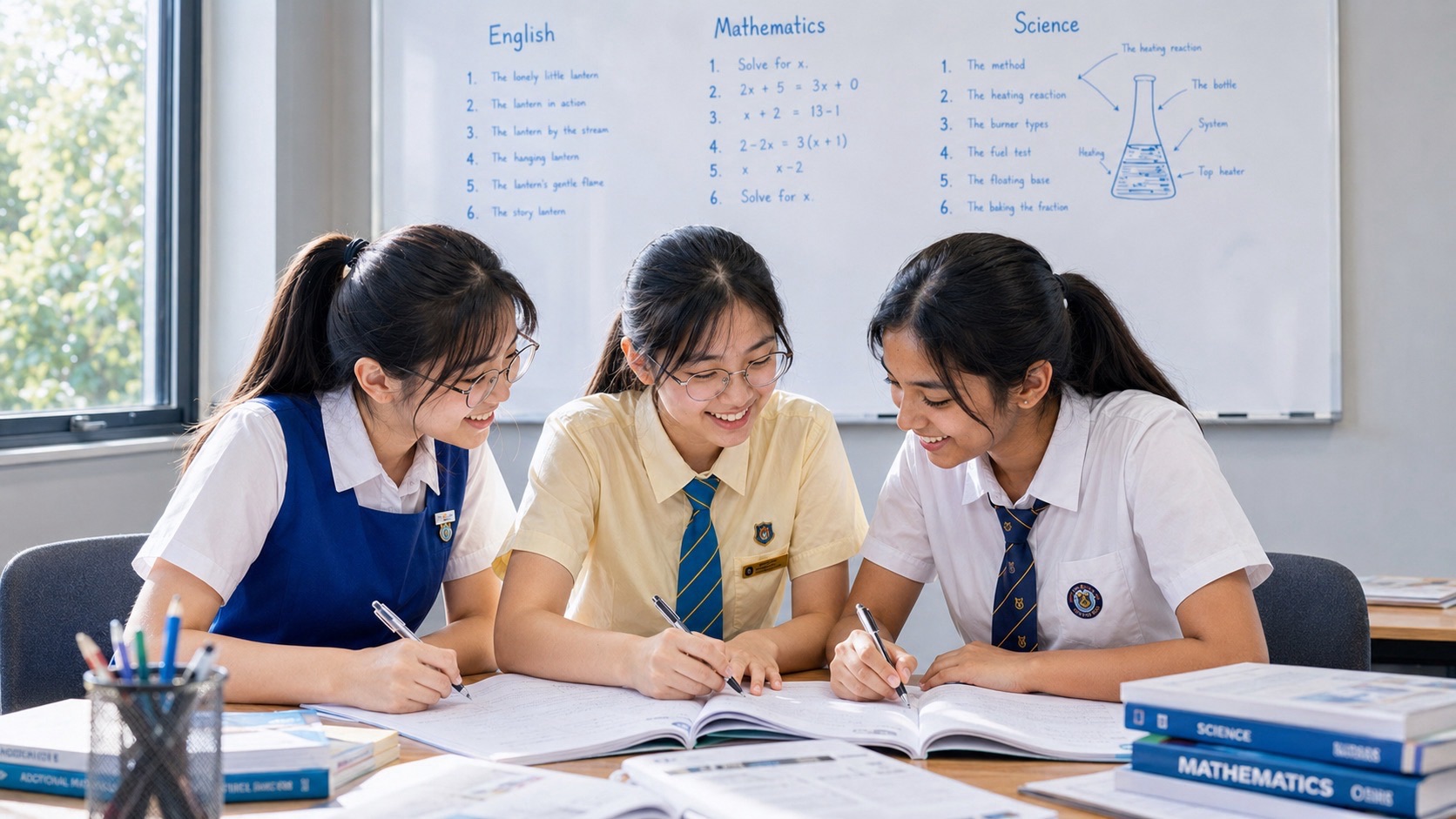
Why three students matters in A-Math
Three students can choose three different legal transformations.
One may factorise. Another may substitute. A third may use a graphical interpretation. The useful discussion is not merely who reached the answer first, but what each route revealed and where each route could become fragile.
The group remains small enough for the tutor to see whether a student selected a method independently or simply followed someone else’s opening move.
What progress should look like
- algebraic transformations become more reliable;
- students can explain what a transformation is trying to expose;
- functions feel like relationships rather than formulas;
- graphs and equations are connected more naturally;
- method selection becomes less dependent on hints;
- longer symbolic chains contain fewer accidental errors;
- students verify equivalence rather than assuming it;
- the first move becomes increasingly independent.
What parents can ask at home
- “What form is this expression in?”
- “What stays true after this transformation?”
- “What does this form make easier to see?”
- “Can the same relationship be represented another way?”
- “What clue tells you which method belongs?”
- “Where was the first step you stopped knowing what to do?”
These questions reveal more than asking whether the child has finished the worksheet.
The current 2027 SEC context
From the 2027 graduating cohort, the Singapore-Cambridge Secondary Education Certificate replaces the previous N- and O-Level certificates. Under the SEC, students sit subjects at the relevant G1, G2 or G3 subject level.
For 2027 school candidates, SEAB lists Additional Mathematics at both G2 and G3. Students should follow the level and syllabus offered by their school rather than assume one universal A-Math pathway.
This distinction is important. “Additional Mathematics” names the subject family, but the student’s actual subject level determines the current examination syllabus.
Frequently Asked Questions
Does struggling at the start of Sec 3 mean my child is unsuitable for A-Math?
Not automatically. A-Math introduces a genuine abstraction shift. The useful question is which capability is failing first: algebraic fluency, recognition, representation, method selection or working-memory load.
Should my child memorise more formulas?
Formula knowledge matters, but many difficulties come from not recognising when a known method applies. Method-selection practice is often as important as formula recall.
Why does my child understand examples but freeze on homework?
Worked examples contain hidden guidance: the chapter, method or first step may already be implied. Independent questions remove those cues and expose whether the learner can classify the structure alone.
Is Additional Mathematics only a G3 subject under the 2027 SEC?
No. SEAB’s current 2027 school-candidate listings include Additional Mathematics at both G2 and G3 subject levels.
The deeper idea
Jurong West is understandable because movement occurs through systems under constraints.
A-Math is similar. Symbols can move, expressions can change form and representations can switch, but the mathematics remains trustworthy only when the relationship underneath survives intact.
Secondary 3 Additional Mathematics becomes powerful when transformation stops looking like symbol movement and starts becoming a deliberate way to reveal structure without losing truth.
Continue through the tuition network: Tuition Programmes Directory · Programmes & Locations · West Singapore Tuition Directory · eduKateSingapore Hub.