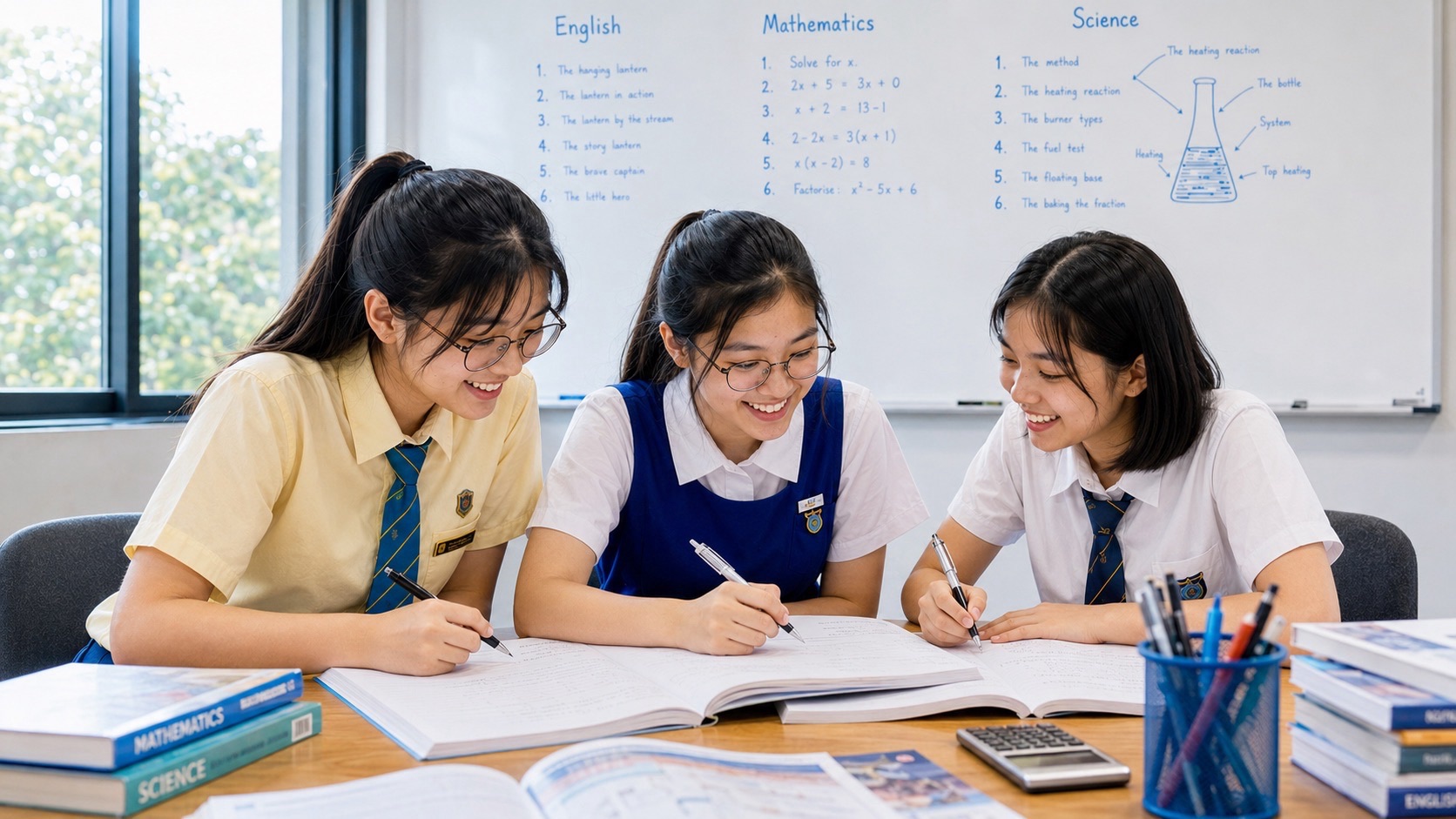
Canonical local owner: start with Secondary 2 English Tuition Tengah for the current location × year × subject route. This older page is retained as supporting material with its original explanatory angle. Secondary 2 is often the year when a student stops being able to “get by” on language instinct alone.
In Secondary 1, unfamiliar formats can be explained away as transition. By Secondary 2, the patterns are clearer. A student who reads quickly but loosely begins losing inference marks across several texts. A student who has ideas but weak paragraph control produces increasingly uneven writing. A student who relies on conversational English finds that grammar and register problems now appear in reports, essays and comprehension answers.
The useful work of Secondary 2 English is therefore structural. It is the year to identify which language habits are stable enough for upper secondary—and which are still being held together by familiarity, prompting or luck.
Quick Read for Parents
- Secondary 2 is often when earlier language weaknesses become repeatable patterns.
- Comprehension increasingly requires interpretation of tone, intention, implication and evidence.
- Writing needs stronger paragraph development and clearer relationships between ideas.
- Grammar and vocabulary problems become more visible because tasks are longer and less scaffolded.
- Argument begins to matter more: students need claims, reasons, examples and qualification.
- Good tuition should repair recurring language structures before upper-secondary examination pressure intensifies.
The One-Sentence Answer
Strong Secondary 2 English tuition should make the student’s reading, writing and language-control patterns reliable enough that increased complexity does not repeatedly expose the same hidden weak link.
Why Secondary 2 Is a Structural Year
A language weakness becomes structural when it begins affecting more than one section.
Weak sentence boundaries can hurt editing and composition. Limited vocabulary depth can weaken comprehension, summary and writing. Poor understanding of cause and contrast can appear in both reading and argument. A student who cannot distinguish evidence from opinion may struggle in comprehension and persuasive writing at the same time.
This is why we avoid treating every lost mark as an isolated mistake. We look for the shared process underneath several mistakes.
The Curriculum Is Still About Meaning, Not Worksheet Categories
MOE’s Secondary English Language Syllabus 2020 treats language as an integrated system for making and creating meaning. Students work with print, non-print and multimodal texts, while grammar and vocabulary operate as resources for communicating effectively across purpose, audience, context and culture.
Read MOE’s Secondary English Language Syllabus 2020.
This matters because Secondary 2 students often compartmentalise English too strongly: grammar belongs to editing, vocabulary belongs to a list, comprehension belongs to a passage and writing belongs to composition day. In reality, the same language knowledge travels across all of them.
Seven Secondary 2 Patterns Worth Diagnosing
1. Comprehension answers are plausible but unsupported
The student understands the general idea but does not anchor the answer to precise evidence. We train an evidence discipline: locate the phrase, explain what it implies, and stop where the text stops.
2. The student repeats the text instead of interpreting it
Copying can disguise uncertainty. The student has found the correct region but has not decided what the language means or why it matters. We teach paraphrase, inference and effect as separate moves.
3. Paragraphs contain points but no development
A paragraph may open with a reasonable idea, then jump to the next one before the first has been explained. The repair is not “write more”; it is learning how reasons, examples and explanation develop a claim.
4. Vocabulary is either too simple or overdone
Some students avoid precision because they rely on a small familiar vocabulary. Others overcorrect and insert elaborate words that do not fit the register. We teach semantic range, collocation and tone rather than prestige.
5. Grammar errors increase in longer writing
This often means the rule is known but not automated. As the student manages more ideas, sentence structure and accuracy become less stable. We build targeted editing routines around the student’s actual recurring errors.
6. The student writes what they believe but cannot argue it
Opinion is not yet argument. A defensible paragraph needs a claim, a reason, supporting example or evidence, and enough qualification to show the writer has considered complexity.
7. School feedback is understood but does not transfer
The student corrects the marked essay but repeats the same problem in the next one. This shows that feedback has been recognised without becoming a reusable rule. We convert corrections into a small personal error library and test each rule on fresh work.
Comprehension: Evidence Before Interpretation, Interpretation Before Effect
Secondary 2 reading becomes more reliable when the student separates three operations.
- Evidence: Which words or details matter?
- Interpretation: What do those words imply?
- Effect: Why did the writer choose them in this context?
Students frequently skip the middle step. They quote a phrase and immediately claim it “creates suspense” or “makes the reader interested”. We ask them to explain what the phrase means first. Once meaning is secure, effect becomes less generic.
Summary and Synthesis: Reduce Without Distorting
One of the most sophisticated language skills is compression. The student must identify what is essential, remove repetition, preserve relationships and express the idea more economically.
This is not simply shortening sentences. A weak summary can be brief but inaccurate. A strong summary is selective without losing the logic of the source.
We teach students to identify the informational job of each sentence before compressing. Which detail is evidence? Which is example? Which is repetition? Which carries the main relationship?
Writing: A Paragraph Needs an Internal Engine
Students are often taught paragraph acronyms. These can be useful scaffolds, but the deeper structure is simpler: a paragraph makes a meaningful claim and develops it enough for another person to follow.
Development may come through explanation, example, comparison, consequence, qualification or evidence. The choice depends on the writing purpose.
We therefore ask, “What job does this sentence do?” If three consecutive sentences all repeat the same claim in different words, the paragraph is longer but not more developed.
Argument: Stronger Than Opinion, More Flexible Than a Formula
Secondary 2 is a good year to build argument before upper-secondary stakes rise.
A strong argument does not merely sound confident. It acknowledges that real questions can have competing considerations. Students should learn to distinguish claim from reason, example from proof, and counterargument from surrender.
We use current but age-appropriate issues, school contexts and everyday decisions so students practise thinking before they practise sounding persuasive.
Grammar: Build a Personal Error Map
Generic grammar revision can be inefficient because students do not all make the same errors.
One student may struggle with agreement. Another with tense control. Another with sentence boundaries, pronoun reference or article use. We classify recurring errors and create a checking routine around the student’s own pattern.
The aim is for correction to move from teacher-owned to student-owned.
Vocabulary: Build Networks, Not Lists
Vocabulary becomes durable when words are connected by meaning, tone and use.
Instead of memorising important = crucial = vital = paramount as though the words were interchangeable, students compare when each sounds natural, formal, exaggerated or precise. They notice common word partnerships and how meaning shifts by context.
This improves comprehension because unfamiliar wording becomes easier to infer, and improves writing because word choice becomes more controlled.
Why Three Students Works Well in Secondary 2 English
Secondary 2 English needs enough discussion for students to hear competing interpretations, but enough individual attention for the tutor to see exactly where each student’s reasoning fails.
Three students makes that balance possible. One student can defend an inference, another can challenge it with textual evidence, and a third can identify which interpretation better fits the writer’s tone. In writing, students can compare paragraph development without being reduced to one model answer.
What Parents Can Do in Secondary 2
- Look for repeated errors across subjects. Weak explanation may appear in English, Science and Humanities.
- Ask what feedback keeps returning. Repeated comments reveal structural weaknesses.
- Encourage broad reading with discussion. Ask what the writer assumes, not only what the article says.
- Do not rewrite essays. Ask the student to improve one paragraph and explain the changes.
- Build an error notebook. Personal recurring grammar and vocabulary issues are more useful than random revision lists.
- Ask for evidence before agreement. “What makes you think that?” is one of the best language questions a parent can ask.
The Current Singapore Secondary Pathway
Full Subject-Based Banding has been fully implemented since 2024, with subjects offered at G1, G2 and G3 levels according to students’ strengths and learning needs. These are subject levels, not simply replacements for the old stream labels.
From 2027, graduating students sit the Singapore-Cambridge Secondary Education Certificate (SEC) examinations at their respective subject levels. Secondary 2 students therefore sit inside a system that is already structurally different from the one many parents remember.
MOE: Full Subject-Based Banding and SEC transition.
TengahOS Keeps the Local Architecture Clean
The broader town story belongs in TengahOS. This page remains focused on Secondary 2 English and the structural language problems that begin appearing at this age.
That separation prevents local context from becoming filler. The town pillar can go deep on place; the tuition page can go deep on learning.
What Improvement Should Look Like
Secondary 2 improvement should look increasingly reusable.
The student does not merely correct one inference question; they learn how evidence constrains inference. They do not merely repair one paragraph; they learn how development works. Grammar corrections become categories the student can self-check. Vocabulary choices become more appropriate to register.
The real sign of progress is that feedback begins transferring to work the tutor has never seen before.
Who This Programme Can Help
Secondary 2 English tuition can help students whose Sec 1 transition issues have become recurring patterns, who need stronger evidence-based comprehension, better paragraph development, more reliable grammar, deeper vocabulary control, stronger argument or greater independence with feedback.
Stronger students can be stretched through ambiguity, rhetoric, competing interpretations, more demanding argument and writing where structure must be chosen rather than supplied.
Frequently Asked Questions
Why is Secondary 2 important if the major examination is still later?
Because this is often the last relatively calm year to repair recurring language habits before upper-secondary content and examination preparation intensify.
Should tuition focus on school worksheets?
School work provides valuable evidence, but tuition should also strengthen the underlying process so improvement transfers beyond one worksheet format.
How can my child improve inference?
Require evidence. Ask which exact words support the interpretation, what those words imply and whether another interpretation fits the text better.
Should my child start memorising upper-secondary essay content?
Content knowledge is useful, but Secondary 2 is better used to build the ability to develop reasons, examples and qualifications flexibly. Memorised content without argument structure transfers poorly.
Secondary 2 Is Where Weakness Becomes Architecture—or Gets Repaired
A repeated language error is rarely just an irritating mark lost twice.
Left alone, it becomes part of how the student reads, writes and thinks under pressure. Repaired carefully, it can improve several sections at once.
That is why Secondary 2 deserves more than maintenance. It is the year to make the language structure sound before upper secondary starts placing real weight on it.