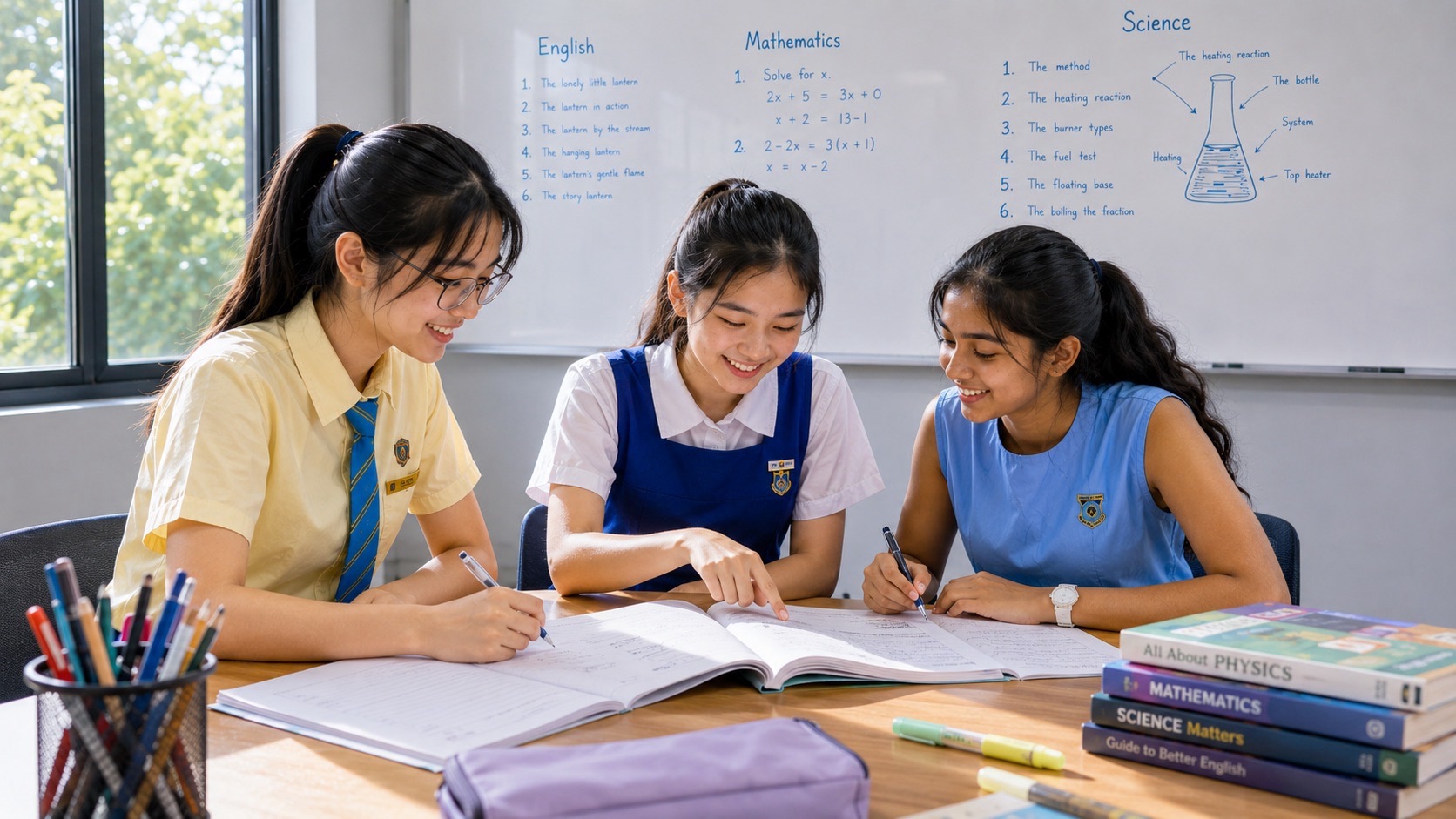
Secondary 1 Mathematics is where numbers begin to behave less like answers and more like objects that can be represented, transformed and related.
A Primary 6 student may be very comfortable calculating with known quantities. Secondary 1 introduces a different demand: the learner must increasingly reason with unknowns, negative values, symbolic expressions, proportional relationships, graphs and geometric properties.
The transition is not simply “harder Math”. It is a change in mathematical language.
Quick Read for Parents
- Secondary 1 Mathematics is the bridge from arithmetic into algebraic thinking.
- Under Full Subject-Based Banding, students may offer Mathematics at G1, G2 or G3 according to their learning needs and strengths.
- G1, G2 and G3 are subject levels, not old-style whole-school streams.
- Students need to become comfortable with symbols, negative numbers, ratio, algebraic expressions, geometry and data relationships.
- A student who calculates accurately can still struggle if representation and algebraic meaning are weak.
- Good tuition should align to the student’s actual subject level and diagnose the earliest unstable concept.
The One-Sentence Answer
Strong Secondary 1 Mathematics tuition should help a student move from performing calculations on known numbers to reasoning confidently with symbols, relationships and representations.
The First Big Shift: Arithmetic to Algebra
Primary Mathematics often asks, “What is the answer?” Secondary Mathematics increasingly asks, “What relationship is true?”
Consider 7 + 5 = 12. In arithmetic, the task is complete. In algebra, the student may instead meet 7 + x = 12, or 3x + 2, or a statement in which a letter represents a quantity that can vary.
The symbol is not decoration. It changes the kind of thinking required.
Students who treat x as a mysterious “thing to solve” often become dependent on memorised manipulation rules. We begin earlier: what does the symbol represent? Which quantities are fixed? Which can vary? What relationship does the expression describe?
The Current Singapore Mathematics Context
Full Subject-Based Banding has been fully implemented from the 2024 Secondary 1 cohort. Students may take Mathematics at G1, G2 or G3, and can adjust subject levels at appropriate points according to readiness.
MOE’s current G2 and G3 Mathematics syllabuses emphasise Number and Algebra, Geometry and Measurement, and Statistics and Probability, together with mathematical reasoning, communication, application and problem solving. G1 Mathematics follows the same broad mathematical purpose at a different level of demand.
MOE: G2 and G3 Mathematics Syllabuses
Seven Secondary 1 Mathematics Patterns Worth Diagnosing
1. The student is strong with numbers but uncomfortable with letters
This is often an algebraic representation problem rather than a calculation problem. We connect symbols back to quantities and patterns before increasing manipulation.
2. Negative numbers feel arbitrary
Rules such as “minus times minus becomes plus” can be memorised quickly and forgotten quickly. Number lines, direction, temperature and algebraic structure help the student understand what negative values represent.
3. The student expands expressions correctly but cannot explain why
Procedure without meaning becomes fragile when signs, brackets or coefficients change. We reconnect distributive structure to area models and arithmetic examples where useful.
4. Ratio and proportion are treated as isolated tricks
Secondary Mathematics expects students to recognise multiplicative relationships across contexts. We ask what is being compared and what stays constant before choosing a method.
5. Geometry is learned by picture recognition
Secondary geometry relies more heavily on stated properties and reasoning. A diagram may not be drawn to scale, so the student must learn to trust definitions and relationships over appearance.
6. Word problems become harder even though the arithmetic is easier
The difficulty is often translating a verbal relationship into an equation, ratio, graph or diagram. Representation becomes part of the solution rather than an optional extra.
7. The student waits for the teacher to choose the method
Secondary Mathematics increasingly requires method selection. We deliberately ask students to identify what kind of relationship is present before beginning calculation.
Algebra: Symbols Should Reduce Complexity, Not Create It
Algebra is powerful because it compresses relationships.
A sentence such as “three more than twice a number” can be represented compactly as 2x + 3. A repeated pattern can be described by a general term. A relationship between quantities can be turned into an equation and solved systematically.
The learner should therefore see algebra as a language for structure, not a collection of rules about letters.
Equations: Preserve Equality
Students are often taught to “move a term across and change the sign”. That shortcut can work, but it hides the underlying principle.
An equation states that two expressions are equal. Solving means performing equivalent operations that preserve that equality while isolating the unknown.
Once students understand this, later algebra becomes easier to reconstruct because the method is grounded in balance rather than memorised movement.
Graphs: A Relationship Made Visible
Graphs introduce students to the idea that a relationship between two variables can be seen geometrically.
Coordinates, tables of values and graph shapes are not separate topics. They are different representations of the same relationship.
We repeatedly move between equation, table and graph so the learner begins seeing mathematics as connected forms rather than separate worksheet sections.
Geometry: Properties Beat Appearance
In primary school, shapes are often visually obvious. Secondary geometry becomes more formal. Students need angle relationships, properties of triangles and quadrilaterals, constructions and increasingly precise reasoning.
A useful habit is to mark only what the question gives or what can be proved from known properties. This prevents the common error of assuming something simply because the diagram looks symmetrical, perpendicular or equal.
Mathematical Working Is Communication
Secondary Mathematics requires clearer working because problems contain more steps and symbols.
Good working does not mean writing every thought. It means preserving enough structure that the student can see what each line follows from and can locate an error when the final answer is wrong.
We teach students to make transformations legible, align equations sensibly and label units and geometric statements where needed.
Why Three Students Works Well for Secondary 1 Mathematics
Mathematics transition errors are highly individual. One student misunderstands the negative sign. Another understands the concept but expands brackets carelessly. A third can manipulate symbols but cannot translate a word problem.
In a three-student group, the tutor can inspect the route each learner takes. Students also hear alternative methods and learn that different representations can express the same mathematical relationship.
What Parents Can Do During the Sec 1 Mathematics Transition
- Check the actual subject level. Use the student’s G1, G2 or G3 Mathematics materials and school expectations.
- Ask what x means. Symbol meaning matters before manipulation.
- Ask why a step preserves equality. This exposes memorised algebra.
- Keep marked scripts. Signs, brackets, translation and arithmetic errors need different repairs.
- Do not judge only by speed. Algebraic understanding can initially slow a student before later making work more efficient.
- Encourage checking by substitution. Putting a solved value back into the original equation is powerful evidence.
TengahOS Carries the Town Context
The broader story of Tengah is already carried by TengahOS. This page stays focused on the Sec 1 Mathematics transition.
The connection remains useful: maps, transport, rates, scale, geometry and data all exist in real towns. Mathematics gives students languages for describing those relationships with precision.
What Improvement Should Look Like
Secondary 1 improvement should look like greater comfort with abstraction.
The student sees a letter and asks what it represents rather than panics. Negative values fit on a number line. Expressions are simplified with attention to structure. Equations are solved as balanced relationships. Graphs are recognised as representations of changing quantities.
The deeper sign of progress is that the student begins to explain why a method works, not merely reproduce it.
Frequently Asked Questions
Why did my child’s Mathematics marks fall after PSLE?
The mathematical language changes. Algebra, signed numbers, formal geometry and new representations can expose weaknesses that were not visible in primary arithmetic. Look at the error pattern before assuming lack of ability.
Are G1, G2 and G3 Mathematics the old streams?
No. They are subject levels under Full Subject-Based Banding. A student can have a subject-level profile rather than one stream identity applied to every subject.
Should we begin Additional Mathematics in Secondary 1?
Formal Additional Mathematics is an upper-secondary subject where offered. Sec 1 is better used to make algebra, number and geometry foundations strong enough that later A-Math has something stable to build on.
What if my child is already very strong?
Increase depth: multiple methods, generalisation, proof-like explanation, modelling and unfamiliar problems. Acceleration is only one form of stretch.
Secondary 1 Is Where Mathematics Learns a New Language
The most important Sec 1 transition is not a particular formula.
It is learning that symbols, graphs, equations and diagrams can preserve relationships more efficiently than ordinary arithmetic alone.
Once that language becomes familiar, Secondary Mathematics stops looking like a collection of mysterious rules and starts becoming a coherent system.
Continue through the tuition network: Tuition Programmes Directory · Programmes & Locations · West Singapore Tuition Directory · eduKateSingapore Hub.