SECONDARY 1 · MATHEMATICS · JURONG EAST · FULL SBB · SMALL-GROUP TUITION
Secondary 1 Mathematics Tuition Jurong East
Secondary 1 Mathematics begins when the learner stops seeing every problem as a collection of particular numbers and starts seeing the general relationship underneath them.
Primary Mathematics already contains relationships: part-whole, ratio, fraction, percentage, area, volume, rate and multi-step dependency. Secondary school makes those relationships more explicit and more abstract. A number may be replaced by a letter. A table may become a graph. A geometric pattern may be described by a rule. A comparison may become an algebraic statement.
The important Sec 1 transition is therefore not “harder sums”. It is generalisation.
Quick Read for Parents
- Sec 1 Mathematics is a transition from arithmetic into structure.
- Full SBB is the current framework. Students may offer Mathematics at G1, G2 or G3 subject levels according to their school pathway and learning needs.
- Algebra introduces general relationships. A letter is not simply a missing number.
- Graphs are representations of relationships, not decorative pictures.
- Ratios, rates and proportions need the student to track how quantities change together.
- Geometry becomes stronger when students reason from properties rather than visual appearance.
- Method selection matters as soon as more than one route becomes possible.
The one-sentence answer
Good Secondary 1 Mathematics tuition helps students move from calculating particular cases to recognising, representing and manipulating the general relationships that connect quantities.
The first Sec 1 shock: the answer is not always a number
In Primary school, students often expect a problem to end with a numerical answer.
Secondary Mathematics asks a different kind of question.
A learner may need to simplify an expression, describe a relationship, identify a pattern, form an equation, interpret a graph or explain why two quantities change together.
The destination may therefore be a structure rather than a number.
This matters because some students continue treating algebra as arithmetic with letters sprinkled through it. That approach becomes fragile quickly.
Algebra: a variable is a carrier of possibility
A letter such as x can represent an unknown value, a changing quantity, or a general number depending on the context.
The important question is not simply “What is x?”
It may be:
- What relationship connects x to another quantity?
- How does the expression change when x changes?
- What value of x makes the statement true?
- What pattern does x represent generally?
This is the beginning of algebraic thinking: the symbol carries a relationship that can apply beyond one numerical example.
From number sentence to equation
A Primary learner may solve a missing-number problem by trial, model drawing or inverse operation.
Secondary Mathematics increasingly makes the equality structure explicit.
An equation says that two expressions represent the same value.
When one side is transformed, the student must preserve that equality.
This is why legal algebraic moves matter. The goal is not symbol movement. It is relationship preservation.
Negative numbers: direction and position matter
Negative numbers often expose whether number sense is attached only to counting objects.
A number line helps because it represents magnitude and direction together.
Students should be able to reason about:
- which number is greater;
- distance from zero;
- movement left or right;
- how subtraction can change direction;
- why a visually longer expression is not automatically a larger value.
The number line becomes a transfer bridge from concrete intuition into abstract signed numbers.
Ratio and rate: quantities move together
Ratio and rate are important because they describe relationships between quantities rather than quantities in isolation.
Students need to ask:
- Which two quantities are being compared?
- Does one quantity change when the other changes?
- Is the relationship fixed?
- What does “per” mean in this context?
- What representation makes the relationship easiest to see?
The student becomes more mathematically mature when the focus moves from “What are the two numbers?” to “How are the two quantities connected?”
Graphs: another language for the same relationship
A graph is not a picture added after the Mathematics.
It is another representation of a relationship.
A table may show corresponding values. An equation may show the rule. A graph may show trend, intersection, rate of change or comparison more visibly.
We train movement in both directions:
- table → graph;
- graph → verbal interpretation;
- verbal relationship → equation or table;
- equation → graphical meaning where appropriate.
The mathematical object remains connected even while the representation changes.
Geometry: properties outrank appearance
A diagram can be misleading if the learner trusts appearance more than properties.
Lines may look parallel without being stated as parallel. An angle may look acute but require reasoning from known relationships. A drawing may not be to scale.
Secondary geometry strengthens one important habit:
Use what is mathematically given, not what the picture merely seems to show.
This is evidence discipline inside Mathematics.
Representation choice: not every problem wants the same map
Some students arrive from Primary school believing that one familiar representation should be used everywhere.
Secondary Mathematics rewards flexibility.
A number line may be useful for signed numbers. A table may reveal a pattern. A graph may expose a relationship. An equation may compress the same relationship. A geometric diagram may be necessary when spatial constraints matter.
The deeper question is:
“Which representation reduces the most uncertainty in this problem?”
Method selection: more routes create a new kind of difficulty
As students learn more Mathematics, they gain more possible methods.
This is progress, but it creates a selection problem.
A learner may know several procedures and still freeze because the first move is unclear.
We distinguish:
- method knowledge: can the student execute the procedure?
- method recognition: can the student identify when it applies?
- method selection: can the student choose sensibly when more than one route is possible?
These are different capabilities and should be practised differently.
Working memory: abstraction can expose weak foundations
Secondary Mathematics often feels suddenly harder because several small operations are now stacked together.
If fraction arithmetic, signed numbers, ratio, place value or basic algebraic manipulation remain effortful, they consume working memory that should be available for strategy.
This is why the first Sec 1 repair is sometimes an older foundation.
Good teaching does not treat that as regression. It locates the earliest weak dependency and repairs it so the newer structure has something stable to rest on.
How Jurong East makes the idea visible
Jurong East is useful as a local analogy because an interchange turns many individual journeys into a connected network.
Secondary 1 Mathematics does something similar to Primary arithmetic.
Individual calculations become connected through general rules. Particular values become variables. Separate tables become graphs. Repeated examples become patterns.
The learner stops seeing isolated stops and begins seeing the network.
The town is not the Mathematics syllabus. It gives students a concrete image of mathematical generalisation and connected representation.
A useful Sec 1 parent diagnostic
If your child says, “I can do the examples but not the homework,” choose one question and remove the calculation demand temporarily.
- Ask what quantities are involved.
- Ask how they are related.
- Ask what the letter or unknown represents.
- Ask which representation might help.
- Ask for two possible first moves.
- Only then calculate.
If the child can continue after the structure is named, the bottleneck may be recognition rather than missing procedural knowledge.
What a Secondary 1 Mathematics stall can actually mean
- Arithmetic foundation: older number skills remain too effortful.
- Algebraic meaning: letters are treated as mysterious placeholders rather than quantities in relationships.
- Equality: transformations are performed without preserving the equation.
- Representation: tables, graphs, equations and diagrams remain disconnected.
- Ratio/rate: paired quantities are manipulated without understanding how they change together.
- Geometry: visual appearance overrides stated properties.
- Recognition: methods are known but not retrieved independently.
- Method selection: the student chooses a valid but unnecessarily heavy route.
“Weak in Sec 1 Math” is too broad to guide a useful repair.
Why three students matters
Three students can represent the same relationship differently.
One may prefer a table. Another moves immediately to algebra. A third understands the graph but struggles to form the equation.
The tutor can compare these routes and see whether each learner owns the relationship or only one representation of it.
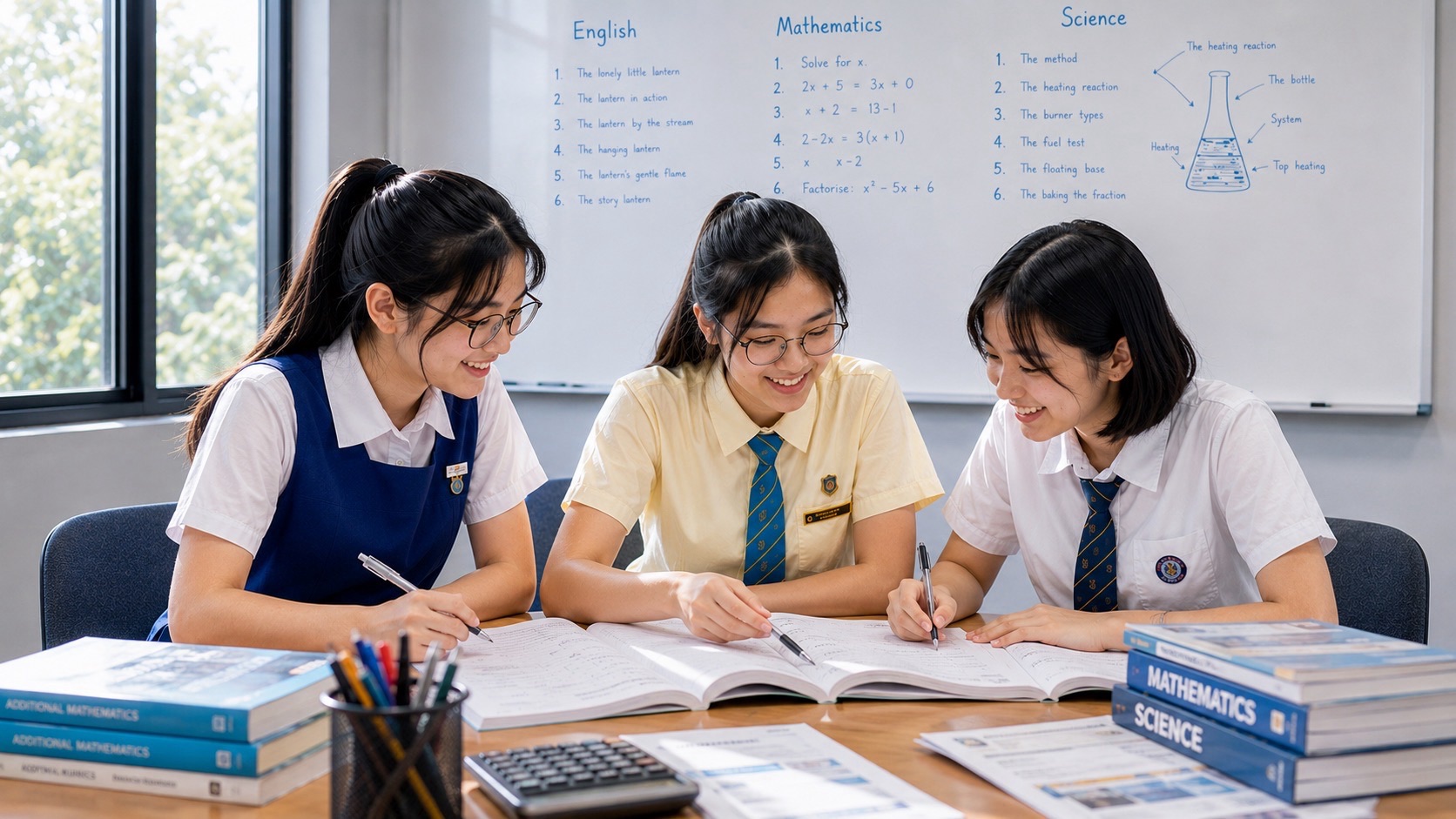
The small group creates enough contrast for mathematical discussion while keeping every reasoning path individually visible.
What progress should look like
- letters feel less mysterious;
- equations are understood as relationships rather than instructions;
- signed numbers are reasoned about more securely;
- ratios and rates remain attached to the quantities they compare;
- graphs and tables are interpreted as connected representations;
- geometry relies more on properties than appearance;
- method selection becomes more independent;
- older arithmetic foundations consume less working memory.
What parents can do at home
- Ask what a variable represents in words.
- Ask whether two algebraic expressions are equal and why.
- Move one relationship between a table, graph and verbal description.
- Ask which geometric facts are given and which are only visual assumptions.
- Ask “What changes together?” in a ratio or rate problem.
- After a wrong answer, identify whether the structure or the calculation failed first.
A useful parent question is: “What general relationship is this particular question an example of?”
Current Full SBB context
Full Subject-Based Banding has been fully implemented since 2024. Students may offer Mathematics at G1, G2 or G3 subject levels according to their school offering, strengths and learning needs. These subject levels should not be flattened into one universal syllabus.
Parents can use MOE’s Full Subject-Based Banding information for the current framework and consult the relevant Mathematics syllabus for the student’s actual subject level.
Frequently Asked Questions
Why does Sec 1 Mathematics feel so different from Primary 6 Mathematics?
The subject becomes more explicit about general relationships. Variables, equations, graphs and abstract representations increase the distance between the mathematical idea and a familiar concrete situation.
Should my child memorise algebraic procedures first?
Procedural fluency matters, but it becomes more reliable when the learner understands what the symbols represent and what each transformation preserves.
Does Full SBB mean all Sec 1 Mathematics classes cover exactly the same material?
No. Students may offer Mathematics at G1, G2 or G3 subject levels. The student’s actual school subject level should determine the syllabus and pacing used for tuition support.
The deeper idea
Primary Mathematics teaches a child to solve many particular problems.
Secondary 1 begins teaching the child to see what those problems have in common.
The mature Sec 1 learner begins to understand that algebra, graphs, ratio and geometry are not new worlds replacing arithmetic. They are more general languages for relationships that arithmetic was already quietly teaching.
Continue through the tuition network: Tuition Programmes Directory · Programmes & Locations · West Singapore Tuition Directory · eduKateSingapore Hub.