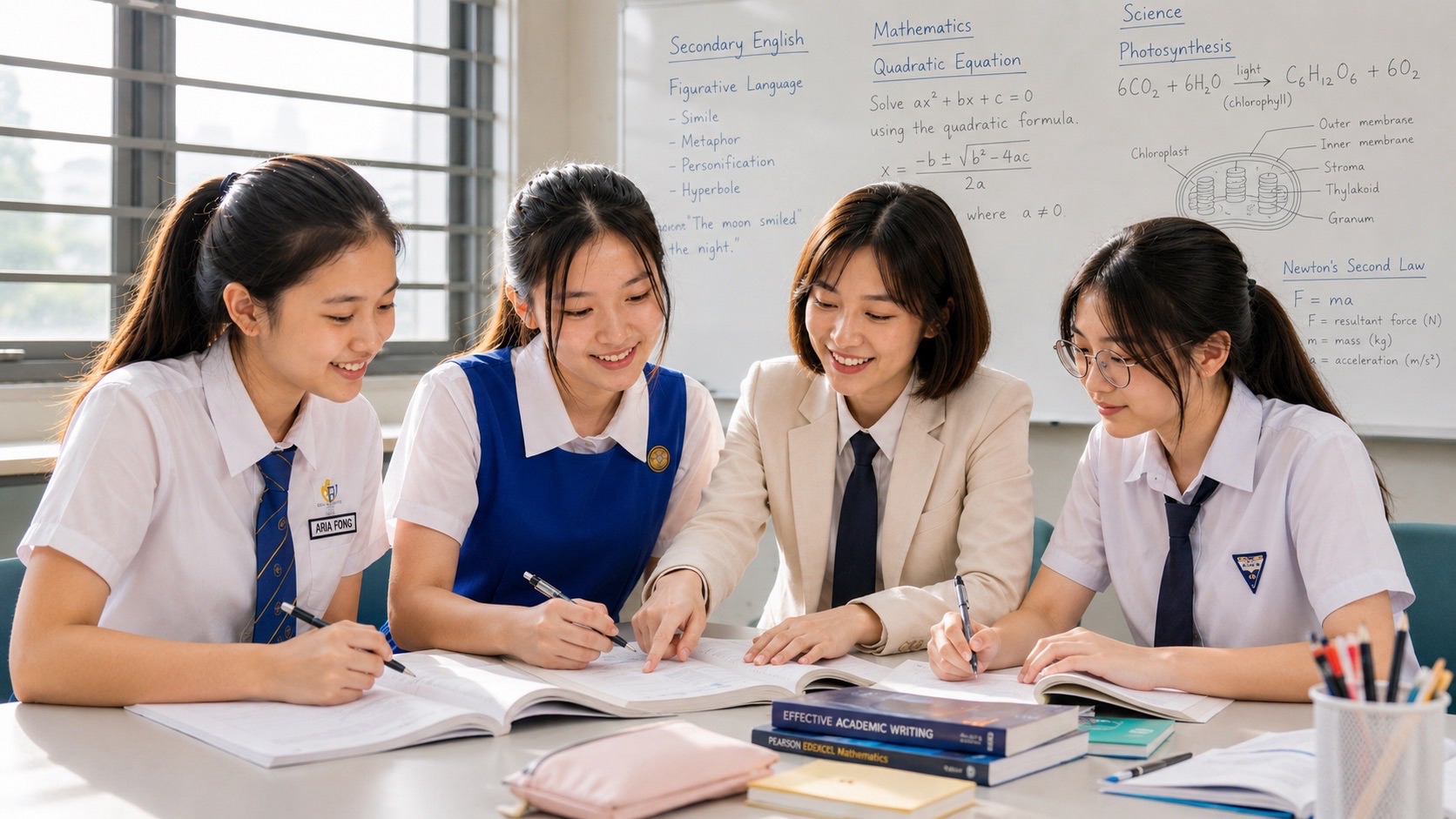
Secondary 1 Mathematics is often the first point where parents notice something unexpected.
A child who was comfortable with Mathematics in Primary School may suddenly become slower.
Homework takes longer.
Algebra feels unfamiliar.
A student who can follow examples in class may struggle when the question looks slightly different.
Marks may become inconsistent.
And sometimes, the most confusing situation of all appears:
“My child seems to understand the work. Why are the results not showing it?”
This is why Secondary 1 Mathematics deserves more attention than its position as the “first year” of Secondary School might suggest.
It is not simply another year of Mathematics.
It is the year when a student begins changing from a Primary School learner into a Secondary Mathematics learner.
The foundations built here influence what happens in Secondary 2, the transition into upper-secondary Mathematics, future readiness for Additional Mathematics, and eventually examination performance.
Good Secondary 1 Mathematics tuition should therefore do more than help a student finish homework.
It should help the child become a stronger mathematician.
Why Secondary 1 Mathematics Feels So Different From Primary School
Parents sometimes expect Secondary 1 to feel like a slightly harder version of Primary 6.
It usually does not.
The change is deeper.
Primary Mathematics already develops sophisticated problem-solving skills, but Secondary Mathematics begins asking students to work with greater abstraction, more compact mathematical notation and a growing dependence on algebraic reasoning.
The student is expected to become increasingly comfortable moving between:
words,
numbers,
symbols,
equations,
graphs,
tables,
diagrams,
and mathematical relationships.
This creates an important transition.
A Primary School student may have learned to solve a familiar type of problem through a recognised method.
A Secondary School student increasingly needs to ask:
What mathematical structure is hidden inside this question?
That is a different kind of thinking.
And it takes time to develop.
Secondary 1 Mathematics in Singapore Today
Singapore’s Secondary School landscape has changed considerably.
From the 2024 Secondary 1 cohort, the former Express, Normal (Academic) and Normal (Technical) streams were removed under Full Subject-Based Banding.
Students are now admitted through Posting Groups 1, 2 and 3, while individual subjects can be studied at G1, G2 or G3 levels according to the student’s strengths, learning needs and readiness.
Importantly, Posting Groups primarily guide admission and the initial subject levels a student takes. Students may subsequently take subjects at different levels and adjust them at appropriate points in their Secondary School journey.
This makes one idea increasingly important for parents:
Do not think only in terms of what “group” your child belongs to. Look at how well your child is actually learning Mathematics.
A student may be strong in one subject and need more support in another.
Another student may begin Mathematics at one level and later become ready for greater challenge.
The educational pathway is becoming more flexible.
That makes accurate teaching and accurate diagnosis more valuable—not less.
From 2027, graduating students will also sit for the Singapore-Cambridge Secondary Education Certificate examinations at their respective subject levels, replacing the previous separate O-Level and N-Level certification structure.
For a Secondary 1 student today, the important message is not to worry about an examination several years away.
It is simpler:
Build the Mathematics properly now so that more options remain available later.
What Does Secondary 1 Mathematics Actually Build?
MOE continues to publish Mathematics syllabuses at G1, G2 and G3 levels under the current Secondary School structure. The curriculum develops mathematical understanding across areas including number and algebra, geometry and measurement, and statistics and probability, together with reasoning, application, communication and problem-solving.
Schools may sequence topics differently, so parents should not become overly concerned about whether one school teaches a particular chapter several weeks earlier than another.
The more important question is:
Is the child developing the underlying abilities that future Mathematics depends upon?
Several foundations matter particularly strongly.
1. Algebra Must Stop Feeling Like a Foreign Language
For many students, algebra is the first major change.
Letters now represent quantities.
Expressions must be manipulated.
Equations must remain balanced.
Negative signs matter.
Brackets matter.
A small mistake in one line may affect everything below it.
Students must gradually become comfortable with ideas such as:
- algebraic expressions;
- substitution;
- expansion and simplification;
- equations;
- inequalities;
- relationships between quantities;
- graphs and algebraic representation.
The difficulty is not usually the letter x itself.
The difficulty is that Mathematics has acquired a new language.
A student who never becomes fluent in that language may continue struggling long after the original Secondary 1 chapter is over.
This is why we take early algebra seriously.
It is not simply one topic to complete.
It becomes part of the working language of later Mathematics.
The Most Important Question Is Not:
“Did My Child Finish the Worksheet?”
It is:
“Can My Child Do It Independently?”
There is a major difference between recognising Mathematics and owning it.
A student may look completely comfortable while:
watching a tutor solve a question,
following a worked example,
doing homework immediately after a lesson,
or completing several questions of the same type.
Then the school test arrives.
The wording changes.
Two topics appear together.
Nobody gives the first hint.
The student has to decide which method to use.
Suddenly, the Mathematics seems much harder.
Parents sometimes describe this as:
“He knows his work but cannot perform in tests.”
That sentence is extremely important.
Because it tells us that more practice may not automatically solve the problem.
We first need to discover where the independence breaks down.
Why Students Can Do Tuition Work but Still Struggle in School Tests
A question completed with help does not prove that the student can perform alone.
A familiar worksheet does not prove that the student can recognise the same concept in an unfamiliar form.
Untimed work does not prove that the method remains reliable under examination pressure.
This creates several possible gaps.
The student does not fully understand the concept.
They may have memorised the steps without understanding why those steps work.
The student understands but cannot recall the method independently.
Once the example disappears, they cannot begin.
The student knows several methods but chooses the wrong one.
This becomes increasingly important as Mathematics grows more complex.
The student can solve familiar questions but struggles when the presentation changes.
The Mathematics underneath may be identical, but a different diagram, context or wording causes confusion.
The student works correctly but too slowly.
The knowledge exists, but examination time exposes the weakness.
The student repeatedly makes small errors.
Signs, brackets, arithmetic, copying, units and substitutions may appear to be “careless mistakes”.
Sometimes they are.
But when the same kinds of mistakes happen repeatedly, there is usually a pattern worth investigating.
The student thinks they understand more than they actually do.
Recognition can feel like mastery.
The student sees a solution and thinks:
“Yes, I know this.”
The real test is:
“Can you produce the solution yourself tomorrow, without seeing the example first?”
That difference matters enormously.
Before Giving More Work, Find the Real Problem
One of the easiest mistakes in tuition is to respond to every poor result in exactly the same way:
Give the student more questions.
Sometimes more practice is precisely what is needed.
Sometimes it is not.
Imagine two students who both score 55%.
Student A understands almost everything but works too slowly and leaves questions incomplete.
Student B works quickly but has serious weaknesses in algebra.
The mark is similar.
The problem is completely different.
Or consider two students making “careless mistakes”.
One rushes because they are overconfident.
The other is so uncertain that their working becomes disorganised.
Again, the visible symptom looks similar.
The solution should not be.
This is why effective Secondary 1 Mathematics tuition should begin by looking carefully at the child.
Not only at the grade.
We want to know:
What can the student do without help?
Where does the working first become uncertain?
Which errors keep returning?
Is the problem conceptual or procedural?
Does the child understand the question?
Can the child choose a method?
Can the child explain why the method works?
Does performance survive when the question changes?
Can the student work accurately within reasonable time?
Once these questions are answered, tuition becomes much more precise.
Build the Earliest Weak Link First
Mathematics is cumulative.
Later ideas often depend on earlier ones.
This means the visible problem is not always the original problem.
A student may struggle with algebraic fractions.
But the deeper weakness may be ordinary fractions.
A student may struggle with equations.
But the deeper weakness may be negative numbers.
A student may struggle with graphs.
But the deeper weakness may be coordinates, substitution or algebraic relationships.
A student may struggle with word problems.
But the deeper weakness may be mathematical translation: turning language into the correct mathematical form.
This is why simply reteaching the chapter where the student lost marks may not be enough.
Sometimes we have to travel slightly backwards.
Not because the child is incapable.
Because Mathematics has dependencies.
Repair the earliest unstable part, and later learning often becomes much easier.
Foundation Before Acceleration
Singapore parents are understandably ambitious for their children.
Many capable students should be challenged.
But acceleration works best when the foundations underneath it are strong.
There is little value in racing several chapters ahead if the student:
cannot manipulate algebra reliably,
depends heavily on prompting,
forgets earlier work,
or collapses when questions become unfamiliar.
Being ahead is useful only when the learning remains usable.
A stronger sequence is:
understand → practise → perform independently → handle variation → retain → then move forward.
For an advanced student, this sequence can happen quickly.
For a struggling student, some stages require more repair.
The principle remains the same.
We are not trying to slow good students down.
We are trying to make future speed sustainable.
Secondary 1 Mathematics Has Three Different Learning Situations
Not every student comes to tuition for the same reason.
Understanding this helps parents make much better decisions.
Route 1: The Student Is Falling Behind
Signs may include:
- Mathematics becoming increasingly confusing;
- repeated weak tests;
- homework taking excessive time;
- dependence on parents, friends or answer keys;
- increasing anxiety around Mathematics;
- avoidance;
- major weaknesses carried forward from Primary School.
The immediate goal is not to rush ahead.
First stabilise.
Find the earliest gaps.
Repair them.
Rebuild independent success.
Then reconnect the student to the current school curriculum.
A struggling student needs to feel:
“I can start this.”
Then:
“I know what I am doing.”
And eventually:
“I can handle this myself.”
Confidence built this way is much more durable than reassurance alone.
Route 2: The Student Is Doing Fine and Needs to Stay Strong
This group is often overlooked.
The child may be scoring reasonably well.
There is no crisis.
But parents know that Secondary Mathematics will continue increasing in difficulty.
For these students, tuition should not manufacture unnecessary pressure.
The purpose is maintenance and strengthening.
We look for:
small weaknesses before they grow,
better methods,
cleaner mathematical writing,
stronger algebra,
better retention,
and the ability to deal with unfamiliar questions.
The aim is consistency.
Good students should not have to wait until they fall before receiving useful guidance.
Route 3: The Student Is Strong and Ready to Move Ahead
A capable student should not spend every lesson repeating questions they have already mastered.
Once foundations are secure, stronger students can develop:
- deeper reasoning;
- greater flexibility;
- more difficult applications;
- multi-step problems;
- speed without sacrificing accuracy;
- connections between topics;
- preparation for the increasing abstraction of upper-secondary Mathematics.
The objective is not acceleration for appearance.
It is genuine readiness.
For some students, that eventually contributes to a smoother pathway into Additional Mathematics and more advanced Mathematics later.
But the starting point remains the same:
strong fundamentals.
Why Algebra Is So Important in Secondary 1
Parents sometimes ask:
“Which topic should we focus on most?”
There is no single chapter that replaces the whole syllabus.
But algebra deserves special attention because it becomes a tool used throughout later Mathematics.
A student who is uncomfortable with algebra often experiences future topics as separate difficulties.
A student who becomes fluent in algebra begins seeing connections.
Equations become easier.
Graphs make more sense.
Formula manipulation becomes more natural.
Later work in functions, coordinate geometry, trigonometry and Additional Mathematics becomes easier to enter.
This is why we do not teach algebra only as:
“Follow these three steps.”
The student should gradually understand:
what is changing,
what remains equivalent,
why an operation is allowed,
and how to check whether an answer makes sense.
This creates mathematical control.
A Good Mathematics Student Learns to Detect Their Own Errors
There is an important stage in learning that parents do not always see.
At first, the teacher detects almost every mistake.
Eventually, the student should begin doing it.
Strong students develop an internal sense that something is wrong.
They notice:
“This answer is far too large.”
“The sign should probably be negative.”
“These two expressions cannot be equivalent.”
“I substituted the wrong value.”
“The unit is wrong.”
“I answered a different question from the one asked.”
This ability is powerful.
Because examinations do not provide a tutor standing beside the child.
The student has to become their own first checker.
Good tuition therefore does not create permanent dependence.
It gradually transfers more control to the student.
The Tuition Process Should Change as the Student Improves
A lesson should not look exactly the same throughout the year.
At the beginning of a weak topic, the tutor may explain more.
Then support should gradually reduce.
A useful progression is:
First: Understand
The student needs a clear explanation.
Then: Practise With Guidance
Mistakes are corrected before poor habits become established.
Then: Work Independently
The tutor stops rescuing every hesitation.
Then: Introduce Variation
The question changes shape.
The student must recognise the underlying idea.
Then: Mix Topics
Now the student must decide which method applies.
Then: Add Time Pressure
The skill must become efficient enough for assessment conditions.
Finally: Review Errors
What failed?
Why?
Will the same error happen again?
That final question matters.
Correction is not simply writing the correct answer beside a wrong one.
Correction should reduce the probability of repeating the same mistake.
Why Small-Group Secondary 1 Mathematics Tuition Can Work Well
At eduKate Singapore, we favour very small classes because Mathematics contains many details that are easy to miss in a large group.
The final answer alone does not tell us enough.
We often need to see:
where the student hesitated,
what they wrote first,
which line changed incorrectly,
why they selected a method,
whether they understood the question,
and what happened immediately before the mistake.
In a maximum 3-pax small group, the tutor can remain close enough to observe the process while still giving students the valuable experience of learning alongside peers.
There is also an important balance.
Students receive individual attention without becoming dependent on constant one-to-one prompting.
They still have moments when another student is being guided and they must think, attempt and persist independently.
That independence matters.
The aim is not to create a child who can only perform when a tutor is sitting beside them.
The aim is to create a student who gradually needs the tutor less.
What Parents Should Look for in Secondary 1 Math Tuition
Choosing a Mathematics tutor should go beyond asking:
“Does the tutor teach Secondary 1 Mathematics?”
A more useful set of questions is:
Does the tutor identify why the student is struggling?
Not every weak mark has the same cause.
Does the tutor watch the working, not just the final answer?
Mathematics mistakes leave clues.
Is algebra being built properly?
This matters greatly for later Mathematics.
Does the student gradually become more independent?
Good tuition should reduce unnecessary dependence.
Are old weaknesses repaired?
Moving forward while carrying unstable foundations creates future problems.
Does practice progress beyond identical questions?
Students must learn to recognise concepts in unfamiliar forms.
Is the student taught to work under time pressure eventually?
Understanding without execution may still fail in examinations.
Can the tutor explain the child’s position clearly to the parent?
Parents should not be left with:
“He needs to practise more.”
They should understand what needs improvement and why.
A Simple Way to Read Your Child’s Current Mathematics Position
Parents do not need to become Mathematics teachers.
But a few observations are extremely useful.
Ask your child to do a familiar question without notes.
Can they begin independently?
Ask them to explain why they used that method.
Do they understand, or are they reproducing steps?
Change the question slightly.
Does the understanding survive?
Revisit the topic one or two weeks later.
Has the learning remained?
Watch time.
Does a simple question take far longer than it should?
Look for repeated mistakes.
Are the same errors returning?
These simple observations often reveal more than asking:
“Do you understand?”
Most children will say yes.
And often they genuinely believe they do.
Independent performance gives us better evidence.
What Parents Can Do at Home
Parents can support Secondary Mathematics without turning every evening into another tuition lesson.
A few habits are especially useful.
Encourage regular work instead of emergency revision
Mathematics responds well to consistency.
Small amounts of deliberate practice are usually more useful than long periods of exhausted cramming.
Ask questions instead of immediately giving solutions
Try:
“How did you start?”
“Why did you choose that method?”
“Where do you think it went wrong?”
This encourages thinking.
Keep old topics alive
Mathematics is cumulative.
A topic disappearing from the current chapter does not mean the skill is no longer needed.
Treat mistakes as information
A wrong answer is useful when it tells us what needs repair.
The objective is not a perfectly clean worksheet.
The objective is better Mathematics next time.
Watch confidence carefully
Confidence should grow from evidence.
A child becomes genuinely confident when they repeatedly experience:
“I can solve this myself.”
What About Moving From G2 to G3 Mathematics?
Under Full Subject-Based Banding, students can take subjects at different G1, G2 and G3 levels, and MOE states that subject levels may be adjusted at appropriate junctures based on strengths, interests and learning needs.
For parents considering whether a child may be ready for a more demanding Mathematics level, it is better to think beyond one good test.
Look for sustained evidence.
Can the child:
work independently,
retain previous learning,
handle unfamiliar questions,
maintain accuracy,
cope with the current workload comfortably,
and show genuine conceptual strength?
Moving upward should create opportunity.
It should not simply move a fragile student into greater pressure.
Readiness matters.
Secondary 1 and Future Additional Mathematics
Parents sometimes begin thinking about Additional Mathematics surprisingly early.
There is nothing wrong with planning ahead.
But the best preparation for future A-Math is not necessarily to rush into A-Math content in Secondary 1.
It is to become extremely competent at the Mathematics that A-Math will later depend upon.
In particular:
strong algebra,
accurate manipulation,
comfort with symbols,
equations,
graphs,
mathematical reasoning,
and disciplined working.
A student with these foundations enters harder Mathematics with tools.
A student without them may experience every new chapter as another difficulty.
Secondary 1 is therefore part of the runway.
You do not need to force the take-off early.
Build the runway properly.
Secondary 1 Is Not Won in Term 4
One of the most expensive learning patterns is waiting until the final examination approaches before reacting.
By then, several problems may have accumulated:
an early algebra weakness,
followed by difficulty with equations,
followed by graph confusion,
followed by declining confidence,
followed by avoidance.
Now what looks like one Mathematics problem is actually several problems stacked together.
Earlier intervention is usually simpler.
This does not mean every child needs tuition from January.
It means parents should respond to patterns rather than wait for a crisis.
One poor quiz may mean very little.
Repeated uncertainty deserves attention.
The Best Time to Repair Mathematics Is Before the Student Decides:
“I Am Just Bad at Math.”
This sentence can become more damaging than any individual weak chapter.
Children form stories about themselves.
“I am careless.”
“I cannot do algebra.”
“I always fail Math.”
“I am not a Math person.”
Once repeated often enough, these ideas influence effort.
The student approaches difficult questions expecting failure.
Avoidance increases.
Practice decreases.
Weakness then becomes evidence for the original belief.
The cycle can be interrupted.
But the best way is not simply to tell the child:
“You are good at Mathematics.”
Give them proof.
Repair a weakness.
Teach a method clearly.
Let them practise it.
Let them solve independently.
Then increase the difficulty gradually.
Achievement begins replacing the old story.
Our Approach to Secondary 1 Mathematics Tuition at eduKate Singapore
We have spent more than 25 years teaching students and watching the same broad truth appear repeatedly:
Children improve best when teaching matches the problem they actually have.
Some students need repair.
Some need structure.
Some need consistency.
Some need confidence rebuilt through successful independent work.
Some need greater challenge because ordinary work has become too easy.
Some need examination discipline.
And many students need a combination that changes throughout the year.
This is why our Secondary 1 Mathematics tuition is designed around a maximum of three students per class.
We want enough proximity to see the details.
Not only whether the answer is correct.
But how the child thinks.
Where the uncertainty begins.
Which mistake repeats.
Whether a method is understood.
Whether earlier learning remains stable.
And what should happen next.
The lesson then becomes more purposeful.
Not simply:
Do more Mathematics.
But:
Do the Mathematics that produces the next improvement.
What Progress Should Eventually Look Like
Good progress is not only a higher mark.
We also look for changes such as:
The student begins questions without waiting for help.
Working becomes cleaner.
Methods become easier to recall.
Algebra becomes less intimidating.
Repeated errors reduce.
Old topics remain usable.
The student can explain their reasoning.
Unfamiliar questions create thought rather than immediate panic.
Timed work becomes more controlled.
Marks become more consistent.
And perhaps most importantly:
Mathematics feels less mysterious.
The child begins seeing structure.
That is when progress becomes easier to sustain.
Frequently Asked Questions About Secondary 1 Mathematics Tuition
Is Secondary 1 Mathematics much harder than Primary 6 Mathematics?
The transition is significant because Secondary Mathematics becomes more abstract and increasingly uses algebraic and symbolic reasoning.
Some students adapt quickly.
Others need time to reorganise how they think about Mathematics.
Early difficulty does not automatically mean low ability.
It often means the student is still adapting to a new mathematical language.
When should a Secondary 1 student start Math tuition?
There is no universal month.
The better question is whether the student is showing a pattern that requires support.
Consider additional help when confusion persists, weaknesses begin accumulating, homework dependence increases, test performance repeatedly differs from apparent understanding, or a capable student needs greater challenge than they are currently receiving.
Should my child have tuition even if Mathematics results are already good?
Not necessarily.
A strong student does not need tuition simply because tuition exists.
However, good tuition may still be useful when the aim is to strengthen foundations, develop deeper reasoning, maintain consistency or provide suitable stretch.
The purpose should always be clear.
How do I know whether the problem is carelessness or weak understanding?
Look for patterns.
A genuinely isolated slip is different from repeatedly losing negative signs, choosing incorrect methods, skipping steps or misunderstanding questions.
Repeated “carelessness” is often worth investigating more deeply.
Is algebra the most important part of Secondary 1 Mathematics?
The whole curriculum matters, but algebra deserves particular attention because it becomes a language and tool used throughout later Secondary Mathematics.
Weak algebra tends to affect multiple later topics.
Strong algebra makes future learning considerably easier.
Can tuition help a student move from G2 Mathematics to G3?
Tuition can help strengthen the knowledge, independence and readiness needed for more demanding Mathematics, but subject-level decisions ultimately depend on the student’s circumstances and the school’s processes.
Under Full Subject-Based Banding, students may take subjects at different G-levels and adjust subject levels at appropriate junctures according to their strengths and learning needs.
The goal should be genuine readiness rather than simply moving levels as quickly as possible.
Why choose a 3-pax small group?
Very small groups allow tutors to observe individual working closely while students still learn to think independently and participate in a shared learning environment.
For Mathematics, this is particularly useful because the important clue is often hidden inside one line of working rather than the final answer.
Secondary 1 Mathematics Is the Beginning of a Four-Year Story
Parents do not need to make Secondary 1 frightening.
It is not a year where one mistake decides a child’s future.
Quite the opposite.
It is a year with enormous room for growth.
A student can arrive from PSLE strong and become even stronger.
A student can arrive uncertain and rebuild.
A student can struggle in Term 1 and become confident later.
A student can discover that Mathematics makes much more sense once the right explanation, structure and practice are in place.
What matters is recognising the child’s real starting point.
Then making the next move accurately.
Secondary Mathematics becomes much easier to navigate when we stop asking only:
“What chapter are they doing?”
and begin asking:
“What can my child do independently now—and what needs to become stronger next?”
That is where good tuition begins.
At eduKate Singapore, our Secondary 1 Mathematics tuition uses maximum 3-pax small groups so that teaching can remain close, precise and responsive to each student’s progress.
For students who are falling behind, we repair the foundations.
For students who are doing well, we strengthen and stabilise.
For students ready to move further, we build depth, independence and greater mathematical capability.
The goal is not simply to get through Secondary 1.
It is to leave Secondary 1 ready for what comes next.