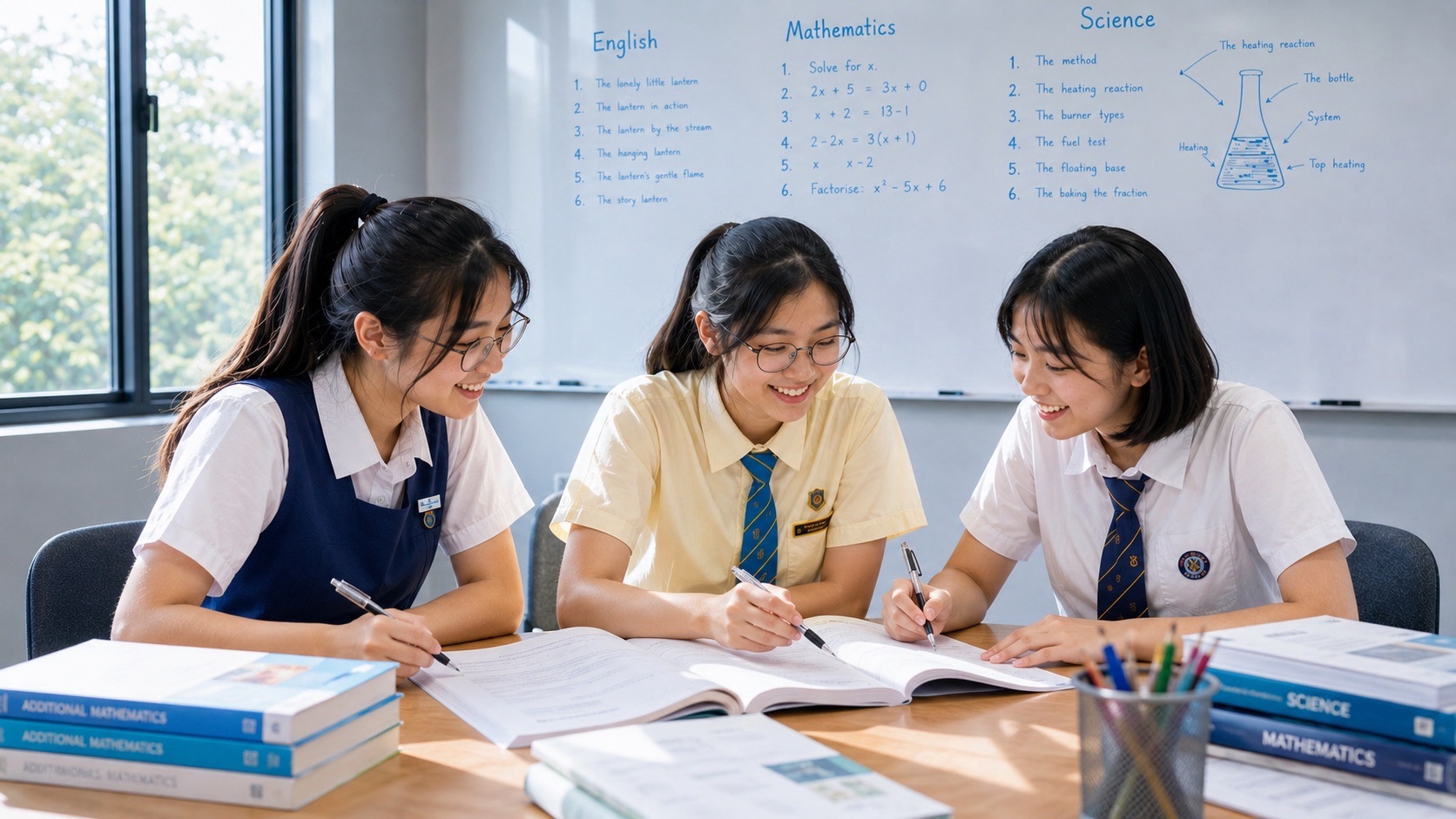
Secondary 1 English: What Changes From PSLE is the eduKateSingapore transition guide for the first year after Primary 6. The jump is not simply “harder English”. Secondary English asks students to carry more meaning independently: longer texts, less obvious questions, more varied writing purposes, more demanding vocabulary, stronger control of evidence, and a greater need to explain why an answer is justified.
Parents searching for Secondary 1 English, Sec 1 English, how Secondary English differs from PSLE, Secondary 1 comprehension, Secondary 1 composition or how to prepare for the move from Primary 6 are often looking for one practical answer: what exactly changes, and what should a child repair first? The safest answer is to follow the learner’s work. Secondary 1 exposes weaknesses that Primary 6 routines could sometimes hide, especially when a child relied on familiar formats, teacher prompts or memorised composition structures.
This guide sits between the Singapore English Guide by Exam Paper, the wider English World, the Singapore Vocabulary Guide and the learner-state routes in eduKate Sengkang. It is a teaching owner, not a tuition-sales page; families comparing tutors can use the supporting Secondary 1 English Tutor Singapore guide.
Quick answer: the seven biggest changes from PSLE
- Reading becomes less literal. Students are expected to follow implication, viewpoint, structure and language effect more often.
- Writing becomes less formulaic. The same topic can be approached through narrative, personal, expository, argumentative or mixed modes.
- Vocabulary becomes academic as well as expressive. Words must work across subjects, essays and comprehension.
- Evidence matters more. Answers increasingly need textual support rather than broad impressions.
- Summary and paraphrase become more important. Students need to compress ideas without losing meaning.
- Register broadens. Students write for more audiences and purposes.
- Independence matters. The learner must choose a method rather than wait to be told which method to use.
Primary 6 success can hide Secondary 1 risk
A pupil can score reasonably at PSLE while still carrying fragile habits. For example, a child may recognise grammar answers but struggle to generate accurate sentences independently; memorise composition phrases but fail to adapt them; find literal comprehension evidence but over-infer; or know many words without controlling their collocations.
Secondary 1 is therefore a useful diagnostic year. The correct question is not “Was the PSLE score high enough?” but “Which language systems survive when the text, topic and task change?”
Reading: from answer-hunting to evidence mapping
Primary comprehension often trains students to locate information efficiently. Secondary comprehension retains retrieval but adds denser inference, viewpoint, tone, reference, text structure and language effects.
- Read the question demand.
- Locate relevant evidence.
- Name the relationship: cause, contrast, reference, sequence, inference, attitude or effect.
- Decide how much can safely be inferred.
- Write an answer at the exact scope required.
This reasoning chain is already visible in the canonical PSLE Comprehension Open-Ended owner. Secondary 1 extends the same evidence discipline into longer and more varied texts.
Writing: from one familiar composition world to several modes
Secondary students need to recognise the dominant writing job in a prompt. Narrative writing is driven by event and choice. Personal recount is driven by experience and reflection. Expository writing explains an issue or process. Descriptive writing controls perception and atmosphere. Later, argumentative and discursive modes demand explicit reasoning.
This is why the next Atlas owner, Secondary 1 and 2 Essay Types, teaches mode selection rather than one universal composition template.
Vocabulary: from lists to networks
Secondary vocabulary must support reading, writing and subject learning. A word should be stored with meaning, word family, collocation, register, contrast and example. “Significant” is more useful when the learner also knows significance, significantly, significant to, significant increase, and how it differs from “important”.
Use the How to Build Secondary Vocabulary guide and the eduKate Vocabulary Learning System to move beyond isolated memorisation.
Grammar: from exercise accuracy to sentence control
Secondary grammar should appear inside real writing and comprehension, not only in worksheets. A student who knows the rule for subject–verb agreement but repeatedly loses it in essays has not yet transferred the rule. Grammar knowledge becomes useful when the learner can retrieve it while thinking about content at the same time.
A good correction asks two questions: what was the rule, and what made it fail under this task?
Summary: the first serious compression problem
Summary introduces a new level of reading control because students must distinguish main idea from detail, merge overlap, paraphrase and manage word limits. The skill is not “write less”; it is “preserve the right meaning using less language”.
The companion Secondary 1 and 2 Comprehension and Summary Basics page builds that foundation before upper-secondary summary becomes exam-critical.
Oral and discussion: longer thinking aloud
Secondary students are expected to explain views, respond to alternatives and develop ideas with more independence. Good spoken English is not a memorised speech. It is the ability to form a position, give a reason, support it with an example and adjust when the question changes.
This spoken reasoning also improves writing because students learn to hear whether an idea is complete.
The first 12 weeks: a practical transition map
Weeks 1–2: Baseline
Collect one writing sample, one comprehension task, one grammar/vocabulary sample and one oral explanation. Classify repeated errors before adding extra work.
Weeks 3–4: Reading evidence
Work on question demand, reference, inference and answer scope.
Weeks 5–6: Sentence control
Repair one or two recurring grammar patterns inside real writing.
Weeks 7–8: Essay mode recognition
Compare narrative, recount and expository prompts. Practise planning before full essays.
Weeks 9–10: Summary and paraphrase
Extract main points, distinguish examples and practise meaning-preserving rewrites.
Weeks 11–12: Mixed transfer
Use unfamiliar texts and prompts so the learner chooses the method independently.
The Secondary 1 error map
- Reading: answer extends beyond evidence.
- Vocabulary: recognises word but cannot use it accurately.
- Grammar: rule known in isolation but fails in writing.
- Writing: memorised structure ignores prompt.
- Summary: copies source or retains examples.
- Organisation: paragraphs exist but do not perform distinct jobs.
- Oral: opinion stated but undeveloped.
- Execution: slow start, poor checking or overdependence on prompts.
A worked transition diagnosis
Observation: a Secondary 1 student writes fluent narratives but scores poorly on an expository task.
Weak diagnosis: “English is weak.”
Better diagnosis: the student can generate language but has not learned to organise explanations around claims, reasons and examples. The first repair is not more vocabulary. It is mode recognition and paragraph function.
Transfer test: give a different expository topic three days later. If the student can plan explanation paragraphs independently, the repair has begun to transfer.
How home support should change after PSLE
Secondary students need more ownership. Parents can still help by protecting routines, discussing reading and asking questions about evidence, but constant line-by-line correction can prevent independence.
- Ask what the question is really asking.
- Ask the child to show evidence before explaining an inference.
- Ask what job each paragraph performs.
- Preserve uncorrected first attempts for diagnosis.
- Encourage regular reading across fiction and non-fiction.
- Use vocabulary in conversation rather than testing lists only.
When tuition helps
Tuition is most useful when it identifies a repeated bottleneck and builds an explicit route from modelled success to independent transfer. A tutor should be able to explain what has changed over several weeks, not simply report that more worksheets were completed.
For parent decision-making, see Secondary 1 English Tutor Singapore. For the English-specialist tuition estate, use Singapore English Tuition Centre Secondary English.
Frequently asked questions
Is Secondary 1 English much harder than PSLE English?
The language system is continuous, but texts, writing modes, independence and evidence demands expand. Students often experience the change as a jump because familiar Primary routines no longer cover every task.
Should my child start O-Level papers in Secondary 1?
Not as the main programme. Build the reading, writing, grammar, vocabulary and summary foundations that later examination work depends on.
What should we diagnose first?
Use current school work. Find the error pattern that repeats across more than one task.
How much vocabulary should a Secondary 1 student learn?
Focus on durable learning and use rather than a fixed weekly number. Word families, collocations and repeated retrieval matter more than list size.
Should writing still use composition templates?
Use structures as teaching scaffolds, but students should learn to select and adapt a mode to the prompt.
Is summary important already?
Yes as a comprehension and compression skill, even before upper-secondary exam conditions make it more formal.
How should parents help with comprehension?
Ask for evidence and reasoning rather than supplying the answer.
Where do essay types go next?
Use Secondary 1 and 2 Essay Types.
Where do comprehension and summary go next?
Use Secondary 1 and 2 Comprehension and Summary Basics.
Where does this page sit in Atlas?
This is the canonical Secondary 1 transition owner under The Singapore English Guide by Exam Paper.
The final transition rule
Do not prepare for Secondary 1 by making Primary 6 work harder. Prepare by widening the system: longer reading, stronger evidence, more writing modes, deeper vocabulary networks, early summary, and greater independence. The goal is not to rush into O-Level work; it is to build the language architecture that later examination performance will need.