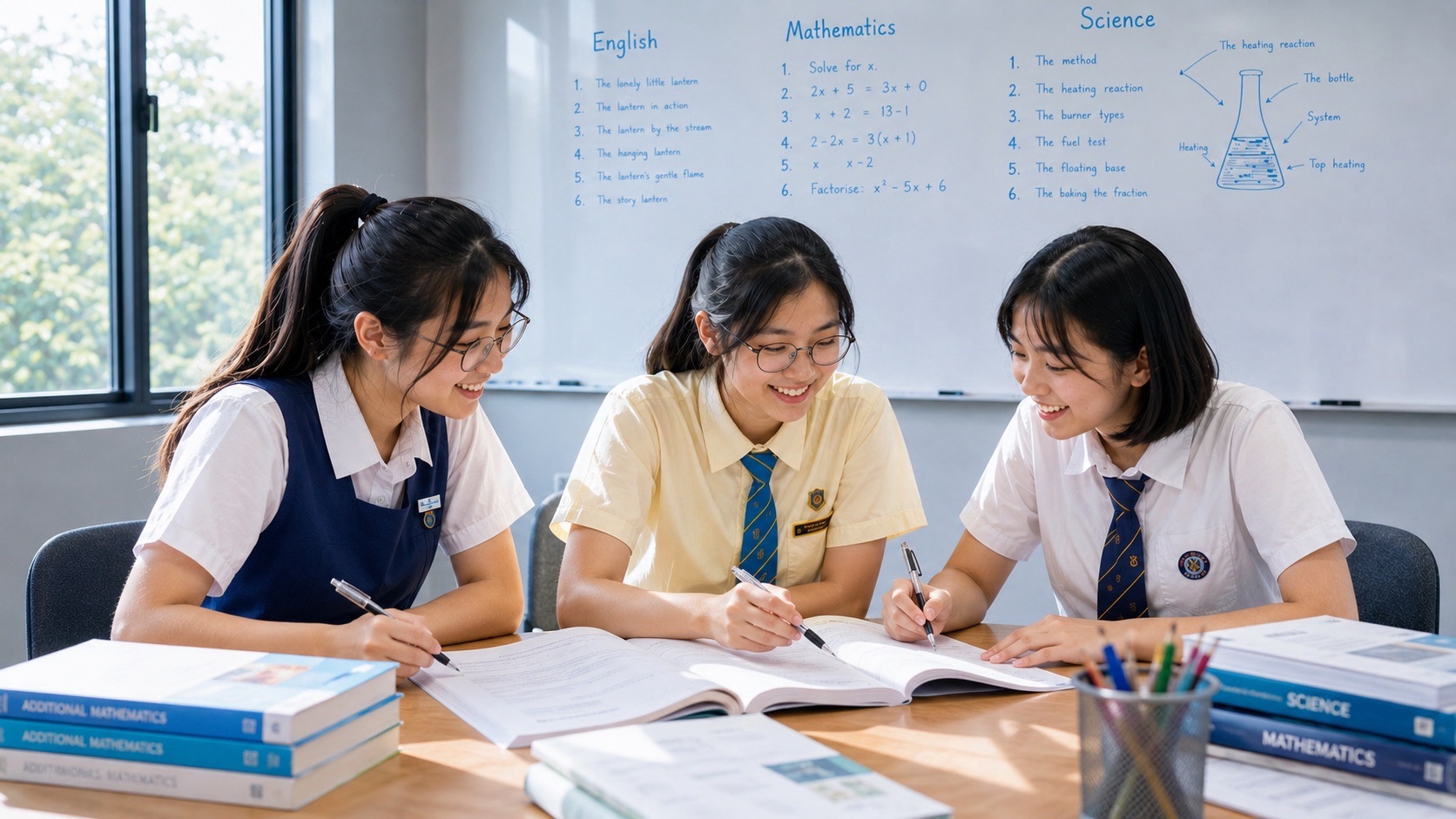
Secondary 1 English is not simply Primary 6 English with longer passages.
The student is entering a different language environment. Texts become denser and more varied. Writing increasingly depends on audience, purpose and form. Comprehension asks for interpretation of tone, perspective and implication. Visual and multimodal texts carry meaning alongside words. Oral communication requires more sustained ideas.
The main transition is therefore independence: the learner has to make more language decisions without a familiar primary-school template telling them exactly what to do.
Quick Read for Parents
- Secondary 1 English is a transition year, not merely a harder version of P6.
- Students encounter a wider range of print, digital and multimodal texts.
- Writing increasingly depends on audience, purpose, context and text form.
- Comprehension requires more inference, interpretation and attention to how language creates effect.
- Grammar and vocabulary remain important, but they function as resources for meaning rather than isolated worksheet skills.
- Good tuition should diagnose which part of the transition is unstable before increasing workload.
The One-Sentence Answer
Strong Secondary 1 English tuition should help a student shift from completing familiar English tasks to making increasingly independent decisions about meaning, evidence, audience, structure and language.
What Changes After Primary 6?
Primary-school foundations still matter, but secondary English asks them to operate at a higher level of complexity.
A primary comprehension question may ask why a character acted in a certain way. A secondary text may ask how the writer’s language shapes the reader’s view. A primary composition may centre on a clear event. Secondary writing may require reflection, exposition, persuasion or a form chosen for a particular audience.
Singapore’s Current Secondary Context
Full Subject-Based Banding has been fully implemented since 2024. Students can offer subjects at G1, G2 or G3 levels according to their strengths and learning needs, rather than being defined by the old streaming labels.
From the 2027 graduating cohort, the Singapore-Cambridge Secondary Education Certificate replaces the separate N- and O-Level certificates.
Read MOE’s Full Subject-Based Banding and SEC update.
Seven Secondary 1 English Patterns Worth Diagnosing
1. “My child did well at PSLE but is suddenly average.”
This may not indicate decline. The comparison group, text difficulty and task demands have changed. We inspect actual scripts before deciding what needs repair.
2. The student understands the passage but cannot explain the writer’s effect
Literal comprehension is present, but analytical reading is still developing. The student needs to connect language choice to tone, emphasis, perspective or reader response.
3. Writing is grammatically correct but thin
Accuracy alone does not create a developed piece. The student may need better idea generation, paragraph development, evidence, examples or reflection.
4. Primary-school composition habits no longer fit
A student may continue relying on memorised narrative openings even when the task calls for a different purpose or form. Secondary writing requires more adaptability.
5. Vocabulary is strong but register is weak
The student knows many words but does not yet judge whether they suit a formal report, personal reflection, persuasive piece or spoken discussion. Appropriate English depends on context.
6. Visual-text questions feel unpredictable
Multimodal comprehension requires students to interpret how image, layout, typography and words work together. The repair is learning to identify the communicative job of each element.
7. The student waits for a model answer
This is an independence problem. Secondary English increasingly rewards judgement. The student needs frameworks that support decision-making without turning every task into a template exercise.
Reading: From What the Text Says to How the Text Works
Secondary reading asks students to notice not only content but construction.
Why did the writer choose this verb? Why is this detail placed here? What attitude is implied by the phrase? How does the image change the effect of the caption?
We teach students to move through three layers: meaning, evidence and effect.
Writing: Audience and Purpose Become Central
Secondary writing improves when students stop asking only “What should I write?” and begin asking “Who is this for, why am I writing it, and what does this reader need?”
We teach structure as a set of choices rather than one universal formula. A paragraph should have a job. An example should support an idea. An introduction should orient the reader. A conclusion should complete the purpose.
Grammar and Vocabulary Still Matter—But Their Job Changes
Grammar becomes more important because ideas become more complex. Sentence structure controls emphasis and relationship. Vocabulary becomes more contextual: the strongest word is the one that carries the intended meaning with the right tone and precision.
Why Three Students Works Well in Secondary 1 English
Secondary English benefits from comparison because interpretation and expression often allow more than one defensible route. Three students is enough for genuine discussion and still small enough for every paragraph, answer and misunderstanding to remain visible to the tutor.
What Parents Can Do During the Sec 1 Transition
- Do not compare Sec 1 marks directly with PSLE marks.
- Read the marked script.
- Ask what the question wanted.
- Keep broad reading alive.
- Ask for reasons and textual evidence.
- Let the student own revisions.
Bukit PanjangOS and the Secondary English Series
The broader town story belongs in Bukit PanjangOS. This page has a different job: explaining the Sec 1 English transition.
What Improvement Should Look Like
Secondary 1 improvement should look like increasing control over unfamiliarity. The student returns to evidence, chooses more appropriate structures, writes with clearer paragraph jobs and develops oral answers rather than stopping after one sentence.
Frequently Asked Questions
Why did my child’s English grade change after entering secondary school?
Secondary English asks for different forms of interpretation, writing and independence. A changed grade does not by itself reveal whether the issue is adjustment, task understanding or a specific language weakness.
Are G1, G2 and G3 the same as the old streams?
No. Under Full Subject-Based Banding, G1, G2 and G3 refer to subject levels. Students can offer different subjects at different levels according to their strengths and needs.
Secondary 1 Is a Change in Language Responsibility
The deepest change is that the student is being given more responsibility for interpreting the task, selecting evidence, shaping a response and judging whether the language fits the situation.