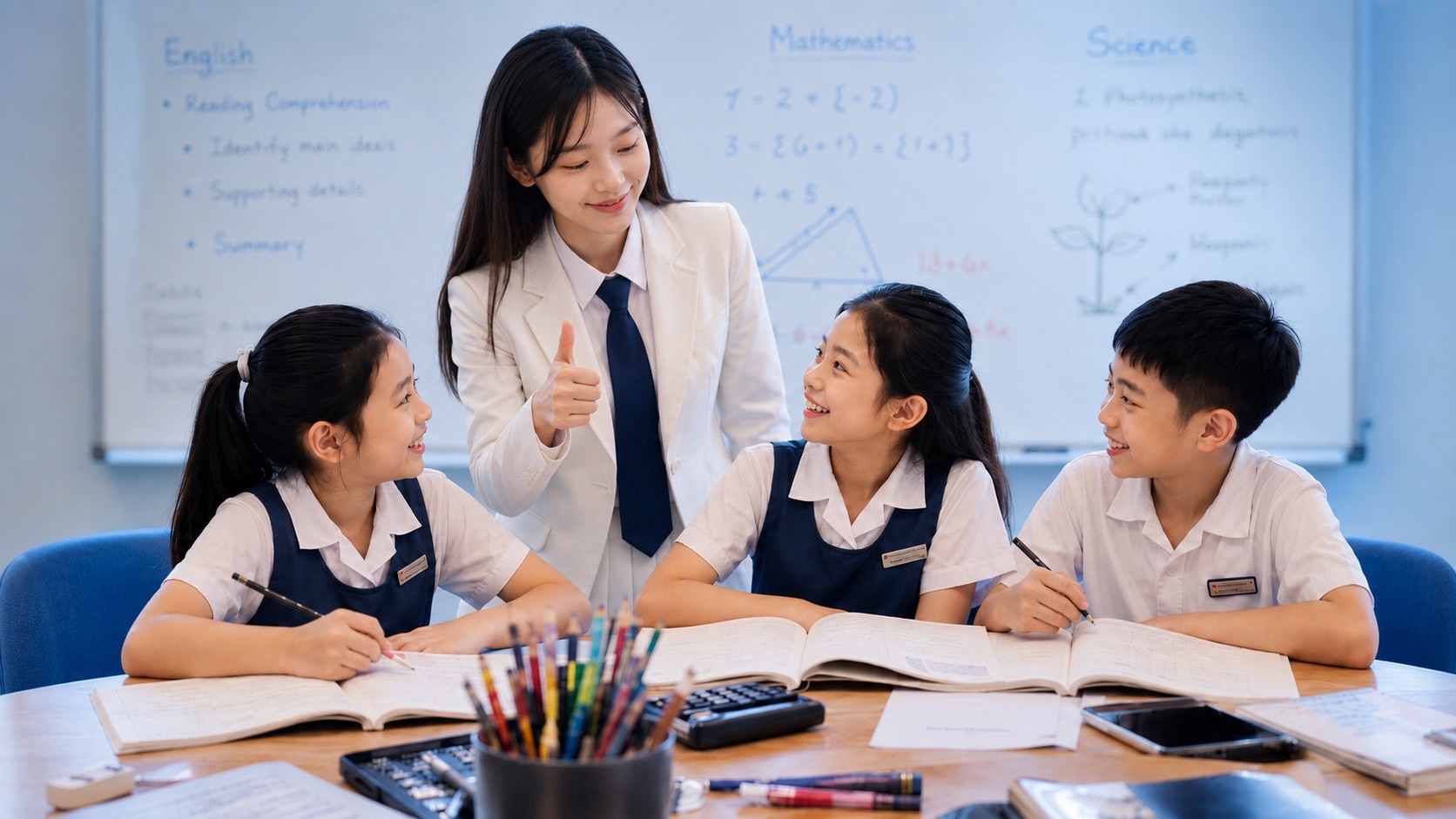
Primary Math Tuition Sengkang | A P1–P6 Mathematics Learning Programme
A strong Primary Mathematics programme should not feel like six disconnected years of worksheets. It should feel like one growing system: early number sense becomes fluency, fluency supports representation, representation supports problem solving, and problem solving eventually has to survive examination pressure.
The child should not merely know more each year. The child should become better at seeing what Mathematics is asking.
This page explains the broad P1–P6 Mathematics programme used for eduKate Singapore’s Sengkang students. It is the programme architecture page for parents who want to understand how foundations, diagnosis, practice, transfer and PSLE preparation fit together over time.
Quick Read for Parents
- P1–P2: make number relationships, place value, operations and mathematical language dependable.
- P3–P4: strengthen multiplication, division, fractions, representation and the ability to choose operations in word problems.
- P5: manage denser relationships involving fractions, decimals, percentage, ratio, geometry, measurement and data.
- P6: convert six years of Mathematics into reliable PSLE performance without abandoning weak foundations.
- Across all levels: locate the weak point, repair it, reconnect it to the syllabus, practise, vary the problem, remove help and test whether learning returns.
The One-Sentence Answer
Primary Math tuition works best when it follows the child’s developing mathematical system rather than simply adding more questions to the school week.
The Current MOE Primary Mathematics Framework
From 2026, MOE’s 2021 Primary Mathematics syllabus applies from Primary 1 through Primary 6. The curriculum places mathematical problem solving at its centre and develops five connected components around it: concepts, skills, processes, metacognition and attitudes.
The syllabus also emphasises thinking, reasoning, communication, application and metacognitive skills. That matters because a child can be accurate in routine exercises and still struggle when the question requires interpretation, choice or explanation.
Official reference: MOE Primary Mathematics Syllabus P1–P6.
Our Core Teaching Sequence
Across the primary years, we repeatedly use the same broad teaching sequence.
Locate → Repair → Connect → Practise → Vary → Verify → Return.
Locate
Find where the reasoning first becomes unreliable. Is the concept missing? Is the child unable to represent the problem? Is the wrong operation being chosen? Is the arithmetic unstable? Is the answer never checked?
Repair
Fix the smallest important weakness rather than re-teaching everything. A weak fraction foundation may be the real problem inside percentage. A language misunderstanding may be the real problem inside a word problem.
Connect
Show how the repaired idea supports later topics. Mathematics becomes easier when the child sees relationships rather than memorising isolated chapters.
Practise
Use enough repetition to make a sound method fluent.
Vary
Change the wording, numbers, diagrams or topic context so the child has to recognise the structure instead of copying a pattern.
Verify
Teach the student to ask whether the answer is reasonable, correctly labelled and consistent with the problem.
Return
Revisit the concept after time has passed. Immediate success shows that the explanation worked. Delayed success tells us more about whether the student learned.
Primary 1: Build Meaning Before Speed
Primary 1 is where the child begins translating everyday quantity into formal Mathematics. Number sense, counting, place value, addition, subtraction, comparison, simple measurement, shapes and mathematical language all matter.
The important question is not simply, “Can the child get the answer?” It is, “Does the child know what the number and operation mean?”
Primary 2: Make the Foundation More Automatic
Primary 2 should make early number relationships more fluent while preserving understanding. Place value grows, addition and subtraction become more demanding, and early multiplication and division ideas begin to matter.
We also watch mathematical language carefully because a child can know the arithmetic and still misread what a word problem is asking.
Primary 3: The Child Starts Coordinating More Tools
Multiplication and division become more central. Fractions appear more visibly. Problems hold more information. The child increasingly needs to decide how to represent a situation before calculating.
This is often the point where a child who relied heavily on memorised routines begins to feel less secure.
Primary 4: Move From Performing Operations to Choosing Them
By Primary 4, the student possesses many mathematical tools. The new difficulty is selecting among them.
A child may know addition, subtraction, multiplication and division but still be unable to decide which relationship a word problem contains. That is why representation, comparison and method selection become increasingly important.
Primary 5: Hidden Weaknesses Become More Expensive
Primary 5 often exposes earlier fragility because new topics depend on older relationships. Fractions support percentage. Multiplicative comparison supports ratio. Geometry and measurement require careful interpretation. Longer problems increase working-memory load.
The correct response is not automatically harder worksheets. Sometimes the fastest route forward is to repair the older idea carrying the new topic.
Primary 6: Prepare for PSLE Without Turning Everything Into PSLE
Primary 6 is the year when accumulated Mathematics has to become more reliable under examination conditions.
Mixed papers, time management, question selection and exam familiarity become increasingly useful. But a timed paper cannot repair a missing concept by itself.
For the 2026 examination, SEAB lists revised PSLE Mathematics under subject code 0008. Parents can refer to the official 2026 PSLE formats.
Why Students Can Look Strong Until They Suddenly Do Not
Earlier Primary Mathematics often gives strong topic cues. The worksheet says “Fractions” or “Multiplication”, so the child already knows which tool to use.
As the years progress, questions become less generous. Several topics may be mixed. The child must decide what is relevant.
A student may therefore appear to “suddenly become weak” when the deeper issue is that recognition and connection were never fully developed.
The Role of Mathematical Language
Primary Mathematics is partly a language subject.
Words such as difference, remaining, twice, more than, fewer, ratio, percentage, average and per carry mathematical relationships.
A child who can calculate accurately may still choose the wrong operation if the relationship described by the sentence is unclear.
We therefore ask students to explain what each number represents before rushing into calculation.
Why Three Students Changes the Lesson
In a three-student group, the tutor can watch more of the student’s actual decision-making.
- Who starts immediately and who waits?
- Who reads the whole question?
- Who draws a model that clarifies the relationship?
- Who chooses an operation because of one keyword?
- Who checks the answer without being asked?
- Who can solve a changed version after the example is removed?
The group also allows structured peer comparison. One child’s different method can become useful mathematical content for the other two.
What Parent Feedback Should Sound Like
Useful feedback should be specific.
“Needs more practice” may be true, but it is incomplete. A stronger update might be: “Your child can calculate percentage correctly but does not yet recognise when a word problem contains a percentage comparison. We are varying the question forms and then retesting without prompts.”
That tells the parent what is wrong, what the lesson is doing and what improvement should look like.
What Improvement Looks Like
- Number work becomes more fluent without becoming careless.
- The child can explain what quantities mean.
- Models and diagrams become simpler and more purposeful.
- Operation choice becomes more reliable.
- Hints become smaller.
- The same mistake stops recurring across several topics.
- Checking begins before an adult asks for it.
- The child can solve a changed version rather than only the worked example.
What We Removed From the Old Version
The previous page mixed a broad programme overview with generic tuition-rate tables and repeated commercial claims. Those elements did not explain the actual teaching sequence and risked overlapping with level-specific Sengkang pages.
This version keeps the URL’s role clear: it is the Sengkang P1–P6 programme page, while level-specific pages can go deeper into the developmental job of each year.
A Quiet Programme Standard
A good Mathematics programme should gradually become less visible inside the student’s work.
At first, the tutor may need to ask the first question, suggest the representation and remind the child to check.
Later, the child begins before being told.
Eventually, the learner receives a problem, makes sense of it, chooses a route and notices when something is wrong.
That is the long journey from Primary 1 to Primary 6.
eduKate Singapore · Sengkang Primary Mathematics
Small-group tuition with up to three students, subject to class fit and availability.
Phone: +65 8823 1234 · Email: admin@edukatesg.com
