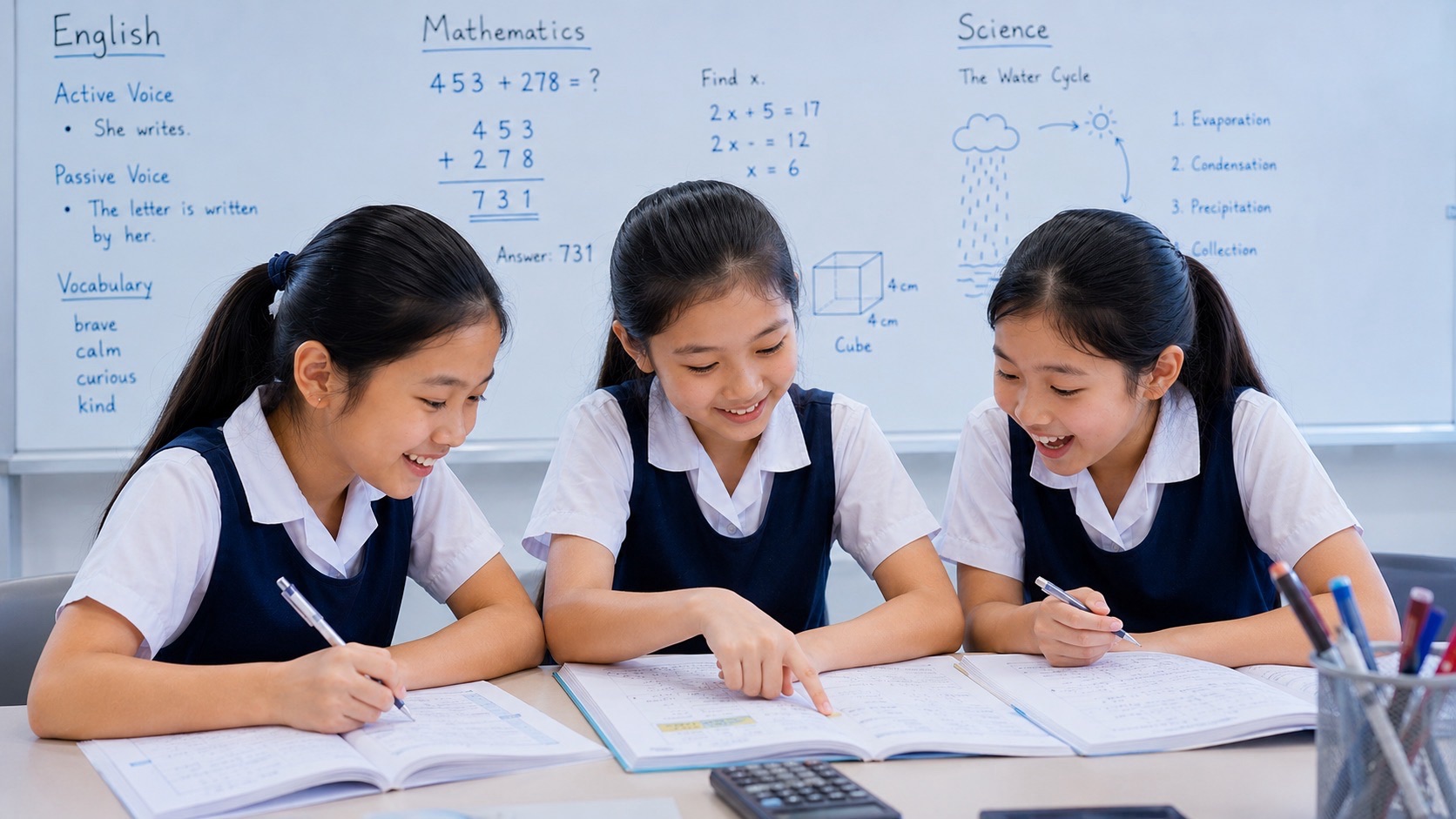
Primary 6 Science is where four years of formal Science have to behave like one connected model of the world.
The examination does not need to announce “this is a heat question” or “this is a plant-system question”. It can present an unfamiliar apparatus, organism, graph or scenario and ask the student to recognise which scientific relationships matter.
The final primary-school challenge is therefore transfer: use known concepts in new-looking situations without losing the evidence, mechanism or precision of the explanation.
Quick Read for Parents
- Primary 6 Science should integrate P3–P6 concepts rather than revise only by chapter.
- Unfamiliar contexts test recognition and transfer, not necessarily new content.
- Open-ended answers need evidence, concept, mechanism and outcome.
- Experimental questions require control logic, data interpretation and careful claims.
- Repeated papers are useful only when lost marks are classified and repaired.
- The goal is reliable scientific reasoning under examination conditions.
The One-Sentence Answer
Strong Primary 6 Science tuition should help a student recognise familiar scientific mechanisms inside unfamiliar evidence, explain the causal chain precisely and test whether the conclusion is actually supported.
Why Primary 6 Science Is a Transfer Problem
A student may know the notes yet hesitate when the same concept appears through an unusual organism, machine or experimental setup. This does not automatically mean the concept was never learned. It may mean the learner has stored the idea too closely to the examples used during revision.
MOE’s Primary Science syllabus emphasises inquiry and conceptual understanding across Diversity, Cycles, Systems, Interactions and Energy. P6 preparation should therefore preserve the connections between those themes.
Read the MOE Primary Science Syllabus.
Eight Primary 6 Science Patterns Worth Diagnosing
1. Notes are strong but unfamiliar questions freeze the student
We practise recognising concepts from observations, relationships and mechanisms rather than from familiar pictures.
2. The answer names the concept but stops too early
We extend the causal chain until it reaches the outcome asked about.
3. The student explains beyond the evidence
Scientific confidence should not exceed what the data or setup supports. We distinguish observation, inference and speculation.
4. Experimental controls are named without purpose
We ask what alternative explanation the control removes.
5. Graphs are described but not interpreted
We move from pattern to scientific mechanism while remaining anchored to the data.
6. Keywords appear without causal grammar
Correct terms do not rescue an explanation if the relationship between them is wrong or missing.
7. “Careless” open-ended losses recur
We classify them as evidence omission, wrong concept, incomplete mechanism, imprecise comparison, unsupported claim or failure to answer the stated variable.
8. Full papers multiply while performance remains unstable
This usually calls for targeted repair between measurement cycles.
Open-Ended Questions: Build the Explanation From the Evidence
A dependable sequence is: identify the relevant observation or data, select the scientific concept, trace the mechanism and return explicitly to the outcome in the question.
This structure is not a script to memorise. It is a way to ensure the explanation has both evidence and causal completeness.
Experiments: Ask What the Comparison Can Actually Prove
A fair comparison reduces competing explanations. Students should understand why a condition is controlled, what variable is deliberately changed, what outcome is measured and whether the evidence is sufficient for the conclusion being claimed.
This last step matters: an experiment may support one conclusion while leaving a broader claim unanswered.
Data: Separate Description From Explanation
First state what the graph or table shows. Then explain why the pattern is scientifically plausible. Keeping these steps distinct reduces the risk of forcing a favourite concept onto data that does not support it.
Mixed Revision: Remove the Chapter Labels
Chapter revision is useful for repair. Mixed revision is necessary for recognition. Once a concept is stable, we vary organisms, apparatus, diagrams and surface wording so the learner has to identify the mechanism independently.
Practice Papers: Measure → Diagnose → Repair → Transfer → Recheck
- Measure: complete a suitable paper or section.
- Diagnose: classify the first meaningful error.
- Repair: rebuild the missing concept or reasoning step.
- Transfer: test the repair in a changed context.
- Recheck: return to mixed-paper conditions.
This makes every paper part of a learning loop rather than a score-producing ritual.
Why Three Students Works Well in Primary 6 Science
Three students allow close comparison of explanations. One may identify the correct concept but miss the evidence; another may use the evidence but skip a causal step. The tutor can expose those differences while every student’s reasoning remains observable.
What Parents Can Do in the PSLE Year
- Keep several marked scripts.
- Sort errors by reasoning layer.
- Ask what evidence supports the answer.
- Retest corrections in unfamiliar contexts.
- Use mixed revision alongside targeted repair.
- Protect sleep, routine and recovery.
Choa Chu KangOS Carries the Town Story
The broader local context belongs in Choa Chu KangOS. This page stays focused on P6 Science and reliable transfer into examination conditions.
What Improvement Should Look Like
P6 improvement should look increasingly stable across unfamiliar contexts. The student extracts relevant evidence, identifies the concept sooner, traces complete causal chains, makes more disciplined experimental claims and corrects imprecise answers independently.
Frequently Asked Questions
Should P6 Science be mostly past-year papers?
Papers are important for calibration, but targeted concept and reasoning repair should happen between them.
Why does my child say the question was “not taught”?
Sometimes the surface context is new while the underlying concept is familiar. The useful question is whether the student can recognise that concept from the evidence provided.
Primary 6 Science Is the Year the Model Has to Travel
The strongest preparation cannot predict every organism, apparatus or diagram that might appear.
It does something better: it gives the learner a scientific model strong enough to travel into unfamiliar territory and still remain anchored to evidence.