Primary 6 Mathematics is where six years of mathematical learning have to behave like one dependable system.
The student is no longer solving only chapter-labelled exercises. Fractions, decimals, percentages, ratio, geometry, measurement and data now appear inside mixed problems. The main challenge is increasingly recognition: seeing what structure sits underneath unfamiliar wording.
The final primary-school job is reliability. The student should be able to identify the relationship, choose a method, execute accurately and check whether the answer deserves belief.
Quick Read for Parents
- Primary 6 Mathematics should integrate the P1–P6 curriculum rather than treat every chapter separately.
- Mixed problems test recognition and method selection as much as calculation.
- Fractions, percentages and ratio need a clear reference whole.
- Geometry and measurement require property and unit control.
- Timed papers are useful only when the weaknesses they reveal are repaired.
- The goal is smaller performance variance across unfamiliar questions.
The One-Sentence Answer
Strong Primary 6 Mathematics tuition should help a student recognise familiar mathematical relationships inside unfamiliar questions and convert that recognition into accurate, efficient and checkable working.
Why Primary 6 Mathematics Is an Integration Problem
A question may begin with percentages, move into ratio and finish with geometry or measurement. None of the individual ideas may be new, but the student has to coordinate them without a chapter heading revealing the route.
Eight Primary 6 Mathematics Patterns Worth Diagnosing
- Chapter work is strong but mixed papers are weak.
- Long problems collapse halfway.
- Percentage and ratio errors come from losing the reference whole.
- Geometry is solved from appearance rather than properties.
- Units disappear during multi-step work.
- Routine marks leak under time pressure.
- Repeated “careless” errors are not classified precisely.
- Full papers increase but scores stay flat.
Method Selection: See the Relationship First
Before calculating, we ask: What quantities are involved? What relationship connects them? Which representation would make that relationship clearer?
Practice Papers: Measure, Diagnose, Repair, Retest
- Measure with a suitable paper or section.
- Diagnose lost marks by process.
- Repair the weak process directly.
- Retest with unfamiliar questions.
- Reintegrate the repair into mixed-paper conditions.
Why Three Students Works Well in Primary 6 Mathematics
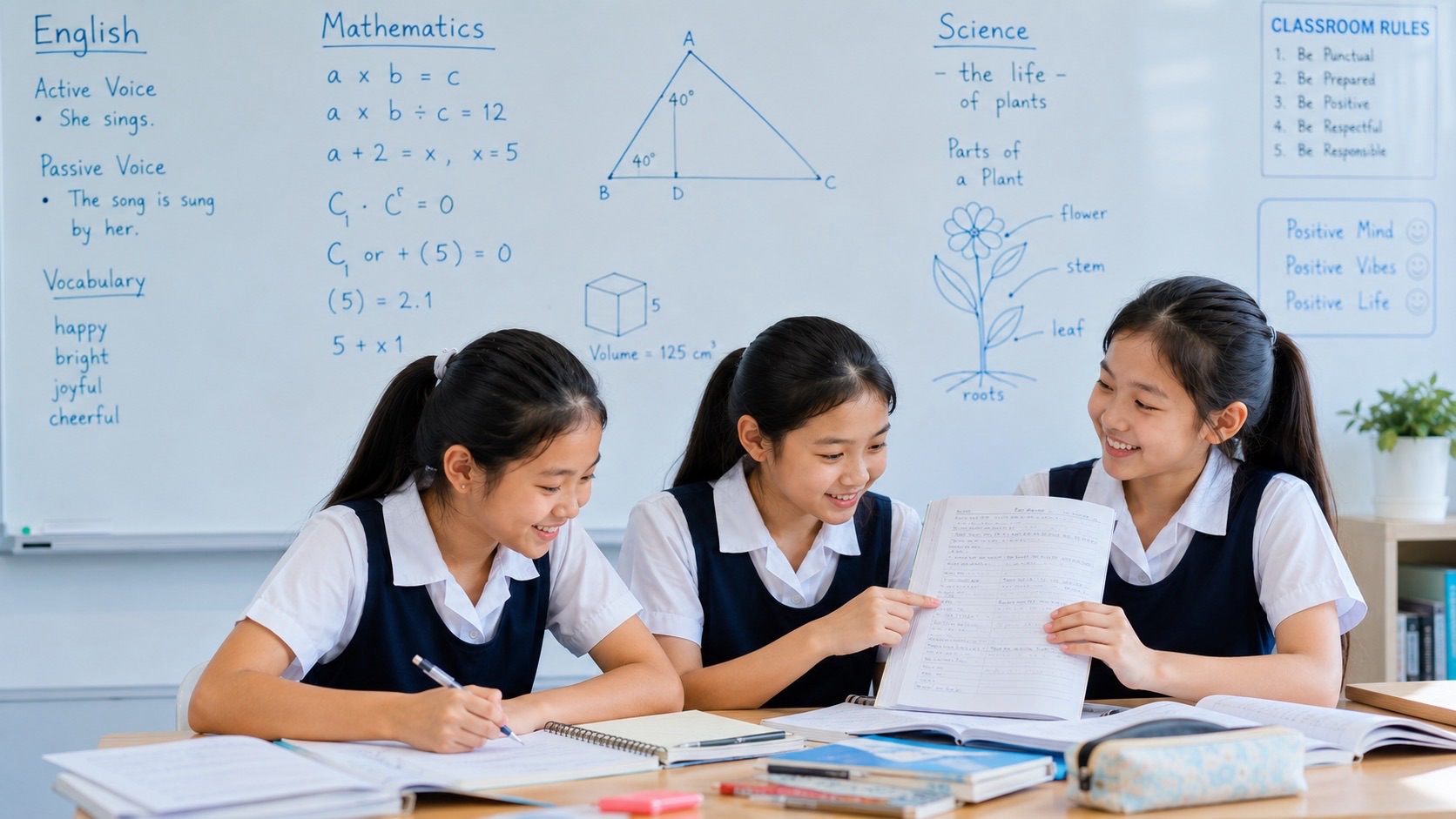
Mixed problems often produce several defensible routes. In a three-student group, the tutor can compare methods while still inspecting every learner’s first wrong line and checking whether the chosen representation actually helps.
What Parents Can Do in the PSLE Year
- Keep several marked scripts.
- Look at the first wrong line.
- Ask what the reference whole is.
- Use mixed practice, not only chapter work.
- Protect sleep and routine.
- Do not mistake paper volume for progress.
Jurong WestOS Carries the Town Story
The wider local context belongs in Jurong WestOS. This page stays focused on the Primary 6 Mathematics learner and reliable integration.
What Improvement Should Look Like
Primary 6 improvement should look more predictable. The student recognises structures sooner, models selectively, controls units, checks deliberately and recovers more calmly when a question looks unfamiliar.