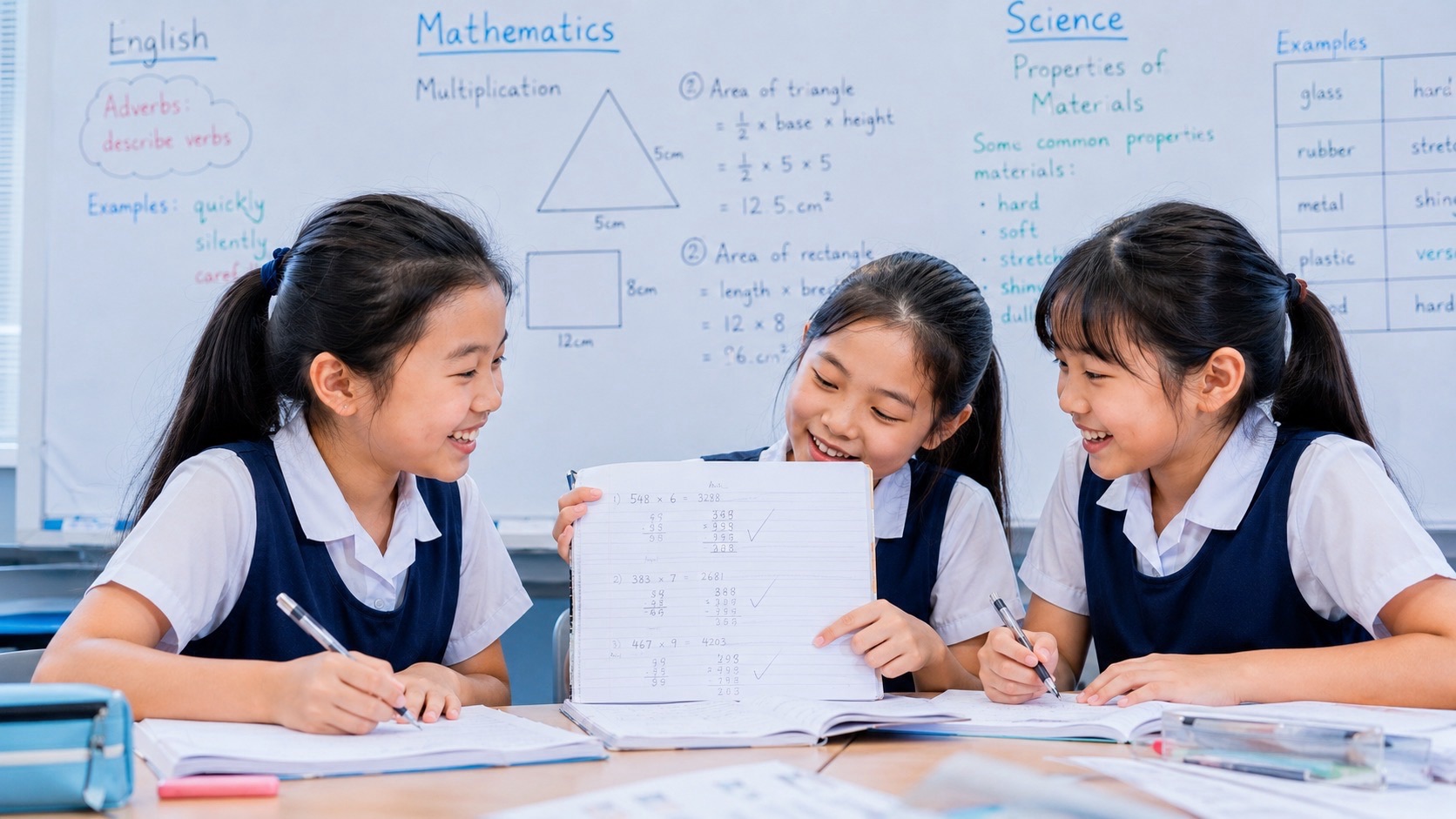
PRIMARY 6 · MATHEMATICS · CHOA CHU KANG · PSLE PREPARATION · SMALL-GROUP TUITION
Primary 6 Mathematics Tuition Choa Chu Kang
Primary 6 Mathematics is not mainly about learning one last set of topics. It is about making six years of mathematical relationships reliable enough to survive a mixed paper.
By P6, students have accumulated number sense, operations, fractions, decimals, percentages, ratio, measurement, geometry and problem-solving methods. The examination does not keep those ideas in tidy chapters. A question can combine several of them before the child reaches the final calculation.
The final-year challenge is therefore conversion: recognise the structure, choose a representation, sequence the method, calculate accurately and check whether the result makes sense under time pressure.
Quick Read for Parents
- P6 is an integration year. Topic knowledge has to survive mixed questions.
- Recognition is part of mastery. A child who succeeds only when the chapter is announced is still borrowing part of the routing.
- Fractions, decimals, percentages and ratio form a connected proportional system.
- Full papers should diagnose. They are most useful when the mistakes change what gets taught next.
- Checking is trainable. Estimation, inverse operations, units and magnitude can catch avoidable errors.
The one-sentence answer
Good Primary 6 Mathematics tuition helps students convert accumulated mathematical understanding into reliable PSLE-ready performance by strengthening recognition, representation, sequencing, checking and timed execution.
Fractions, decimals, percentages and ratio: one family of relationships
P6 students often treat fractions, percentages and ratio as separate revision folders. This increases memory load.
A stronger approach is to see the shared proportional structure. A fraction describes part relative to a whole. A percentage expresses a relationship through a base of 100. A ratio compares quantities multiplicatively. Decimals provide another notation for quantity.
When those representations connect, students can choose whichever form makes the current problem easiest to see.
Mixed problems: representation comes before operation
A common final-year stall occurs when the learner has several operations available but cannot determine the sequence.
We slow the first few seconds down:
- What quantities are known?
- What quantity is missing?
- Which relationships connect them?
- What intermediate quantity must be found first?
- Would a bar model, table, diagram, number line or equation make the structure clearer?
Once the representation is right, the calculation is often less mysterious.
Geometry and measurement: properties and units are evidence
In final-year geometry, students should not trust appearance alone. A figure may be drawn out of scale. A length or angle must follow from stated information or established properties.
Measurement also demands unit discipline. A mathematically correct calculation using incompatible units is still wrong. We teach students to check units before and after operations, not simply attach them at the end.
Checking: build a second route to the answer
“Check your work” is too vague to be useful unless the student knows how.
- Estimate: is the magnitude plausible?
- Inverse operation: can addition be checked by subtraction, or multiplication by division?
- Substitute: can the result be put back into the original relationship?
- Units: does the final unit match the quantity asked?
- Boundary: can a percentage exceed the logical range in this context?
- Diagram: does the result fit the visible geometry?
Checking becomes strongest when it uses a different representation from the one that produced the answer.
Full papers: measurement, not punishment
PSLE-year families often increase paper volume quickly. That can help only if each paper produces useful information.
After a paper, we classify errors:
- concept missing;
- question misclassified;
- representation weak;
- operation sequence wrong;
- calculation error;
- unit or copying error;
- time-management failure.
Then we repair the highest-value recurring cause before simply assigning another paper.
How Choa Chu KangOS helps at P6
Choa Chu KangOS can still support transfer through routes, distances, rates, capacity, percentages, maps and comparisons.
At P6, however, the important skill is portability. The child should recognise the same mathematical relationship when the PSLE changes the surface story completely.
The town gives the relationship somewhere familiar to begin. Mixed examination questions test whether that relationship can travel.
How we diagnose a P6 Mathematics stall
- Concept: is the underlying Mathematics understood?
- Recognition: can the learner identify the structure without a chapter label?
- Representation: can the situation be converted into a usable model?
- Sequence: are the steps arranged correctly?
- Execution: is arithmetic accurate?
- Checking: can the student detect implausible results?
- Timing: does performance deteriorate when the clock is introduced?
Two children with the same mark can need entirely different repairs.
Why three students matters in the PSLE year
At P6, small-group value lies in seeing the individual reasoning chain.
One student may know the Mathematics but choose inefficient methods. Another may calculate quickly but misread relationships. A third may work well untimed but lose sequencing under pressure.
Three students provide enough contrast for method comparison while preserving enough tutor bandwidth to diagnose each learner precisely.
What progress should look like
- mixed questions are classified more quickly;
- proportional relationships connect across fractions, decimals, percentages and ratio;
- representations are selected deliberately;
- geometry relies less on visual guessing;
- units are checked more consistently;
- timed performance moves closer to untimed ability;
- the same error category appears less often across papers.
What parents can do in the PSLE year
- Keep marked papers and group repeated errors by cause.
- Ask what the question is really asking before asking for the method.
- Ask for an estimate before exact calculation.
- Use topical repair after a paper exposes a recurring weakness.
- Do not automatically add more papers after one low score.
- Protect sleep and routine so practice measures Mathematics rather than fatigue.
A useful parent question is: “Where was the first point you stopped knowing what to do?”
Current curriculum context
The current Primary Mathematics syllabus applies through P6 from 2026 onward and continues to emphasise conceptual understanding, skills, processes and problem solving across the full Primary progression.
Parents can consult the official MOE Primary Mathematics syllabus for the curriculum owner.
Frequently Asked Questions
Should P6 revision be mainly full papers?
No. Full papers test integration and timing, but recurring concept or representation weaknesses should still be isolated and repaired directly.
Why does my child do well topically but poorly in mixed papers?
The missing capability may be recognition or method selection rather than knowledge. The student knows the tool but cannot yet identify when it belongs.
The deeper idea
The PSLE does not ask whether a child has seen enough worksheets.
It asks whether mathematical relationships remain available when the chapter labels disappear and the clock becomes real.
Final-year Mathematics becomes reliable when the child knows not only how to solve a familiar problem, but how to recognise what an unfamiliar problem needs.
Continue through the tuition network: Tuition Programmes Directory · Programmes & Locations · West Singapore Tuition Directory · eduKateSingapore Hub.