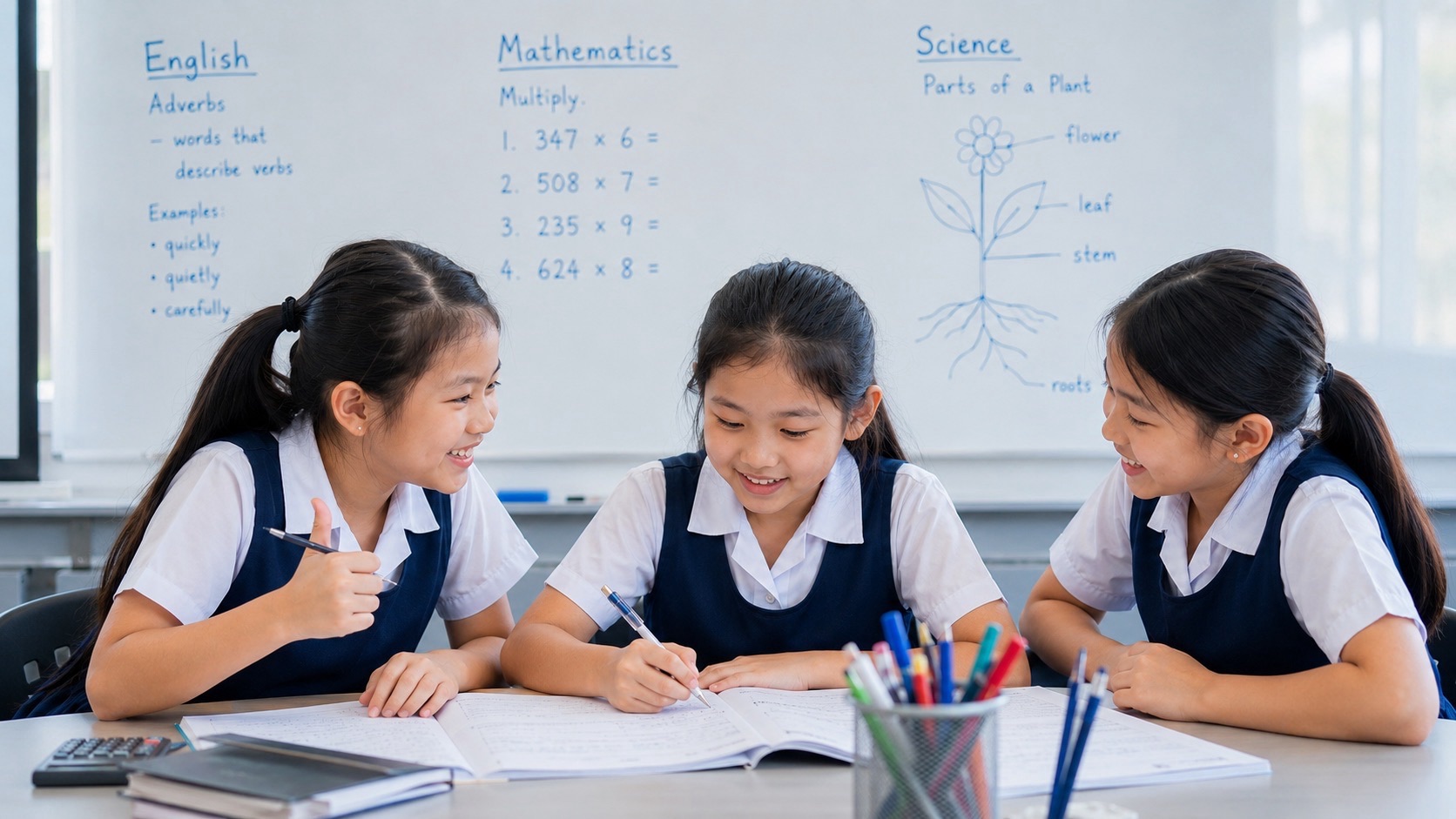
PRIMARY 4 · SCIENCE · CHOA CHU KANG · SMALL-GROUP TUITION
Primary 4 Science Tuition Choa Chu Kang
Primary 4 is where Science begins to feel less like a collection of topics and more like a web of relationships.
A student may know what heat is, what light does, which materials are transparent and how living things respond to their surroundings. The challenge is that questions increasingly ask how one idea affects another. A material is chosen because of a property. A result changes because one condition changed. A living thing responds because something in its environment changed.
The learner therefore needs to move from naming facts toward explaining relationships.
Quick Read for Parents
- P4 is a connection year. Scientific ideas begin depending on one another more visibly.
- Fair comparison matters. Students need to notice which condition changed and which should stay similar.
- Evidence and explanation are different jobs. A result tells us what happened; Science explains why the result matters.
- Open-ended answers need a causal bridge. Correct vocabulary alone does not earn full understanding.
- Local observations can support transfer. Choa Chu Kang provides familiar examples of light, heat, materials, plants, water and change.
The one-sentence answer
Good Primary 4 Science tuition helps students connect observations to scientific relationships so that evidence, variables and explanations begin operating as one system.
From result to explanation
A child may read a table correctly and still give a weak Science answer.
Suppose one object became warmer than another. The result is that its temperature increased more. The scientific explanation depends on the conditions and the relevant concept. The student has to identify what was changed, what was measured and what relationship the evidence supports.
We teach a simple discipline: result → relevant concept → consequence.
Fair comparison: what changed, and what did not?
P4 students are ready to think more carefully about experimental control.
If we want to compare how two materials respond to heat, several other conditions should remain similar. If one object is larger, placed closer to the heat source and exposed for longer, the comparison becomes difficult to interpret.
The child does not need advanced statistical language. The learner needs the logic: change one relevant condition, keep others reasonably similar, observe the outcome.
Heat and materials: property becomes consequence
Students often memorise that materials behave differently. P4 questions increasingly require them to use that idea.
A handle may be chosen because the material reduces heat transfer to the hand. A container may need a material that withstands a particular condition. The relevant property matters because it changes what happens in use.
We therefore ask, “What property matters here, and what consequence does it create?”
Light: seeing a path rather than memorising a sentence
Light questions become easier when students think in paths and interactions.
Where is the light source? What is in the path? Does light pass through, get blocked or change direction? What does the observer receive?
Diagrams are therefore important evidence. The child should reconstruct the path rather than search memory for one familiar sentence.
Living systems: parts do jobs inside a larger whole
As biological ideas expand, students need to see that a part is useful because of the job it performs inside a system.
A root, stem, leaf or other structure should not remain an isolated label. The student should connect the structure to what it helps the organism do.
This prepares the learner for later systems thinking: a living thing survives because several processes and structures work together.
How Choa Chu KangOS helps
Choa Chu KangOS provides a stable local environment for seeing relationships outside a worksheet.
Students can compare shaded and exposed surfaces, notice how materials are used in buildings and shelters, observe plants in parks, examine how water moves after rain and distinguish older and newer infrastructure.
The town is not the Science syllabus. It is a transfer environment where curriculum ideas can be recognised in ordinary life.
How we diagnose a P4 Science stall
- Knowledge: is the scientific concept missing?
- Evidence: did the learner miss the important result?
- Variable control: can the child identify what changed?
- Relationship: can the concept be connected to the result?
- Vocabulary: is the correct idea being expressed vaguely?
- Transfer: does understanding disappear when the context changes?
A mark tells us that something failed. It does not yet tell us which layer failed.
Why three students matters
Three students can look at the same evidence and produce different explanations. This makes scientific reasoning visible.
One may identify the correct observation but use the wrong concept. Another may know the concept but overstate the conclusion. A third may give a correct answer without explaining the causal bridge.
The tutor can compare these differences while still hearing every learner.
What progress should look like
- results and explanations are separated more clearly;
- variables are identified more accurately;
- material properties are linked to purpose;
- light questions are reasoned through diagrams;
- living-system parts are connected to function;
- open-ended answers include a clearer causal bridge;
- students claim only what the evidence supports.
What parents can do at home
- Ask, “What changed, and what stayed the same?”
- Ask the child to point to the evidence before explaining.
- When discussing a material, ask why that property matters.
- Use simple diagrams for light-path questions.
- Ask what job a plant or animal structure performs.
- When an answer sounds certain, ask whether the evidence supports that level of certainty.
Current curriculum context
Primary 4 sits inside Singapore’s formal Primary Science progression, where knowledge develops together with scientific inquiry, evidence use and communication.
Parents can consult the official MOE Primary Science syllabus. eduKateSingapore’s Science Learning Library remains the wider curriculum-facing owner.
Frequently Asked Questions
Why does P4 Science feel harder than P3?
Because ideas begin interacting more. The student must increasingly connect evidence, conditions and scientific explanation rather than recall one fact at a time.
Should P4 students memorise model answers?
Strong examples are useful, but memorisation becomes fragile when the child cannot reconstruct the causal relationship in a new context.
The deeper idea
Primary 4 Science begins teaching the child that scientific knowledge is relational.
A result matters because of the conditions. A property matters because of its consequence. A structure matters because of the job it performs inside a larger system.
The subject becomes more powerful when the child stops collecting facts and starts seeing what depends on what.