Canonical local owner: start with Primary 3 Science Tuition Choa Chu Kang for the current location × year × subject route. This page is retained as supporting material with its original explanatory angle.
Primary 3 is the year Science becomes a formal school subject—and that changes the job.
Curiosity still matters, but curiosity now has to work with scientific vocabulary, stated properties, observations, classifications and evidence. A child who knows many interesting facts can still struggle if those facts are not organised into the relationships the question is testing.
Quick Read for Parents
- Formal MOE Primary Science begins in Primary 3.
- P3 introduces scientific concepts alongside observation, comparison, classification and communication.
- Diversity, materials, life cycles and magnets become contexts for evidence-based explanation.
- Scientific vocabulary matters because everyday words can be too vague.
- Good tuition should connect observations to concepts rather than turn each topic into isolated notes.
- The aim is to build a scientific explanation habit early.
The One-Sentence Answer
Strong Primary 3 Science tuition should help a child move from knowing facts about the world to using observations, properties and evidence to explain the world scientifically.
What Changes When Science Becomes Formal
In earlier years, a child may explore freely and describe what is interesting. In P3, the question begins deciding which observation is relevant. The student has to identify the concept being tested and express the answer with enough precision that another person can follow the reasoning.
The current MOE Primary Science syllabus develops concepts progressively from Primary 3 to Primary 6 across Diversity, Cycles, Systems, Interactions and Energy, while inquiry skills run through the course.
Six Primary 3 Science Patterns Worth Diagnosing
- Facts are remembered but the question is not answered.
- Classification is based on appearance alone.
- Materials are memorised without linking property to use.
- Life cycles become sequences to recite.
- Magnet questions are answered from memory instead of evidence.
- Everyday language replaces scientific precision.
How to Build a P3 Science Explanation
A useful early structure is simple: identify the relevant observation, name the scientific property or concept, then explain how that concept accounts for what happened.
Why Three Students Works Well in Primary 3 Science
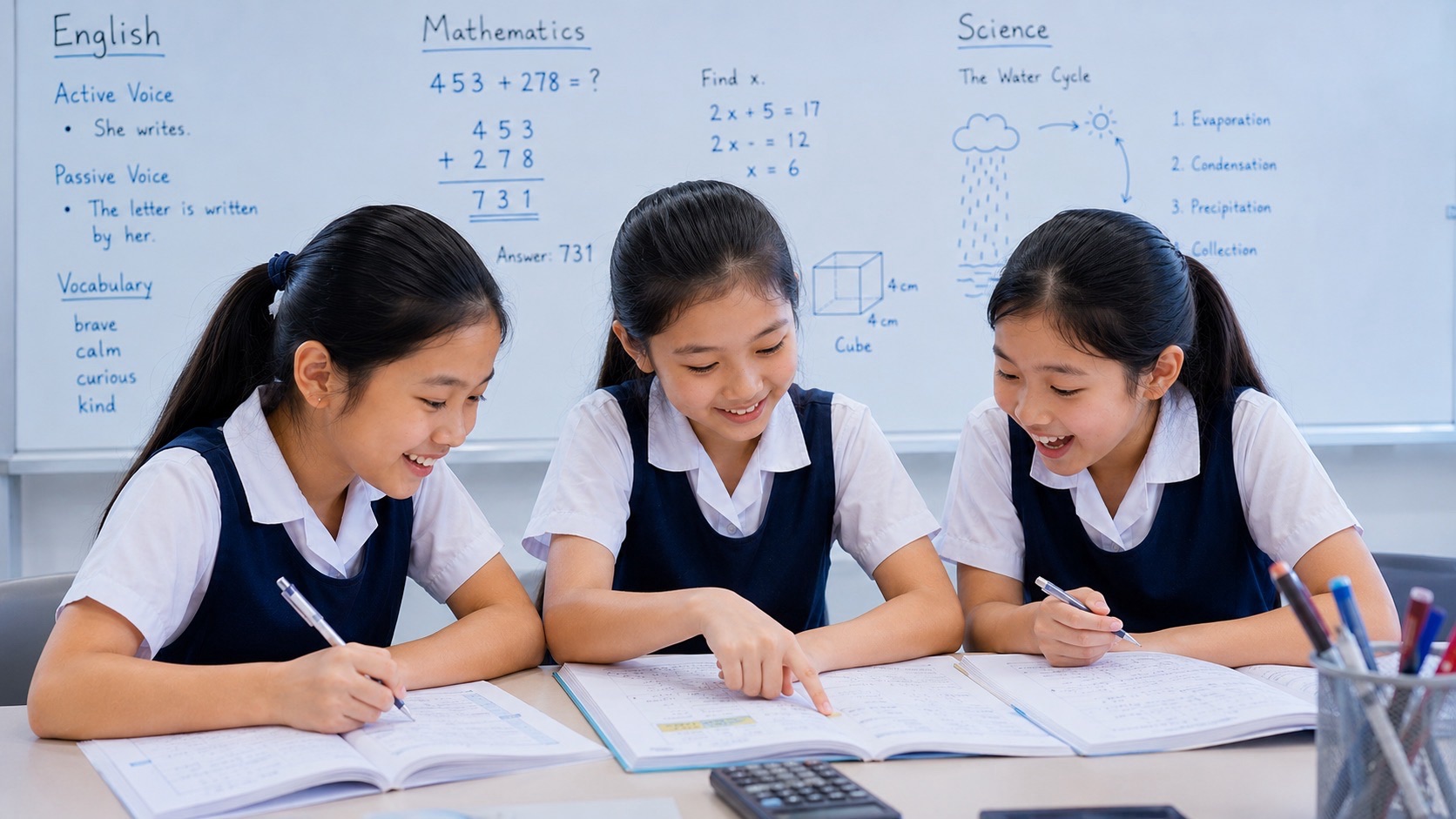
Three students can observe the same object or diagram and notice different features. The tutor can ask which observation matters to the question, compare explanations and make every child’s reasoning visible.
Choa Chu KangOS Carries the Town Story
The wider local context belongs in Choa Chu KangOS. This page stays focused on the P3 Science tuition job.
What Improvement Should Look Like
P3 improvement should look like increasing precision. The child classifies with reasons, connects properties to uses, compares life-cycle stages, uses observations as evidence and explains with the relevant scientific idea.
Continue through the tuition network: Tuition Programmes Directory · Programmes & Locations · West Singapore Tuition Directory · eduKateSingapore Hub.