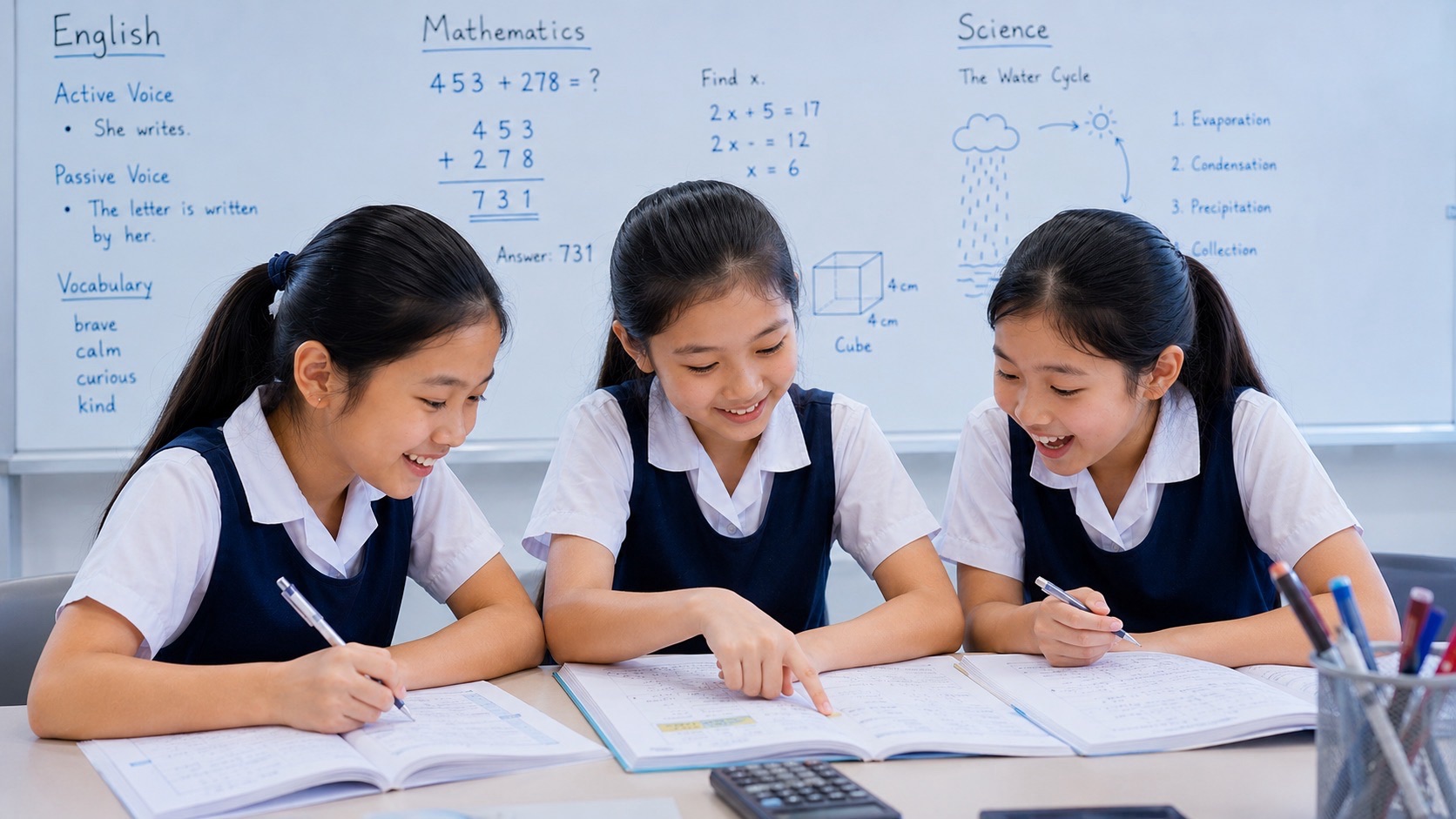
Primary 3 Mathematics tuition in Marine Parade is often sought when families notice that Mathematics has moved beyond straightforward calculation. Parents comparing Marine Parade Mathematics tuition, Parkway Parade tuition centres, Singapore Math enrichment, small-group Maths classes and problem-solving programmes often look for stronger multiplication, division, fractions, bar models, heuristics and word problems. The important shift is that Primary 3 students now need to select and connect methods across several steps instead of relying on one familiar operation at a time.
A strong Primary 3 Mathematics programme should connect multiplication and division, fraction concepts, place value, measurement, geometry, money, time, bar models and structured problem solving. The child should not only know procedures but also understand why the procedure matches the problem. A learner can memorise times tables and still struggle to decide whether a word problem requires grouping, sharing, repeated comparison or a combination of operations.
At eduKate Singapore, 3-pax Primary 3 Mathematics tuition is built around making method selection visible. The tutor can hear the child explain what each number represents, inspect whether a bar model matches the story, see whether multiplication and division are being treated as inverse relationships, and identify whether a weak answer comes from arithmetic or interpretation. Primary 3 is where disciplined problem-solving habits become especially valuable.
Primary 3 Is Where Mathematics Becomes More Relational
Earlier primary years establish number sense and flexible calculation. Primary 3 increasingly asks the learner to coordinate those skills inside richer problems. A student may need to multiply, compare, subtract and interpret units within one question.
This is why some children suddenly find Mathematics harder even though their arithmetic remains strong. The bottleneck is no longer only calculation. It is deciding what the quantities mean and how they relate.
Understand → Represent → Select → Calculate → Check
Multiplication: Facts Need Structure
Times-table fluency is useful because it frees working memory for problem solving. But multiplication should remain connected to equal groups, arrays, scaling and repeated addition.
We teach students to derive facts from known relationships. If 6 × 5 = 30, then 6 × 6 can be seen as 30 + 6. If 4 × 8 is known, then 8 × 4 is the same product. Derived relationships reduce dependence on isolated memorisation and strengthen number sense.
Division: Sharing, Grouping and Inverse Relationships
Division becomes more flexible when students see both meanings: sharing a total equally and finding how many equal groups can be formed. These two structures lead to different story interpretations even when the arithmetic fact is related.
We also connect division to multiplication. If 7 × 4 = 28, then 28 ÷ 7 = 4 and 28 ÷ 4 = 7. This fact-family view supports later fractions, ratio and algebraic thinking.
Fractions: Build Meaning Before Rules
Fractions can become fragile when students memorise numerator and denominator rules without understanding part-whole relationships. We begin with equal parts, unit fractions, fraction magnitude and visual representations.
A child should understand why one-third is larger than one-fifth when the whole is the same, and why the size of the whole matters. Diagrams and number lines help students see fractions as numbers rather than decorative pieces of a shape.
Bar Models: Translate Language Into Structure
Bar models become more useful at Primary 3 because word problems contain more relationships. A model can show part-whole structure, comparison, repeated groups or an unknown quantity.
The key is translation. Every bar and label should correspond to the story. We ask students to explain what each segment represents and why its size relationship makes sense. This prevents the bar model from becoming another procedure to copy blindly.
Heuristics: Strategies Are Tools, Not Passwords
Primary 3 students may encounter strategies such as drawing a model, making a systematic list, looking for a pattern or working backwards. These heuristics are useful only when the child understands the problem structure that makes them appropriate.
We therefore teach strategy selection. What makes a bar model useful here? Why would a table help? What information becomes clearer if we work backwards? This creates judgement rather than a checklist of tricks.
Multi-Step Problems: Keep the Intermediate Quantity Visible
Students often lose control in multi-step questions because the result of the first step is not interpreted before the second step begins. A number is calculated, but the child forgets what that number represents.
We teach students to label intermediate quantities. After each calculation, ask: what did we just find? How does it help answer the final question? This small habit reduces random chaining of operations.
Step 1 result → Name it → Reconnect to the question → Choose Step 2
Units: Mathematics Is Not Just the Number
Measurement, money and time problems remind students that quantities have units. An answer of 12 can mean 12 cm, $12, 12 minutes or 12 objects. Losing the unit often signals that the learner is manipulating numbers without tracking meaning.
We ask students to write units consistently and check whether the final unit matches the question. This supports later Science and upper-primary Mathematics as well.
Estimation: A Powerful Error Detector
Primary 3 students can begin using estimation more deliberately. Before exact calculation, approximate the likely size of the answer. If 198 + 302 is around 500, an answer of 50 should immediately look suspicious.
Estimation develops magnitude sense and makes checking more intelligent. It does not replace exact calculation; it tells the child whether the exact result deserves trust.
Common Primary 3 Mathematics Problems
“My child knows the times tables but still struggles with multiplication word problems.”
The issue may be operation meaning rather than fact recall. We check whether the learner recognises equal groups, repeated comparison and scaling relationships.
“My child draws bar models but they do not help.”
The model may be decorative rather than representational. We return to the story and ask what each bar means, which quantities are known and what the unknown segment represents.
“My child gets the first step right and then goes wrong.”
The student may not be labelling intermediate quantities. We make the meaning of each result explicit before moving to the next step.
Why Three Students Works Well in Primary 3 Mathematics
Primary 3 problems benefit from explanation because several valid approaches may exist. In a three-student group, every learner can show and defend a method.
- times-table weaknesses are visible quickly;
- bar models can be checked before calculations begin;
- students compare solution routes;
- multi-step reasoning can be interrupted and repaired at the exact point of error;
- strong students can justify generalisations;
- corrections can be retested with changed numbers or contexts.
A Useful Primary 3 Mathematics Lesson Loop
- Retrieve: recall one fact or relationship.
- Represent: model the new problem visually or verbally.
- Select: choose the operation or heuristic.
- Solve: calculate accurately.
- Explain: state why the method fits.
- Vary: change one condition or number.
- Check: estimate and verify the final answer.
Catch Up, Keep Up or Move Ahead
- Catch up: stabilise multiplication facts, division meaning, place value and basic word-problem representation.
- Keep up: improve fraction understanding, multi-step reasoning and bar-model accuracy.
- Move ahead: compare methods, solve unfamiliar contexts, generalise patterns and justify heuristics rather than simply starting Primary 4 worksheets early.
Marine Parade Families: Comparing Primary 3 Mathematics Tuition
Marine Parade, Parkway Parade, Parkway Centre and Katong offer many Primary Mathematics tuition and enrichment options. Parents may encounter keywords such as Singapore Math, bar models, heuristics, multiplication mastery, problem solving and small-group tuition. These are useful categories, but the important question is how the programme teaches method selection and correction.
Ask whether students must explain why an operation is chosen. Ask whether bar models are checked for meaning. Ask how multi-step errors are diagnosed. Ask whether times-table fluency is connected to multiplication structure. Ask how strong students are extended beyond worksheet volume.
For related navigation, see Primary 2 Mathematics Tuition Marine Parade, the Tuition Programmes Directory and the Central Singapore Tuition Directory.
What Parents Can Do at Home
- ask the child what each number represents;
- practise multiplication facts through arrays and relationships;
- draw simple bar models for word problems;
- label intermediate answers in multi-step questions;
- estimate before exact calculation;
- revisit corrected problems with changed numbers;
- ask for a second solution method where sensible.
How We Know Primary 3 Mathematics Is Improving
- multiplication and division are treated as related operations;
- fraction magnitude becomes more intuitive;
- bar models match the story rather than a memorised template;
- intermediate quantities are labelled;
- units remain visible during problem solving;
- students choose strategies more deliberately;
- estimation catches implausible answers;
- unfamiliar word problems feel less threatening.
Frequently Asked Questions
How important are times tables in Primary 3?
Very important for fluency, but they should remain connected to equal groups, arrays and inverse division relationships. Understanding makes retrieval more useful.
Should every word problem use a bar model?
No. A bar model is a tool for revealing relationships. Simple problems may not need one, while some complex problems benefit greatly from visual representation.
What makes Primary 3 word problems harder?
More operation choices, multi-step structure, larger numbers and increased need to represent relationships. Arithmetic alone is no longer enough.
Primary 3 Mathematics Should Turn Procedures Into Problem-Solving Tools
A strong Primary 3 learner knows facts and methods, but more importantly knows when and why to use them. Multiplication represents equal groups and scaling. Division reverses and partitions those relationships. Fractions describe parts and magnitudes. Bar models make relationships visible. Heuristics help when the structure demands them.
That is the purpose of Primary 3 Mathematics tuition for Marine Parade families: connect calculation to structure so the child can solve, explain and adapt rather than simply follow procedures.