PRIMARY 3 · MATHEMATICS · JURONG EAST · SMALL-GROUP TUITION
Primary 3 Mathematics Tuition Jurong East
Primary 3 Mathematics becomes more powerful when a child learns that the same problem can be represented in several ways—and that one representation may make the unknown much easier to see.
A word problem can be represented with objects, a drawing, a bar model, a number sentence or a short equation. A fraction can be shown as part of a whole, a point on a number line or a numerical relationship. A measurement can be carried in a diagram, a table or a calculation.
The mathematical relationship is the same. The representation changes what becomes visible.
This is one of the important shifts at Primary 3. The learner is no longer only calculating. The learner is beginning to choose a model.
Quick Read for Parents
- P3 numbers extend to larger place-value structures. The child needs secure quantity sense, not only written procedures.
- Problem solving becomes more representational. A useful diagram can reduce working-memory load.
- Multi-step questions require dependency. One unknown may need to be found before another can be solved.
- Fractions need visual and numerical meaning.
- Measurement and geometry become easier when diagrams preserve the relevant relationships.
- The best representation is the one that makes the mathematical job clearer.
The one-sentence answer
Good Primary 3 Mathematics tuition helps students choose and move between representations so the unknown, the dependency and the operation become visible before calculation begins.
The new P3 problem: the numbers are not always the hardest part
A child may know how to add and subtract accurately but still fail a two-step problem.
The issue may be that the learner cannot see the structure:
- Which quantity is known?
- Which quantity is missing?
- Which relationship must be resolved first?
- What does the first answer become in the second step?
This is why more arithmetic practice does not always repair problem solving. The child may need a better representation.
Words to model: transfer the relationship, not every detail
A word problem contains both mathematical information and story information.
The student needs to preserve what matters mathematically while discarding decorative detail.
We ask:
- What quantities are involved?
- How are they related?
- Which one is unknown?
- Does the problem describe joining, comparison, grouping, part-whole, repeated quantity or another relationship?
The model should carry the relationship across from language into Mathematics.
Bar models: useful when they reveal dependency
A bar model is not automatically helpful because a child has drawn rectangles.
The drawing must preserve the quantity relationship.
If one quantity is larger, the model should show that. If a whole contains parts, those parts should fit the whole. If a difference is being compared, the excess should be visible.
A good model reduces the problem. It makes the missing quantity visible enough that the next operation becomes easier to justify.
Multi-step problems: one answer becomes the next input
Two-step questions are difficult because the child must preserve an intermediate result.
The first answer is not the destination. It is a transfer point.
We teach students to identify the dependency explicitly:
First unknown → intermediate result → final unknown
If the learner understands that chain, the problem stops feeling like two unrelated calculations.
Place value: representation still matters as numbers become larger
Primary 3 works with larger whole numbers, including place value to 10,000.
A number such as 4,206 can be represented as:
- 4 thousands, 2 hundreds, 0 tens and 6 ones;
- 4,000 + 200 + 6;
- a position on a number line;
- a quantity being compared with another number.
These representations expose different features. Expanded form makes place value visible. A number line makes magnitude and distance visible. A written algorithm makes calculation efficient.
The learner should know why one representation is useful for the current job.
Fractions: the same value can appear in several forms
Fractions become stronger when children see them as numbers and relationships rather than shaded pictures only.
A fraction can represent part of a whole, part of a set or a position on a number line.
When the representation changes, the child should preserve the same fractional value.
We ask:
- What is the whole?
- Into how many equal parts was it divided?
- How many parts are being considered?
- Would another drawing show the same fraction differently?
This prevents the child from mistaking the visual shape for the mathematical value.
Measurement: units are part of the representation
A number without its unit can lose the physical meaning.
Three metres, three centimetres and three kilograms all contain the numeral 3, but they represent completely different quantities.
Measurement questions become more reliable when students identify:
- what property is being measured;
- which unit belongs;
- whether the answer is reasonable for the object or situation;
- what the diagram or scale is representing.
Geometry: diagrams must preserve the relevant relationship
A drawing can be larger or smaller than the real object and still preserve a geometric relationship.
The child needs to focus on properties such as shape, side relationships, position and measurement rather than assuming that a sketch is an exact physical copy.
This is another early modelling lesson: a useful mathematical representation preserves what matters for the question.
How Jurong East makes the idea visible
Jurong East is a place where the same journey can be represented in several ways: a transport map, a sequence of stops, a distance, a travel time or a verbal direction.
Each representation preserves some relationships and makes others easier to see.
P3 Mathematics works the same way. A word problem, bar model, number sentence and diagram can describe the same underlying structure. The learner’s growing skill is knowing which representation exposes the unknown most clearly.
The town is not the Mathematics syllabus. It gives the child a concrete analogy for representation choice.
A simple P3 representation exercise
Take one two-step problem and solve it without calculating immediately.
- Underline the known quantities.
- Circle the final unknown.
- Ask whether an intermediate unknown must be found first.
- Draw a bar model or simple diagram.
- Write the first number sentence.
- Show where that answer enters the second step.
- Calculate only after the dependency is visible.
The exercise trains structure before execution.
What a P3 Mathematics difficulty can actually mean
- Place value: larger numbers are not organised securely.
- Representation: the child cannot translate a word problem into a useful model.
- Dependency: the learner cannot identify which unknown must be found first.
- Operation meaning: arithmetic is chosen from keywords rather than relationships.
- Fraction meaning: the picture is memorised but the value is unstable.
- Measurement: units are detached from the quantity.
- Execution: the model is correct but arithmetic breaks.
Two children can produce the same wrong answer through completely different mathematical failures.
Why three students matters
Three students may represent the same problem in three different ways.
One draws a bar model. Another writes number sentences immediately. A third uses a number line or verbal relationship.
The tutor can compare which representation exposes the dependency most clearly and whether each learner understands the model or is simply reproducing a familiar template.
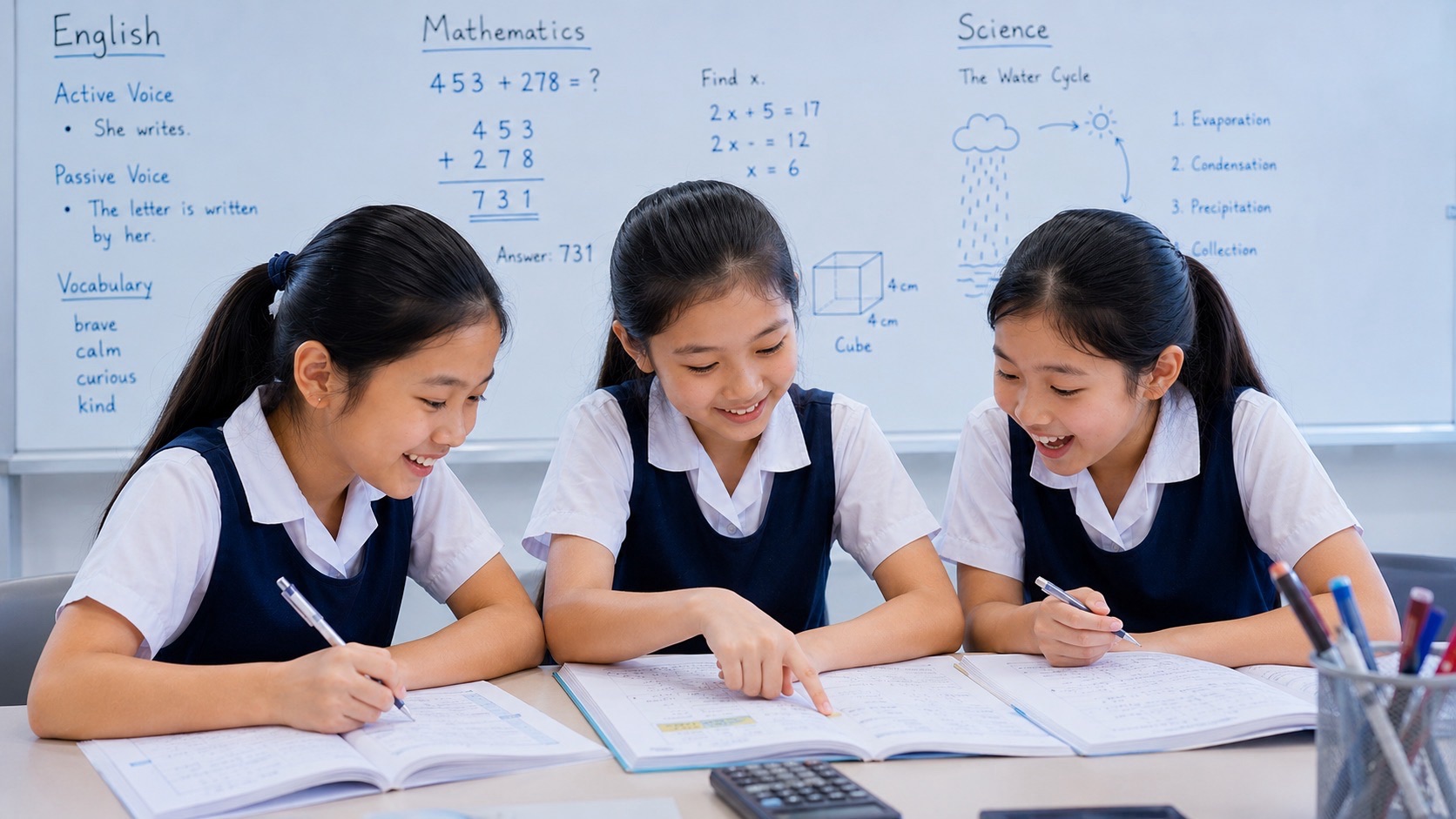
The small group keeps those reasoning differences visible.
What progress should look like
- larger numbers feel structured rather than overwhelming;
- word problems are represented before calculation;
- intermediate unknowns are identified more reliably;
- bar models preserve the correct relationships;
- fractions remain stable across different representations;
- units are attached to measured quantities consistently;
- students can explain why one representation was useful.
What parents can do tonight
- Ask the child to draw a problem before calculating.
- Ask “What do we need to know before we can find the final answer?”
- Represent one fraction in two different ways.
- Ask what each number in an equation stands for.
- Check whether the unit matches the quantity being measured.
- After a wrong answer, ask whether the model or the calculation failed first.
A useful parent question is: “Which representation makes the unknown easiest to see?”
Current curriculum context
Singapore’s current Primary Mathematics syllabus develops P3 learners through larger whole numbers, addition and subtraction, multiplication and division relationships, fractions, measurement, geometry and problem solving, with increasing use of representations and multi-step reasoning.
Parents can consult the official MOE Primary Mathematics syllabus.
Frequently Asked Questions
Why can my child calculate but struggle with word problems?
The arithmetic may be secure while the representation is weak. Ask whether the child can identify the quantities, their relationship and the unknown before choosing an operation.
Should my child always draw a bar model?
No. A bar model is useful when it clarifies the relationship. The deeper skill is choosing an appropriate representation rather than drawing one automatically.
Why do two-step problems cause so many errors?
The learner must preserve an intermediate result and understand how it becomes the input for the next step. A visible dependency chain often reduces this difficulty.
The deeper idea
Primary 1 teaches that quantity can survive a change of representation. Primary 2 teaches that quantity can be regrouped without changing value.
Primary 3 adds a new mathematical responsibility: choose the representation that reveals the structure needed for the problem.
Primary 3 Mathematics becomes stronger when the child stops asking only “What calculation do I do?” and starts asking “What representation makes the relationship visible?”
Continue through the tuition network: Tuition Programmes Directory · Programmes & Locations · West Singapore Tuition Directory · eduKateSingapore Hub.